
Tag: disruption

  • What next for Spotify?

    What next for Spotify?

    We are now one month on from Spotify’s IPO. The IPO was unique – a direct listing whereby the company sold its shares to the public without an intermediary. This is usually an approach taken by smaller, ‘lower profile’ organisations looking to trade publicly. Notably, Spotify was not looking to raise capital as part of the IPO with its co-founder Daniel Ek pointing to business as usual despite the IPO: “Spotify is not raising capital, and our shareholders and employees have been free to buy and sell our stock for years“. The opening market capitalisation of ~$30Bn has since cooled to ~$28Bn as I write this after going as low as $26Bn in the first week after IPO. Analysts believe it is trading lower because of concerns about its business model and the longer term economics of the music industry.

    Certainly, Spotify’s IPO now generates greater scrutiny for Spotify’s ‘freemium’ business model – listeners can access a version of the service for free with advertising or a premium service at with a monthly subscription for ~$10/month. This is the same model employed by other music streaming services like Pandora or RDIO (RIP) which have had limited success. As yet, Spotify has not turned a profit despite earning ~$5Bn a year in revenue. It pays out over 75% of this in royalties to labels, producers, songwriters and artists all of which are controlled influenced or controlled by the 3 big labels Universal, Sony and Warner. Also, these payments are linked to its growth – the more listens, the more its pays out.

    The other major concern for Spotify is competition for its ~70M paid subscribers and ~159M total listeners . The likes of Apple Music (~30M subscribers), Amazon Prime Music (~16M subscribers) and YouTube Red/Google Play (~7M subscribers) are all reporting growing numbers of subscribers. The problem for Spotify is that these services do not rely on the business of music to make money. Instead music streaming in these businesses is used to generate user ‘stickiness’ or in the case of Google’s service to supplement its advertising and AI businesses.

    So what then for Spotify as it stares down uncertainty in its business model and some aggressive competition from rivals who can make money in other ways? This post explores a few options for its core business and considers what the future of music streaming and subscriptions may hold.

    Convert ‘free users’ to paying subscribers

    The most obvious move Spotify can make. Under its current business model, only 10% of its $5Bn annual revenue is generated by advertising with the rest being generated from its premium subscription service. However, less than 50% of Spotify users are paying for the premium service. On one hand, it is a good sign as there is a large pipeline of potential premium subscribers to be converted, on the other there are barriers to conversion which are not easily overcome. One barrier is price – at ~$120/year a music subscription is still a luxury for many households which in conjunction with the other popular subscriptions like Netflix, cable TV or sports would mean a total of >$300/year on media subscriptions. However, Deloitte’s TMT Predictions 2018 highlights that subscription numbers are growing. It is expected that media subscription numbers will double between now and 2020 in developed countries as people value the quality of the service and subscriptions become a norm. We have not hit ‘peak subscription’ yet.

    To remove the barrier for subscribing to Spotify’s streaming service, Spotify could lower its subscription, introduce an intermediate subscription tier or reduce the quality of its ad-funded service. As subscriber growth begins to slow we might expect to see one or two of these tactics or others employed.

    Improve advertising revenues for its ‘free service’

    There is still ‘money on the table’ in the growing segment of digital audio related advertising. According to IAB, digital audio advertising revenue reached $603 million in the first half of 2017 which was compared to 2016’s total of $1.1 billion. Add to this the growing number of hours that listeners (in the US) are spending on digital audio (32 hours in 2017 compared to 26 hours in 2016 and 24 hours in 2015) according to Nielsen. The opportunity for Spotify is to increase the impact of advertising on its platform without ruining the experience for users. A challenge that YouTube has faced with the introduction of YouTube Red. This may mean, creating search advertising as listeners look for music, adding video content in the stream feed or increasing the pass through rates through new interfaces like voice. For those without the premium service, expect to see Spotify ramp up advertising tactics to take advantage of the growth in digital audio spend.

    Introduce a premium-premium offer

    What would the iPhone X of Spotify look like? Of the 70M paying subscribers on Spotify’s platform a high portion of these are likely to be ‘music enthusiasts’ who can afford to pay a little more for a differentiated experience. What might this look like? Firstly, Spotify could target this user group based on their listening habits (e.g. more back catalogue vs today’s pop) and offer increased music quality, data/insights into music or new music experiences (e.g. live streaming concerts, ‘first listens’, behind the scenes look at music development process). This is a strategic imperative for Spotify as it considers its ‘how to win’ strategy for the future. It should expect competition from the likes of Apple and Amazon who will be able to offer hardware or cross-product/service experiences in a way Spotify cannot. For example, it is rumoured Apple’s Airpod 2 due for launch this year may offer more ‘integrated experiences’ into Apple Music – stay tuned.

    Decouple its revenue model from rights and music labels

    The business of legally streaming music requires Spotify to cut deals with record labels to ensure their artists’ music is on their platforms. The interesting thing about music is that back-catalogue (which is owned by the big labels) is as valuable as anything newly produced. Also, music rights are expensive. Since there are only a few major record labels, and a number of competing streaming services Spotify has limited negotiating power. It has been estimated that if it doesn’t cut a deal with the 3 big labels it would lose a third of its library or ~87% of its streams.

    Spotify has publicly stated it would like to get to 35% margin for its services but this would mean renegotiating the contracts with major labels. Longer term it has stated its intentions to directly sign artists to its platforms thus cutting out the labels – this would be one form of decoupling the other would be generating revenue from different means outside of streaming music be that concert tickets, live events, merchandise, data services, curation/collaboration or music related products and services. This second form of decoupling would require a move to an aspiration of being a ‘one stop shop’ for all things music – online and offline, a leap it is perhaps not yet ready for.

    The future of streaming music – Spotify is the bellwether

    The future of streaming music is really exciting (think more explosive heavy metal vs drone of bagpipes :)). The music industry is a poignant example of the change from traditional ‘value chain’ or linear industry thinking to a more ecosystem or value-web approach. Spotify’s rise has been prolific, it has in some ways saved the music labels and given insights into the listeners that were previously not available under physical distribution or iTunes. The big labels have also invested in the streaming service (~15% in total) and cut deals with its competitors as they look to hedge their position in the possible futures that play out. Spotify’s success post IPO will act as a bellwether for the health of the music ‘ecosystem’. If Spotify fails, expect a new era of music dominated by the large aggregators (Amazon and Google) to replace the vacuum it leaves behind.

  • Jeff Bezos’s Annual Letter: 3 ‘take aways’

    Jeff Bezos’s Annual Letter: 3 ‘take aways’

    Every year since Amazon’s inception in 1997, Jeff Bezos (founder and CEO of Amazon) has been writing a letter to shareholders. This year’s letter is the 20th edition which makes for an excellent point of reflection for the company that now has US$107BN in annual sales and a market cap of US$296BN just behind Facebook (sales US$18BN, market cap US$312BN).

    The theme of Bezos’s letter could be summarised as avoiding the perils of scale and maturity or ‘avoiding stasis’ which is neatly refered to as ‘Day 2’. He advocates for quick decisions, ‘obsessing on customer outcomes’ and maintaining a continuous state of ‘Day 1’ – the beginning of a company’s potential. This post covers 3 ‘take aways’ I had from the letter.

    The importance of a ‘Day 1’ approach in mature businesses

    Day 2 is stasis. Followed by irrelevance. Followed by excruciating, painful decline. Followed by death. And that is why it is always Day 1

    I don’t believe any business aims to pursue an ambition of ‘stasis’ or ‘irrelevance’. Quite the opposite actually – many strategies ‘aim to win’ in design and execution. So what is Bezos actually talking about here? Having worked with mature businesses as well as companies launching new products/operations there is often a different approach, culture, leadership and mindset at work compared to those that are pursuing scale, standardisation and optimisation. Businesses ‘starting out’ or as Bezos terms it ‘Day 1’ use an approach which is one primarily of experimentation, accepting failures, planting seeds, protecting saplings, and doubling down on customer delight. Outcomes are a major focus for ‘Day 1’ business (e.g. customer engagement, feedback). However, a ‘Day 1’ approach is often given less emphasis as strategy is translated to execution and scale through policy and process. The point Bezos makes is that in the long run, by ensuring a ‘Day 1’ approach is the policy and outcomes are managed (not process), businesses will be able continue to delight customers, stave off competition and avoid ‘painful decline’.

    Avoid having a ‘one-size-fits-all’ decision making process

    It’s important for decision-makers to disagree and commit…”You’ve worn me down” is an awful decision-making process. It’s slow and de-energizing. Go for quick escalation instead – it’s better.

    Bezos makes this point really well. A ‘Day 2’ approach to decision making can be one of analysis paralysis and consesnsus building which may lead to high quality decision making albeit very slowly. Having worked with organisations at both ends of decision making velocity (slow = 18-24mths vs. fast = days or weeks) there is a different culture that aligns to a high-velocity decision making organisation. The primary factor is that each decision should be judged on its merits with the authority appropriately delegated to individuals to make those decisions in a timely manner. Bezos adds a few nuggets here:

    1) 70-90% of information is all you need, any more and your business is likely to lose velocity

    2) Be good at recognising and correcting bad decisions (Amazon did this well with their smartphone product – Fire)

    Day 1 companies embrace external trends quickly – they don’t use words like ‘cannibalisation’… this is a Day 2 mindset.

    The outside world can push you into Day 2 if you won’t or can’t embrace powerful trends quickly. If you fight them, you’re probably fighting the future. Embrace them and you have a tailwind.

    I doubt you will ever hear Amazon talk about a new product or service ‘cannibalising’ their existing business. For that matter you are unlikely to hear this at Apple, Facebook or Google. However, in incumbent organisations this is often the language. In his letter, Bezos talks about embracing external trends, which on face value most business leaders would agree with. Truly embrace external trends may mean giving up some ground on a profitable core business in return for growing new revenue streams of the future – this is the hard part. He also suggests this needs to be done quickly. Working out the balance of core and new business (‘What level of cannibalisation is tolerable?’) can lead to slow decision making by which time a more nimble competitor is taking a lead on the trend and eating away at the core.

    There are so many examples of embracing external trends over fearing cannibalisation – Apple’s iPod vs iPhone is a good one. In the year the iPhone launched (2007) the iPod was 42% of revenue and the iPhone 2.5% – iPhone launched during peak iPod. At latest results, iPhones were close to 80% of Apple’s revenue with iPod now diminished to a button on an iPhone screen. The smartphone was the external trend, which meant ‘cannibalising’ a very profitable and successful business at its peak.

    I won’t be surprised if you haven’t finished reading this blog post and have instead gone straight to reading the letter – it’s a really interesting one. The letter came out a few weeks ago so there are also some interesting points of view on the content. I really enjoyed this article in the AFR on why Australian listed companies may struggle to replicate Bezos’s advice – suggesting that the primacy of shareholder over customer is a balance many Australian companies struggle with.

  • Music streaming: Future business models

    Music streaming: Future business models

    This past week saw RDIO, Spotify’s major rival in streaming music, file for bankruptcy. RDIO was arguably a superior service to Spotify in terms of user experience and music catalog but has failed to capture the market in the way Spotify (20M paying subscribers), Apple Music (6.5M subscribers) and Pandora (81.5M active listeners in 2014) have. The latter has been reported to be acquiring the ‘key assets’ of RDIO for $75M allowing Pandora to build a stronger, ad-supported radio service experience. Pandora’s management believes: “The result will be the industry’s best combination of streaming radio and subscription songs on demand.”

    So…another music streaming service bites the dust. This despite streaming becoming the fastest growing segment of the music industry and the form that most industry leaders and pundits believe is the future of listening. Despite the popularity of the concept (renting, not owning music), it is clear that the business model of streaming is still in its infancy.

    RDIO’s departure could be the first of many for streaming platforms. If this is the case, what is to become of streaming music as a business model? This post explores some of the possibilities for streaming business models and highlights those players best placed to capitalise on growth in streaming service demand.

    Windowing – streaming as a secondary market

    The current and most well known services like Spotify, RDIO (RIP), Apple Music and Google Play take a one-size fits all approach to music. You pay a subscription (~$10/mth) to have the privilege of listening to whatever you want in a catalog of (hundreds of) millions of tracks. One of the problems here is that music is treated like a commodity – all music is the same. For subscribers, there is no discretion regarding to which artist your $10 is paid (the majority may go to artists you don’t listen to) and for artists the rewards are small. The business model of pure streaming as evidenced by RDIO’s bankruptcy and Spotify’s inability to turn a profit is on shaky ground.

    Windowing, a common practice with movies, allows artists to release their new albums to a market that is willing to pay for it directly (>$10) then after a period the music reverts to a streaming service for listeners on subscriptions. Arguably, Apple Music is best placed to capitalise on this model – with iTunes/Apple Music integration. A number of major artists are already beginning to use this strategy – Taylor Swift, Beyonce and this week Adele.

    Enforcing scarcity on infinitely copyable media is a difficult task but not an impossible one. Swift, Adele and the other artists successfully employing a windowing strategy are already big. These artists don’t need to worry about selling out their concerts or reaching new listeners. However, it is a different situation altogether for musicians starting out, and the situation is particularly nuanced for artists in the middle for which windowing may be better. Those looking to get bigger could adopt streaming for free as a primary approach.

    Niche/Exclusive streaming – streaming of niche content for enthusiasts

    The ‘all you can eat’ streaming model has the downside of not being particularly attractive to artists and squeezing the profits of the streaming service and label. Niche services that specialise in a genre (e.g. classic, jazz, hip-hop) or a label (e.g. Blue Note, Columbia) which contain a deeper but smaller catalog of music may emerge as a profitable and viable alternative for many music lovers.

    Equally, video streaming services (e.g. Netflix) offer clues for exclusivity in streaming. Apple has already begun to dabble in ‘exclusive’ content with Dr. Dre’s new album launching exclusively on the service and “Beats radio” and curated stations offering a compelling reason to join or pay a premium in the future.

    Music plus – streaming as a bolt on

    Access to music as part of a subscription to something else has yet to see huge success but there is potential in this model. Amazon Prime is the best example of this but other companies like DropBox, Ebay or Facebook could offer streaming music in this way.

    Amazon Prime affords Amazon customers same-day delivery on all products, e-book rentals, cloud storage on photos etc. Bundling music into this service helps to create stickiness for Prime also offsetting the profitability issues seen by the major streaming services. Currently Prime members get access to 1 million tracks, which would not be considered a serious proposition for music lovers. Whilst this model is potentially more profitable, it is still treating music as a commodity and without the variety and depth of tracks probably best suited to the casual listener.

    Multimedia streaming – cross-media streaming

    Bundling of different content (e.g. music, video, live entertainment) is emerging as a new business model and potentially a very dominant one. As discussed in my last post, Google is uniquely placed to provide a multimedia proposition through YouTube Red. Although currently limited to U.S. users, YouTube Red includes unlimited access to Google Play Music and its supply of 35 million tracks. Google Play plus YouTube Red could make a phenomenal proposition for streaming overall.

    We are at an inflection point for music streaming. Streaming as a concept has won the format battle but the business models that began the new form of music delivery are starting to feel the pressure from subscribers, labels and artists. New business models which balance the demand for music with artists’ needs (e.g. exclusivity, reach) as well as users’ preferences (e.g. niche, ‘all you can eat’, casual) or which smartly package music with other services or media offer new sustainable options for music streaming. The question is which streaming services will win the war.

  • The Strategy of Alphabet (née Google)

    The Strategy of Alphabet (née Google)

    It is fair to say the world was caught off guard by the major reorganisation of Google last week to a holding company structure under the new name ‘Alphabet’. The move sees the company formerly known as Google now referring to just the core businesses of Search, Android, YouTube, and a handful of others, led by Google’s head of product Sundar Pichai. The non-Google part of the business looks more like venture capital than a company, with Google Auto, Google X, Nest and other R&D ventures falling under its remit. Whilst this may all come as a surprise, strategically this move makes a lot of sense.

    In my recent article ‘Where was Strategy at Google IO and Apple WWDC‘ I highlighted a number of major inconsistencies in the messages presented by both companies at their respective developer conferences in relation to their strategic intent. Google’s mission to ‘organise the world’s information‘ fits nicely with its Search, Android and Youtube businesses but starts to get lost as the company invests in moonshots like Project Loon and driver-less cars.

    So what is Alphabet’s strategy and what can we learn from it? 

    Public markets respond well to strategic clarity

    Companies that appear to have lost strategic direction often suffer in public markets. The change to Alphabet could be seen as placating Wall Street analysts who have often questioned Google’s moonshots and raised objections about the incongruence of R&D project spend with objectives of Google’s core business.  Alphabet is a sign that Larry Page and Sergey Brin will not be backing down from these projects but provide a more consistent market narrative and greater transparency to their business segments.  According to the SEC release Google will start reporting  separately on Google and Alphabet segments as early as Q4 FY16… Let’s see how the market responds now.

    It can be very difficult to innovate without strategic freedom

    From IBM to GE to AT&T to Microsoft or Australian companies like Telstra, incumbent tech companies are looking for ways to avoid complacency and business model disruption. Google is no different. In the recent past it has tried with Google X, now it’s trying Alphabet. Google could very easily fund ambitious projects through Google X, but launching those projects into a standalone business or Google division has proven problematic.  The Alphabet holding  company structure suits organic growth and aggressive acquisition strategies in a way the Google structure could not. A moonshot will be given more space to grow and focus with more funding options available at maturity.

    An example is Google’s driver-less car program which has little in common with Google’s core business but could be extremely profitable some day. Through Alphabet, Google Auto can receive outside funding in exchange for an ownership stake or even consider an IPO to reward Alphabet investors.  This was not readily available under the previous structure.

    Talent are attracted to a more focused and culturally aligned organisation

    The new structure gives Alphabet and its many organisations more management and talent scale. Firstly the incentive of a potential IPO for the moonshots will serve Alphabet to keep top talent within the group. Secondly, the moonshots can start to build their own culture and incentive programs without the pervasive effect of the core. We may see moonshots adopting more ‘non-google’ like behaviour than the core business in order to achieve objectives which are separate from the core.

    In an organisational and strategic ‘gear shift’ there are choices – winners and losers

    In spite of the strategic clarity Alphabet will bring, some of Google’s business ventures could lose out in the organisational and strategic shake up. Of note are Google Fibre or Project Fi which are more ‘adjacent’ than core and certainly not moonshots. They are downstream to Search and additive to the advertising business (e.g. Cheaper broadband access = more Search eyeballs + more users for Google’s core (Youtube)). In this new model they may not have the attention that the core advertising business has and underperform. Google has had some success with Fiber already, it will be interesting to see if this continues under the new structure.

    The success of Alphabet will be closely monitored – How does Search profit from renewed focus? When will the first moonshot IPO occur? I also look at this move as predictor of the ‘new’ structure of a technology/media conglomerate (core + moonshot) and can’t help but wonder who is next. Perhaps we will see Facebook or Amazon follow a similar strategy providing strategic clarity to their core and freedom to their many acquisitions and innovation plays.

    This article is featured on strategy4telcomediatech.com.

  • A Virtual SIM: Implications for Hardware, Consumers & Carriers

    A Virtual SIM: Implications for Hardware, Consumers & Carriers

    Your mobile SIM card will soon disappear. If you read the tech news this week you probably would have seen a headline similar to this – espousing the death of the physical SIM card. The SIM card (as we know it) is such a fundamental part of the cellular business model that a change to that construct has far-reaching implications for hardware developers, consumers and carriers.

    What is a virtual SIM or e-SIM? 

    The concept of replacing a ‘physical SIM’ for a ‘virtual’ or ‘e-SIM’ is not new, but in the last 6 months hardware developers (Apple and Samsung) and carriers have  come to the table to plan its implementation. As early as March this year, as part of the Mobile World Congress (MWC) in Barcelona, it was announced that the GSMA (the association that represents carriers) is working  to create a common and global specification for the remote over-the-air provisioning and management of connectivity to consumer devices. A long list of mobile operators (including AT&T, Etisalat, NTT DOCOMO, Orange and Telstra) provided comment on their commitment to the new SIM format.

    Specifically, an e-SIM card is built into the phone and is not tied to any single carrier. This makes it far easier and far faster for subscribers to switch carriers – something that consumer electronics manufacturers are also keen to adopt for connected items around the house as part of the Internet of Things (IOT). The information on the SIM will be compliant with all operators, meaning a user can decide to change operator with a change in settings. There will also be no physical swapping over required by the user and new SIM will not be required, nor should there be any time delay in switching the e-SIM to its new purpose.

    What are the major implications for Hardware, Consumers and Carriers?

    Hardware developers

    Blackberry, through Movirtu and Apple with its ‘Apple SIM‘ have already started to trial the virtual SIM concept allowing users to select between multiple carriers. The major implications for hardware developers are:

    Global deployment: Hardware manufacturers will have the ability to deploy their mobile hardware anywhere in the world without concern for SIM or carrier specifications. This will help to streamline design but may also remove market barriers for new mobile hardware.

    A standard for IOT  devices: A common standard for e-SIM removes at least one more barrier for manufacturing IOT devices. It can enable multiple devices (or things) to access customised network connections rather than setting up with multiple physical SIM cards.

    Consumers

    Many of the benefits of an e-SIM lie with the consumer – More choice, greater options for connectivity and a seamless customer experience. There are many implications for consumers but the top few are:

    Choice of providers: One of the main benefits is choice of providers. As e-SIMs are rolled out, consumers will have access to any connection at anytime through whichever network they choose. It may even be possible that software will eventually automatically choose the network based on speed or spot price.

    Global roaming: Ever waited in a queue in the airport at another country to pick up a local SIM? A virtual SIM would eliminate this experience potentially boiling it down to a one-click new country activation. A truly mobile experience plus no more global roaming charges.

    Multiple numbers: For some consumer’s the ability to have multiple numbers has meant switching SIM cards on phones or carrying multiple devices. A virtual SIM opens up the possibility to have multiple numbers on a single device which could create identity options for consumers.

    Carriers

    On face value, carriers will face the most change from a virtual SIM environment. It removes yet another layer of consumer dependency on operators helping to create conditions for even greater commoditisation of the network.  That said, representatives from carriers like Francisco Montalvo of Telefónica Group are embracing the changes a virtual SIM will offer:

    “Remote SIM is a natural evolution in our industry. Making the right choices now in terms of technology, usability and user experience will ensure our consumers a successful transition without compromising the quality of service that they expect from the mobile network operators”

    This evolution is likely to lead to the following major implications for carriers:

    New pricing mechanisms: With a lower barrier to switching carriers devices will become ‘carrier agnostic’. To counter this,  Operators are likely to embrace new contracting methods like ‘pay to play’ or models not tied to data usage. Lengthy contracts are going to carry less weight as consumers have more incentive to bring their own device and ‘shop around’ for the best carrier deals.

    Changes to operations: The process of provisioning a service can be quite cumbersome and take up to 2 days for many carriers. Virtual SIMs will put pressure on carriers to provide near real-time provisioning of services out of the virtual environment – a capability many carriers do not have today. At the MWC Shanghai this month Gemalto, a leading SIM provider, has been demonstrating “remote provisioning of consumer devices based on GSMA architecture”. It is an example that other non-carriers may start to own this part of the carrier operations.

    New security and privacy concerns: A virtual SIM adds extra complexity for security and privacy protection for customers. For example, as customers ‘carrier switch’ to find good deals, carriers will need to be able to offer customers real-time protection and privacy. For many carriers this may be a difficult service even as customers are on 1-2 year long contracts.

    New revenue streams and differentiation: New revenue streams such as those relating to Internet of Things, OTT services or device sales are likely to appear as a result of virtual SIMs. Virtual SIM will enable more devices to connect to carrier networks but OTT services will lock customers in. Without differentiation it may be a ‘race to the bottom’ in terms of price.

    A Virtual SIM is an exciting step for the telecommunications industry. It offers up the potential for simple and seamless interactions between carriers and consumers as well as opening the barriers for growth in new device categories. Although many carriers are championing the change, they stand to lose the most from removing this customer dependency. They will need to respond with new charging models, transforming their operations and developing new ‘sticky’ revenue models.

  • Democra-tech is leaving the lab.

    Democra-tech is leaving the lab.

    There was a time when societies had less access to information. There used to be a small minority of influencers who had strong sway on people’s opinions. But times have changed. Technology has empowered more individuals to have stronger voices and make them heard, whether through blogs, online communities or crowdfunding. And whilst many ’cause-based’ and ’cause-funding’ platforms exist such as Fundly, Go Fund Me and Change.org, combining opinions and direct action on a single platform in an engaging and interactive way has been a challenge.

    Enter Brigade. Last week saw the launch of Brigade (in Beta), a platform backed by Silicon Valley heavyweights Ron Conway and Marc Benioff and Sean Parker that has been dubbed the ‘Tinder for politics‘. Brigade allows people to easily share their beliefs on any issue, influence policy and organise with others (supporters) to take action. At its core, Brigade aims to bring to civic life into the realm of engagement that other social platforms have in our lives – Facebook for friends, Twitter for interests, LinkedIn for work, Brigade for politics. This will be no small feat as James Windon – President at Brigade has pointed out from his experiences with Causes.com:

    Civic duty is the brussels sprouts of the internet. Everyone knows it is good for them but most people don’t like the taste.

    How does Brigade work?

    Brigade is addictive. Spend 5 minutes on the platform and you will understand why.     It starts by allowing users to track trending topics, express opinions on the topics they are interested in and compare opinions with friends and supporters. For example I have been following the recent discussion about ‘Internet Policy’ on the platform where opinions like “Comcast and Time Warner should be allowed to merge” or “The FCC should regulate the internet as a public utility” are divided as to whether people agree or disagree with these positions opinion.

    It also allows users to create their own opinions and ask supporters to take a position. Very quickly you can see where you stand on popular topics like immigration, discrimination, drug policy, gun policy and health care. The ‘Tinder-like’ feature comes into play as you scroll through other users and see how similar your positions are – (e.g. I share 75% same view on topics as Ron Conway).

    A new business model for democracy

    Politics is big business particularly in the US. Billions are spent on campaigns and electoral process. The Economist published a piece last year highlighting that the 2012 US elections including congressional races cost up to $7Bn. US elections are expensive because the US is a big, rich country and reaching a population of 300 million in competitive markets costs a lot. Even in Australia where it is compulsory to vote, the 2013 election cost almost $200m. Brigade offers the ability to short-cut the information disequilibrium between constituents, lobbyists, political parties and politicians. Think of Newspoll or Gallop poll on steroids, your local politician being able to poll constituents on local issues or never having to recieve a political flyer in the mail again not to mention enabling voting. What it comes down to is – how much would a politician or lobbyist pay for information on how key constituents might vote on their proposed legislation?

    Democra-tech and organisational governance/culture

    The acts of sharing opinions, taking positions and organising action is very similar to governance in organisations. Whilst enterprise social media (e.g. Yammer) has prevalence in many companies, often these platforms focus on social aspects of the workplace rather than decision making. A ‘Brigade for work’ may have the effect of matching employees to decisions, interest groups, polling opinions of parties with interests in strategic or operational decision making and increasing productivity (we could all use few less meetings!). It may also provide a unique view of organisational culture.

    The future of Democra-tech

    A new form of Democra-tech is leaving the lab. In addition to Brigade there are other platforms aiming to bring democracy to the fingertips of citizens such as DemocracyOS. Whilst these platforms represent strides toward an ideal of E-Democracy particularly in terms of engaging citizens on civic issues the true test will be whether Democra-tech can achieve sustained engagement like its social media counterparts. As Millennials become politically minded it may just stand a chance of engaging them an new generations in the issues they care about and how those issues impact their communities.

  • Mobile World Congress 2015: 5 trends you need to know about and their implications for Australia

    Mobile World Congress 2015: 5 trends you need to know about and their implications for Australia

    During the Mobile a World Congress in Barcelona last month I highlighted in two linkedin posts the main themes from the events, exhibits and speakers I attended. A month on, I thought I would cover off the 5 major trends outlined at the event and their implications for Australia.

    1. 5G is still just a concept

    Possibly the most talked about topic of the conference was 5G, what can be expected and when. The reason for the excitement is that many players in the mobile ecosystem are looking to better network coverage, bandwidth, spectrum utilization, lower latency and power use to support increasingly larger numbers of devices and connected objects. Whatever 5G becomes the hope is it will address these challenges and create new business opportunities for traditional TMT companies and emerging players developing internet of things/M2M offerings.

    In Australia, 4G was rolled out in 2011 and the trend has been that a G is added every year. Given that Australia is 4 years in to 4G it could be sometime before 5G is deployed. That said, at MWC Telstra announced plans to partner with Ericsson to develop 5G which could be commercial by 2020.

    2. The concept of a ‘connected life’ is very (very) real…and coming to your life soon

    Companies manufacturing devices are now going well beyond smartphones and mobile connectivity. Many of the seminars at the MWC highlighted products of different form factors, particularly wearables, with mobile lifestyle at their core. On display were Ford’s smart bike, Will I Am’s connected fashion bracelets, smart furniture and smart toothbrushes which were just some examples of non-technology type brands moving into mobile technology. At the Innovation City pavilion connectivity of all types were on display including connected cars, connected infrastructure and devices that connect in and out of home.


    In Australia, many of these technologies will begin to appear in households, businesses and public spaces in the next few years – connected homes and cars in particular. And they will be connected by intelligent connectivity like Thread or other software defined network solutions. As a result there will be significant opportunities in the Australian market for data analytics, analysis and artificial intelligence to create meaningful linkages.


    3. Smart cities are of major interest to vendors but will require joint action from both public and private sectors


    Sustainable citywide connectivity was the topic of discussion at a number of MWC booths – connected roads, transport, water supply, sewerage, energy, waste management, lighting and public safety solutions were all on display. For many exhibitors, the smart city conversation focuses on scalability and the interoperability of IoT solutions across metropolitan systems. The question is, can cities afford these solutions? There was quite a bit of discussion about requirements for connected cities’ core infrastructure with new technology offerings and the associated cost/benefit.


    As has been pointed out in the Australian media – Australian cities are in no hurry to become smart and the smart waste/water solutions exhibited at MWC and other IOT conferences are at sot probably at the bottom of the list. Adelaide (Australia’s 5th largest city) intends to establish an innovation hub with support from CISCO focusing on smart transport, education and utility solutions. One of the key success factors in this deal is that there is no added financial outlay for the government. Like many things related to the IOT things including solutions across the value chain, partnerships are core to their success.


    4. Security and privacy are gaining prominence quickly…and there is no turning back


    With IoT a major trend, there was a noticeable uptick in security and privacy vendors at MWC. The key message being that as more items are connected and more of our information is in a virtual worl there is a greater need for security and privacy measures. Despite this very real risk and the pain it could cause there is too much value in the virtual world to turn back.

    One example on show was the Silent Circle Blackphone 2 smartphone and Blackphone+ tablet. Both run PrivatOS 1.1, an Android O/S that allows IT administrators to manage, lock and wipe devices. The Blackphone 2 also comes with the “Silent Suite,” which encrypts VoIP video and voice calls, along with encrypted messaging and an encrypted address book. These products are examples of the world we are moving toward where security and privacy are an added feature, a necessity and to some extent a luxury good.


    Data retention laws passed in Australia last week which will force telecommunications providers to keep phone and internet records for two years effectively standardising data retention across the industry. In parallel Telstra is offering customers new access to their metadata for a fee. These are changes to privacy laws which aim to make data retention consistent. What these companies and government do with the data is still not discussed but at the very least a level of transparency surfaced. Australia will need to further beef up security and privacy laws when things like driverless cars become commonplace.


    5. Social media companies are bringing internet to the rest of the world which may disrupt industries in new ways


    Mark Zuckerberg’s keynote at MWC focused specifically on Internet.org and the partnerships Facebook, Google and other the social media behemoths are entering in with telecom carriers – or potentially become carriers themselves. The full market impact is still to be realized, but if these deals begin to gel, there could potentially be a huge, disruptive transition in the way telecommunications services are managed and offered.


    Living in Sydney or Melbourne it would be hard not to have noticed a bus shelter or TV advertisement for Facebook’s Internet.org. Why advertise Internet.org in a country that has a reported internet penetration rate of 94%? I believe the other 6% need access to the internet but this is limited to the most remote areas of Australia. The other view of this is that Facebook is garnering support for its plans to be the internet provider for the ‘rest of the world’, the 68% that have no internet. They will need support not just because of this massive undertaking but because the opposition they may face as an advertising company providing internet access.


  • The ‘full stack’ startup: Lessons for incumbents

    The ‘full stack’ startup: Lessons for incumbents

    The concept of being a ‘full stack’ startup is not new. In fact many prominent examples of these startups exist including Tesla, Uber, Warby Parker, Nest, Buzzfeed, Harry’s and Netflix. What ‘full stack’ refers to is building the complete end-to-end product and service by-passing most existing systems or assets in the industry value chain. This is opposed to traditional technology approaches which are to sell or license the technology to existing companies in that industry.

    Let’s explore two examples to give you a picture:

    Tesla

    The model for electric engines in the automobile industry was focused on selling this new technology to the likes of Ford, GM and Toyota – incumbents in the Automobile market. What Tesla does is not only produce the engines but also designs and builds the car, markets it, manages the software and the infrastructure to support the car and consumer. This is effectively the whole operating model. Tesla does this in order to innovate, completely control the customer experience (which at this stage is for high end users) and most importantly capture a greater portion of the economic benefit in the value chain.

    Über/Airbnb

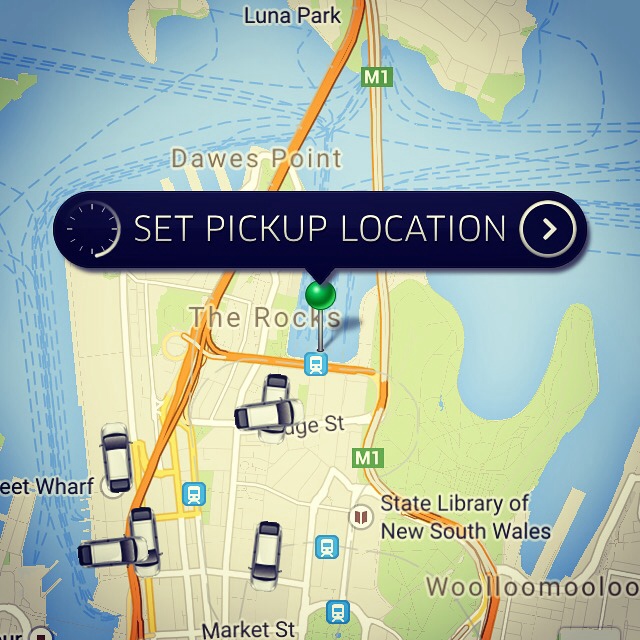
    Über’s taxi platform started off as a ‘full stack’ startup. In the beginning not only did Uber provide the marketplace for cars but it also screened drivers, bought some cars and/or paid drivers to standby in popular areas to keep the wait times low. It has since expanded beyond Uber Black offerings and where it has lost control of assets has suffered some bad publicity. The point though is that it owned the end to end offering at least initially instead of selling the platform to existing taxi companies which many offerings did prior.

    This is not too dissimilar to Airbnb, who at initial startup stages employed staff go to dwellings, inspect them and take the pictures to make them as consistent as possible. It now also defines very tightly the expectations for landlords as well as tenants.

    What can incumbents learn from the end to end approach?

    1) ‘Full Stack’ approaches an industry using a combination of design, analytics and systems thinking

    The ‘full stack’ start up is a combination of these three approaches. Designing for the user experiences, using data between operating model layers (through APIs) to improve the offering and the operating model and identifying the parts of the system that are most profitable. As incumbents evolve and innovate existing offerings these approaches should help to inform their where to play and how to win choices.

    2) A ‘Full Stack’ approach is best suited to ‘information based industries’ or those that have resisted technology

    Obvious industries for this approach include health, education, food, transportation and financial services. These are mostly industries where prices have outpaced inflation due to lack of technology facilitation. They are also not as reliant on large asset holdings for the most part. Space X may be the only exception to this rule.

    3) A ‘Full Stack’ approach requires organisations to be good at many things, a silo approach won’t work

    This is the major challenge for this approach. A start up needs to be able to operate up and down the operating model which requires many different skills which may be hard to find in one spot – everything from software, hardware, design to supply chain management, sales and partnerships. Incumbents may be able to defend or evolve their position in the value chain if they have skills and coordination between operating layers as opposed to silos.

    I think we are at the start of this end to end movement an approach which avoids bad product experience, cultural resistance to new technologies and unfavorable economics. Those who have succeeded to date (e.g. Netflix, Nest, Buzzfeed) will take on other industries with the very same approach. Incumbents need to learn for this approach and evolve/innovate their offering end to end.


  • A Google MVNO in Australia – the implications uncovered

    A Google MVNO in Australia – the implications uncovered

    There was news this week that Google is looking to become a mobile virtual network operator (MVNO) in the US market. Amir Efrati from ‘The Information‘ reported that ‘Google is preparing to sell mobile phone plans directly to customers and manage their calls and mobile data over a cellular network… the new service is expected to run on Sprint and T-Mobile’s networks…a launch this year seems likely’. This news was also picked up by the Wall Street Journal that puts further support behind the rumour. In this post I explore what a Google MVNO in Australia could mean for MNOs (Mobile network operators) and MVNOs and Google.

    What does this mean for Australian MNOs and MVNOs?:

    Classic MVNO strategy is about doing deals with MNOs to address segments in the market that the MNOs cannot reach themselves due to factors like brand, distribution or price. In other words MNOs don’t do deals with MVNOs to kill their own profitable businesses, instead they look to extend their competitive advantage due to owning and leveraging the physical network infrastructure. In Australia there are 4 MNOs (Telstra, Voda, Optus and Voda/Hutch) which provide network coverage to a host smaller of MVNOs. Google entering the Australian market as an MVNO would require a deal to be created with one of the four Australian MNOs all of which have large mobile plan businesses which a Google MVNO could potentially threaten.

    What we can learn from Google’s reported MVNO play in the US market however is that it is working on deals with Sprint and T-Mobile which are the smallest of the four national carriers (Verizon and AT&T are the others) in terms of subscribers and network reach. A deal with the smallest of the MNOs could be momentous in an industry that relies on significant fixed cost (capital) to be spread across a large subscriber base to turn capital expenditure into free cash flow to then build out networks (size and quality) further. Creating a deal with these smaller MNOs and driving subscriber take up could change the market from 2 major players to 3.

    Applied to the Australian context a similar opportunity could exist with the smaller MNOs (Voda or Optus) which would afford them the ability to grow in their subscriber base and therefore network size and quality and earn better returns on their capital investment. A deal with a cashed-up Google is not unrealistic and would have a similar effect of changing the competitive dynamics from 3 major network brands to 2.

    What does this mean for Google?:

    As an MVNO, Google would be offering new mobile phone plans to customers. Depending on the terms of the deal, Google could offer cheap plans for Nexus, Android and Google cloud subscribers giving way to a suite of Google vertical integration. At its most basic level, this will allow more people to use the Web and Google can show them more advertisements, in line with their core business model. An aggressive approach could allow Google to become even more targeted using network data or ‘browser cookies’ to learn which sites users frequent thus extracting a higher price from its advertising model which could more than offset cheaper plans.
    Being an MVNO has some downside for Google in that it would need to develop marketing, distribution and customer service capabilities which are not necessarily in its sweet spot.

    Whilst this news out of the US market is exciting and potentially disruptive in the Australian context, a Google MVNO in Australia may be some time off yet. In fact, we may have Google Fibre in Australia before a Google MVNO.


  • If ‘culture eats strategy for breakfast’…here are 3 ingredients for cultural alignment to strategy

    If ‘culture eats strategy for breakfast’…here are 3 ingredients for cultural alignment to strategy

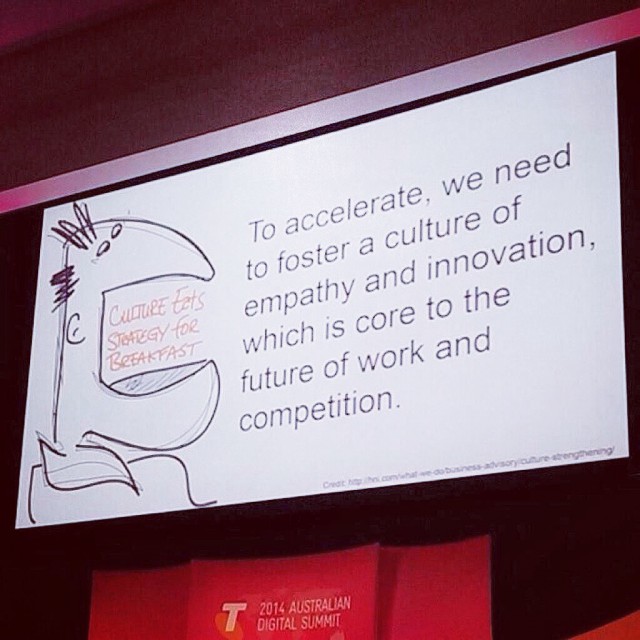
    There were a number of thought provoking themes at the Telstra Digital Summit this week in Sydney. These included CEO of Klout Joe Fernandez’s presentation on the rise of consumer personal marketing, Paypal’s Jeff Clementz overview of the future of payments, Karen Stocks from Twitter on the use of #LIVE marketing on the platform and Troy Malone from Evernote on revolutionising workflow with their software and finding themselves in the process. Whilst these topics were interesting, but in some cases very product orientated (i.e Evernote and PayPal) the topic which stood out most was how important cultural change and leadership are in a digital future.

    This was the focus of David Thodey’s opening address, a panel discussion on ‘working in start ups vs corporates’ and digital evangelist Brian Solis’s discussion on ‘approaching a digital future with an analog mindset’. The key line stringing together these segments was ‘culture eats strategy for breakfast’ or put differently – you can make all the strategic choices you want but without broad employee support for those choices, which may represent new ways of working, new incentives and rejection of existing skills, the strategy you set will count for nought.

    But what does this mean for incumbent enterprises in the TMT industry like Telstra who are staring down uncertain futures built on offerings which are very different to those that make up the current business model? For Thodey it is very real, noting in his address “if we (Telstra) stay in this current form we will become irrelevant…we need to find ways we can apply our collective knowledge to change”. To add to this, Telstra is clear (as are many organisations undergoing this type of change) that customer centricity is critical you need to “change from the outside in”.

    Whilst there is no shortage of rhetoric on the topic, there is a shortage of ‘magic’ solutions to the change required to meet new strategic goals. Below are 3 ingredients I believe need to be in place for cultural alignment to strategy and for change to occur in industries like Telecommunications and Media where there is a shorter change timeline due to disruption (technology or other). These principles drive at the idea that culture is inherently linked to human needs particularly those of safety and belonging:

    1) Strategy infrastructure must be in place

    Employees need to see (and where possible participate in) that strategy has been considered, debated and choices have been tested alongside the companies best portrait of future business conditions. Sensing and shaping is a key part of strategy which in many companies is performed by the CEO and CFO and strategy functions. Add to this the strategic conversations that happen between those setting and those implementing strategy and you have the basic infrastructure of strategy. Without this in place, particularly in larger companies, the change required to meet future challenges head on has little hope of occurring.

    This plays out slightly differently at the smaller end of business scale. An entrepreneur or ‘few’ person company has very specific choices to compete in a market, the agility and small scale culture to match it. Here strategy infrastructure and culture of the company are inseparable. The tyranny of scale increases the risk of the infrastructure being left out or culture being ignored. Famously, the CEO of AirBnB Brian Chesky sent a company wide email to titled ‘Don’t F*ck up the culture’ which was on this very topic. It was titled based on advice Silicon Valley VC Peter Thiel gave to Chesky as company has entered more markets and received over $150m in funding.

    2) Make the burning platform real for all employees

    Reasons to change can often seem very distant particularly if you are at the coal face of a large organisation. The implication of a broad technology change or business model change may be far removed from the day job of the employee. Helping employees understand the implications of future business environments and choices that the enterprise is taking to compete and win requires leadership, communication and embedding strategic thinking into as much of the organisation as possible.

    A large company that does this is GE. They use a process of innovation to inspire change in employees. Top talent are trained on innovation process and incentivised on new business model creation. With this model leaders and employees are forced to explore the consequences of the futures they will operate in. It is here that a burning platform becomes real.

    3) Challenge the old and protect the new with the right incentives

    In many cases moving to a new future will mean the death of currently very profitable business models. The challenge is to reinvent the core operations without betting the company. Incentivising staff to challenge the current business model (e.g the way money is made, the products and features offered, services, policies and processes) whilst allowing new businesses better suited to the future to thrive will support a culture that is prepared for the future. This includes for example, rewarding staff for revenue/earnings from new business, process efficiency/automation of core operations, CSat on new vs old products and channels and time spent by employees making vs operating. Career progression should also be structured around these incentives to ensure talent can see opportunities in the core as well as the new operations (i.e don’t put the C team on new business model generation).

    A panel discussion at the Telstra Summit mulled over this idea with the ED of Digital at Telstra commenting “we recognise we destroy everything we buy”. Whether or not this is entirely the case, it points to the difficulty of challenging the old and protecting the new. Whilst not going into specifics around incentives, the conclusions of the panel were that you can’t build a new future on old technologies, digital is not enough; it must be customer centric and culture must be based on trust not control – agreed.

    These ingredients send cultural signals to employees. In effect, by having these in place it is reinforcing a common understanding of how and why (tough) decisions are made in the enterprise. They show that the enterprise’s future is being sensed and choices are being made within that context, they show the possibility of new realities in the employee’s world and they balance the acceptance of new business models while maintaining a profitable core. Culture may eat strategy for breakfast but that doesn’t mean cultural alignment to strategy cannot occur… even if it takes time.