Blog

  • Deloitte Mobile Consumer Survey dials-up some serious phone conversations

    Deloitte Mobile Consumer Survey dials-up some serious phone conversations

    As we discuss the 2018 Deloitte Mobile Consumer Survey with industry leaders, three hot topics are emerging: the limiting of screen time; voice; and security.

    Putting the world in the palm of your hand has been mankind’s ultimate dream.

    Now it’s there what do we do with it?

    Too much screen time?

    For those who simply can’t look away and can’t turn off, it really is becoming something of a nightmare at times, and the temptations in the form of more entertainment, more workplace connectivity and more apps are increasing exponentially.

    Thirty-nine percent of Australians (with similar percentages reported in the US and UK) are concerned about their levels of phone use, in China that figure is as high as 59%. Delving further into the survey data, Australians who use their phones too much feel that the top 3 effects of doing so are: feeling like they need to check their phone all the time; feeling distracted from a task; and not going to bed at the intended time.

    Smartphone manufacturers are now actively helping customers address these issues. Apple’s ‘Screen Time’ application, for instance, allows iPhone device users (42% of Australian Smartphone users) to limit general screen access at certain times, or to restrict individual applications at certain times. All of which begins to shine some light on just how often we are ‘heads down’ on our device.

    There are however two sides to the story. As responsible as such measures may sound for mobile consumers, on the other side of the equation are those businesses that participate in the smartphone ecosystem. Limiting screen time is likely to have a detrimental effect on the business model of those application providers competing for our attention, or on those operators who compete for our increasing data usage.

    The top 3 applications used more than once a day by Australian media consumers are News, Short video and Gaming applications. These are the first application providers to  feel the ‘screen time pinch’ but we would also expect less essential applications, like dating apps and gambling apps, to experience some reduction.

    So…is all of this the ‘lock out law’ debate coming to the palms of our hands? The nanny state reaching new levels, or is it a serious question about the world we want to live in?

    Whether you are a device manufacturer, app developer, operator, regulator or industry body, there is little question that the screen time debate is something you will need to address in your strategy.

    Hey…The Rise of Voice

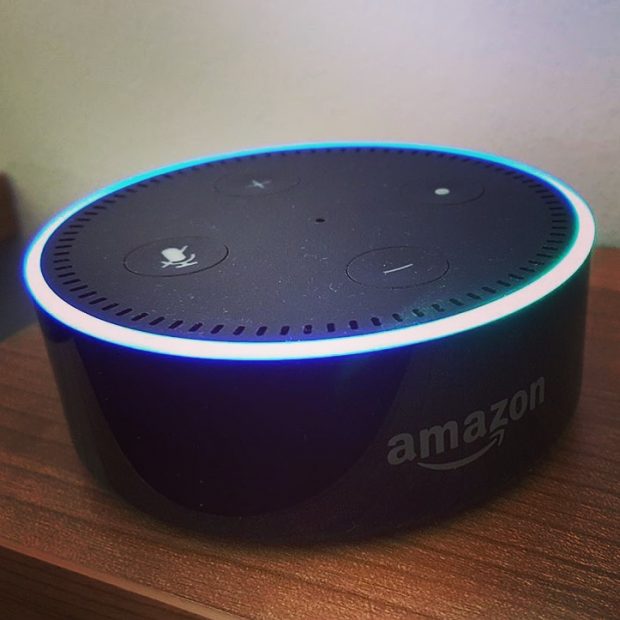
    One solution could be the rise in voice as an interface – allowing for more ‘eyes up, hands-free’ living. Forty-two per cent of survey respondents are aware they have voice assistants on their smartphone. Of this group, 54% are using their voice assistants on a weekly basis. While fewer Australians have voice assisted speakers (only 9%), this audience is much more active in their use, with 47% having used the device in the last day and 20% in the last week.

    Given the rate of take up identified in both the Deloitte Mobile Consumer Survey and the Media Consumer Survey this year, there are going to be plenty of home speakers in Christmas Stockings over the next couple of weeks and the race is on between digital giants Apple, Google and Amazon to encourage us to start talking to them.

    Is Voice really going to take off? Or will it be that seldom used technology trinket in the corner like Google glasses, virtual reality headsets and the home ‘hub’?

    Our Mobile Consumer Survey identified a lag in the adoption of smart technology in our homes.  With the exception of smart TVs and voice-assisted speakers, there has been zero year on year growth in the take up of smart appliances.   Voice may well be the key to addressing some of this.

    The challenge for Voice proponents, and there are big players in the AI field at work here, is to quickly move voice from a one dimensional inquiry about the weather or playing the next song, to something that is actually useful, something that talks back, filters the question and fulfils a need.

    As it does, though, our existing concerns about who is listening and who is watching our every movement are likely to heighten even further.

    Privacy and Data Security Concerns

    This year’s Mobile Consumer Survey raised some serious questions about data security with 84% of respondents concerned about how their personal data is used, shared, and stored by companies they interact with online.  Again these were reflected internationally and were echoed in the Deloitte Media Consumer Survey – the Australian cut.

    People are already worried about their data, yet they continue to share it to access more and more services – something we term the dichotomy of trust. Testing this trust even further will be the implications of open data, which on one hand gives consumers more rights and opportunities, but which on the other takes sharing to a new level.

    In a world where we are increasingly uncomfortable about security, one may well ask if we have reached the point where we need a frank and open discussion about data behaviour. What are we sharing, why are we sharing and how do we choose who to share it with?

    A little like ‘that talk’ we need to have with teenagers, this is the discussion that industry, governments and consumers have been putting off for too long and there is plenty of evidence to suggest we are at the time where we shouldn’t put it off any longer.

    This article features on Deloitte Australia’s Blog
  • What to expect? – Deloitte’s 2018 Mobile Consumer Survey (Australian Cut)

    What to expect? – Deloitte’s 2018 Mobile Consumer Survey (Australian Cut)

    Deloitte’s annual Mobile Consumer Survey – Australian Cut is coming up to its 5th Edition with the 2018 report to be released in late November. The survey of >2,000 Australians explores trends in mobility – devices, mobility, usage, payments, content, privacy etc. and is part of a global survey which is now performed in 6 continents, 35 countries with 54,150 respondents – the largest of its kind.

    2017 Recap

    The 2017 report covered a number of key insights about the mobility ecosystem in Australia:

    • 88% of Australians own a smartphone and Australians have the second highest % penetration of Apple and Samsung smartphones in the countries surveyed at 75% – only Luxemburg at 83% is higher.
    • Australians are purchasing more data in 2017 than ever before – 60% of Australians now have a data limit 3GB or higher.
    • Australians are more likely to connect to WiFi in 2017 than 4G despite 86% of people being on 4G. This is believed to be the result of the current cost of mobile data plans rather than connectivity needs (e.g. speed)
    • 1 in 5 consumers visited an operator store in the last month and 3 in 5 in the last year. Stores are still important for operators especially for testing physical product and technical support.
    • Ownership and access to connected devices in the home is on the rise. In the last year there have been increased purchases of cameras (9%), connected car systems (8%) and connected home appliances (5%).
    • Mobile payment solutions were up 14% from 2016 with over 25% of respondents suggesting they now use the mobile payment solutions.

    What to expect in 2018?

    I’m really excited by the 2018 report – the behaviours related to mobility are continuing to evolve. We are now firmly in the era of smart entertainment, long form content outside of the home, smartwatches, biometrics (fingers and faces) and voice. We are also on the cusp a boom in usage with the first unlimited mobile data plans launched in Australia in 2018 and 5G internet just around the corner.

    This year’s report will look at the behaviours we are starting to witness:

    • We are already at very high smartphone penetration but have we hit peak smartphone usage yet? What might that look like?
    • What are people thinking about when they purchase a device? Is it more than just price?
    • What are users happy to give up (in terms of data privacy) in order to maximise the functionality they get from their mobile devices?
    • What is the extent of the influence of the global digital giants on or mobile habits and behaviours?

    Stay tuned for the launch of the 2018 report and please reach out if you are interested in exploring any of the data behind the report with us.

  • How Australians are consuming today’s Media and Entertainment

    How Australians are consuming today’s Media and Entertainment

    Deloitte’s Media Consumer Survey presents a snapshot of how Australians are consuming different media and entertainment. Now in its seventh edition, the report explores how consumption trends have changed over time and the emerging behaviours, preferences and trends impacting the Telco, Media and Entertainment industry. The report is well worth the read cover to cover.

    Since the last report, the environment surrounding media and entertainment has been turbulent. Events such as the major social media services being brought in front of US Congress, consolidation of major global and Australian media players, aggressive purchasing and creation of content by the likes of Amazon and Netflix and the launch of voice-controlled devices in Australia mean that the survey’s findings are just as interesting as ever. This post pulls out the major findings from the report and highlights some of the implications for Telco, Media, Entertainment and Advertising organisations. The major categories in the report are Digital entertainment, Proliferation of content, New norms and behaviours and The value exchange.

    What are we consuming?

    SVOD on a roll (p.7) – Australian’s continue to increase their engagement in streaming video content with survey respondents saying they watch an average of 13.5hrs of streamed content per week. 43% purchase an SVOD subscription for their household (up from 32% in 2017) with the split of subscriptions going to the three major SVOD players in Netflix, Stan and Foxtel Now (89%, 26%, and 23% of survey respondents with an SVOD service respectively), while YouTube Red (11%) and Amazon Prime (8%) had lower subscriber numbers among survey respondents.

    Stable cable (p.8) – With the increase in SVOD, an expected implication may be a reduction in cable subscriptions (this was forecast in last years report too with 20% of respondents saying they are likely to cancel a subscription in the coming year). However, 31% of respondents indicated they still have a cable subscription (the same as 2017) and pay TV remains the most valued media content subscription for all age groups (except Trailing Millennials) beating SVOD, streaming music services, gaming, newspaper and magazine subscriptions. The number looking to cancel their cable subscription is down to 16% this year.

    Sports attraction! (p.9) – Sport is the number one reason cited for continued pay TV subscription (22%) ahead of other major motives, such as value for money and bundling with home internet access (both 16%). Sports apps (think NBA League Pass or AFL Live) are also on the rise. As an example, 10% of all male respondents indicated they hold an AFL Live subscription, 6% hold an NRL Live Pass and 11% hold an Optus Sport pass. With the bundling of sports apps and telco data plans, the pay TV association with sport is likely to be increasingly challenged in the coming years.

    Rethinking social (p.11) – There was a decrease of 15% in the number of respondents who feel time spent interacting with friends on social media is just as valuable as time spent together in-person (55% to 40%). Daily usage of social media platforms continues to decrease, down to 55% from 59% last year and nearly back on par with 2014 levels (54%).These trends however are in the context of social’s popularity – 85% of respondents and 95% of Millennials are active on some form of social media. Facebook continues to reign supreme and is the platform on which every age group spends the most time each week.

    How are we consuming it?

    So much multitasking (p.16) –  This year and last year, 91% of respondents multi-tasked while watching TV, up from 79% in 2014 when we first started reporting. This is even more pronounced for Millennials, 96% of whom multi-task. Most of this is done on our smartphones. Fifty-eight percent use smartphones while watching TV, ahead of laptops and tablets at 29% and 28% respectively. The ability to engage people while a live event or TV Show is occuring through their device is now more pronounced than ever and provides opportunities for advertising attribution.

    How to find great content when there is so much to choose from? (p.14) – Australian media consumers certainly value volume. Eighty-four percent of respondents value extensive libraries of TV shows and 83% value extensive libraries of movies. But as the number of SVOD services and OTT apps in Australia grows, and content becomes more fragmented across them, discovery is set to become more important than ever.  Nearly a quarter of SVOD users neither value (21%) nor are confident (23%) in the personalised content recommendations provided to them, indicating that recommendations are not useful or, more likely, we don’t always perceive the algorithm results as accurate. This represents opportunities for niche recommendation services or greater personalisation of algorithms that are used to recommend content. We are likely to see this from aggregators such as Apple, Amazon and Google that are launching services like Google TV that aim to make available lots of content in one service.

    Whats new in our media and entertainment consumption habits?

    The rise of Telcotainment (p.20) – Telcos may be enjoying the insatiable appetite for data, but they are also investing to provide more bandwidth while OTT apps and services benefit from increased usage and revenue. This sets up OTT entertainment apps as the perfect mate for telco offerings and is central to the rise of telco-tainment. 21% of video and music streaming service subscribers receive their subscription through a Telco plan. This is even higher in total Millennial subscribers (27%). Seventy percent of total respondents with entertainment bundles indicated the included subscription was a factor in purchasing their mobile or internet plan, while 79% of total respondents said it made them more likely to stay with their provider. Keep an eye on this trend as it is likely to have downsides for payTV providers or SVOD providers not tied into the Telco ecosystem.

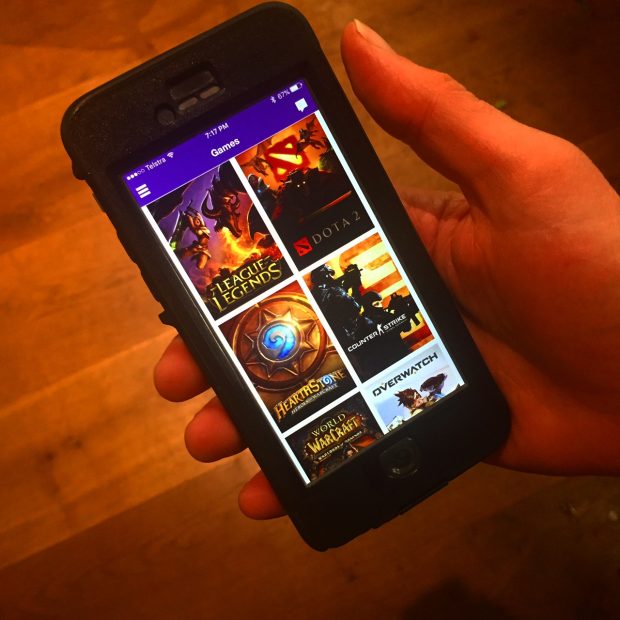
    Esports is popular (for millennial males mostly) (p.22) – Fourteen percent of total respondents have attended in-person or streamed an esports event, for example League of Legends, in the last 12 months. This is largely driven by Millennials (26%) with the biggest enthusiasts being Millennial males, of whom 33% have attended or streamed an event, making esports a fastgrowing channel for advertisers looking to reach this demographic. Esports audiences tend to be mainly concentrated on a small number of digital platforms, with a mix of live and on-demand viewing. The most popular digital platform is YouTube (58%) followed by TV broadcasts (35%), Twitch (28%) and the websites of individual game developers (22%).

    Voice assistants are gaining popularity and control over the user interface (p.23) – Google Home launched in July 2017, Apple HomePod in January 2018 and Amazon Alexa in February 2018 and survey respondents are living up to Australia’s reputation as rapid adopters of consumer tech with 9% already indicating they own at least one of these devices. This compares to 15% in the US which has had commercially available voice assistants for over 3 years.  55% of owners using their devices each day (59% for Millennials) and 86% of owners using their device at least once per week (90% for millennials). Searching or requesting information (26%) is the most valued use of voice-enabled home digital assistants. We are not yet using them for shopping purposes but it is clear that there are implications for brands wanting to reach particular consumers with their product message where the voice interface may dis intermediate that direct connection (compared to digital search and commerce).

    Who do you trust with your data? (p.29) – Media businesses rely heavily on data to drive personalisation and content discovery.  Survey respondents almost unanimously (93%) believe they should have the right to ask a company to permanently delete their data. And 76% stated they would request permanent deletion even if it resulted in a negative impact to their service. Businesses will need to understand what might entice an individual to happily hand over their data – and to whom. Telcos and media companies are fortunately the most trusted companies with 52% of respondents indicating they were among the companies most trusted with their data, second only to financial services providers and banks (70%). Streaming services and social media fare less well, trusted by 20% and 15% respectively, and given the importance of data to these businesses, addressing consumer unease will be critical.

    Deloitte’s media consumer survey continues to shine a light on the changing behaviours of Australian’s as we navigate an world of increasign convergence between Telco, Media and Entertainment providers with ubiquitous content, unlimited distractions, data and privacy concerns and increasingly new things to and ways to consume. The report this year was written by Leora Nevezie, Jess Eade and Nicola Alcorn – Hope you enjoy consuming it!

  • Business Models and Platforms in 2018

    Business Models and Platforms in 2018

    This is an excerpt of a talk I recently gave at Deloitte Australia’s TMT Summit, an annual event where our TMT (Telecommunications, Media and Technology) community and thought leaders in the sector come together to discuss the topics facing Australian and global TMT organisations. The conference focused on the topic of Industry 4.0 and looked at themes such as the enabling smart cities, better health outcomes and mobility as well as the introduction of new technologies, Flexible Consumption Models and new privacy laws.

    The talk was aimed at describing the nature of business models and platforms in 2018, their definition, how they have changed over time and how TMT organisations should consider new business models and platforms as they launch new technologies, look to transform with emerging and evolving technologies or look for new ways to make money.

    Business models and platforms in 2018 – TMT Summit (18th July 2018)

    The topic of business models and platforms and their interrelationship is important to Telecommunications, Media and Technology organisations that are:

    • In the process of planning for and rolling out new technologies (e.g. 5G, Software Defined Networks/Virtualised networks, AI)
    • Transforming their businesses with emerging and evolving technologies
    • Looking for new ways to make money (e.g. moving from ‘static’ to ‘flexible’ methods of value capture – think licence to subscription or for a telco – premise to user)

    Firstly, a quick look at the definitions of business models, platforms and ecosystems. ‘Business models are like art… they are difficult to describe but you know it when you see it’. If you do your research on definitions of business models it can be difficult to pin down a precise definition.

    Wikipedia defines it as “a plan for the successful operation of a business, identifying sources of revenue, the intended customer base, products, and details of financing”, godfather of management theory Peter Drucker defines a business model as “Assumptions about what a company gets paid for” and Joan Margretta former ‘Strategy Editor for HBR’ explains it in two questions “how do we make money in this business? What is the underlying economic logic that explains how we can deliver value to customers at an appropriate cost?” Boiling it down… it is genre of artworks that have 3 core elements, assumptions about making money that lead to a plan to do just that.

    If you are looking for examples of these, there are a few short business model descriptions neatly describe in the book ‘Seizing the Whitespace’ by Mark W Johnson. Doblin’s 10 types of innovation method also describes profit model types that can be adapted along with the other types of innovation in the process of getting tactical in changing an existing business or looking to create new opportunities.

    Connected to business models, particularly those of the last ten to twenty years, is the concept of platforms. Deloitte has some of the most compelling literature on the definitions, characteristics and applications of platforms. John Hagel proposes that a platform can be defined as “layers of infrastructure that impose standards on a system in which many separate entities can operate for their own gains” the features of a platform being a governance structure and a standard set of principles or protocols for communicating, coordinating and collaborating.

    Deloitte identifies 4 common types of platforms – those which aggregate (think of these as market places in their most basic form), those which facilitate social interactions (a social network or communication platform like Whatsapp or We Chat), those which mobilise action (get up, bang the table, kickstarter, Brigade) and those that support learning at scale (think Slack, Trello, Medium, Wikipedia) which can combine a mix of productivity, information resources and structured learning.

    To win in a platform world?…Occupy influence points on the platform. The theory goes that the greatest opportunities for value capture on platforms are at points that tend to emerge whenever and wherever relationships begin to concentrate on platforms. By having privileged access to a larger and more diverse array of knowledge flows, the company occupying an influence point has an opportunity to anticipate what’s going to happen by seeing signals before anyone else does. That company is also better positioned to shape these flows in ways that can strengthen its position and provide greater leverage.

    In the last 20 years, the increasing maturity and penetration of the internet, mobile internet and consumer technology have given rise to multiple influence points which organisations have sought to occupy, build enormous castles, surrounded by formidable moats. In 2018, it is abundantly clear (in a way that it was not only 4-5 years ago) that there is a stark contrast between ‘aggregator platforms’ and platforms in the Hagel sense of the word.

    Platforms like the ones Hagel has described rely on 3rd parties to occupy influence points which in turn make them useful and gives them an ability to build their moat through the creation of an ecosystem. Think of Apple’s ‘App Store’ which turned 10 last week as an example, where third party applications occupy influence points in an ecosystem facilitated (somewhat rigidly by Apple). There are now over 2 million apps of which very few are Apple proprietary apps.

    Aggregators on the other hand attract end users by virtue of their inherent usefulness and, over time, leave suppliers no choice but to follow the Aggregators’ dictates if they wish to reach end users. Facebook, Amazon each display this characteristic with their core platforms… for Facebook it is news media and Amazon it is suppliers of goods, for Google its any business wanting to be found on search.

    What about eco-systems vs platforms? At Monitor Deloitte we have created a new way of thinking about strategy (Strategy 3.0) in the era of ecosystems some of the material is being used in the challenges today. They can be defined as dynamic and co-evolving communities of diverse actors who create value through increasingly productive and sophisticated models of both collaboration and competition. An ecosystem differs from a platform in that:

    −    Encompasses many platforms and value

    −    It may not be owned or dominated by a single player

    −    They are more permanent vs. platforms

    So now that we have definitions for business models, platforms, aggregators and ecosystems. Let’s look at how these are playing out in 2018 in the world of TMT.

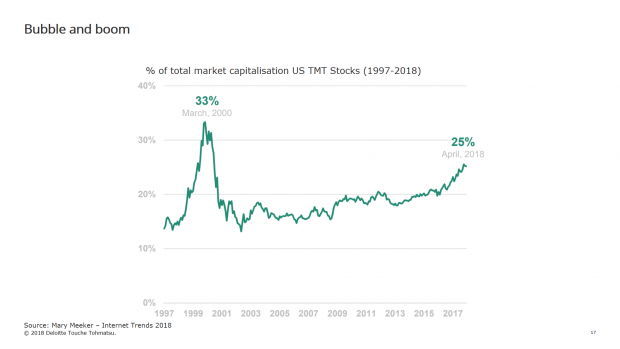
    The market capitalisation of Tech stocks is a good proxy for the looking at the value created by Tech companies. There is a lot to consider on this chart: technology change, economic cycles, elections, a financial crisis but the most interesting thing to ponder is the role of business models in the relative value of Tech stocks to the economy. We could split this into thirds but I’m going to look at the bubble in 1999 and today where Tech is 25% of the total market capitalisation.

    By the way… doesn’t this look familiar? It has a similar shape to the Gartner Hype Cycle for emerging technologies. It might just be a coincidence but one could say that we have perhaps finally hit a ‘plateau of productivity’ for many of the technologies that were on the peak of inflated expectations in 1997-1999.

    It has been said that whenever a new technology comes along that has the potential to dramatically change the competitive landscape, hundreds of companies are formed to try to exploit that opportunity, including many with weak management or poorly thought out business models. Intense competition ensues, returns on capital fall, and most of the new entrants either merge or go bankrupt. This was 1999-2000…

    There were a number of really good ideas during the dot.com bubble that just didn’t make it. Flooz was not one of them. Flooz.com sold online currency that could be used instead of credit cards. After users bought enough Flooz, they could spend it at participating online stores like Tower Records or Barnes & Noble. Despite the questionable merits of this business, Flooz.com raised $35 million from investors. Corporate partners Cisco and Delta Air Lines used Flooz for corporate gifts. Flooz also spent $8 million on an ad campaign featuring Whoopi Goldberg and went Flooz went bankrupt in August 2001, less than two years after it opened its virtual doors.

    Webvan, an online grocery shop with delivery, was an idea that would seem like a no-brainer in 2018 and ebay the e-commerce marketplace was the killer application of Web 1.0 and persists today. Fast forward to the other end of our chart. There is no Flooz, Webvan or ebay but 5 dominant organisations only one of which was in the list of top 5 most valuable companies in 1997. I can’t help but feel that ebay missed the boat that these 5 companies sailed away on. But there is a way to perhaps interpret where ebay wasn’t able to adapt quickly enough. The business model of each of the GAAF is complex, this is the nature of TMT businesses in 2018.

    One of the most compelling interpretations of how they make money and create this amount of value is described by Scott Galloway in his book ‘the four’ as the T-Algorithm. These are today’s 8 rules of what it takes to become a trillion dollar company. Without going through them all in detail, the three which stand out and which I believe all organisations should be considering are Product differentiation, Visionary Capital and Likeability:

    • Product differentiation: each of the four identify where technology can add value, or remove pain from the process/experience of purchasing and each try to offer more for less – e.g. free delivery, the ‘best’ phone+OS, any answer you want for free, all your friends on one platform.
    • Visionary capital: each of the four has the ability to attract cheap capital through the articulation of a vision that is easy to understand. Amazon doesn’t pay dividends, Google’s vision of organising the world’s information and Facebook’s vision of connecting the world are pretty compelling reasons to buy the stocks. Apple has over $250bn in cash reserves.
    • Likeability: “When the news is negative, you want to be perceived as a good company to which a bad thing has happened”. If you watched Mark Zuckerberg in his congressional hearing he got away pretty lightly. And if you don’t like Mark then find me someone who doesn’t like Sheryl Sandberg or for that matter who has a problem with ‘Leaning In’. Both of them are still at the company despite the scandal. The same could be said for the crazy but fun ‘don’t be evil’ Larry Page at Google or ‘im going to space’ Bezos or the cult that surrounds Apple.

    In Australia, there are very few of our local listed companies that could claim to be developing even a few of these 8 factors. In fact, many may find it difficult to achieve 1 or 2 due to their incumbent position, sector orientation, investor pressures or the regulatory environment. The business models of many of these organisations are actually born out of positions of relatively little competition which are in some cases over one hundred years old.

    In 2018 the business models that will generate a 1 trillion dollar valuation are most likely out of the reach of incumbent organisations unless they completely reinvent themselves, like Microsoft is doing or buy their way into it, like AT&T and Time Warner. In 2018, the assumptions and therefore the requirements to make a lot of money are understandably only available to a few. So what hope do businesses have?

    There is one other factor to consider…a TED Talk given by Bill Gross founder of the incubator Idealab gives us some clues. He studied the success and failure of over 100 companies and attributed the outcome to 1 of 5 factors. Timing is the most important factor closely followed by execution.

    As companies continue to experiment with Industry 4.0, and the new technologies that will enable it, they should also look to experiment with new business models that will unlock the value of these technology shifts. In doing so, they should be aware of the new rules in value creation dictated by platforms and ecosystems but also consider the number one and two factor for executing on the assumptions for making money and the plan to do so are timing and execution.


  • Internet Trends 2018 – Highlights

    Internet Trends 2018 – Highlights

    The ‘Mary Meeker’ Internet Trends report is something I look forward to every year – Not just because of the interesting insights about the connected world but also just the sheer volume of powerpoint used to show these insights. This year’s report is 296 pages long, down from 350 pages in the previous year, but still presents a bit of challenge to distill all the insights. Luckily, I have done this for you in this post where I tease out the most interesting highlights from the report. That said, if you have a spare 2 hours, I suggest taking the time to read through the full presentation.

    On to the highlights:

    Global smartphone shipment growth has decreased to effectively nil (pp. 6)

    This may not be a surprise to anyone. As smartphone penetration reaches saturation in mature and now developing markets, shipments of new devices are in decline. Globally, ~1.4Bn smartphones are shipped per annum which has been the case for the last 2 years. The majority of these are still Android devices with iOS making up the balance. Interestingly, ‘other’ operating systems (e.g. Windows etc.) have declined to near obscurity in the last year. Outside of saturation, another big driver of the decrease in shipments is elongating replacement cycles (2-3 years). If this continues I suspect we will see negative growth in the next year, possibly in double digits.

    Internet user growth has also slowed to about 7% in 2016, down from 12% in 2016 (pp.7-8)

    Global internet users of 3.6 billion surpassed half the world’s population in 2018. With penetration reaching this level it is likely that double digit growth will be hard to find. The report also outlined the growth in Wifi – There are around 450 million wifi networks in the world, up from about 100 million five years ago. Cheaper devices and new access points should help Internet user growth, but this likely to be gradual over the course of the next decade.

    Internet growth is slowing but usage is increasing with the average adult spending about 6 hours per day with a digital device (pp.11)

    This is a trend that we have addressed in our Mobile Consumer Survey and TMT Prediction reports. The average smartphone user looks at their device over 50 times a day which may seem a lot, however our smartphones have become the ‘swiss army knife’ of the digital age taking in functionality previously reserved for other devices (e.g. TV, iPod, Calculator, Watch, Heart Rate Monitor, Measuring Tape etc.). Usage is likely to grow with the increasing ‘usefulness’ of digital devices in all aspects of our lives. Combining the slowing growth in internet take up and the increase in internet usage across devices, internet organisations will be battling more for user time on their service vs new users in the coming years to continue to achieve high growth rates.

    There are more than 30 million Amazon Echo devices in users’ homes, up from about 10 million at the end of 2016 (p.26)

    Voice-controlled products are taking off (e.g. Amazon Echo). The Echo’s install base in the U.S. grew from 20M in the third quarter of 2017 to more than 30M in the fourth quarter. This is combined with the number of ‘skills’ an Echo can now perform being close to 30K which has almost doubleed in a year. Unfortunately the report did not give a clear indication of who is winning the battle for the home but there are estimates that the global install base for all home devices will be ~60M by end of 2018.

    Roughly 13% of all retail sales come from e-commerce, up from about 5% a decade ago (pp.44-47)

    I was initially surprised by this figure having worked with organisations who generate over 25-30% of sales online. However, it does speak to the disruption of physical channel and call centre sales which has had a relatively ‘long fuse’ in the era of digital disruption. It is also localised with the US perhaps trailing behind other parts of the world in this trend. The report outlines that E-commerce sales growth is continuing to accelerate – growing 16 percent in the U.S. in 2017, up from 14 percent in 2016. Amazon is taking a bigger share of those sales at 28 percent last year and on the other hand physical retail sales are on the decline. In the section on China, Digital sales are ~20% which speaks to growth of services like Tencent and WeChat providing integrated e-commerce experiences.

    Tech’s influence on the world and the share of wealth is ever increasing with Tech companies rising to 25% of the market cap of the MSCI (pp.39-42)

    There is a really interesting section in the report on the comparison of tech companies to other listed companies. One indicator of tech’s influence is that tech companies account for six of the top fifteen R&D and Capex spenders in the U.S with Amazon, Google Alphabet, Intel, Apple and Microsoft in the top five slots. These companies, including Facebook, are the fastest growing spenders on that list. At an industry level, tech companies versus other industries (e.g. health, industrial products) in the United States, tech companies are the largest and fastest growing R&D and Capex spenders – this is not a bubble.

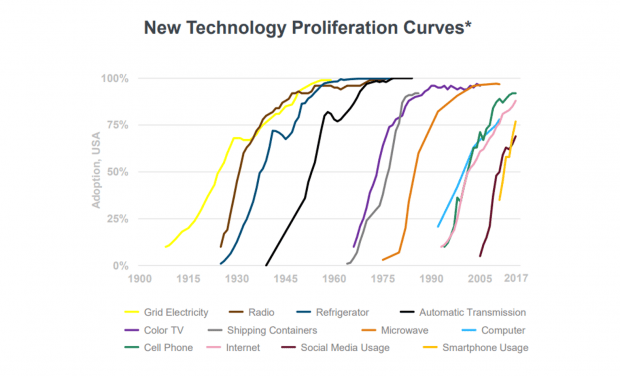
    The speed of technological disruption is accelerating – For example: Adoption of consumer internet took ~10 years, the dishwasher took 80 years (pp.142-165)

    The report looks at tech’s influence on the US economy and jobs. There are some excellent charts showing the adoption cycles of different household goods and the speed of adoption for each decreasing over time. There is also some interesting analysis of the affect of tech on the type of jobs people have. One chart shows the decline in ‘locomotive’ jobs at the same time as the growth in airline jobs (p.149).What I gathered from this section is that in this age we should expect that jobs will shift from structured full time ‘9-5’ arrangements to more on-demand and internet-centric work – there are about ~6M on demand works in the US which is up ~23% YoY (p.165).

    China is achieving relevance and growth in global technology (pp. 237-261)

    China is now home to nine of the world’s 20 biggest internet companies by market cap while the U.S. has 11. If you go back 5 years, China only had two and the U.S. had nine. There are some major trends supporting Chinese tech growth which are called out in the report:

    • E-commerce sales as a percent of total sales, at 20%, highest in the world and the fastest growing
    • Mobile internet users are now 753M (8% growth) and data usage is accelerating, 162% versus 124% in the previous year
    • Mobile video entertainment time is now 22% of all time spent online up from 13% in 2016 with short form video experiencing the most growth compared to long form and gaming
    • Mobile payment volumes are accelerating up 207% YoY vs 116% in the prior year led by Alipay and WeChat
    • On demand transport (car and bike) is up 96%

    The annual Internet Trends report is a rich library of interesting statistics about how our world is changing with the adoption of the internet and new technologies. The items covered above are the highlights I took from the 296 pages (I’ve left out a few sections including the ones on data privacy and big data/AI) but I encourage you to flick through the sections for a more detailed understanding of the trends covered in the report. Until next year!

  • What next for Spotify?

    What next for Spotify?

    We are now one month on from Spotify’s IPO. The IPO was unique – a direct listing whereby the company sold its shares to the public without an intermediary. This is usually an approach taken by smaller, ‘lower profile’ organisations looking to trade publicly. Notably, Spotify was not looking to raise capital as part of the IPO with its co-founder Daniel Ek pointing to business as usual despite the IPO: “Spotify is not raising capital, and our shareholders and employees have been free to buy and sell our stock for years“. The opening market capitalisation of ~$30Bn has since cooled to ~$28Bn as I write this after going as low as $26Bn in the first week after IPO. Analysts believe it is trading lower because of concerns about its business model and the longer term economics of the music industry.

    Certainly, Spotify’s IPO now generates greater scrutiny for Spotify’s ‘freemium’ business model – listeners can access a version of the service for free with advertising or a premium service at with a monthly subscription for ~$10/month. This is the same model employed by other music streaming services like Pandora or RDIO (RIP) which have had limited success. As yet, Spotify has not turned a profit despite earning ~$5Bn a year in revenue. It pays out over 75% of this in royalties to labels, producers, songwriters and artists all of which are controlled influenced or controlled by the 3 big labels Universal, Sony and Warner. Also, these payments are linked to its growth – the more listens, the more its pays out.

    The other major concern for Spotify is competition for its ~70M paid subscribers and ~159M total listeners . The likes of Apple Music (~30M subscribers), Amazon Prime Music (~16M subscribers) and YouTube Red/Google Play (~7M subscribers) are all reporting growing numbers of subscribers. The problem for Spotify is that these services do not rely on the business of music to make money. Instead music streaming in these businesses is used to generate user ‘stickiness’ or in the case of Google’s service to supplement its advertising and AI businesses.

    So what then for Spotify as it stares down uncertainty in its business model and some aggressive competition from rivals who can make money in other ways? This post explores a few options for its core business and considers what the future of music streaming and subscriptions may hold.

    Convert ‘free users’ to paying subscribers

    The most obvious move Spotify can make. Under its current business model, only 10% of its $5Bn annual revenue is generated by advertising with the rest being generated from its premium subscription service. However, less than 50% of Spotify users are paying for the premium service. On one hand, it is a good sign as there is a large pipeline of potential premium subscribers to be converted, on the other there are barriers to conversion which are not easily overcome. One barrier is price – at ~$120/year a music subscription is still a luxury for many households which in conjunction with the other popular subscriptions like Netflix, cable TV or sports would mean a total of >$300/year on media subscriptions. However, Deloitte’s TMT Predictions 2018 highlights that subscription numbers are growing. It is expected that media subscription numbers will double between now and 2020 in developed countries as people value the quality of the service and subscriptions become a norm. We have not hit ‘peak subscription’ yet.

    To remove the barrier for subscribing to Spotify’s streaming service, Spotify could lower its subscription, introduce an intermediate subscription tier or reduce the quality of its ad-funded service. As subscriber growth begins to slow we might expect to see one or two of these tactics or others employed.

    Improve advertising revenues for its ‘free service’

    There is still ‘money on the table’ in the growing segment of digital audio related advertising. According to IAB, digital audio advertising revenue reached $603 million in the first half of 2017 which was compared to 2016’s total of $1.1 billion. Add to this the growing number of hours that listeners (in the US) are spending on digital audio (32 hours in 2017 compared to 26 hours in 2016 and 24 hours in 2015) according to Nielsen. The opportunity for Spotify is to increase the impact of advertising on its platform without ruining the experience for users. A challenge that YouTube has faced with the introduction of YouTube Red. This may mean, creating search advertising as listeners look for music, adding video content in the stream feed or increasing the pass through rates through new interfaces like voice. For those without the premium service, expect to see Spotify ramp up advertising tactics to take advantage of the growth in digital audio spend.

    Introduce a premium-premium offer

    What would the iPhone X of Spotify look like? Of the 70M paying subscribers on Spotify’s platform a high portion of these are likely to be ‘music enthusiasts’ who can afford to pay a little more for a differentiated experience. What might this look like? Firstly, Spotify could target this user group based on their listening habits (e.g. more back catalogue vs today’s pop) and offer increased music quality, data/insights into music or new music experiences (e.g. live streaming concerts, ‘first listens’, behind the scenes look at music development process). This is a strategic imperative for Spotify as it considers its ‘how to win’ strategy for the future. It should expect competition from the likes of Apple and Amazon who will be able to offer hardware or cross-product/service experiences in a way Spotify cannot. For example, it is rumoured Apple’s Airpod 2 due for launch this year may offer more ‘integrated experiences’ into Apple Music – stay tuned.

    Decouple its revenue model from rights and music labels

    The business of legally streaming music requires Spotify to cut deals with record labels to ensure their artists’ music is on their platforms. The interesting thing about music is that back-catalogue (which is owned by the big labels) is as valuable as anything newly produced. Also, music rights are expensive. Since there are only a few major record labels, and a number of competing streaming services Spotify has limited negotiating power. It has been estimated that if it doesn’t cut a deal with the 3 big labels it would lose a third of its library or ~87% of its streams.

    Spotify has publicly stated it would like to get to 35% margin for its services but this would mean renegotiating the contracts with major labels. Longer term it has stated its intentions to directly sign artists to its platforms thus cutting out the labels – this would be one form of decoupling the other would be generating revenue from different means outside of streaming music be that concert tickets, live events, merchandise, data services, curation/collaboration or music related products and services. This second form of decoupling would require a move to an aspiration of being a ‘one stop shop’ for all things music – online and offline, a leap it is perhaps not yet ready for.

    The future of streaming music – Spotify is the bellwether

    The future of streaming music is really exciting (think more explosive heavy metal vs drone of bagpipes :)). The music industry is a poignant example of the change from traditional ‘value chain’ or linear industry thinking to a more ecosystem or value-web approach. Spotify’s rise has been prolific, it has in some ways saved the music labels and given insights into the listeners that were previously not available under physical distribution or iTunes. The big labels have also invested in the streaming service (~15% in total) and cut deals with its competitors as they look to hedge their position in the possible futures that play out. Spotify’s success post IPO will act as a bellwether for the health of the music ‘ecosystem’. If Spotify fails, expect a new era of music dominated by the large aggregators (Amazon and Google) to replace the vacuum it leaves behind.

  • The future of subscriptions

    The future of subscriptions

    Last week Spotify filed for listing. The world’s largest music streaming business is looking to IPO which is likely not only to increase the profile of the business but also heighten scrutiny of its business model. Much has been written about the sustainability of Spotify and SVOD services in general. Spotify has both an ad-supported business model and a premium subscription service which makes it more akin to YouTube than Netflix, which it often gets compared to. With the increased scrutiny of streaming business models its worth considering what the future of media subscriptions might be – what’s currently happening and where it may end up.

    Subscriptions now

    Deloitte’s Telecommunication, Media and Technology Predictions for 2018 predicts that by end of 2018, 50% of adults in developed countries will have at least two online-only media subscriptions, and by the end of 2020 that average will have doubled to four. The heaviest users (1 in 5 adults in developed countries) will spend over $1200 annually on subscriptions for content including TV, movies, music, news and magazines. This is not new behavior – subscriptions in a more analogue world (newspapers, magazines, etc.) declined in the online revolution of the 1990s as people accessed more content for free. However, digital has seen a renewed rise in subscriptions due to a few key drivers:

    • Consumers have realised that not all content is equal and premium content comes at a price. This is particularly true in the age of fake news
    • Technology has advanced access to digital services, making it easier through speed, quality of experience and depth of libraries/back-cataloagues
    • Increased penetration of power mobile technology and better networks has made on-the-go consumption possible
    • Subscriptions often enable the avoidance of advertising (to various degrees)
    • In a world where digital advertising revenues have been declining for some content, subscriptions models have been adopted to complement advertising

    Subscription revenue is good news for media, but still very modest – low 10s of billions globally, compared with TV ad revenue which is $70b in US alone. The media industry cannot rely on online subscriptions alone, even if for some media companies this option does bring in the majority of their digital revenue. Media must also remain focused on advertising – but with ad formats and an ad load appropriate to its customer base.

    As the prediction above foresees, we are likely to see a proliferation of new subscription models in the near future. This brings the question of what this may look like for consumers and providers of content/services.

    Subscription of the future – the ‘micro-subscription’

    When thinking of the future of subscriptions it is important to acknowledge that at the heart of the evolution of the model is the customer experience. A focus on the customer, rather than the transaction, product or the enabling technology, is the driving force of subscription models and their application.

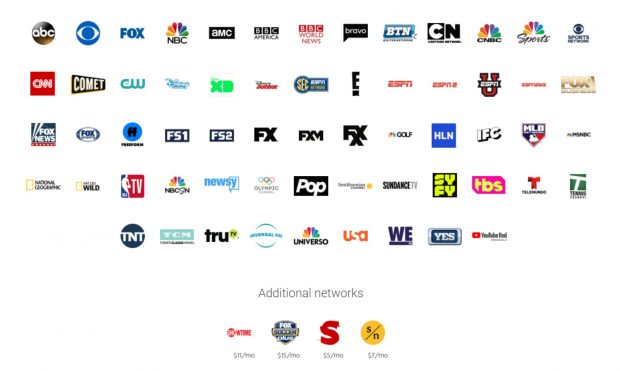
    How will people consume media in the future? What will their viewing/listening experience be like? A scan of services in the market gives us some clues. We are starting to see the growth of OTT content aggregator services which set out to give the customer the most content possible, when they want it. For example, YouTube TV (not yet available in Australia) is an example of possible viewing experience of the future. The service (currently $35/month) aggregates channels (and therefore content), much the same as a cable provider, offering additional subscriptions for niches (e.g. soccer fans). FetchTV in Australia also has a similar aggregation offer allowing it to remain content agnostic.

    Outside of the content offering, the interface for the consumer will also play a role for these services. An aggregator like YouTube TV could neatly tie into the Google Home interface where a user could simply ask ‘Hey Google, show me last night’s NBA game’ and the content would then be beamed to the TV or device. It is unlikely that one service will have all the content available for its basic subscription package, however you can imagine a world where a ‘micro subscription’ would be available for a user to gain access to content not on the platform: ‘I’m sorry, last night’s game is not available, would you like to purchase a subscription for the game and the rest of the game for the month?’. It is possible that we will see these aggregator services cut more deals with content providers or rights holders to enable content to be shown on their platform (for a price). This would lead to a situation when Amazon Prime shows all NFL games on its platform but on YouTube TV you cannot get all games for the basic subscription meaning micro-subscriptions are available for certain games/teams.

    Deloitte’s prediction is highlighting the growth in the number of subscriptions media consumers will have in the future. This aligns to the idea of a proliferation of micro-subscriptions to compliment basic OTT service subscriptions. For this to be true there will also need to be a growth in the ‘share of wallet’ subscription services command – how much a consumer is willing to pay for the content they wish to watch… watch this space!

  • Smartphone innovation: the invisible superpower

    Smartphone innovation: the invisible superpower

    This blog post is featured on Deloitte Australia’s blog in conjunction with the launch of Deloitte’s Global TMT Predictions 2018.

    As covered in our Global TMT Predictions 2018 report, the smartphone’s global success over the next five years will be underpinned by an array of innovations that are largely invisible to its users, but whose combined impact should feel tangible, in the form of greater ease of use, or improved functionality, for example for maps and photos.

    These invisible innovations should enable the smartphone to continue ‘absorbing’ the functionality of an ever-broader array of physical objects and to further displace the PC as the preferred device for a growing range of digital applications.

    There are three local trends that perhaps heighten the effect of invisible innovation on the smartphone in Australia. These include the strong penetration of high end smartphone devices in our market, the quality of mobile networks in Australia, and the already high adoption of smartphones for use in enterprise settings.

    Overall, expect to see alternate uses for the smartphone increasing in Australia.

    More and more gadgets are being integrated into smartphones, from apps that help us with day to day life-flow, or those that allow us to spend more time playing games or reading. Much as we’ve seen with the impact of Spotify and Apple Music on how we listen to music – reading and watching media are moving in the same direction. This is fostered by increases in screen size and improvement in network quality, especially as we move toward having more and potentially unlimited data, possibly making room for an increase in activities like watching long form video on our phones, where traditionally people would purchase another device.

    We’ll also see more smartphone activated Internet of Things (IoT) functions and work-flow based business applications. The enterprise will be well placed to see smartphone technology as a tool to support work agility and flexibility, giving people the confidence and ability to be mobile and do their work or training from anywhere. Small business can use the smartphone to do almost everything these days from placing orders to raising invoices or other random tasks. While sectors such as personal banking, home security and insurance will further capitalise on the smartphone to improve customer experiences.

    Strength in numbers

    Taken from our Mobile Consumer Survey 2017, here’s a numbers view of why the prevalence of premium phones with latest innovative technology will continue to be high here:

    • 88 percent of Australians now own a smartphone, up from 84 percent last year. Australia is likely to surpass the 90 percent penetration rate by end-2018, ahead of the global prediction of 2023.
    • Penetration rates for Australian under 55 years-old are already above the 90 percent mark and therefore the growth in penetration is likely to come from >55 age group. In 2017, there was a five-point increase for 55-64 year olds (77 percent to 82 percent) and a nine-point increase for 65-75 year olds (69 percent to 78 percent). This can be largely attributed to the decommissioning of the 2G network.
    • We’re starting to see growth (~50 percent increase 2017-2016) in the purchase of Internet of Things (IoT) that is cheap to install and smartphone activated – all enabled by smartphone apps.
    • 67 percent of Australians are using their smartphones for work. There’s only low use for submitting timesheets, expenses and accessing intranet sites, but expect this to increase as functionality becomes more useable.

    With these numbers in mind, telcos must look to maintain market share by providing Australians with the best phones on the best networks – they still need to be a focus on network quality. Other industries will look to further capitalise on the smartphone to improve customer experience, e.g. personal banking, home security, health insurance. And companies who target business applications (both small business and enterprise) should look to develop software that allows them and their employees to use simple mobile centric applications to run their business.

    Can smartwatch outsmart smartphone?

    With Australia reaching almost peak smartphone penetration, with one of the highest smartphone penetrations worldwide, we are big smartphone users.

    However, 41 percent of Australians adults think they use their mobile phones too much and 70 percent of Australian 18-24 year olds feel they use their phones excessively, with 50 percent trying to limit and half of them doing so successfully.

    Can the smartwatch assist here? We are seeing notable growth in the smartwatch (ownership almost doubled from five percent in 2016 to nine percent in 2017, according to our Mobile Consumer Survey 2017), and it’s likely to overtake the traditional fit bands as the price point comes down or as customers see more value in the functionality they receive for the price they pay. An increase in functionality is been driven by more powerful chips in wearable devices as well as the cellular connectivity.

    The beauty of the ‘smarter’ smartwatch means users can disconnect from their phone for many of the tasks they were previously relying on the smartphone for. People can use smartwatches to pay for things, contact people, and listen to music, while still being connected to the things that are critical such as call and text – but the phone stays at home.

    Organisations should keep this in mind when looking to create connected experiences for their users and how it may be transferred to a wearable format. There may be an increased opportunity to create new experiences whilst also supporting people’s smartphone usage.

    To find out more about TMT Predictions 2018 and view the other predictions, click here.

  • The 3 most influential TMT ideas in 2017

    The 3 most influential TMT ideas in 2017

    2017 has been a big year for the Telecommunications, Media and Technology (TMT) industries – the iPhone’s 10th Anniversary, 5G standard approvals, the Disney and Fox deal, crisis at Uber, growth at Amazon, Snap’s IPO, Google in home and on the go (v.2), iPhone X/Watch 3 and the growth of Chinese Tech – Huawei, Baidu, Alibaba, Tencent. Last year I looked at the 3 most influential ideas of 2016 which were ‘Fake News‘, ‘Everything As A Service‘ and ‘Blockchain‘ (v.2 of the internet). The influence of these ideas continued to make an impact on the the TMT industry, politics and culture in 2017.

    ‘Fake News‘ became the frequent catch cry of the US president in an ongoing public battle (on Twitter and in public addresses) against mainstream media. It also led to Facebook, Twitter and Google being brought in front of a US Senate hearing on ‘Fake News’ connected to Russian meddling in the 2016 presidential election and contributed to the growth of news services like ‘All Sides‘ which allow readers to engage in different political angles for the same news stories. ‘Everything As A Service‘ as an idea continues to be extremely influential with TMT organisations looking for new services to provide to their customers. The concept of Artificial Intelligence-As-A-Service in particular has become mainstream in the last 12 months with the larger technology players like Google, IBM, Amazon and Facebook providing algorithms and databases as a service and niche players like Clarifai offering AI-As-A-Service to specific industry verticals. Equally, Blockchain has continued to increase in awareness in 2017. As far as cryptocurrencies go, Bitcoin, Ethereum and Litecoin have increased in market cap (Bitcoin up from $15Bn to $250Bn in 12 months) making people who missed the Mt Gox crash ~2013 who continued to own bitcoin very wealthy (almost overnight). Outside of the Bitcoin buzz, initial coin offerings (ICOs) raised over a billion dollars in funding in 2017 with mixed results – for example, the seemingly fraudulent like Plexcoin or the seemingly legit like EOS. Speculation aside, there are more and more use cases for blockchain being identified now than a year ago and 2018 may see some excellent examples of blockchain implementations.

    On to 2017…what were the most influential ideas in TMT in 2017 and why will they continue to shape the industry in 2018 and beyond?

    1. Augmented reality

    I know what you are thinking… ‘Augmented reality’ (AR) was so 2016, remember Pokemon Go? This is fair, but I believe that AR was a more influential idea in 2017 than 2016 for a few reasons. Firstly, investment in AR this year (leaving aside investments in Magic Leap in 2016) hit an all time high with US$1Bn invested in AR in Q4 2017 alone and over $2.5Bn over the year according to a Digi-capital report. Secondly, Apple, Google and Facebook each released their own AR developer tools (ARKit, ARCore and Camera Effects). The launch of these tools signals the start of opensource AR on the world’s largest operating systems which when paired with advancements in the world’s most powerful mobile hardware (e.g. iPhone X, Pixel 2, Huawei P10, Samsung S8) particularly the camera technology, there is tipped to be an explosion of new AR apps and games. Finally, AR made tangible steps into the workplace in 2017 particularly in the fields of maintenance, engineering and manufacturing. Productivity related AR applications received a large portion of VC investment and the world’s largest engineers like GE and Siemens demonstrated examples of work AR related productivity (e.g. GE technician wiring a wind turbine’s control box using the company’s current process, and then doing the same task while guided by line-of-sight instructions overlaid on the job by an AR headset. The device improved the worker’s performance by 34% on first use).

    Why is this influential?

    Deloitte TMT predicts that in 2018 1 billion smartphone users will created at least one piece of AR content (e.g. a video, photo or game) and the industry will generate US$100M revenue. Looking a bit further out to 2020, AR is predicted to be a $1Bn industry 10x that of 2018. These figures are not yet counting for the productivity gains more and more businesses (outside of engineering and manufacturing) will experience with AR or the new applications particularly in retail. Get ready for mainstream AR.

    2. Asia’s increasing influence on Telecommunications, Media and Tech

    As a region, Asia was often in the headlines 2017, mostly due to geopolitical reasons as North Korea and the US traded rhetorical blows, China held its first public test of the Belt and Road Initiative in May and the US signaled a move away from the Trans-Pacific Partnership agreement (a multi-lateral trade deal between Pacific-Rim nations). The TPP is likely to forge ahead (without the US) and Asia’s influence on TMT industries will continue. 2017 was a watershed year for Asia’s influence on TMT globally for a few reasons. Firstly, 2017 was the first year that the top two smartphone manufacturers were from the region. Huawei has now overtaken Apple to join Samsung as the world’s two most popular smartphone brands. To continue growth (and rival Samsung) Huawei will need to break into the US, South Asian and Indian markets. Secondly, VC investment in Asian startups maintained its high from 2016 with >US$12bn invested in both Q2 and Q3 of 2017. Behind the dollars were significant investments in AI particularly Facial Recognition ($410M raised by Chinese company SenseTime) and >US$4Bn invested by SoftBank Vison Fund in Indian Technology companies (e.g. Paytm, FlipKart and Oyo). Finally, in 2017 Asia is now the home to some of the most interesting technology innovations. For example, Japan became the world’s largest Bitcoin market in 2017 and has started to embrace the crypto-currency in regular ecommerce. Chinese Fintech companies like Ant Financial, 2Boss, Qdian and InsuranceBox are all geared at changing banking, insurance and finance with plans to move into overseas markets and smart cities like BSD City Jakarta or Cyberjaya in Malaysia are a first of their kind in supporting ‘digitally enhanced’ lifestyles.

    Why is this influential?

    The balance of global investment, innovation and new businesses growth is swinging towards the Asian region and this is forecast to continue. As part of this, Asian governments and private investors will continue invest heavily in TMT infrastructure, Asian tech companies will also play an increasing influence and the next global tech hubs will be in the region (e.g. Beijing, Bangalore, Singapore). Get used to hearing about Asian Telco, Media and Tech innovations, business, VCs and policies influencing the rest of the world.

    3. Social and political backlash against TMT companies

    Social backlash against the TMT industry was an umbrella topic in 2017 and played out in a number of ways. The #metoo (hashtag), started in October 2017 to route out misogynistic behaviour and sexual harassment in the entertainment industry, has led to a number of high profile resignations of men in positions of power. It has also spread to media, tech, government, academia and sadly, it is likely to be wide reaching. There have been some high profile examples of social movements in the TMT industries. The most high profile was the resignation of the CEO of Uber after employee Susan Fowler’s accounts of sexual harassment and inappropriate beaviour at the company. This prompted a social movement #deleteuber calling for boycott of the ride hailing app. Another example was James Danmore’s ‘Google Manifesto’ which was valourised by those that see diversity as ‘bad for business’ and demonised by diversity advocates. Google’s response was to fire Danmore but not before the memo went viral. At the backdrop social backlash on the topics of sexual harassment and anti-diversity has been a leading indicator of a trend towards reducing time spent on smartphones consuming media – the digital detox. Deloitte has identified that in 2017 globally >45% of people worry that they use their smartphones too much and in the coming years will try to limit their usage.

    Political backlash against TMT organisations has come from the overarching trend of governments trying to regulate Big Tech (e.g. Apple, Google, Facebook, Amazon, Twitter, Tencent, Baidu, Alibaba). There is a need for government oversight of technology but there is also a risk that political overreach may stifle the industry – so the right regulatory structure will be difficult to settle on. In Europe this year, Google was hit with a US$2.7Bn fine for breaching its antitrust agreement and cloud providers (e.g. Amazon, Google, Apple, Alibaba) will all need to comply with Europe’s new data protection regulations. In the aftermath of the ‘fake news’ incidents related to the 2016 elections governments are looking at how to regulate news/information aggregators like Facebook/Twitter/Google given the control they have over society’s access to information. Ultimately government policy towards tech needs to evolve inline with tech advancements but equally, these powerful organisations may need to think differently about their role in society and their products/services or face further backlash politically and socially.

    Why is this influential?

    2017 saw TMT companies publicly challenged at a viral scale on the issues of diversity, inclusion and the culture the industry sets for women to succeed. Politically, the question of how best to regulate technology companies, particularly the major platforms was brought to a head in a number of high profile cases. The effects of these events will be long lasting. We should expect TMT organisations to continue to adapt their approach to address the issue of sexual harassment and at the very least promote healthy awareness and debate on issues of diversity and inclusion. Politically, there does not yet exist an adequate regulatory structure that allows TMT businesses (particularly FANG organisations) to benefit from technologies without aggregating power and with it wealth to a monopolistic end. At the same time, industries are unlikely to voluntarily regulate.

    2017 has been a challenging year for the TMT industry. The pace of change in the industry is driving the need for a balance of business objectives and social objectives now more than ever.

    Thank you for reading strategy4telcomediatech in 2017 and happy new year!

  • The new Aussie battlers: The context and rationale for “challenger” strategies in Australia

    The new Aussie battlers: The context and rationale for “challenger” strategies in Australia

    This post is featured on Deloitte Australia’s Strategy blog. The blog is co-authored by Kate Huggins, Michael Chen and Samantha Twibill.
    Today, it is possible to interact almost exclusively with ‘challenger businesses’ in our day-to-day lives – we can fly with Jetstar (Qantas’ challenger business), connect with friends and family using Belong mobile or Belong broadband(Telstra’s challenger business), manage our finances with UBank (NAB’s challenger business), access entertainment content on Foxtel Now (Foxtel’s challenger business) and lease/buy property on domain.com.au (Fairfax’s challenger business).

    These are just a few Australian examples of market leaders who have launched separate businesses that operate alongside their core businesses; new faces for a new age. So what is behind this trend?

    The term ‘challenger’ is in vogue and has been used to describe anything from a low-cost brand alternative to a disruptive tech-enabled new entrant. We have defined ‘challenger businesses’ as offshoots launched by a market leader to operate in its core business but compete on a different basis. It’s easy to associate ‘challenger’ with ‘low cost’ – broader trends related to digital disruption have undoubtedly given rise to a new class of organisation that are leaner and more agile than we have been used to.  However, the desertion of the low cost and value segments from an incumbent’s core business may also be the canary in the coalmine that suggests a more fundamental shift in the economics underlying an industry.

    We have looked at several examples of market leaders that have launched/purchased a ‘challenger’ business to identify a potential set of strategic rationales for the incumbent business which can be broadly flagged as ‘defensive’ or ‘offensive’ plays.

    The defensive challenger

    As discussed in the ‘Innovator’s Dilemma’, new entrants (particularly those enabled by new technologies) will start off at the low-end of the market with a product that is just good enough. A ‘defensive’ challenger strategy for the market leader seeks to limit the ability for that new entrant to move up the market and into the core customer base of the incumbent business. When Virgin Blue entered the Australian domestic airline market in the early 2000s, amidst the collapse of Ansett in 2001, Qantas was faced with a competitor that was quickly gaining market share by undercutting on price. Once Virgin listed on the ASX in 2003, Jetstar became Qantas’ response; a low-cost airline which helped drive a wedge between the low and high ends of the market and allowed Qantas to maintain its premium position.

    The strategy also accelerated a choice for Virgin: should it stay in the low-end and compete with Jetstar or try and leapfrog Jetstar and compete with Qantas? The latter would have significant capital investment to be much better than Jetstar but also good enough against Qantas. As such, to be successful while protecting their core, Jetstar needed to play in a separate market to Qantas, confining its routes to domestic and then Asia-Pacific, while Qantas continued to perform its full service across longer leg journeys to Europe and the US.

    Outside of the airline industry, we have seen the defensive challenger strategy play out in telecommunications with the launch of businesses such as Belong in Australia and Skinny Mobile in New Zealand and in financial services with digital pure-play banks such as UBank. Next in line could very well be the energy sector, with consumer demand for cheaper, cleaner resources driving market leaders to question how to better serve this need, while maintaining their traditional offering.

    On the front foot

    Not all markets can support both the incumbent and new entrants amidst disruption. While, foreseeably, there will always be budget travellers and premium travellers, the same cannot be said of streaming video services and cable television services. When a market leader faces a fundamental shift in the economics underpinning the industry, a more ‘offensive’ challenger strategy seeks to use the privileged assets of the incumbent business to take hold of the revolution and lead the cannibalisation of the core business in order to retain market leadership in the new world. As uptake of streaming video services are expected to exceed the 30 percent ceiling for cable television, Foxtel has doubled-down on its Foxtel Now challenger business with a rebrand, new pricing models and new devices. Foxtel’s initial strategy, Foxtel Play, was heavily geared to video game consoles as the access point (a customer base with low cannibalisation risk to their core business).

    This was partly successful, but when streaming began to take hold of the mainstream market (given a nice little shove by Netflix’s launch in Australia), Foxtel launched Presto as a joint venture with Seven. Presto fell short of rapidly rising customer expectations on content and user interface relative to Stan and Netflix, driving Foxtel to buy out Seven, shut down the service, and relaunch Foxtel Play as Foxtel Now, making it available as a streaming service on any connected device, and slightly unbundling its subscription tiers to be more price competitive. The risk of cannibalisation was higher, but the competitive threat was higher still. Foxtel Now has repositioned itself to win on the basis of exclusive, premium content – something that leverages the traditional assets of the incumbent business to carve out a defensible position in the streaming video market against agitators such as Netflix.

    Accordingly, Foxtel Now takes advantage of Foxtel’s exclusive licensing deal with HBO, its range of local original content and its live sports licensing deals to offer a compelling customer value proposition for a new world for on-demand content that is detached from cable television.

    In summary, not every decision by a market leader to launch a challenger business is the same, it is not just about creating a low-cost offshoot because the incumbent business cannot support a cost leadership position in the market.  The strategic choices behind the challenger business should be informed by the answers to three key questions:

    1. What is the customer need and market this business will serve?
    2. How is it similar / different from the core business?
    3. How will it compete?

    By understanding the nature of the threat to competition faced by the incumbent, market leaders can determine the value of a developing a challenger strategy, and whether that strategy will be an offensive or defensive play.

  • The state of mobile in Australia: Highlights and implications from Deloitte’s Mobile Consumer Survey

    The state of mobile in Australia: Highlights and implications from Deloitte’s Mobile Consumer Survey

    2017 marks the 10th anniversary of the iPhone. Reflecting on the decade past, it is clear that Australians have enthusiastically embraced the smartphone and its many uses with consumers and businesses being the beneficiary of this era-defining technology. As mobility continues to mature beyond today’s smartphones into new more powerful devices or the mass adoption of wearables and drones it is important for businesses to stay across the trends in mobility and their implications for product strategies, innovation, customer experience, content and operations.

    Deloitte’s Mobile Consumer Survey, now in its fourth year, is a multi-country study of mobility around the world. The 2017 study comprises more than 51,500 responses across 33 countries. The Australian edition is based on 2,000 national responses from consumers aged 18-75 polled during May and June 2017. Special mention to the team that prepares this report in Australia led by Jeremy Drumm, Nick White, Morne Swiegers and Maggie Davey.

    This post draws out a number of the key findings from the 2017 Australian edition of Deloitte’s Mobile Consumer Survey and the implications for Australian businesses. The full report is insightful for those in leadership and management roles in Australia’s carriers/operators, RSPs or businesses looking to further understand how to capture the value of mobility to their organisation.

    ‘Silver surfers power smartphone swell’ (p.7)

    It may come as no surprise that smartphone ownership is on the rise for older generations – 78% of 65-75 year olds now own a smartphone which is up almost 10% on last years’ figure. With the decommissioning of the 2G network a portion of the population have left behind their feature phones and in 2017 88% of Australian’s own a smartphone. It is expected that in the coming 18 months 90-95% of Australian’s will own a smartphone as older generations continue to adopt and embrace this technology.

    Implications

    We are reaching saturation in smartphone ownership which means device manufacturers will need to continue to innovate to profit from replacement/market share vs growth from new adoption. For businesses looking to reach older generations, now is the time to seriously consider the mobile experience (sales/service) for the elderly.

    ‘A slice of Apple’s pie’ (p.8)

    Australians are Apple and Samsung junkies. We have the second highest % penetration of Apple and Samsung smartphones in the countries surveyed at 75% – only Luxemburg at 83% is higher. Interestingly, Samsung’s share has increased slightly YoY and Apple’s share has decreased by 2% all in a period which included the Galaxy note safety recall. The data in the survey correlates to users of Samsung Galaxy (S6-8) and iPhone (6-7) models. It will be interesting to see the change in next year’s data with the iPhone X (most expensive smartphone ever) and SIM enabled watch (Do i still need a smartphone?) adding new dimensions to smartphone ownership.

    Implications

    Australian’s are clearly premium smartphone buyers but we can expect the ~$AUD 2,000 iPhone X test Australian’s love for the brand as well as the growing number of competitive (tech and $ price) Android devices (e.g. Pixel 2, Huawei P10). I suspect this mix to change again next year perhaps with the non-Apple/Samsung smartphone brands gaining more mind and wallet share.

    ‘Demanding data divas’ (p.13)

    Australians are purchasing more data in 2017 than ever before – 60% of Australians now have a data limit 3GB or higher. Interestingly, those that have between 3-5GB plans are 2x more likely to exceed their data limit than those with 500MB or less. The report estimates those who exceed their data collectively to pay close to $30M per month or $313M per year for extra data.

    Implications

    Australians are data hungry. This is following a growing trend seen around the world. The obvious long term implication is that the operators that can provide the most data at an affordable rate will win and already a number of global carriers are offering unlimited plans. Operators will need to look to improve their cost base in order to remain competitive in an unlimited world. Equally, customer experience will begin to play more of a role as operators try to maintain quality connections across their network.

    ‘WiFi wins…this round’ (p.19)

    Australians are more likely to connect to WiFi in 2017 than 4G despite 86% of people being on 4G. This is believed to be the result of the current cost of mobile data plans rather than connectivity needs (e.g. speed) – only 40% of consumers identified that 4G is faster than their home speed.

    Implications

    This WiFi vs Mobile connectivity is a hotly debated topic in Australia currently. The reality is that it is more likely to be complementary rather that one replacing the other. The introduction of devices like ‘hybrid’ modems and ‘broadband plans’ to households are likely to reduce consumers concerns over the utility of one network or another. Bottom line, consumers and businesses want to be connected and to be able to access content, technology and services – in a world of ubiquitous connection, the type of network a consumer connects onto (e.g. WiFi, Mobile, Mesh) will likely be an afterthought.

    ‘High street hangs in’ (p.20)

    1 in 5 consumers visited an operator store in the last month and 3 in 5 in the last year. Stores are still important for operators especially for testing physical product and technical support. The cross channel stat – 23% of smarthphones (mostly by 35-44 year olds – 30%) were purchased online but only 3% of these were collected in the operator store – more scope for omni-channel experience.

    Implications

    Face to face and physical interactions with customers are still important particularly for operators – there is value in face to face exploration, sales, service and support interactions. Whilst there is a lot of information online and the channels to service customers the increasing pace of device innovation, new technologies and solutions is creating a complex environment for many to navigate. Stores will continue to deliver value particularly when aligned to a coherent and compelling omni-channel strategy.

    ‘Our homes are getting smarter’ (p.33)

    Ownership and access to connected devices in the home is on the rise. In the last year there have been increased purchases of cameras (9%), connected car systems (8%) and connected home appliances (5%). The popularity of home security systems seems to indicate consumers value connected home devices for increased security and convenience. There is also a clear preference for devices that are easily self-installed such as smart lighting.

    Implications

    These findings indicate that in the short to mid term bets in smart home IoT are best placed on products that have a clear customer benefit, short replacement cycle and are easily self-installed. More complicated home device set ups will require support to enable. Operators looking to provide consumer IOT solutions need to look carefully into the set up and support model (and cost) as part of the business case for mass-consumer IOT installations.

    ‘Seamless shopping on the go’ (p.44)

    Mobile payment solutions are up 14% from 2016 with over 25% of respondents suggesting they now use the mobile payment solutions. Pay Pal has taken a hit in this survey which is likely due to the fact that tap and go payments from the iOS app. Apple Pay is therefore increasingly popular accounting for 18% of mobile payments nudging out Samsung Pay at 12%.

    Implications

    There is still room for growth in mobile payments in Australia with solutions going beyond early adopters. There is increasing value in developers creating seamless experiences combining mobile applications and payments for fast purchasing on the go. App developers and online channels should look to include mobile payment options online and retail stores should look to include tap and go options where possible in the next 18 months.

    The bottom line

    Australian’s are high on the adoption curve for smartphones globally, we are consuming more data now than ever and we are using our devices everywhere and at anytime. Devices are becoming more innovative some innovations are getting our attention like fingerprint security (35% increase on 2016) and mobile payments (25% increase on 2016) but we still don’t care much (yet) for voice assistants.

  • Reflections on Tech in APAC

    Reflections on Tech in APAC

    On a recent trip to Singapore I was able to spend time with a few local and Asia Pacific (APAC) startup founders and the APAC heads of business in technology companies. These conversations were really insightful particularly with regard to the macro trends in the region. This post is my reflections from these conversations on doing business in Asia, the of growth and adoption of tech across the region and some opportunities Australia might consider to make a greater impact in APAC.

    Doing business in Asia

    Regulation for new, tech-driven economies

    Regulation plays such an important role in opening up markets to new technologies. In APAC there are some really interesting examples of progressive regulation which have allowed existing institutions and ‘startups’ to test new technologies. In 2016, the monetary authority of Singapore (MAS) launched a ‘sandbox’ which allows financial institutions to rapidly trial and test innovative financial services. Behind sandbox environments now in Hong Kong, Malaysia and Australia has been the recognition by regulators that there needs to be a balance of experimentation with new technologies and security.

    At the same time some regulators are supporting innovation there are also examples where greater scrutiny of new entrants is being applied. Deloitte’s APAC Centre for Regulatory Strategy identifies the major shifts in regulation that are occurring in APAC markets. Areas of changing regulation include e-money, data retention, privacy, regulation of new technologies and international entrants (i.e. ride-hailing) and cyber security. There are numerous examples where understanding the current regulations in local markets as well as the regulatory risks specific to the market can mean the difference between successful market entry, drawn out application processes and/or failure.

    The presence and influence of large conglomerates

    Large family-owned conglomerates continue to play a dominant role in many of the APAC markets. Presence and influence varies by market, however it is impossible to ignore these family businesses in Asia. Take for example the Widjaja family in Indonesia who own the Sinar Mas conglomerate. As of November last year, Sinar Mas had a total market capitalisation of ~USD$10bn in pulp, paper, palm oil, property, finance and urban development. If market capitalisation is an indicator of presence, influence may be indicated by something like BSD City which is a Sinar Mas owned development in Jakarta’s neighbor district Tangerang. BSD city is half the size of Paris and complete with hospital, housing, malls, telecoms, entertainment and transport. Whilst many of jurisdictions in APAC are looking to governments to help fund and experiment with smart city concepts (e.g. Cyberjaya in Malaysia), BSD City is an example of a smart city developed by a conglomerate a clear example of how conglomerates a shaping the future of living, work and technology adoption in Asia.

    Growth and adoption of technology

    Investment in new technologies

    In the last 3 years, APAC has consistently accounted for ~30% of total VC back companies globally (US ~60% and Europe 10%) with consumer tech/software particularly in China soaking up a lot of investment. In the 3rd quarter of 2017, 6 of the top 10 deals by size came from APAC with companies like TouTiao (a personalised information system) or SenseTime (facial recognition tech) receiving hundreds of millions in funding. This data shows the strength in innovation in new technologies in the region.

    Based on my discussions in Singapore, the trends to watch appear to be the growth in investment in AI as new opportunities to monetise are identified, electric/autonomous vehicles in China due to Chinese government directives to replace gasoline cars by 2030, transformation of payment methods in SE Asia nations (particularly Philippines and Indonesia) and transport tech including bikes and delivery services.

    China’s Tech giants going abroad

    Alibaba, Tencent, and JD.com are just some of the Chinese tech giants that are eyeing off global expansion. Specifically, they are looking to India and Southeast Asia to acquire talent and technologies to expand their reach. Investment in the Southeast Asia tech market has climbed to ~$5bn in the last two quarters of 2017 from ~$3bn in the all of 2016. These Chinese tech companies have been connected to a number of massive deals, including Alibaba’s $2 billion commitment to Lazada Group (an e-commerce start up) or its $1.1 billion investment in Tokopedia. Tencent has recently signing a deal with Sea — a gaming and ecommerce firm. Meanwhile, JD.com is working with Thailand’s Central Group on a $500 million joint venture. The activities by these tech giants reflects the growth prospects for tech in the APAC region – this at a time when other regions are experiencing a relative cooling off.

    What might Australia do?

    Greater connectivity to SEA, China and India

    The leaders I spoke to in Singapore all used the following phrase to describe Australia – Minnow Power. Australia’s economic ties to China, political ties to the US, natural resources, stable government, established banking system and education all seem to rate highly. However, there is a commonly held view that distance, cultural differences, small population and political orthodoxies mean that the growth of new tech economies in APAC may occur without involvement of Australia or Australians. Improving connectivity to Asian nations was an overall theme with some ideas:

    • Joint sponsorship of economic initiatives in the region by either government or private investors (e.g. APAC ‘future of work’ labs)
    • Australian government directives/subsidies for companies developing new technologies for Asian markets
    • More ‘landing pads‘ for Australian nationals in select SEA countries and hosting of APAC techology events

    Shenzen in Australia

    What is the Shenzen of Australia? This question was posed to me in Singapore. Shenzen (aka Silicon Delta) is China’s tech capital and a major part of the technology supply chain for the world. Everything from semi-conductors, robotics, smartphones are designed and manufactured in Shezen. Australia’s reputation in Asia for its fresh produce could be a clue. A Shenzen style hub for fresh produce/food including contract kitchens, food innovation, food tech, packaging etc. might be an opportunity to connect create the food ‘supply chain’ for the region.

    The growth of tech in the APAC region continues to go from strength to strength. The leaders I met in Singapore were very bullish about the region’s prospects and its growing influence on the global economy particularly in the form of Chinese tech giants, India’s digital development and major family conglomerates. Australia can play a greater role but this will only be possible through increased connectivity and investment in Asian jurisdictions.

  • Apple: The X Strategy

    Apple: The X Strategy

    In Apple’s most recent keynote on September 19th, the company announced the launch of a new generation of iPhone (the iPhone X) at the same time as upgrading their existing iPhone range with the iPhone 8. Underlying this move is an interesting strategy that I will investigate in this post focusing on how the iPhone X has (yet again for Apple) created segmentation in the market for an iPhone, the brand strategy underlying the X and how the launch of the X is a sign of the maturity of the mass production of smartphones and Apple’s response.

    Segmenting the iPhone market

    This is not the first time Apple has offered different types of iPhones in parallel with an upgrade to the existing model but it is the first time Apple has announced a more expensive, new design and a ‘full number’ upgrade at the same time. In 2013, the introduction of the 5C at the same time as the 5S or the introduction of the iPhone SE are examples of previous attempts to segment the market. In these instances the iPhone 5C, with an iPhone 5 design and plastic casing but iPhone 6 components, was a way for Apple to sell ‘no frills’ iPhones to more price-sensitive customers – thus segmenting the market at the ‘lower end’. In a similar vein, the iPhone SE allows people who want a decent iPhone to get one without paying top dollar (an upgrade on the 5C). This is particularly relevant to markets like China and India where the Apple brand has prestige but the price tag can be a barrier.

    The iPhone X represents a segmentation at the top end. It sells to two markets:

    • Those who want the most ‘prestigious’ phone on the market
    • Those who want the ‘newest’ and the ‘best’ phone

    The announcement of the iPhone 8 at the same time as the X is a new strategy which will test the strength and size of these markets for Apple. Some who would typically fit in these cohorts may opt for the iPhone 8 for a ‘good enough upgrade’ at $300 less, making the buyers of iPhone X relatively small. Apple’s first quarter results will show the outcome of this segmentation approach.

    iPhone X as a luxury brand

    The iPhone X will be the first smartphone to retail at USD$1000 – a premium pricing strategy. This is interesting strategically for two reasons. Firstly, over the past 10 years Samsung and Chinese device manufacturers like Huawei/LG have caught up to Apple in terms of design and technology. Their current smartphones have ~90% the same components/features (e.g. facial recognition) but for 30% less. Granted, Apple’s software/hardware integration may be worth a premium but this is an example of a strategy pushing for ‘good enough’ innovation at a premium price.

    Secondly, luxury goods are a comparatively faster growing market globally. In a recent Deloitte report Global Powers of Luxury Goods 2017, Deloitte highlights that luxury goods growth year on year is 6.8% with a CAGR of 5.2% (2013-2015), compared to a global rate of all goods of 1%. Entering the ‘luxury’ market for Apple and differentiating from its previous iPhone models is following the growth in this segment. In executing on a luxury strategy we may see Apple place more emphasis on marketing versus its core of product design.

    The iPhone and mass production

    A famous HBR case is that of Ford vs GM and the competing approaches to mass production (cost optimisation vs. flexibility). In short, Ford’s Model-T earned them the status of the dominant car manufacturer of the first three decades of the twentieth century. However, Ford’s focus on cost minimisation also led to inflexibility, allowing other manufacturers like General Motors to compete with newer designs and incorporate changing technology. The parallel here is that like Ford’s Model-T, iPhone design hasn’t changed greatly in the last 10 years. This has likely meant greater cost optimisation in Apple’s supply chain. The iPhone X represents a break away from cost optimisation with a new design (e.g. OLED Screens, edge to edge, new configuration of chips and cameras, ‘the notch’) meaning that Apple will likely oversee multiple supply chains for smartphone devices. This could be seen as a strategy to counter strong competition (i.e. the General Motors) from other manufacturers (e.g. Huawei and Samsung) which have multiple device designs in the market and could more easily adjust to changes in technology.

    At the macro-level, another ~1.7bn smartphone shipments are forecast by 2020. Some of these will be first time buyers of a smartphone whilst many will be replacements. Through its iPhone X strategy, Apple will hope to make millions of customers luxury device owners while also enticing those who might have settled for an SE or equivalent, the proud owners of an iPhone 8. A good test of this strategy will be to see whether next year, come September/October, Apple launches an X2, an 11 and/or a 9.

  • Apple’s WWDC and the state of today’s consumer tech battlegrounds

    Apple’s WWDC and the state of today’s consumer tech battlegrounds

    10 years ago Apple launched the iPhone, a product that has been at the forefront of the growth in mobility globally and an icon of the digital era – a major consumer technology battleground. The iPhone has positioned Apple as a leader in the Telecommunications, Media and Technology ecosystem along with its other offerings like the App Store, Apple Music, Apple TV, Watch and other devices.

    At the recent Apple developer conference last month (WWDC) there were a number of major software and hardware announcements made. Apple often uses the conference to showcase new products or product features as well as excite the developer community on how they might build (apps/services) on top of new hardware and software. Watching the event, I could not help but think about the messages of the announcements and what they say about Apple and the position of other players in the key consumer tech battlegrounds of today.

    This post outlines the some of the most interesting battlegrounds in consumer tech at the moment and what Apple’s messages at WWDC say about the competition for these domains.

    Battle for streaming: Winning in TV media is all about content (still)

    The first announcement of the conference was about Apple TV and the news that Amazon Prime Video will be available on Apple TV. This says a lot about the nature of streaming video/TV on demand and Apple’s role. Winning in this medium is not about the hardware or the software or even the integration of the two, it is about content which is something (at least in TV content) Apple has not been investing in at the scale of Amazon, Netflix and HBO.

    Battle for new content: Podcasts are growing in popularity for customers but not yet for advertisers… or Apple

    Apple announced iOS 11 their new smartphone operating system which could have made up the entire keynote itself. One of the features of the new OS is an improved podcast app allowing for greater functionality for users and analytics for podcast publishers. This addition speaks to the growing popularity of podcasts as a medium for Apple users and the growing demands of publishers. Despite growing over the past 5 years, podcast revenues are small compared to other content at ~$220M. This is relatively small if compared to other ad revenues Apple could be tapping in, which partially explains why podcasting has received little attention until now. Perhaps the changes Apple makes will increase the commercialisation of the content (e.g. visibility of listens, content changes).

    The battle for the assistant in-home: Apple vs Google vs Amazon

    The announcement of Apples’ Homepod has stolen a lot of the limelight post event with much excitement from techies and audiophiles alike. Like Amazon’s Echo and Google Home, Apple is now launching its own (belated) take on the home assistant. The focus of Apple’s unveiling of the Homepod showed how much ground Amazon and Google have made with their assistant products versus Siri with Apple making a big deal about the audio quality of the Homepod speaker firstly, the quality of the assistant (Siri) secondary and the price thirdly (>$100 more than the Amazon and Google assistant). If Amazon and Google have changed the game on Siri with the concept of the home assistant, Apple is trying change the rules by making the quality of the speaker the most important feature of the in-home assistant. It remains to be seen how many people need a home assistant and for Apple, one with an impressive speaker.

    The battle for the assistant on your wrist: Apple vs Google vs Amazon

    Siri also featured in the watchOS announcement with the introduction of the Siri watch face. This implies a broadening of the scope of Siri from voice commands to context based assistance when you need it. This may sound very similar to Google Now launched a few years ago the difference being that it is play to Apple’s main advantage over Google – integrated software and hardware. Google Now requires a different watch and phone entirely but Apple has this functionality on an increasingly popular watch that works natively with an iPhone.

    These consumer tech battlegrounds are interesting for the same reasons that the smartphone was 10 years ago (and continues to be) with the introduction of the iPhone. It is fair to say that the need for a home assistant or an assistant on your wrist is still not as great as the need for a smartphone, however how these battlegrounds change and the basis of that change will be of interest for the coming decade.

  • Technology and ‘me too’ strategy

    Technology and ‘me too’ strategy

    One of the strategy trends in technology that I find most interesting is the one of copying well – often known as ‘me too’ strategy. Technology innovation moves so quickly that companies are often left behind in the wake of technological change. However, technology in many cases can be easily copied and companies that follow well are often rewarded. In the short term the best ‘copy cats’ may not be the largest player in the market, however, they are often a close second. Equally, over time the ‘me too’ company may overtake the first to market by out innovating the company they began to copy in the first place. On the other hand, there are also some notable failures in ‘me too’ strategy in tech.

    The theory…‘Me too’ strategies tend to be deployed when there is a product that has successfully found ‘product market fit’ and where barriers to entry are low (i.e. copying the technology is sufficiently easy). It typically follows that a company introduces a new technology or product which is taken up by early adopters. As it crosses the ‘trough of disillusionment’ and reaches mass market, the copycats pounce to make their mark in the expanding market. ‘Me too’ entry at this stage is a much faster route to market than being a first mover.

    As more companies digitise, ‘me too’ strategies it can be argued, should be considered by more than just pure technology players. This article looks at 2 examples (one hardware, one software) of tech companies employing ‘me too’ strategies and the lessons learned for others looking to do the same.

    Microsoft Zune and the iPod

    Almost nobody remembers the Zune. And if you do, chances are you weren’t a ‘pod person’ during the height of iPod fanaticism. Launched in 2006, the Zune was Microsoft’s attempt to copy the success of Apple’s iPod which revolutionised portable music in 2001. Apple had been unrivaled with the iPod for 5 years so Microsoft sort to take a portion of a very large market with its own me too music player. The Zune was pulled in 2009 (3 years after launch) and 2 years into the rise of Apple’s iPhone launched in 2007. At the time Zune had 2% market share of portable MP3 players compared to the iPod’s 75%. The interesting fact was that 25% of the non-iPod market was up for grabs and Zune’s ambition was to take this and hopefully convert a few ‘pod people’ on the way.

    Lessons for ‘me too’ strategies:

    a) Following fast makes a difference: Microsoft was about 5 years too late into the portable music player market. By 2007 it was already developing a replacement in Windows Phone smartphones and the iPhone had started to remove the need for a separate music player device.

    b) Follow fast in a strategic domain: Microsoft at the time was a software company playing in a hardware battle. Pre-iPod touch, portable player software was pretty marginal and Zune brought the benefit of great software to the table. Keeping up with hardware requirements was not Microsoft’s core competency which made it difficult to convert great software experiences.

    c) Make a choice to follow and go hard at it: A few things about Microsoft’s approach to distributing and marketing Zune felt like they were ‘dipping their toe in the water’ – It was was only sold outside of the USA at the end of its life and its marketing was no match for the iPod fanaticism drummed up through clever marketing at Apple or the large effort put into marketing other Microsoft products like Bing or Windows 7.

    Snap and Instagram

    A different type of ‘me too’ strategy is currently playing out between Facebook and Snap Inc. In particular, Facebook’s photo sharing app Instagram is playing ‘me too’ to Snap’s flagship vanishing-messaging app and shows in Snap’s first quarterly earnings. Snap’s first quarterly report since their IPO was relatively underwhelming for low advertising revenue growth QoQ but moreover their lower than anticipated user growth. Snap struggled to maintain strong user growth 5% QoQ and 36% YoY which only just beat Twitter in its first quarter as a listed entity 4% and 30% over the same respective time frames. A big part of this is due to Facebook’s copying strategy. Through Instagram, Facebook has been quick to replicate features on Snap – Stories, interactive filters and messaging. Unlike the Zune example above, Instagram is making a different ‘me too’ play – a defensive one. It already has a 100 million active users (who do the same with Instagram as users of Snap – ‘kill time’) and has just started to increase monetisation efforts through advertising on the platform. With this number of users the strategy here is to not give any user a reason to want to use Snap. For Snap this makes user acquisition (a major determinant of success as a business) just that little bit more difficult.

    Lessons ‘me too’ strategies:

    You don’t have to be the challenger to employ a ‘me too’ strategy – Facebook/Instagram are the incumbent in this situation but it is clear they have kept a keen eye on the innovations made by Snap to messaging, photo filters, stories and advertising. In this case, ‘me too’ is being used by Facebook to protect the core (their network) against the challenger Snap.

    Defending a competitor employing a ‘me too’ strategy against you is hard if barriers to copy are low – In the case of Snap and Instagram the biggest barrier to copying is network. However, Instagram (and Facebook) have one of the largest networks in the world. The only major barrier therefore is software development. This however is a barrier easily overcome with Facebook’s ability to attract talented developers.

    A little more ‘me too’?

    The best copiers in tech (e.g. Samsung, Facebook) appear to have explicit strategic ambitions but use copying as a choice in ‘how they win’ in their chosen markets. Copying well requires the capability to keenly monitor innovations of others and produce (if needed) replicas to defend or grow in a category. With the pace of technological change, it is a wonder why copying well isn’t more prevalent in ‘pure play’ technology companies and those beginning to use technology to support their strategies.

  • Jeff Bezos’s Annual Letter: 3 ‘take aways’

    Jeff Bezos’s Annual Letter: 3 ‘take aways’

    Every year since Amazon’s inception in 1997, Jeff Bezos (founder and CEO of Amazon) has been writing a letter to shareholders. This year’s letter is the 20th edition which makes for an excellent point of reflection for the company that now has US$107BN in annual sales and a market cap of US$296BN just behind Facebook (sales US$18BN, market cap US$312BN).

    The theme of Bezos’s letter could be summarised as avoiding the perils of scale and maturity or ‘avoiding stasis’ which is neatly refered to as ‘Day 2’. He advocates for quick decisions, ‘obsessing on customer outcomes’ and maintaining a continuous state of ‘Day 1’ – the beginning of a company’s potential. This post covers 3 ‘take aways’ I had from the letter.

    The importance of a ‘Day 1’ approach in mature businesses

    Day 2 is stasis. Followed by irrelevance. Followed by excruciating, painful decline. Followed by death. And that is why it is always Day 1

    I don’t believe any business aims to pursue an ambition of ‘stasis’ or ‘irrelevance’. Quite the opposite actually – many strategies ‘aim to win’ in design and execution. So what is Bezos actually talking about here? Having worked with mature businesses as well as companies launching new products/operations there is often a different approach, culture, leadership and mindset at work compared to those that are pursuing scale, standardisation and optimisation. Businesses ‘starting out’ or as Bezos terms it ‘Day 1’ use an approach which is one primarily of experimentation, accepting failures, planting seeds, protecting saplings, and doubling down on customer delight. Outcomes are a major focus for ‘Day 1’ business (e.g. customer engagement, feedback). However, a ‘Day 1’ approach is often given less emphasis as strategy is translated to execution and scale through policy and process. The point Bezos makes is that in the long run, by ensuring a ‘Day 1’ approach is the policy and outcomes are managed (not process), businesses will be able continue to delight customers, stave off competition and avoid ‘painful decline’.

    Avoid having a ‘one-size-fits-all’ decision making process

    It’s important for decision-makers to disagree and commit…”You’ve worn me down” is an awful decision-making process. It’s slow and de-energizing. Go for quick escalation instead – it’s better.

    Bezos makes this point really well. A ‘Day 2’ approach to decision making can be one of analysis paralysis and consesnsus building which may lead to high quality decision making albeit very slowly. Having worked with organisations at both ends of decision making velocity (slow = 18-24mths vs. fast = days or weeks) there is a different culture that aligns to a high-velocity decision making organisation. The primary factor is that each decision should be judged on its merits with the authority appropriately delegated to individuals to make those decisions in a timely manner. Bezos adds a few nuggets here:

    1) 70-90% of information is all you need, any more and your business is likely to lose velocity

    2) Be good at recognising and correcting bad decisions (Amazon did this well with their smartphone product – Fire)

    Day 1 companies embrace external trends quickly – they don’t use words like ‘cannibalisation’… this is a Day 2 mindset.

    The outside world can push you into Day 2 if you won’t or can’t embrace powerful trends quickly. If you fight them, you’re probably fighting the future. Embrace them and you have a tailwind.

    I doubt you will ever hear Amazon talk about a new product or service ‘cannibalising’ their existing business. For that matter you are unlikely to hear this at Apple, Facebook or Google. However, in incumbent organisations this is often the language. In his letter, Bezos talks about embracing external trends, which on face value most business leaders would agree with. Truly embrace external trends may mean giving up some ground on a profitable core business in return for growing new revenue streams of the future – this is the hard part. He also suggests this needs to be done quickly. Working out the balance of core and new business (‘What level of cannibalisation is tolerable?’) can lead to slow decision making by which time a more nimble competitor is taking a lead on the trend and eating away at the core.

    There are so many examples of embracing external trends over fearing cannibalisation – Apple’s iPod vs iPhone is a good one. In the year the iPhone launched (2007) the iPod was 42% of revenue and the iPhone 2.5% – iPhone launched during peak iPod. At latest results, iPhones were close to 80% of Apple’s revenue with iPod now diminished to a button on an iPhone screen. The smartphone was the external trend, which meant ‘cannibalising’ a very profitable and successful business at its peak.

    I won’t be surprised if you haven’t finished reading this blog post and have instead gone straight to reading the letter – it’s a really interesting one. The letter came out a few weeks ago so there are also some interesting points of view on the content. I really enjoyed this article in the AFR on why Australian listed companies may struggle to replicate Bezos’s advice – suggesting that the primacy of shareholder over customer is a balance many Australian companies struggle with.

  • MWC 2017 – Articles, Opinions, Podcasts

    MWC 2017 – Articles, Opinions, Podcasts

    Mobile World Congress (MWC) is over for another year. More than 108,000 people attended the show in Barcelona, which is an increase from last year of 6%. 2,300 companies were on display and there were 11 keynote sessions over the 4 days with topics ranging from 5G, IOT, Network virtualisation and OTT (Content, SaaS). But what were the key take aways from industry analysts and attendees?

    The State of the mobile industry – Techcrunch

    The MWC (attendees, keynotes, announcements) always provides an interesting insight into the state of the mobile ecosystem. At its origin, MWC was dominated by mobile infrastructure providers, carriers and handset manufacturers. Today, there are content providers, other OTT players, SaaS companies, browsers, car manufacturers, sports and fitness companies. The mobile ecosystem has expanded.

    Techcrunch gives their overview of the the trends from MWC in this article. Interestingly, they pick up on the fact that the industry seems to have moved on from the Samsung Galaxy Note 7 episode (even if you may have heard an announcement on the flight over) with only LG stressing the importance of their battery safety in their keynote for the G6. Along with exploding batteries, excitement has died down for smartwatches. CES in January had few smartwatch announcements (e.g. Garmin Fenix 5) and at MWC Huawei was the only major company announcing a new device. Smartwatch category sales are down – perhaps we are reaching (or have reached) peak smartwatch?

    MWC according to Android – Android Central

    MWC is predominantly an Android affair. Apple and other OS players have a comparatively small presence and in the last 5 years Samsung (the largest Android device manufacturer) has chosen the event to launch its flagship smartphone. This year however, Samsung chose not to launch their latest S8 smartphone at the congress which prompted the questions – has Samsung outgrown the MWC?

    For Android Central, the pick of the phones was the LG G6 which may start to rival the S8 as an alternative though it will ultimately be difficult to compete with Samsung’s budget and existing mind share with consumers. The P10 from Huawei, another often-talked about device at MWC is impressively spec’d, but for Android Central, misses some key features (e.g. smudge resistant screen).

    Macro trends at the MWC

    There are a number of articles that cover off the major trends in keynotes, announcements and the many panel sessions held through out. This post by Jaime Rodriquez Ramos (Monitor Deloitte Spain) and CNET’s ‘Final Wrapper’ article cover the major trends at MWC. Here are a few…

    Retro making a comeback – Nokia, Motorola and Blackberry all had MWC presence with new devices this year.

    Assistants, Chatbots and Robots – Last year at MWC VR was the hit…this year everyone had their own assistant from Baidu to Telefonica. The assistant is more than an interface it is about creating industry/customer ontology.

    5G – hype or reality? – Lots of demos and discussion but the industry hasn’t come to an agreement on what 5G will actually look like. What many agree on is that it has disruptive potential to the last mile of fixed broadband access (see AT&T and Verizon trials) also that we will see mass roll out of 5G in 2019 (sooner than previously expected).

    Startups leading gadget innovation (4YFN) – While the big companies fight for better batteries, screens and cameras at the main event, the side event ‘4 years from now (4YFN)’ showcased a number of interesting startups. A few notables – Hu:toma a bot marketplace company, Soracom a IoT platform, Skyguru an in-flight IOT service and a super light ultra thin phone made from composite materials by Carbonworks.

    Take aways for telecommunications carriers

    There are 3 major (traditional) mobile ecosystem players at MWC – Device manufacturers, telecommunication carriers and network infrastructure providers. This post by Kate Huggins (Monitor Deloitte Australia) highlights a number of the trends affecting carriers from MWC. Firstly, there are increasingly more categories which are ‘connectivity hungry’ including vehicles, drones and AR/VR which were all on display at MWC. Carriers will be required to meet the needs of these categories but as Kate points out – at what network cost. There was a lot of talk about the benefits of 5G at MWC but there was also concern from some corners about the return on capital from this network upgrade. Secondly, innovation in the physical infrastructure of networks may help to reduce the capital cost of networks (e.g. MIMO, HPUE) as well as the way networks are managed (e.g. network virtualisation). Thirdly, carriers need to start to prepare for a hyper-connected, hyper mobile future where consumers have virtual SIMs allowing the ability to switch between connectivity solutions seamlessly based on their context…

    The question is whether the operators enable this or Google does.

    Other sources

    There are a host of other sources that provide insight into the goings-on and take-aways from MWC. I enjoyed this Techpinions podcast and This Week in Tech’s take on the event.

    Until next year!

  • Mobile World Congress 2017 – What to expect?

    Mobile World Congress 2017 – What to expect?

    Mobile World Congress (MWC) 2017 in Barcelona starts this Sunday. This annual event now attracts over 100,000 attendees and includes keynotes, panel discussions, displays and meetups from many of the most influential players in mobile technology and the mobile ecosystem. Over the course of the last 10 years, the landscape of players at MWC has morphed from being heavily device/handset focused to including software and service providers that play a role in the mobile ecosystem.

    For the last two years I have covered the major announcements and talking points from the MWC. In 2015, the major talking points were net neutrality, wearables, IOT and 5G. In 2016, was all about virtual reality, tapering-off in device innovation and vehicles. In this post I look at what we might be able to expect at MWC 2017 and provide some tips for first timers.

    Device announcements

    There are always a few major device announcements at MWC. Last year, LG stole the show with their G5 device which included modular hardware (e.g. removable batteries). The excitement for this was not matched by sales in the G5 so this year we are likely to see a ‘tamer’ G6 as a redemption.

    Samsung has always used the MWC to announce its latest smartphone, however we are not going to see an S8 smartphone launch in Barcelona. Rather, Samsung is tipped to launch its Galaxy Tab S3 which is a premium tablet product. In a turbulent year for Samsung, launching a Tablet against a backdrop of falling Tablet sales globally is a gutsy move (predicted to be ~165 million units globally in 2017).

    Huawei is expected to launch a new smartphone and smartwatch. After being relatively unknown in the Australia 3 years ago, they are bringing impressive hardware to the market at competitive price points. The P10 smartphone and smartwatch 2 are expected to be talking points of the conference.

    For the nostalgic, Blackberry is back courtesy of Chinese manufacturer TCL who will be launch the DTEK60. TCL licensed the BlackBerry name after pursuing the Acatel brand name in price sensitive markets. It will be interesting to see if broad appeal of Blackberry still applies despite a number of high-profile failures. Nokia is also making a comeback with its revamped 3310. This may be a sentimental gift for those who remember when two out of every five mobile phones was a Nokia or an upgrade for those still using the phone on 2G (which is being mothballed in many markets).

    5G

    Expect more discussion on 5G from the tech providers and the carriers. Verizon has just announced 5G trials in 11 US markets a week before the conference. There are a number of other trials expected for later in the year in Asia, Australia and some European countries. Despite these trials, 5G has not yet been codified as a standard. Many of the 5G trials and the commercial rollout of LTE Advanced and LTE Pro are an evolution to 5G, piecing together the elements required (MIMO, Beamforming, Licence Assisted Access, High levels of aggregation and QAM). MWC attendees should be looking to compare vendor roadmaps vs. carrier roadmaps, compare trial approaches of vendors and carriers and discuss the the implications for fixed line services.

    IOT

    Now a perennial topic of the conference. This year a lot of the IOT discussion at the conference is expected to focus on devices using LPWAN (Low Power Wide Area Networks) particularly in industrial IOT. In addition, computing on the edge of these devices will be a topic for discussion with increasing concerns for device security and reliance on connectivity for processing power. MWC attendees should be interested in new use cases for IOT, trials of IOT systems and platforms globally and the state of consumer IOT.

    Tips for first timers…

    There is so much to see at MWC (and Barcelona) in a short amount of time.

    • Sunday is announcement day (for some device manufacturers) but the real show starts Monday – pace yourself!
    • Reed Hastings of Netflix is replacing Mark Zuckerberg for the Monday keynote. Expect him to talk about the future of content, data analytics and media distributions
    • Prior to Reed, sessions on autonomous vehicles and chatbots and virtual assistants in the main auditorium look interesting with speaks from car manufacturers, to software start ups providing their perspectives
    • Get out to see the exhibits from the vendors – Ericsson, Huawei, IBM, Samsung, AT&T and Android have all had interesting displays in previous years
    • A companion event ‘4 Years from Now’ (4YFN) is held at Fira Montjuïc which showcases start ups (mostly SaaS) from around Europe and has talks from companies that are core to the mobile ecosystem (e.g. Facebook) and those that ar emerging. Chat to the founders, find something new.
  • Predicting Tech in 2017: Reports, articles and blog posts

    Predicting Tech in 2017: Reports, articles and blog posts

    What will happen in technology in the coming year? So rapid is the pace of technology change that predicting the future can be risky. However, at this time of year it has become custom for analysts of the global technology industry to release their point of view on consumer trends, technology innovation, investment and industry performance. In the ‘prediction game’, a 12 month prediction can actually be more difficult to make than a 5 or 10 year one – longer term predictions pick up on mega-trends (e.g. computing power, autonomous vehicles, AI) whereas short term predictions look to specific points in a technology cycle, consumer sentiment or shorter term technology advancements.

    This post covers some of the most interesting reports, articles and blogs that are predicting the next 12 months in tech and highlights their key prognoses.

    Deloitte TMT Predictions 2017

    In its 16th year, Deloitte’s TMT predictions 2017 covers subjects that are topical in Technology, Telecommunications and Media but often revealing their implications in the coming year. Topics from previous years have included ‘Virtual Reality: the $1Bn niche’ (from 2016), ‘3D printing is a revolution: just not the revolution you think’ (from 2015), or ‘One became many: The Tablet market stratifies’ (from 2014). The report is led by Paul Lee and Duncan Stewart, co-authored by a global team and has a comprehensive reference list to support the analysis.

    The recently launched TMT predictions have a tighter focus than previous years (10 predictions in 2017 vs 17 predictions in 2016). They have also been grouped together for the first time reflecting the convergence occurring in TMT. The overarching theme of the 10 predictions is the capability being brought to our daily lives by advances in computing power and machine intelligence. In the prediction ‘Biometric security reaches the billions’, Deloitte picks up on the trend that a growing portion of people now have devices with biometric security enabled (35% in Australian) but only 2 thirds of people with biometric security use it. This is predicted to increase globally in 2017 as 1 billion devices in the world will have biometric capability. Deloitte also predicts that in 2017 over 300 million smartphones (a fifth of all units sold) will have on-board neural-net capability. This is the computing power to perform offline machine learning activities. Smartphone innovation is trending beyond cameras and physical design to the ‘smarts’ that can be performed natively – predicting app usage, supporting health outcomes, facial and recognition of a person’s emotional state.

    This report has been picked up by the mainstream media in Australia who covered the prediction topics of tablet sales, cyber security and machine learning on our smartphones as matters of interest.

    Fred Wilson VC – What is going to happen in 2017?

    Fred Wilson, founder of Union-Square Ventures and of AVC blog writes a prediction post each year which outlines his thoughts about what will happen in technology. Last year he predicted VR to disappoint (it did); one of Facebook, Google, Amazon or Apple to falter (they didn’t, except Apple has worrying signs); and publishing inside Facebook would go badly for some high profile publishers (it hasn’t, but the ugly downside of Facebook as a publishing platform revealed itself in the form of a fake news crisis).

    This year Fred Wilson’s predictions like Deloitte’s TMT single out machine intelligence as a driver of technological change including stating that:

    “AI will be the new mobile. Investors will ask management what their “AI strategy” is before investing and will be wary of companies that don’t have one”

    Fred is also predicting more IPOs and M&A activity in 2017 lead by Snapchat and possible changes to capital gains as a result of a Trump presidency and tax reform. Whilst Russian hacking of elections are topical, Fred predicts that ‘cyber warfare’ will be ‘front and centre’ in our lives a prediction that Deloitte corroborates in its prediction that DDOS attacks will reach terabyte level frequently in 2017.

    Recode: Predicting the Top 10 tech developments for 2017

    Tech blog Recode publishes its predictions every year just before CES. The predictions pick up on well-known tech topics but give their spin on the coming 12 months. Some of the more interesting predictions this year include: Non-gaming related applications of VR growing faster than gaming applications, Amazon Echo becoming the default gateway to the smart home, large scale IOT projects being down-scaled but small scale IOT project (e.g. smart home) booming; and mobile app installs declining as technology services increase (e.g. registering for skills on Alexa).

    Reading the Recode predictions, a number of these efforts appear to be underway already in some shape or form, it will be interesting to see the extent to which they play out in local jurisdictions (e.g. Alexa entering homes in Australia with Amazon launch in 2017).

    MIT Technology Review: 5 big predictions for Artificial Intelligence in 2017

    AI (machine intelligence) is an over-arching mega-trend supporting a number of the predictions this year. MIT Technology Review puts forward a view of the trends in AI that will play out this year. From a technology standpoint – Positive reinforcement (an approach where computers figure out how to navigate a maze by trial and error and then associate the positive outcome—exiting the maze—with the actions that led up to it) will be applied to automated driving and industrial processes. Advances will also be seen in the application of generative adversarial networks that can create synthetic data based on learned and un-learned data sets.

    From a consumer point of view – China is predicting to take on AI in a serious way in 2017 and the Review predicts a slight backlash to the hype around AI off the back of ‘fake’ AI start up Rocket AI last year and other imposters likely to appear in the near future.

    Fintech Predictions for 2017

    Fintech has been a ‘buzz topic’ in tech for a few years now. Shopping around for predictions in this area of tech brings up a few interesting posts. David Klein who has written a number of articles for Techcrunch outlined Fintech trends in 2016 (which he tells us he was 75% right about…not too bad). In his 2017 edition, Klein predicts a consolidation of lending Fintech, growth in asset management Fintech, more acquisition activity by incumbent financial institutions and blockchain having operational success in financial institutions.

    A blog that covers all things Fintech – The Daily Fintech – also has predictions for 2017. These predictions are slightly more speculative than other prediction commentary for 2017 but it does pose food for thought – Will Bitcoin ‘move from dark net to clear net’ in 2017? Will Insurtech funding slow down? Will VC funding for Fintech in Asia outstrip all other VC funding in the West?… time will tell.

    KPBC – Internet Trends (Mary Meeker Report)

    Yes, this is not an early 2017 report…but it is an important annual report released in June which highlights the trends in the coming year. Originally intended to be ‘internet trends’ the Mary Meeker report has moved beyond internet connectivity to cover topics like mobile commerce, artificial intelligence and data privacy.

    The June 2016 report had predictions including the rise of voice interfaces as a (20% of searches of internet content from voice – Siri, Alexa, Google) or messaging becoming the ‘home screen’ for many mobile users worldwide with the growth of services like WeChat and Messenger. Looking forward to the 2017 edition already!

    “The future is already here, it’s just not evenly distributed”

    This quote rings true when you consider many of these predictions for tech in 2017. Tablet sales will be down, cyber-attacks will be up, some phones are getting smarter, voice will begin to replace the handset in home, Bitcoin will stop being a ‘shady’ currency, M&A activity will increase but B rounds in VC will dry up… depending where you are in the world – these trends may already be part of your currently reality. Here is to 2017 and the technology change it holds for us all!


  • The 3 most influential TMT ideas in 2016

    The 3 most influential TMT ideas in 2016

    As 2016 comes to a close, it is a good time to reflect on what has been another interesting year in the Telecommunications, Media and Technology (TMT) industries. Last year I covered the ‘Top 5 stories’ in 2015 which included the launch of Apple Watch, Ad-Blocking, the re-birth of Google as Alphabet and the imminent demise of Yahoo. These stories have all continued into 2016 – Yahoo sold to Verizon for US$5Bn, Google (Alphabet) has faced criticism for its ‘moonshot’ approach and Apple is looking for new revenue streams outside of consumer products including moving into AI.

    This year, this post is slightly different in that it covers the big ideas not just the stories. As far as world events go, 2016 will be remembered for the edgy political backdrop brought about by Brexit and a hard-fought (particularly on social media) US presidential election. The changes that will eventuate from enacting Brexit and a change of presidency in the US will have enduring effects on the global economy and TMT into 2017 and beyond. For the TMT industry specifically, this post explores the ideas that have been most influential – the ones that will continue to shape the media, telecommunications and tech industries in 2017 and beyond. Some of these ideas were born from the global political backdrop and others are the result of advances in technology and implementation of new use cases.

    So…what were the most influential ideas in TMT in 2016 and why will they continue to shape the industry in 2017 and beyond?

    1. Fake News

    In the news media, the boundaries between satire, propaganda, reality based on facts and news that has been indisputably made-up have been blurred for years. In 2016 however, the growth and maturity of social media as a news source, a US presidential election fought on dubious claims/facts and the ubiquity of user-generated content formed the perfect storm for the creation, proliferation and exploitation of news stories that were fake. One analysis performed by Buzzfeed highlighted that Fake News stories like Pope Francis endorsing Donald Trump for president (he didn’t) and Hillary selling weapons to ISIS (she didn’t) actually performed better than real news on the 2016 presidential election toward the end of the campaign. Fake news articles also performed well outside of politics with stories about numerous dead celebrities (who are alive and well), match-fixing Superbowl 50 and a Nazi submarine being found in Lake Ontario all receiving readership and significant attention.

    Why is this an influential idea?

    There are 3 major reasons why ‘fake news’ as a concept will continue to be influential in 2017 and beyond:

    1. Society acting on fake news has serious consequences: There is the very real issue that parts of society are being influenced by and acting upon fake news reports. In 2016, fake news is thought to have had a large influence on how people decided to vote in the presidential election but it has also led to other activities such as a shooting in a pizza restaurant in Washington D.C. People acting on false news has and will continue to have very serious consequences for society.
    2. Filtering of social media feeds: Secondly, and more specific to TMT is the role Facebook and other social media sites play as the distributors of fake news stories and how they will act to maintain credibility (seen to be important for its users and business model). By 2016, Facebook has evolved from being a digital property where ‘offline networks’ of friends congregate to being a news source (62% of US adults get their news from social). This has come through the growth of services like Instant Articles and Facebook Live. Media and social are now more intertwined than ever with a majority of Facebook users prioritising time spent reading their Facebook feed over reading a newspaper. The social business model (based on advertising spend) rewards engagement with stories/articles/baby pictures – anything to keep you on the feed longer. The scrutiny waged against social sites like Facebook is related to the algorithm that is used to serve up content to users that will ensure engagement, time in feed and clicks on advertisements are maximised – even if the content happens to be fake. Facebook CEO Mark Zuckerberg has denounced the link between their algorithm and fake news claiming ‘99% of what people see is authentic’. However, there is increasing pressure on social sites to intervene where news they are distributing is fake. On first appearance, this sounds like a positive thing in the fight against fake news. With greater consideration, increased filtering of social media feeds (even for fake news) is a very slippery slope toward the owners of these sites censoring and controlling everything you see (beyond driving engagement for advertisements).
    3. Growth in fact-checking and a return to traditional news sources: Fake news has been somewhat of a boon to fact-checking sites and traditional media. Fact checking sites like Snopes, Factcheck.org and Poynter have received attention this year as sites performing the function of reviewing the facts supporting news stories or claims by politicians. Part of Facebook’s response to the fake news claims has been to propose the use of these sites to check the facts of stories in their news feeds. What is interesting for media organisations will be the growth in these organisations as the arbiters of ‘truth’ in news stories (a potentially valuable role). As credibility of news displayed on sites like Facebook is called into question, traditional media sites have an opportunity to entice readers back to their properties for fact-filled and expert opinion.

    Fake news will be influential to news media and social media in the coming years both in terms of the content developed and distributed but also the business models these organisations are defending and evolving.

    2. Everything as a service

    In this post ‘The Best is Last’ from April 2016, Benedict Evans points out:

    A technology often produces its best results just when it’s ready to be replaced — it’s the best it’s ever been, but it’s also the best it could ever be. There’s no room for more optimisation — the technology has run its course and it’s time for something new, and any further attempts at optimisation produce something that doesn’t make much sense…

    At the Mobile World Congress in Barcelona this year it was apparent that smartphone innovation has hit a peak and we are starting to see a 2 tier market – incremental innovations (better camera, screen, battery) from the premium hardware manufacturers and commoditisation of these features by fast following low-cost players. In 2016, we have reached peak smartphone innovation. This has been corroborated by slower replacement rates of smartphones globally in 2016 and a halving of smartphone sales from 14.4% growth YoY in 2015 to only 7% YoY on 2016. If this technology has “run its course” what is the something new that will replace it?

    In 2016, there has been a lot of discussion about what comes next after the smartphone. From observations of the last few years it’s not tablets, nor is it watches; it could be voice assistants and possibly headsets. Regardless of the technology and the form factor, the business model of product manufacturing (particularly in the fast paced world of Tech) is not scalable nor is it particularly responsive to major advances in technology. This year, product companies like Apple, Siemens, GE, Phillips etc. have started to become public about their transformations from products to services. They are taking a lead from other internet businesses (Uber, Airbnb, Amazon etc.) that ‘everything as a service’ is a highly scalable, profitable and ultimately richer (in terms of data, user feedback, product development) model by which to conduct business. Take Amazon Web Services as an example – it offers computing power as a service (instead of buying servers) to companies all around the world. In doing so it has greatly reduced the barriers to entry for start ups, growing with the businesses it supports and is now making a healthy profit.

    There will always be a need for product businesses in technology – in fact Google made a move into products this year with the Pixel phone. However, it is the services (everything as a service) that accompany, support or are developed as part of the product ecosystem that are likely to be the most profitable and scalable.

    Why is this an influential idea?

    ‘Everything as a service’ will be an influential idea for two major reasons:

    1. It will underpin the development of new products: The development of new tech products (possibly any product) in the future will look to consider the service elements that could support it. This could include AI (computer intelligence as a service), insurance, analytics, data storage, security and privacy. The internet is very effective at distributing services and product developers will increasingly be effective at designing product-service combinations.
    2. It is at the core of business transformation in the digital age: I’ve written about Google and Apple’s transformation efforts which are underpinned by ‘everything as a service models’. Other companies such as Siemens and GE, which are eyeing off the consumer and industrial markets for the ‘internet of things’, are also undergoing transformations of their own. They are looking to incorporate ‘everything as a service’ type models into their businesses to not only be makers of machines but fully integrated digital businesses. These transformations will take time and will continue to evolve for years to come.

    3. Blockchain can ‘fix the internet’

    One of my favourite articles of the year was from Walter Isaacson of the Aspen Institute – “The internet is broken. Starting from scratch, here’s how I would fix it.” In the article, he outlines a number of changes that would make the internet more secure, more private and less prone to monopolisation by aggregators. In 2016 we know more about blockchain than ever and its use cases in TMT and other industry sectors. Its key characteristics include a digitally distributed ledger which is updated in real-time, cryptographically secure, irreversible and auditable, making it a prime candidate for supporting new technologies as they emerge and for fixing issues in the internet’s design.

    In supporting new technologies, Telecommunications provide some interesting examples. 5G technology will start its implementation possibly as early as 2017 in some countries. Blockchain could be used to streamline the processes of implementing 5G connectivity. To realise 5G potential of ubiquitous access across various networks, network providers will need to handle heterogeneous access nodes and diverse access mechanisms. Selecting the fastest access node for every user or machine will be a central challenge which blockchain can enable. This will create a new generation of access technology selection mechanisms to build sustainable solutions. Another example technology is the ‘Internet of Things’ for which blockchain can enable secure and error free peer-to-peer connectivity for thousands of IoT devices with cost-efficient self-managed networks.

    Walter Isaacson highlights 5 ways to fix the internet of which 4 have potential blockchain solutions:

    1. Create a system that enables content producers to negotiate with aggregators and search engines to get a royalty whenever their content is used: A difficult issue to solve in the internet particularly the negotiation part. Companies like Mediachain are looking to connect content producers with aggregators to register, track and identify creative works online (even if it is sampled, remixed or copied) using blockchain protocol.
    2. Embed a simple digital wallet and currency for quick and easy small payments for songs, blogs, articles, and whatever other digital content is for sale: This is bitcoin.
    3. Encode emails with an authenticated return or originating address:Blockchain based identity and authentication is becoming more popular through organisations like Blockstack or Blockverify which build server-less applications that allow users to be in control of their data. This could be used for messaging in the future where advances in email authentication through DKIM and STF are not satisfactory.
    4. Enforce critical properties and security at the lowest levels of the system possible, such as in the hardware or in the programming language, instead of leaving it to programmers to incorporate security into every line of code they write: Blockchain uses cryptography in its protocol to secure information. Thus, blockchain based applications use this underlying security to achieve higher levels of security at the application level.

    Why is this an influential idea?

    The internet is a forty year old concept. Isaacson points out in his article:

    “It is still a marvelous and miraculous invention, but now there are bugs in the foundation, bats in the belfry, and trolls in the basement.”

    The technology to help update the internet for many of its flaws and to support the introduction of new technologies and business models is blockchain. In 2016, the TMT industry moved beyond defining what blockchain is to identifying and implementing applications of blockchain to solve for issues of security, fraud, privacy and distribution. We have finally reached a point of understanding that blockchain is an ‘enabler of things’ much like the internet was 40 years ago and is at a grand scale today. While blockchain may not ever reach the scale of the internet, the next 40 years will see its growth and use in new technologies especially where the internet is failing the most.

    2016 has been an interesting year for TMT advancements. Other ideas that narrowly missed out on a top 3 spot were ‘Transportation as a service’, ‘Consumerisation of IT’ and ‘Reverting back: Books, Vinyl and TV Advertising’. I look forward to writing about these and other advancements on strategy4telcomediatech in 2017.

    Thank you for reading in 2016 and happy new year!


  • The State of Start Ups.

    The State of Start Ups.

    At almost no time in the last 10 years has there been this much publicly available information on the state of venture capital, start ups and sub-categories of start up organisations (e.g. fintech, fastest growing start ups). In the last few months, half a dozen reports/surveys have been released globally and in Australia which paint a comprehensive picture of the growth and health of disruptive small-medium enterprise (often referred to as ‘start ups’) and the various players that support them (e.g. investors, incubators/accelerators, educational institutions). This post is not about the state of reporting on this industry (although I think that speaks volumes about state of the industry analysing start ups), rather this post aims to give a brief overview of the available reports and summarise the main messages on the state of start ups and what the future may hold for the industry globally and in Australia. (Please add any recent reports I may have missed in the comments).

    Global Reports and Findings

    Deloitte Tech Fast 500 (APAC, EMEA, North America)

    For more than 20 years, Deloitte has provided a snapshot of the fastest growing companies in technology. The report is regionally developed and ranks applicants based on their relative revenue growth over 3 consecutive years. If you are looking for fast-growing companies releasing new, emerging technologies – this is the report. The companies listed represent industries from software to biotech, SaaS, cloud computing, data analytics, and mobile sectors.

    This year’s winners in each region include Chengdu Wolaila (China, APAC) which provides e-commerce and 24-hour express delivery services through an internet portal called Sposter (lock box), Fingerprint Cards AB (Sweden, EMEA) which develops, produces and markets biometric technology and LootCrate (US, North America) a subscription box service for geeks (1337).

    State of start ups

    In its second year, First Round Capital’s State of Start Ups Survey aims to capture what it is like to be a start up founder. It surveys 700 founders covering topics like ‘Are we in a start up bubble?’ and ‘Is now a good time to start a business?’. This is a helpful overview of sentiment and gives an insight into the diversity of founders and their teams. Australia’s equivalent is the Start up Muster – the 2015 results are here (2016 out shortly).

    Venture Pulse

    Looking at the state of venture capital at Global scale, the Venture Pulse report produced by CB Insights and KPMG gives a quarter by quarter snapshot of VC activity globally and by region highlighting deals, stage of deals, industries and key trends. An informative read for the macro perspective on VC.

    Israel and UK Venture update

    If you are looking for more detail on VC, particularly in Israel and European markets, this report prepared by Gil Dibner provides a detailed overview of the deals done in Israel and Europe. It looks at all the angles – industry, size, rounds, stage of company, country vs country… Very interesting to see what’s ‘hot’ in Israel at the moment – Cyber Security is a clear favourite for investors in Q3.

    Fintech 100

    The Fintech 100 is a relatively new report jumping on the bandwagon of ‘start up lists’. This report by KPMG and H2 Ventures profiles the companies at the heart of the rise of technologies disrupting traditional financial institutions – ‘Fintech’. This is a really comprehensive list and gives an excellent sense of the types of Fintech being created (e.g. lending, payments) and the origins/profiles of the companies and their founders.

    Compass Global Start up Report 2015

    There are a number of reports that seek to compare countries or cities on their relative strengths in terms of innovation and ‘entrepreneurialism‘. The report produced by Compass with contributions from Deloitte provides a comprehensive and structured overview of the relative strengths the entrepreneurial ecosystem of cities globally on the aspects of funding, performance, talent, start up experience and market reach. Sydney slipped 4 places from 12 to 16 between the 2012 and 2015 rankings. Not surprisingly, Silicon Valley takes the number 1 spot. Looking forward to the next edition.
    The 3 things you need to know from global reports…

    1. Software is still ‘eating the world’ – Whichever way you cut it, software and SaaS as a sub-sector of software are still the most popular type of start up company to invest. They are also the fastest growing companies. >50% of deals done globally in the last year were software/SaaS deals followed by deals in the mobile/telecoms (~17%) and healthcare (~10%) sectors. In the US Tech Fast 500 report listing the fastest growing companies, 290 companies were software of which 44% were SaaS, 24% Enterprise Software and 10% Security. A number of the globl reports talk to the future opportunity in sectors like AgTech, Life Sciences, Sensors, Security and Space with IOT and Bitcoin on the otherhand being considered as ‘overhyped’ (at least according to the State of Start ups survey respondents).
    2. Are we in a bubble? – The evidence points to… possibly. 57% of First Round Survey respondents say we are in a bubble but this is down 22% from the prior year – so it is almost a coin toss. At the same time, 43% of respondents are optimistic about exits in 2016 up 10% from 2015. From an investment point of view, VC investment globally hit an 8 quarter low in Q3 2016, but this may be a period of stabilisation after Brexit, US elections and predicted US rate rises in Q4. 2015 was an outstanding year for VC deals with $131Bn invested compared to 2014’s $91Bn. By end of Q3 2016, VC back deals totaled $79Bn. This implies that a very impressive Q4 is required to meet 2014 levels – perhaps this is the bubble stretching?
    3. Asia wakes up – The Compass report’s biggest mover between 2012 and 2015? Singapore. This gateway to SE Asia has implemented numerous government backed incentives to the tune of $3bn (to 2020) to support their entrepreneurial ecosystem and it is paying dividends. The Compass report did not include Chinese cities in its rankings – but if it did it believes Beijing and Shanghai would be top 10. This is backed up by the rise Chinese companies in hi-tech industries (DJI is now the world’s largest Drone manufacturer) as well as Fintech. The Fintech 100 features numerous Chinese based companies with 5 in the top 10. Expect to see more from APAC in the coming months/years.

    Australian Reports and Findings

    Deloitte Tech Fast 50

    Australia’s version of Deloitte’s regional reports, ‘The Fast 50’ profiles the fastest growing tech businesses in Australia. Many of the companies that make the list are now household names like Vocus and Siteminder, which are now in their 7th and 6th year in ‘The Fast 50′ rankings respectively. Other list makers are breakthrough businesses which are experiencing rapid growth in Australian and overseas markets. The winners’ report profiles of the Fast 50 companies as well as providing a comprehensive overview of the issues facing fast growing tech companies in Australia.

    StartupAus – Crossroads Report

    The 2016 Crossroads Report is the 3rd edition from StartupAus which started producing the report in 2014. This is a report of biblical proportions (and size… at 182 pages!). It contains comprehensive stats, opinions from industry representatives and recommendations to move the Australian entrepreneurial ecosystem forward. Highlights in this edition include state by state overviews, international policy framework examples and a 6 theme action plan. There is a lot in this report. In some ways, this indicative of the developing maturity of the start up industry…and the industry that analyses it.

    AVCAL Yearbook

    This is the annual report (started in 1999) from the industry body that represents Private Equity and Venture Capital in Australia. The yearbook is often taken to be the ‘single source of truth’ for investment, deal, capital raising and exit figures in Australia despite analysts now having access to Pitchbook, CB Insights and Crunchbase databases. No hype here, just facts with some VC industry advocacy thrown in.

    The 3 things you need to know from Australian reports…

    1. Australia is falling behind the rest of the world – Sydney (the focal point for the Australian entrepreneurial ecosystem) slipped 4 spots in Global rankings and Melbourne slipped out of the top 20. The reasons? A shortage in funding, poor exit volumes/returns and a lack of reach in to global markets. The 6 themes the Crossroads report outlines in its action plan aim to address these issues suggesting more favourable tax conditions, government intervention and a focus on education. The Tech Fast 50 report highlights similar themes suggesting that despite our relative rankings, ‘the time is ripe’ to start a company in Australia.

    2. Funding boost..but are there companies and returns worth investing in? – According to AVCAL, 2016 saw the highest investment by Australian VC in the last 10 years at $347M (this does not include the $250M invested in Campaign Monitor in 2014 by offshore VC). In addition, VC ‘dry powder’ at June 2016 was $883M which was up ~$100M from the prior year amidst a number of announcements of VC capital raises. Of the $347M invested, only ~$240M went into Australian companies which was ~$40M above the 10 year average. For VCs to get the returns they need, they are still looking beyond Australian shores. Equally, super funds are starting to ‘dabble’ in this asset class with only a few pension funds adding to VC round in the last year to the tune of ~$300M. $300M is <0.02% of the total pension asset pool in Australia (the 3rd largest in the world on $ size and % of GDP).
    3. Australia is due for another high profile exit – There is nothing like a high value exit to spur on the virtuous cycle of investment in the start up industry. Much of the interest in start ups and VC in Australia at 2016 is arguably the result of high profile exits like Atlassian’s IPO in December 2015. The Crossroads report lists milestones from the Australian ecosystem. Notably, many of the company related milestones are not about exits, rather they are about investments made in series A and B rounds. With the exit window opening globally and more exit experience in the Australian industry, it is quite possible that Australia will see a high profile exit in the next 12-24 months. This would likely have the knock-on effect of encouraging greater investment from institutional investors and drawing more talent into the start up industry.

    We now have more publicly available information on the start up industry than ever before. The reports covered in this article provide a snapshot of the state of start ups and the industry that supports and analyses them. Globally the reports paint a picture of the rise of Asian tech businesses, the continued dominance of SaaS and apprehension about the funding bubble. In Australia, the ecosystem is just getting warmed up. Local reports point to a need for Australia to improve its relative attractiveness globally as a destination to start new business. This is likely to be supported by increased funding/government support and more high profile exits in the next 12-24 months.

  • Google & Apple: The New Age of Transformation

    Google & Apple: The New Age of Transformation

    All companies need to transform. Despite their relative positioning in the digital age, Google and Apple are by no means an exception. As the digital era matures (characterised by cloud, social, mobile and data) and the age of exponential technologies ensues (Quantum Computing, AI, Blockchain, VR, IOT etc.), we are witnessing a battle for ascendancy between these two companies and a raft of new-comers. We are also witnessing their transformations.

    I’ve written and spoken publicly about transformation of businesses and I think it is helpful to have a working definition before exploring what is going on at Google and Apple. Transformation is about:

    Continuously evolving the way business is conducted to create sustainable value in response to shifts in the market or operating conditions.

    Both Google and Apple are on similar transformation trajectories despite their very different beginnings and their seemingly insurmountable positions in their respective markets. Apple was created in 1976 with a purpose of ‘making the personal computer ever more personal’ and Google was founded over 20 years later in 1998 with a purpose fit for the information age of “organising the world’s information”. Despite these differences, they both have leading roles in the cornerstones of the digital age – Apple has led the growth of mobility globally through its iPhone and other products. Google on the other hand has dominated internet search as well as other aspects of the consumerisation of the internet (e.g. SVOD, Maps). They are near equals in terms of market value, with Google narrowly nudging out Apple in being the world’s most valuable company in May this year with Apple claiming this title again recently.

    Shifts in the market and operating conditions

    We have just seen the latest quarterly results for Google and Apple and each talk to the shifting nature of the operating conditions facing each company.

    For Google:

    These results were exceptional particularly compared to last quarter’s earnings. It was in last year’s third quarter that Google added additional features to mobile search results, the effect of which may be coming in to play in the 20% increase in revenue it experienced this quarter. The company now controls 95% of the mobile-search market and 78% on desktops according to recent estimates. This is a strong position to be in but it is also points to a fundamental change in their operating conditions. The source of revenue is moving from desktop to mobile and with it the value attached to search advertising. Mobile ads are generally cheaper than desktop ads, so advertisers’ average price for an ad-click has declined as mobile ads have increased. Google said that advertisers’ cost per click decreased 11% in the quarter compared to 7% in the prior quarter. They are balancing mobile’s higher acquisition costs with sustainable advertising revenue.

    To add to this, Facebook’s recent quarterly announcement put a spotlight on the strength of competition Google faces for mobile advertising revenue. Facebook now controls 13% of the worldwide digital advertising business second only to Google at 32%. The future of search advertising is questionable compared to the specificity of Facebook’s ‘graph’. Also, the rise of AI and assistants (e.g. Alexa, Cortana, Allo, Siri) will provide a significant challenge to ‘traditional web-search’. Instead of searching and providing a list of options (paid for or influenced by advertisers), these services will just tell you the answer that is most suitable for you and what it already knows about you.

    For Apple:

    Devices, smartphones in particular, are continuing to play a huge role in our lives but innovation has slowed for the handset manufacturers and upgrade cycles appear to be slowing (although this may also be the effect of pulling forward people who have upgraded). What was interesting from the recent results is that the Mac business for Apple is now more of a side business to its phone, tablet and watch businesses, accounting for ~10% of total revenue. This may well change with the launch of the new Macbook but it also highlights the opportunity and difficulty of being a business primarily focused on product innovation vs. services in the technology industry. Product life-cycles can be fickle and innovations often become incremental (e.g. a slightly new camera) towards the end of a product’s s-curve.

    Apple is entering interesting territory as it searches for the next improvement on the smartphone or the watch (what is more personal than these devices?). It is also up against competition that are using data to make devices even more powerful – something that Apple is working towards with its Siri product but will struggle to lead due to the limited amount of data it captures by comparison to the likes of Google, Microsoft or Amazon.
    Continuously evolving Google and Apple

    Google’s transformation – Edges and ‘Moon shots’

    In August 2015, Google announced a change to become Alphabet which split off the ‘moon shot’ parts of its business from Google to provide structural separation. On the recent earnings call they noted:

    As we’ve frequently noted, our move to Alphabet was motivated by our belief that revolutionary ideas drive the next big growth areas. Long-term success requires a commitment to making bets, putting the right talent and resources behind those bets, and remaining flexible and dynamic as we pursue them.

    As of yet, Google’s ‘other bets’ which is the focus of ‘Alphabet’ have failed to return much to shareholders. The earnings call highlighted that in the case of ‘other bets’ Google last quarter spent more on stock-based compensation ($200 million) than they derived in revenue ($197 million). The recent shuttering of Google Fiber is also another example of a ‘moonshot’ providing dubious value to the company. It is still early days – the bold move to focus on ‘moon shots’ may yet pay off with a big business being born out of one of these bets.

    To its credit, Google has many sustainable growth opportunities, and all of them are on the edge of what Google is uniquely capable of doing (e.g. search advertising) rather than the more risky ‘moon shots’. Selling hardware (like its recent Pixel phone and Daydream VR announcement), developing Google Cloud or building out YouTube Red’s proposition are far less exciting than any ‘moon shot’ but are also a natural evolution from Google’s core search business. Not all of these will succeed (I don’t think Google expects them all to) but they all make sense in the context of Google’s business; most of the ‘other bets’, in contrast, exist only because Google has cash to put toward them.

    Sustainable transformation for Google means finding a balance between evolution brought on by more disruptive ‘moon shots’ (disruptive innovations) and transforming its core business on the edge (natural extensions of its existing business). The moonshots which leverage Google’s assets to a much greater extent, like Google’s self-driving car, provide compelling narrative for the Alphabet business – something Google is keenly aware of for the security of talent and future public funding.

    Apple’s transformation – Products and Services

    In contrast, Apple’s transformation efforts with regards to their product businesses show a tenacity for the company to make new products at the expense of cannibalising existing profitable businesses. For example, the iPod business (its many variations – Mini, Shuffle, Touch) was decimated by the iPhone’s launch and subsequent growth since 2007 and arguably the tablet business has usurped the PC/Laptop business. For Apple, its purpose of ‘making the computer ever more personal’ has meant that these transformations have had strong internal and external narratives which will continue to help Apple transform to support new products (driverless cars, airpods and virtual reality) and customers (B2B segments, emerging markets). However, this is not the major transformation issue for Apple. Rather, Apple’s ability to compete with ‘smarter products’ that use data and link to valuable services is its transformation challenge.

    iTunes and Apple’s cloud offerings are examples of the type of service transformation Apple has been capable of in the past. However, even these services have required their own transformation in the last 10 years with the growth in streaming music and video leading to the launch of Apple Music about 18 months ago and AWS’s dominance of cloud. Siri (Apple’s voice assistant) represents another example of how Apple is looking to bring integrated services into its products. Like iTunes before it, Siri is facing significant competition from other providers (like Amazon and Google) who are able to leverage much larger data sets (e.g. Google’s search database; Amazon’s consumer products database) to make their assistants smarter and more intelligent.

    At the core of these transformations is an evolution in capability. For Apple, it is about adapting and investing in capability that is service (instead of product) oriented and for Google it means applying existing capability to edge businesses or divesting moonshot capability when necessary. These two cornerstones of the Digital Era will continue to provide interesting case studies for how transformation occurs in a rapidly changing world of consumer preferences and technological innovation.

  • Australia’s Tech Dilemma

    Australia’s Tech Dilemma

    What is Australia’s tech dilemma? I was recently invited to speak on a panel at an event created by BandT magazine called “Daze of Disruption“. The topic of discussion was “Australia’s Tech Dilemma”. This post is an outline of the notes I put together in preparation for the event and reflect my experiences with Deloitte’s TechFast50, TwoTribes and S4TMT in Australia and overseas.

    The topic “Australia’s Tech Dilemma” implies that Australia has a singular ‘tech dilemma’ … but there is more than one. And we have heard them all:

    Should we try to be Silicon Valley? Should we be the Silicon Valley of Asia? Why can’t we be more like Tel Aviv? What is our unique technology advantage? How do we attract our share of tech talent and funding? How can we grow a thriving technology ecosystem?…

    These dilemmas relate to the growing globalisation of, and competition in, the technology ecosystem (more about this later) as ‘software eats the world’ and smartphones grow to become common household items – everywhere. They are also heightened by the curtain dropping on one industrial era and the birth of another – a virtual one which is causing structural adjustments as job automation, task virtualisation and connectivity force workers to learn new skills. But these dilemmas are not unique to Australia. They are dilemmas for all locations vying for relevance in a global market for technology talent, funding, return on investment and customers.

    When visiting Toronto and New York last month I met with a number of local technology founders and VCs who separately expressed similar dilemmas for their locations – Should we be more like Silicon Valley? How to attract and retain technology talent? How can we grow a thriving tech ecosystem? There are some unique dilemmas though. For Toronto, proximity to the mega-hubs of Silicon Valley, Chicago and New York as well as the larger consumer markets of North America bring the unique challenges/opportunities of creating pathways to and from these locations for talent and funding and breaking into markets much like RIM did (maker of Blackberry from Waterloo just outside of Toronto) in the 2000’s. In New York, the high cost of living (7th most expensive in 2015, Singapore was 1st) creates dilemmas of its own with many early stage technology ventures looking to the up and coming (less costly) ecosystems in Austin, Seattle or even Boulder, Colorado.

    What are the conditions creating Australia’s unique tech dilemmas?

    For Australia, the conditions creating our unique tech dilemmas relate to two major factors:

    1) Competition in the global technology ecosystem and our domestic and regional markets for talent, customers, funding and returns.

    2) They are also intrinsically tied to our strengths, for example:

    We are an island nation which means we enjoy a fantastic quality of life with 90% of the population living close to the ocean But… this also brings an ‘island nation mentality’ – defensiveness, a desire for self-sufficiency instead of fostering connections. Australian businesses are 21 out of 24 of the OECD countries in terms of collaboration.

    We have excellent (by world standards) educational institutions and a stable economic and regulatory environment But… many of our most innovative people or foreigners trained in Australian institutions end up going offshore or back home. Approximately 2 million foreign students have been through Australian higher education institutions in the last 10 years with only a small percentage staying on or keeping ongoing ties to Australia.

    We come from the land of plenty – agriculture, mining and property But… there has been an historic reliance on the commodity boom and we are disproportionately consolidated in our major industries – we haven’t HAD to innovate.

    According to a 2015 Compass report on Global Startup Ecosystems, Sydney ranks #16 (slipping 4 places from 2012) and Melbourne is out of the Top 20. Talent is cited as a strength for Sydney (despite its high cost compared to the region). Sydney however lags in terms of funding, return on investment and market reach – being a small (but relatively sophisticated) consumer base. Creating and nurturing a thriving Australian technology scene in the backdrop of global competition and our unique local conditions comes with some unique dilemmas.

    Australia’s unique technology dilemmas

    Looking at the technology ecosystem aspects of talent, customers, funding and returns some of our unique ‘tech dilemmas’ are as follows.

    Talent dilemmas

    Talent dilemmas are the most important for Australia to solve. Technology talent will be the driving force behind Australia’s position and differentiation in the technology ecosystem. Below are a few dilemmas:

    Homegrown talent: How do we foster the skills (primary to tertiary) required to fuel a globally competitive technology industry? How do we make being a technology entrepreneur as attractive and stable a career choice as traditional (high ATAR careers) such as law, banking and finance?

    International talent: How do we attract the best international talent to our shores by promoting our quality of life? How do we keep better ties with the millions of foreign students trained in Australian universities? How do we remove the boundaries to collaboration (the ‘island mindset’) with the best technology talent in the global ecosystem?

    Much has been written about potential solutions to these dilemmas including a greater focus on STEM (science, technology, engineering and mathematics) education in our schools and revising visa conditions for technology talent, but there are other options. The Compass report suggests Sydney would be an excellent location for a second office for major technology companies globally. Pundits in Singapore are already thinking along these lines; attracting Google to set up an Asian headquarter in Singapore could be part of the solution for technology talent.

    Winning solutions to each of these dilemmas (talent or otherwise) require drawing on our strengths (see above) and differentiating in the technology ecosystem regionally and globally. They may include promoting ‘Silicon Beach‘ in our universities and international technology powerhouses or expanding our tech infrastructure (e.g. spaces, offices, incubators) out of our expensive CBDs to new locations to help democratise tech. We could look to formalising alumni relationships with foreign students educated in Australia to promote their ties to Australia abroad or draw the typically risk-averse talent of corporate Australia into the local technology ecosystem to consider technology as a career option.

    Getting more specific, we could highlight and incentivise a particular type of technology talent to thrive in Australia that is valuable to the global ecosystem. The panel at Daze of Disruption considered Design skills as a natural talent advantage for Australia – should Australia be the regional and global design hub for technology? (another dilemma…).

    Customers (Market Reach) dilemmas

    We are a very small market domestically but we are closely positioned to a number of the largest and growing consumer and enterprise markets in the world including Indonesia, China and India. Many of our fastest growing companies fail to export their product or service (these are typically non-tech companies) and our largest tech companies have the majority of their customers in the US (e.g. Canva, Campaign Monitor, Atlassian). Our unique dilemmas here are:

    Customers: How do we leverage the cultural diversity of the Australian population to test and export technologies suitable for overseas markets? How do we develop technology products or services for the major consumer and enterprise markets of Asia?

    The solutions here are not obvious or easy. It requires having an excellent understanding of the challenges (of a particular market segment) in these vast markets, not to mention technology entrepreneurs creating global solutions. ‘Pathways to Silicon Valley‘ are often discussed as being important for the Australian tech ecosystem but arguably, pathways to Jakarta, Beijing, Shanghai and Bangalore are more important (a role our governments could play). Australian/Singaporean entrepreneur Marcus Lim has recognised this and is developing a simple payments platform targeting the large Indonesian market after success with an Australian domestic focused consumer tech platform. He sites the difficulties of entering a market like Jakarta (regulation, skepticism of foreigners) but these need to be overcome if we are to improve our market reach.

    Funding and Returns dilemmas

    The availability of funding has increased in Australia over the last 5 years as the global funding for tech has grown post-GFC and superannuation funds in Australia have again allocated money back into alternative investments (early to late stage VC being one of them). That said, returns on tech investments are still relatively poor compared to global investments with growth of exit valuations under-performing compared to other countries.

    Funding: How do we maintain confidence in the Australian technology sector compared to other industries? How do we support technology companies to grow and scale quickly with funding? How do we attract global funding to Australian shores?

    Returns: How do we create pathways for founders and investors to realise the value of their ventures through IPOs or other exits?

    Tech is a risky sector for investment and Australians are risk averse. Money flowed out of the sector in the early 2000s and again during the GFC – right now is a new awakening for Australian investment in tech. Globally, investors are looking for the next big thing in tech and it could come from Australia. Government plays an important role in signalling and incentivising private investment in Australian tech (particularly more risky sub-sectors or growth stages). For private investors, one solution is smarter investment (tech portfolios which are risk weighted) which will breed returns and success, while attracting more funding to the sector. Another solution includes increasing liquidity for private investment with more successful local IPOs and exits.

    We have much to be excited about for Australian tech – our dilemmas are actually opportunities. They are unique and will need unique solutions which play to our strengths but also differentiate us in the regional and global competition for technology talent, customers, funding and returns.

  • eSports and business: Big but small

    eSports and business: Big but small

    DOTA 2, LoL, Hearthstone, PewDiePie, Suma1L, Dager, Evil Geniuses…Do any of these words mean anything to you? If they do you are probably up to date with the world of eSports. If not, hopefully this post will pique your interest in a world traditionally only available to ‘gosu‘ in the PC Bangs of downtown Seoul or ‘gamers’ in their dark-lit bedrooms.

    Gaming is now big sport with growing viewership worldwide thanks to platforms like Amazon’s Twitch. Just this month, the 2016 edition of the The International, DOTA 2’s (a game) biggest tournament of the year, was held in Seattle. The total prize money for the tournament was US$20 million. To put that into perspective, the Australian Open Tennis total prize money this year was US$31.1 million. This is a sport that may seem very niche but one that is fast becoming recognised (at least in prize money) as a spectacle comparable with traditional athletic pursuits and other content.

    Media and telecommunications companies in Australia and globally are beginning to seriously consider eSports as a media property and growing business. However, is it all it seems to be? How big is it? Why invest in it? This article looks at these questions and others to uncover the business of eSports.

    Gamers and Esports viewers 

    It is important to consider alignment to core audience or growth audiences if looking to invest in eSports. So – who plays and/or watches eSports? According to Activate Inc. Tech and Media Outlook this market is 75% millennial (ages 18-33) and 82% male – Probably not surprising. This is an attractive market segment for many media and telecommunication companies. Globally it is estimated that there are over 150 million regular and occasional viewers of eSports which according to Deloitte’s 2016 TMT Predictions is up ~25% from 2015. Much of this fan base is in South Korea, China and US but it is expanding with large tournaments being held in Australia.

    Viewer value

    With a large viewership also comes the value associated with it.

    eSports prize money is growing.The top ranked DOTA 2 player in 2015,  Peter Dager, earned over US$2 million, nearly double that of the top ranked player in 2014.The revenue from viewership is also growing.

    In 2016, it is expected that the revenue generated by eSports viewership from rights, subscriptions and ticket sales will be in the order of US$500 million. This according to Deloitte is up ~25% on the 2015 figure and according to at least one analyst heading for $1.2 billion by 2018. This is a growing market – one that is growing faster than any other ‘sport’ in the world.

    Companies looking to take advantage of this growth should consider where and how they can create and capture value. There have already been a number of high profile acquisitions and investments in the eSports market mostly in digital viewership platforms or viewing spaces/theatres . Amazon acquired Twitch for just under $1 billion in 2014, while 2015 saw Swedish media company Modern Times acquire a majority stake in ESL, the oldest eSports company for $87 million. Russian investors have committed $100 million. Canadian motion picture exhibitor Cineplex is spending $15 million to acquire an eSports company and create a new gaming league that will take place in its theatres, and the first dedicated eSports venue has been opened in the UK in partnership with a cinema chain.

    Growing but comparatively a very small market

    Despite the attractiveness of eSports in terms of demographics, prize money and viewer numbers the total revenue (US$500 million) is by global standards comparatively small. European soccer and all major league sports in the US are expected to eclipse eSports revenue in 2016. Soccer, which has been a significant investment for cable and telecommunication companies in Australia (Foxtel, Optus) and worldwide (BskyB, BT) is expected to generate US$30 billion in revenues and NFL Football, the largest of the US sports, is expected to generate US$11 billion.  The NHL, the smallest of the US sports, is US$4 billion – nearly 10 times the size of eSports. Looking forward – even if eSports grows to $1.5 billion in revenue, as some predict it will, this represents one percent of global sports revenues of over $150 billion. A small drop in a large ocean.

    So what to make of the business of eSports?

    As a phenomenon, eSports is intriguing – to get a sense of the hype just watch a PewDiePie video or a Twitch channel. As a business it has challenges. Organisations expecting to generate the kinds of returns they obtain from other sports or content may be underwhelmed. However, there some adjacent upsides to consider. These include the ability to reach millions of people on a regular basis in an attractive demographic, the different revenue models available in gaming formats (e.g. subscriptions, ‘freemium’, in-app purchases), and the relationship between gaming and exponential technologies like Virtual and Augmented Reality. Companies that are able to capture value from eSports’ adjacent applications will have the best chance of capitalising on this billion dollar niche.

  • The case for ‘place as a platform’

    The case for ‘place as a platform’

    Platforms have grabbed unprecedented attention in the digital era. This can be partially attributed to the hype surrounding internet-enabled platforms in every realm of commerce. A deeper reason that platforms have lately captured the attention and imaginations of business leaders is that they enable a “pull-based” approach to serving customers profitably. The opposite to this is a “push based” approach which requires anticipating customer demand and bringing the right resources and people to produce the right quantity of a good or service at the right time. This approach is efficient if the forecast is right… but this is a big ‘if’ – particularly in the industries that have a fixed physical space or place as the cornerstone of their business.

    In recent times, pubs and restaurants in Sydney have experienced rising property, labour and supply costs compounded by increased competition and enforcement of ‘lock out’ laws (no new patrons after 130am). To illustrate the impact of these factors on hospitality, there was news recently of the sudden collapse of Sydney food and pub group Keystone, which runs the Australian franchise of Jamie Oliver’s Jamie’s Italian. The news article points to a simple story: “overreach in the competitive world of food and beverage and too much debt.” But, there is something more to it…The world has fundamentally changed since many of today’s venues (around the world) were established. How and where people choose to spend their time and money has fundamentally changed and the network of suppliers that support venues are now more digitally savvy than ever.

    This post looks at the case for ‘place’ as a platform – or said another way:

    The opportunity created for venues or physical spaces by the convergence of the digital and physical worlds providing layers of capabilities and standards that other players in that market can tap into and use.

    To illustrate, the post will briefly run through four different characteristics of place as a platform. Before this, it is hard to talk about ‘place as a platform’ without mentioning the recent phenomena of Pokemon Go. Not to dwell on the features of the augmented reality game (as it has been covered in numerous blogs) but it demonstrates how the concept of ‘place’ is changing. Pokestops, lures and hosting Pokemon gyms in a venue (e.g. restaurants, museums, parks) is an example of how the physical and digital are melding together to create new uses for space and new ‘pull factors’ for venues characteristic of platforms.

    Four characteristics of place as a platform

    Pop-up vs Permanent

    Many venues are founded with the intent of becoming permanent fixtures. This is best suited to a traditional world where people have a favourite place to go to or where affinity with patrons is created mostly by proximity to a venue. It is aligned to the “push model” of customer acquisition. Platforms however need not be permanent – by their very nature they are fluid in the way they bring new players (customers and suppliers) together to create value that is decoupled from a permanent fixture or focus. The growing trend in the retail industry towards short-term leasing and pop-up stores is an example. Pop-up stores aim to test new and alternative retail offerings with customers, maximising their returns in a short period of time. Large retail property companies like Westfield are embracing this trend creating space for short term leasing in their malls. The opportunity is to do the same in hospitality creating the conditions to maximise value in a short period of time through scarcity, exclusivity and test and learn principles.

    On-demand vs Linear

    Closely related to the concept of a pop-up venue is that of a venue on-demand. The ‘physical world’ has a lot to learn from the trend in media to on-demand content and ‘binge watching’. Traditional venues have opening hours, waitlists and queues. Platform venues are transparent, opening up their schedules, seating plans, customer details and menus. They are democratised by allowing customers to choose when they should open and what they should offer. They are also variablised – staffing up and stocking up based on demand rather than ‘potential demand’. To enable this, the economics of the venue need to be determined using on-demand principles (e.g. What is the number of people required to open the venue on Sunday at break-even or higher).

    Participants vs Patrons

    Participation is a common requirement for many internet-enabled platform businesses (e.g. iTunes, Airbnb). This can be in the form of membership to the platform or participation as a developer building on the platform. Membership helps to create stickiness and orients the platform around the pull vs. push mechanism for customer acquisition. It also supports the customer experience and alignment with the venue’s success. For places to become platforms, membership is likely to be a core enabler. This is not a new concept in hospitality, in fact is is very similar to many ‘clubs’ in the world. Consequently, membership allows for governance of the place as platform. Members agree to the terms of the platform and the experience is then fixed around those principles. Place as a platform will require a base level of membership but the opportunity to monetise off non-members (e.g. pay-per-use, extensions of place (e.g. food delivery from the kitchen)) then exists.

    Then there are other participants outside of members – ‘the developers’. Companies like Deputy which helps businesses manage bespoke work forces or accounting software like Xero are ‘plugins’ into the venue. Place as a platform will allow many participants to ‘play’ in the physical space not just patrons.

    Scale vs Single use 

    Platforms are scalable which is almost the exact opposite of how most venues are set up. Many hospitality businesses ‘fixed to place’ with the exception of franchise models which are formulas that can scale out across multiple places (e.g. McDonalds, KFC etc.). Redefining place as a platform requires a level of modularisation of the experience, products or services from the venue. Where possible these aspects should be digitised to allow for distribution and replication. For example, the sign-in/booking process and software, the member notification services or even the menu could be adopted by other venues.

    There will always be a place for traditional venues – not every successful business is a ‘platform’. But the case for place as a platform is becoming clearer. The divide between digital and physical is closing which opens up new opportunities for places to interact with venue goers and suppliers in a platformatised, pull-based way. The venues that adapt by offering pop-up concepts, on-demand to participants (rather than patrons) and at scale, will be best place to capture value in a digital+physical world.

  • Facebook’s strategy: Live and Connected

    Facebook’s strategy: Live and Connected

    There were two announcements at Facebook’s F8 conference back in April that tell us a lot about Facebook’s strategy. As a social media platform it has traditionally been a a digital ‘destination’. I’ve written previously about how platforms like YouTube and Facebook are winning your ‘boredom’ time (e.g. on the bus, in a queue). However, Facebook is moving well and truly pass just being a destination – it wants to be the internet.

    The company’s goal (under its purpose of connecting the world) appears to be that when you connect to the digital world you do it with Facebook whether through its platform (including commerce/bots), its mobile apps (Whatsapp, Instagram), virtual reality, instant articles (for news), Facebook Live for live events or further down the stack into connectivity assets (Terragraph, ARIES). It is these last two ‘where to play’ and ‘how to win’ choices that signify the change from destination to a full service ‘connectivity’ provider. This post looks at the strategy behind Facebook Live and Facebook’s connectivity assets and the potential impact to  the media and telecommunications industries.

    Facebook Live

    Facebook Live and relevance

    As far as live video goes, Snapchat, Twitter (to a certain extent) and YouTube were into live video streaming well before Facebook. Facebook Live, which allows you to view live feeds from your friends as well as celebrities and news organisations, is a response ‘me too’ offering in its basic form (it even looks and feels like Snapchat). Where Snapchat has been successful with ‘millennial’ audiences, Facebook is also trying to appeal to the next generations by adding this live video feature. In Mark Zuckerberg’s own words: “support whatever the most personal and emotional and raw and visceral ways people want to communicate are as time goes on”. Facebook needs to continue to be relevant to the next generations so expect more acquisitions or ‘me too’ products that appeal to next generations (e.g. a Facebook response to Pokemon Go!?).

    Facebook Live and the news

    Despite it being a ‘me too’ product, Facebook Live represents much more than this particularly when it is considered in concert with its publishing product Instant Articles. As part of its move from being a destination to being a provider of connectivity, Facebook is aiming to control more of the ways people experience the news. The destination websites of the past (e.g. publishers) are now being encouraged by Facebook to present their stories wholly inside the platform.

    There was recent news that Facebook is paying media outlets like HuffPost, BuzzFeed and publisher Condé Nast to post live video. It is also likely to get into creating content of its own. This presents an interesting relationship between Facebook’s business model and ‘impartiality’ in news. The risk is that Facebook’s control over what people see online (particularly news) is becoming increasingly strong. Before Live, Facebook could claim to be neutral simply by serving up 3rd party content. Now with live video, and users (and Facebook’s) ability to create content, it is no longer just 3rd party content it is serving up Facebook starts to become the news.  This is a strong challenge to Facebook’s impartiality in journalism.

    Facebook’s connectivity assets

    Google is building fibre assets and connectivity balloons and Facebook’s response is small cell wireless technology, antennas and satellites. For both companies these ventures represent attempts to own the ‘last mile’ of connectivity to users from high speed (>1GB speed) internet to the applications used on mobile devices (Facebook’s attempt at a phone was as successful as the Google’s Nexus). Let’s look at Facebook’s plans.

    Terragraph and ARIES

    According to Facebook Engineering VP Jay Parikh, the Terragraph system is a “multi-node wireless system focused on bringing high-speed (~2Gbps) internet connectivity to dense urban areas…(it is) a distribution network to replace fiber in these dense urban areas.” Terragraph transmits data in the millimeter wave spectrum based on the WiGig open standard. This allows third-party hardware to be built with Terragraph-friendly antennae (this could include cars and phones). Facebook is currently running tests with the technology (which requires line of sight to work) in San Jose along with its ARIES antennae. ARIES is a single-base station with 96 different directional antennae. It is able to pick up 24 different devices on each band of spectrum by eliminating noise. The implication is that it will be able to transmit far greater amounts of data on spectrum than current antennae.

    Connectivity asset implications

    Facebook’s connectivity assets have two major implications on connectivity markets. Firstly, if deployed strategically with broadband connectivity they could be disruptive in connectivity markets like Australia or emerging markets where GB speed internet is relatively uncommon or unheard of. Secondly, by being the ‘last mile’ it could subsidise connection to the higher speed by locking people into the platform for their connectivity needs – literally a ‘Facebook RSP/MVNO’. The one thing stopping GB speed internet from being in high demand is a high demand use case. Demand for GB speed internet has not hit fever pitch but the ‘killer’ use cases are likely to be in Facebook’s sweet spot including mainstream virtual reality (Oculus) and 8K video (Facebook Live). Facebook is positioning itself to be an enabler of these use cases in terms of connectivity and platform.

    Facebook’s strategy has moved well and truly beyond being just a digital destination. It is fast becoming a connectivity ‘one-stop-shop’ for the future. Its Facebook Live product and connectivity asset strategy set it up to not only own the ecosystem on your mobile but to be the news creator and aggregator (for your friends and the world) as well as the last mile of high-speed connectivity.

  • Voice control + AI platform: The future of the Internet

    Voice control + AI platform: The future of the Internet

    Smartphones are great devices, but not for everything. There are often times when having a device on you is the last thing you need, particularly if you are not using the screen. Amazon, Google and Apple are all betting that screen-less, intelligent, voice interaction will play a large role the future of the internet at least in the home (if not the office, the car etc.). This article looks at some of the trends and recent announcements that suggest that voice control interfaces linked to artificial intelligence (AI) is the future of the internet.

    There were two major milestones in the technology calendar this week. Firstly, Recode’s ‘Code Conference’ featuring Amazon’s Jeff Bezos and Tesla/Space X ‘s Elon Musk in fascinating interviews. Bezos spoke candidly about the company’s Alexa AI platform, the Echo and the future of retail. Also this week, Mary Meeker (from VC firm KPBC) released her yearly Internet Trends report which covers everything from device usage and sales to the uptake of ride-sharing globally. If you add in announcements from Google’s I/O developer conference last month about its voice assistant ‘Google Home’ and Tensor Flow AI platform, there are a number of points supporting the growing role of voice control and AI in the future of the internet.

    Smartphone growth and innovation cools off in 2016

    One of the interesting stats in the Mary Meeker report was the slowdown in the growth of smartphones globally. The device now has over 2.5BN users worldwide but usage and shipments slowed in 2016 – usage (’15 31% YOY vs. ’16 21% YOY) and shipments (’15 28% YOY vs. ’16 10% YOY). This is partly related to reaching a critical mass (particularly in mature markets) but it is also related to innovation of the form factor. At the Mobile World Congress this year it was evident that smartphone innovation has reached a peak. With the exception of LG’s G5 modular design there were only tweaks to speed, screens and cameras in phones. As physical form factor peaks we are set to see software and in particular voice recognition play a bigger role in device innovation.

    Touch is ‘tapped out’ – voice as the interface

    Voice control has a number of benefits over touch as a user interface. For most it is faster to speak than type and easier to do so. Voice is also more likely to be context driven and ‘in the moment’ as opposed to having to type into a small screen, or sit down at a PC to converse. There are also a number of unique qualities to voice control. Firstly, for queries it provides random access to a database as opposed to the user having to search for the website (e.g. Google, Yahoo) and then query – the interface takes care of that. Secondly, it is lower cost for the user as it is screen-less and can be smaller (i.e. it only requires, microphone, connectivity, processor). Finally, it requires natural language processing which has an application in textual inquiry but a broader application for voice. It is advancements in voice recognition and natural language processing that are driving greater adoption of voice as the interface.

    Advancements in voice recognition and voice assistant devices

    The Internet Trends report has some interesting information on the growing accuracy of voice recognition as well as the adoption rate. The report suggests that voice automation technology is “still [in] early innings.” That said, voice-controlled assistants like Apple’s Siri and Microsoft’s Cortana saw big jumps in use, from just 30 percent of its respondents in 2013 to 65 percent in 2015. Word accuracy is also improving with 90% accuracy being reported by Google and Biadu assistance which equates to ~10 million words recognised by machine.

    The growing popularity of voice assistant devices like Amazon’s Echo or Google Home is likely to speed up improvements in voice recognition over time. Since launch in November 2014, Amazon has sold 4 million Echo units with ~1 million shipments in Q1 2016 alone. This is a significant head start on Google and Apple with Google Home set for launch in US Autumn 2016. Amazon and arguably Apple are likely to have an advantage over the Google Home device in their ability to create a ‘command and control’ ec0-system around voice recognition. Google on the other hand is likely to be a very strong competitor to the Amazon and Apple as an AI platform supporting voice. There are a two major advantages – Google has the ability to scale globally (across languages) and Google has a huge advantage in Natural Language Processing based on its data platform (e.g. years of search queries, OK Google etc.)

    Improvements in AI platforms and developer kits supporting voice

    The AI platform supporting voice is a crucial to the success of voice as an interface. At the moment, the Amazon Echo has a lead over Google and Apple thanks to the surge in companies like Spotify, Uber and Domino’s Pizza  integrating their services or “skills” to Echo’s computer interface, which is named Alexa. Recent reports show that within nine months from September 2015 to May 2016, the skills that Alexa learned jumped from 14 to over 1,000. Amazon’s Jeff Bezos at the Recod Code Conference made some interesting comments about Alexa that show why the platform is so important:

    We expose two different SDK’s for Alexa. One is the Alexa Voice Service which lets you through a set of APIs embed Alexa in your own device or app and do with it what you want. So you could make an alarm clock and you could embed Alexa Voice Service in it. And then we have the Alexa Skill Kit which lets you teach Alexa new skills, and those two things work together.

    The point is… The Echo is the first, best customer of Alexa. Longer term, it appears the goal is to have Alexa everywhere. Like all of Amazon’s other businesses that get better with scale (e.g. AWS), Alexa — as is the case for all of these machine-learning based assistants — will only get better the bigger and more widespread it is. The question of competition against Google is whether Google’s vast AI Platform will catch Alexa – time will tell.

    The future is voice

    Touch as the primary interface for computing and the internet has gone through many generations – cards, keyboard, joystick, mouse and smartphone touch. Touch will continue to remain relevant for many years even as Moore’s Law plays out – it is a very useful interface but not for everything. Voice on the other hand offers huge potential as a widely used interface particularly as word recognition, devices, device ecosystems and supporting platforms improve.

    Picture Credit: Mary Meeker Internet Trends Report

  • Strategy in the age of ‘robotic content’

    Strategy in the age of ‘robotic content’

    We live in a world of information abundance. The ability to create, produce, market and distribute content in almost any form has becoming very easy. So easy that a shocking amount of what we’re reading is created not by humans, but by computer algorithms – perhaps even this post ;).

    In the most recent post on strategy4telcomediatech I highlighted the need to consider the role that ‘bots’ play particularly in automating conversational commerce – ‘sales and service’. In this post I take a look at the use of ‘bots’ or algorithmic content in digital media, how it is shaping our consumption habits, content creation and some of the capabilities required in both traditional and new media organisations.

    What is robotic content?

    Algorithms and natural language generators have been around for a while. However, recent developments in computing power and increased access to big data have meant that they are getting better and faster. The sheer volume and complexity of the big data we generate calls for artificial rather than human intelligence to derive meaning from it all.

    Robotic content is content that is produced and distributed by artificial intelligence. Examples include Associated Press’s (AP)  Automated Insight’s Wordsmith platform or Narrative Science’s Quill platform which is used by Forbes publishing sites. According to reports, AP is creating more than 3,000 AI-led stories per quarter which includes everything from quarterly earnings updates to sports reports and weather. Robotic content however goes beyond news – there are books, edited videos and websites being produced by robots – rounding  out a good portion of the content we might view.

    The other aspect to robotic content that is important to understand is how it (and other content forms) are being distributed and consumed.

    Media consumption and robotic content

    Many people have moved on from linear viewing of content (e.g. Broadcast TV shows, Print news/magazines)  into on-demand (e.g. SVOD, SMOD) and increasingly on mobile devices. The places we now go to for content (e.g. Netflix, Twitter, Facebook, YouTube etc.) are even a step further from ‘on demand’ – they are ‘algorithmic on demand’ and offer the ‘next thing’ to watch or read based on your profile, friends, likes and dislikes. These algorithms help to find content to keep consumers on their platforms longer.  This makes sense in a world where there is so much information available – but it has some consequences.

    Last week there was a lot of press from a Gizmodo article about Facebook’s trending news feed. Facebook’s relationship with publishers continues to evolve. With more than a billion people on the platform and many using Facebook daily, Mark Zuckerberg wants Facebook Instant Articles to be the primary news experience for people to have. The controversy in the Gizmodo article was probably a little overstated (who reads the ‘trending news’ section of Facebook?) but it did highlight that Facebook (more than other platforms or publishers) is an extraordinarily powerful media gate-way and yes…algorithms aren’t neutral even if the ‘appearance’ of the platform is (ask yourself: ‘is Facebook conservative or liberal?’). Evidence of the power of the platform could be seen when earlier this year Facebook prioritised video in its feed which saw a drop in referrals to other media websites.

    We are well on our way to a world where a lot of content is created by robot and served up to us based on an algorithm. So what does this mean for publishers and content creators?

    AI-first content = AI-first capabilities

    Publishing and content creation has been transformed in many ways already – machines and automation already play a large role in modern media. However, as with a ‘bot strategy’ in e-commerce, taking an AI-first approach to media signals the need for new publishing and content creation capabilities. To maintain relevance and economic viability, publishers and creators should look to augment their content creation process with robotic content (increasing productivity), create content that is searchable by algorithms, manage alliances with platforms (e.g. mobile, hardware platforms) or create unique algorithms that serve up compelling content in new ways for viewers and readers in the mobile eco-system.

    An interesting example of a traditional digital media publisher going ‘AI-first’ is Quartz’s news app. Quartz is a news service (not unlike any other) but in March this year launched a mobile app for its content. The content in the app is served up like an mobile chat back and forth with a friend – a conversational style. This indicates a few things – its mobile, its a differentiated experience for the reader (aimed mostly at millennials), it is short snippets of content (probably robotic) and first and foremost it is learning what people like and don’t like – training an algorithm. It is possible that Quartz could run its whole service with a bot and algorithm it refines through the app.

    Narrative Sciences co-founder believes 90 percent of news could be algorithmically generated by the mid-2020s. This is just an indication of the kind of change to take place in publishing and content creation. Out of the change though, I hope that content becomes more relevant, interesting and we begin to see new innovative forms created.

  • Do we need a bot strategy?

    Do we need a bot strategy?

    Just last week a leader of a corporate digital function asked me:

    ‘Do we need a bot strategy?’

    Two things struck me about this question. Firstly, ‘bots’ have been around for sometime… why now? and secondly, is the ‘bot’ movement important enough to warrant a strategy for a large corporate? Before looking at these questions I want to clarify exactly what is meant by a bot.

    What is a bot?

    A bot in its most generic form is software that performs an automated function or task – think repetitive tasks but increasingly more complex ones. Bots, in the context of the question above, are used to do things like – add an appointment, take an order or make a reservation. These are tasks which can be automated by a bot and which are now appearing in the messaging apps that many people around the world use on a daily basis (e.g. Whatsapp, FB Messenger, WeChat etc.). This use of a bot is closely aligned to the rise of a movement called ‘Conversational Commerce’ which changes the dynamic of purchasing goods or services from a static ‘page based’ web experience to a ‘question and answer’ experience. These bots live inside your messaging apps and are designed to feel like you are chatting back and forth with a human.

    A relatively recent example of a bot is Amy from X.ai which is a personal assistant that can be used to manage the to and fro that occurs when trying to book a meeting. To the ‘untrained eye’ it feels like a conversation with a personal assistant. Although bots like Amy are relatively new, they have been around for some time. Twitter has had bots since its launch in 2006. For example – there are bots that tweets about weather or earthquake warnings. Recently Microsoft launched ‘Tay’ a ‘chatterbot’ supposed to mirror the tweets of a 19 year-old American girl. Unfortunately, Tay turned out to be (at least initially) racist, sexist and well just inappropriate as it used the feeds of tweets directed at it to develop its personality.

    Despite the many applications, commerce is most interesting. Bot integration into the digital customer experience can be a powerful enabler to reduce ‘cost to serve’ but also improve customer experience. Working with a messenger service and a large consumer business at ways to service customers through a third party messaging platform, a bot experience excels. A bot is able to handle a relatively large range of queries in the messenger where as previously, you might be directed out of the messenger into a mobile web-page or an app, thus breaking the flow and potentially losing a sale. Facebook is exploring how to enable this for its major customers but also a community of developers/ startups.

    Why Bots now?

    2016 is the year of the Bot and these are 3 major reasons why Bots (particularly in an e-commerce sense) are of significant important today.

    1. The Facebook effect

    There is no doubt bots are becoming more mainstream particularly in e-commerce sales and service. At Facebook’s recent developer conference F8, the company showcased a number of applications of chatbots on their messenger platform. Bot integration into Messenger is fundamentally driving mainstream adoption given that over 1bn people use the service at least once a day.

    By having bots in Messenger, Facebook is trying a number of things. Firstly it is solving many of the sales and service operations burdens for its customers that result from filling out forms or calling a call centre. Secondly, by bringing bots into Messenger it is allowing Facebook to ‘listen in’ on the conversations between retailers and customer and paint an even better picture of the user and thirdly it is setting itself up to be a commerce platform by stealth. It is not hard to imagine that once Facebook is the interface for all your sales and service queries, it could extend further in the value chain to offer logistics services…watch out Amazon.

    2. The global mobile-ecosystem effect

    Facebook’s announcement about bots is also aligned to its greater global ambitions to be the world’s social platform. In mobile messaging, companies like Tencent’s WeChat in China already have similar ‘bot like’ services through the 10 million brands on the platform that users can interact with to do things like buy food, pay bills, go to the movies or settle a tab. Conversational commerce is necessary to compete with the likes of WeChat or Line in Asian markets.

    3. Alternatives to the mobile app and mobile web

    It is arguable that the web and mobile web are in decline as users are spending more time on mobile devices, and more time in apps instead of web browsers. With this trend, Bots start to own space inside existing apps (e.g. Messenger, Whatsapp, Snapchat) in the mobile eco-system. In turn, they are likely to form the bulk of monetisable internet activity happening in apps. This is giving rise to the concept of ‘bot stores‘ to compliment app stores and an ecosystem of bot creators like Botapps.io.

    Do we need a bot strategy?

    The short answer is yes. We are at an inflection point with regards to machine learning due to advances in data analytics, computer science and the application of AI in business (be that in the customer layer or the operational layers). It is becoming not only a way to interact with customers but infused into products, services and operations delivered digitally. Many incumbents companies/organisations currently working out their response to digital technologies (e.g. cloud, social, mobile and big data) need also to consider how AI (aka cognitive technologies) fits into their strategy. Specifically, if you are an organisation with a mobile presence, developing a ‘bot’ strategy could help maximise value from existing apps (e.g. conversational commerce, operational improvement, customer satisfaction) or presence in a mobile app (e.g. new revenue, new service experiences).

    Finally, Google CEO, Sundar Pichai said recently on Alphabet’s earnings call:

    In the long run, I think we will evolve in computing from a mobile-first to an AI-first world

    …for the most part, I could not agree with him more.

    Picture Credit: botapps.io

  • What is Australia’s unique culture of innovation?

    What is Australia’s unique culture of innovation?

    Recently, the Australian Assistant Minister for Innovation, Wyatt Roy,  received some airtime (and with that scrutiny) on the Australian Government’s Innovation Agenda. The major points of contention lobbed at the minister were the inadequacy of the funding ($1.1BN over 4 years) compared to private sector investment and that the funding has been tied to university grants rather than private institutions – start ups and incubators. Both criticisms have led to the comment that the government is investing in ‘slow lane innovation’.

    Outside of the criticism, in both forums – ABC’s Q&A and at an event put on by the Australian Start up/Investor community organiser Innvation Bay – the minister talked about Australia creating a unique culture of innovation:

    “We can’t just perfectly replicate what’s happening in Israel or Singapore we have to create a uniquely Australian innovation ecosystem…” 

    This culture, according to the minister, could be based on the ‘bright talented people’ Australia produces (of which 20,000 are currently working in Silicon Valley), the lifestyle (e.g. beach, outdoors) we offer and Australia’s proximity to 1BN new consumers in the Asian middle class. Here, each of these aspects will no doubt play a role in the culture Australia creates around innovation. However, hearing the minister speak I was left wondering – what is truly unique about Australia’s innovation culture – the way Australian’s innovate?  

    Exactly replicating other innovation eco-systems is difficult, however it is worth pausing to reflect on what fosters the culture of innovation in a place like Israel – There are a few major drivers. Firstly, Israel has a small population (7 million) and few natural resources which necessitates an emphasis on the country’s ‘human capital’. Israel has an ‘innovate to grow’ mentality with investment  supporting education in technology innovation in particular, as opposed to relying on economic growth from agriculture, mining and manufacturing. Secondly, the geo-political situation in the Middle East inspires an ‘innovate or perish’ culture in the population. Being at conflict with neighboring states drives the need to ‘anticipate, defend and out-think’ in high pressure. Life or death situations have often been shown to be the most effective environments for innovation. Thirdly, being at conflict means that Israel enforces 18-30 months of national service (something in common with Singapore) for citizens aged 18+. The shared experience of national service and exposure to cutting edge technology, forms lasting bonds, communities and collaboration in a slice of the population most likely to innovate.  This is the culture that with support from the government, private investment and collaboration with the global Jewish diaspora that has developed innovations like flash drives, cardiac stents, instant messaging and shopping.com.

    A good starting point for a discussion on what could be Australia’s unique culture of innovation is a definition. Innovating according to innovation think-tank Doblin is defined in this way:

    “Innovating requires identifying the complicated problems that matter and working through them to deliver elegant solutions” 

    Breaking this definition down surfaces some elements that could be considered uniquely Australian.

    “Identifying the complicated problems that matter…”

    This part of innovating is about identifying the needs of humans (met and unmet) – the problems that currently have no solutions. Australians have a relatively wide-problem set to choose from. The traditional industries of energy and resources, agriculture, tourism and education all have complex problems that need solving be that developing renewable energy sources, sustainable mining techniques, preservation of environment or new forms of tourism. Australians are well-placed given the current expertise in these areas. Beyond the problem set, a unique culture of innovation requires Australian’s to have a unique way of identifying the ‘complicated problems that matter’. Here our best cultural asset is diversity.

    Australia is a country where First Nation cultures and the cultures of immigrants (over the last 200 years) meet. The lifestyle and environment of the country also play an important part in continuing to attract immigrants from around the world. Deliberately investing in and encouraging continued diversity (e.g. through First Nation support, better ‘innovation immigration’ policies, education support, collaboration in the APAC region) and therefore the ‘diversity of thought’ which is crucial to breakthrough innovations may well form the backbone of our unique innovation culture.

    To compliment diversity, a culture of openness (something that is counter-cultural in Australia’s history) needs to be encouraged. Where Israel draws upon its connections globally through religious affinity, Australia’s culture of innovation could uniquely draw upon the connections of our immigrants. Case in point, if you believe the rhetoric that Australia is well positioned to be an ‘innovation powerhouse’ for Asia, then fundamental to this is understanding the complicated problems that matter for people in Asian countries. This requires focused investment in onshore and offshore ‘innovation capabilities’ (e.g. universities, incubators, collaborations) that put diversity at the centre of the way problems are identified.

    “…working through them…”

    Australian’s have a rich history of doing more with less, exploring and pioneering – culturally, this is how Australian’s work through and solve the problems that matter. For example, Australia’s First Nation ancestors have used innovative techniques for to hunt, cook and survive for thousands of years – they are an exemplar of frugal or ‘Jugaad Innovation‘. Equally, the early colonialists (many who were British convicts) had to innovate to come to terms with life on a land completely different to that in their homeland. This included pioneering new farming techniques, investing in Spanish Merino sheep to meet the demand for wool, or creating low-tech ‘hacks’ like the Coolgardie safe (the prototype of the refrigerator) to cope with the conditions. Australia’s modern day innovators also show these traits –  people like Barry Marshall  – who proved a causal link between bacteria and peptic ulcers by digesting the H. pylori bacteria, monitoring his symptoms and performing endoscopy’s to understand the culture in his stomach. There is something unique in this cultural combination of frugal pioneering that mixed with diversity could lead to very practical solutions to the world’s most complex problems.

    “…to deliver elegant solutions.”

    Possibly the hardest part of innovation for Australians culturally is ‘the elegant solution’. Australia has a firm love of the ‘underdog’ and a dislike of ‘tall-poppies’. Elegant solutions are not ‘underdog’ solutions (e.g. ‘me too’ solutions) but if they are too good they could be considered ‘tall poppies’. Australia’s unique culture of innovation needs to overcome these social mores. Part of this is about more readily embracing failure but for the main it is about not being satisfied with copying other’s innovations (e.g. another Uber or Airbnb) and celebrating the truly original innovations in a way that Australian’s have not previously (e.g. perhaps innovation awards or grants for the most ‘elegant’, ‘breakthrough’ or ‘original’ solutions).

    The above gives some pointers to where our unique culture of innovation may come from. Yet, culture is a very difficult thing to define and even harder to shape. What is clear from the current discourse on Australian Innovation is that Australia has clean slate on innovation culture – if nothing else this is exciting! This means there is an opportunity to create a culture around innovation that is Australia’s own. This may take 5 years or maybe 20, whatever the time scale success will sound like – “that could only be an Australian innovation“.

  • The iPhone SE Strategy

    The iPhone SE Strategy

    This past week Apple launched the iPhone SE as well as an updated version of the iPad Pro. Both devices are interesting in their design and construction – the iPhone SE has the smaller design of the iPhone 5 (4″ screen) with the components of the 6S whilst the new iPad has a smaller 9.7” display compared to its predecessor (12.3”), half the RAM and a smaller processor (probably for cost reasons). Design choices aside, the strategic rationale for both devices in particular the iPhone SE was not clear from the launch event. This post will explore the strategic rationale (where to play and how to win choices) and what it tells us about Apple’s approach to the global smartphone market.

    Apple has previously launched ‘scaled down’ and cheaper versions of its iPhone – the iPhone 5C is a case in point. It is tempting to compare the SE to the 5C but it is different…subtle as it may seem on first appearances. The SE is a high-end phone in a slimmed down design for a cheaper price whilst the 5C was an old design (unapologetically plastic) with year-old components for a cheaper price. In fact, Apple published this quote on its website to distinguish the SE from its other smartphones:

    “To create it [the iPhone SE], we started with a beloved design, then reinvented it from the inside out.”

    This description is important to have in mind when making sense of the strategic rationale and the SE’s place in the global smartphone market.

    Today’s global smartphone market

    If you were following the news from the Mobile World Congress recently you would have seen and heard about a number of smartphone manufacturers developing relatively sophisticated devices at a very competitive prices. Xioami’s Mi5 ($550 AUD), targeted at the Chinese domestic market, uses commoditised components to achieve a lower price point for the millions buying a smartphone for the first time. Similarly, UK smartphone startup Wileyfox is offering affordable smartphones for ~$500 AUD reducing the upfront cost for a device which in turn allows consumers to avoid the need for a 2-year lock-in contract with their carrier. These are the offerings defining the ‘low-end‘ of the smartphone market…which is growing and innovating.

    At the ‘high-end‘, Samsung and Apple enjoy healthy competition in almost every major market in the world. In Australia, over 70% of smartphones are either Apple (41%) or Samsung (32%) – this is a very large market for high-end phones driven by carrier subsidies and lock-in contract models. Globally, what sets these two giants apart however is status. Apple, particularly as the brand relates to China’s growing middle-class, is considered a luxury brand (along the same lines as Hermes, LV, Chanel etc.). To own an Apple is on par with owning a $2000 LV handbag (better value if you ask me :)). But what about the ‘mid-market’?

    Extending the high-end

    A misconception that people will have about the iPhone SE is that is targeted at the ‘mid-market’. However, if you believe status is a major driver, particularly in emerging markets such as China and India, then it is better to think of the SE as an extension of the high-end. The quote (above) from the Apple website gives some clues as to Apple’s intentions – ‘a beloved design’ (it looks like an Apple phone people know and love) ‘reinvented from the inside out’ (with the latest technology features). Unlike the 5C the SE is objectively a high-end smartphone with a price tag of $399 USD – an extension of the high-end.

    So who is the market for the iPhone SE?

    The smaller 4″ screen will attract some smartphone users, although I suspect there are many who people who are now used to the larger screen size of the 6 and 6S. I don’t believe this is Apple’s target market – why give away margin to people who are likely to buy an iPhone anyway? Conversely, I think the market for the SE is two-fold:

    1) Late-stage adopters in developed markets: People in developed markets who are buying their first smartphone or their first Apple device. This market is concerned with their device ‘just working’ (much more that early adopters – who will forgive glitches for the latest technology) and almost certainly more price sensitive than early-adopters. The cheaper an iPhone is, the more people there will be willing to pay for it.

    2) Tech enthusiasts in developing countries: Probably a larger market than the first category, this comprises of people who simply don’t have the funds to purchase a 6 or 6S…but want the latest Apple smartphone. This group also doesn’t want hand-me-down phones, they want the best, they just need to be able to afford it.

    The iPhone SE with its attractive price, industrial design and top-of-the line components is aimed squarely at the tech-savvy in China and India. It is still expensive and will not compete with the Xiaomi or Micromax models, but it is an iPhone and one that is likely to expand Apple’s presence in these huge markets.

    As Apple extends its ‘high-end’, the response in developing markets from the ‘low-end’ device manufacturers will be something to keep an eye on  – the question is how far will either side go to capture the markets that are buying their first smartphone?

  • Mobile World Congress update – Wednesday and Thursday

    Mobile World Congress update – Wednesday and Thursday

    MWC is almost over – 94,000 people walked the exhibition halls, wore VR headsets, made deals, met clients and listened to thought leaders of the mobile industry. After the excitement of ‘Media Tuesday’, Wednesday and Thursday offered a look at some different aspects of mobility – in particular mobility in emerging markets and ‘cognitive technologies’ applied to mobility.

    Mobility in emerging markets

    Chinese start up Xiaomi launched the Mi5 the new and much-awaited flagship smartphone on Wednesday. The Mi5 is the company’s attempt to turnaround handset performance after missing target by 12% in 2015. The new model will be targeted at the Chinese domestic market which continues to grow, as well as international markets – India was called out specifically. Key features of the Mi5 include the 820 Snapdragon Chipset from Qualcomm, lighter weight than the iPhone 6s and a better screen to body ratio. The neatest user functionality of the Mi5 is the optical image stabilisation which reduces blur when taking photos. The phone’s proposition is unique for emerging markets boasting the latest design elements, technology hardware and for 1/3 the price of the iPhone or Galaxy.

    Companies like Xiaomi continue to impress with their design and ability to put commoditised components together at a cheap price. Looking at the growth still to occur in emerging markets for smartphones it is easy to see why they have been so focused on China and India. For Australians (and the US/UK for that matter…) don’t expect to see a Xiaomi available anytime soon.

    Another company addressing mobility needs in emerging markets is payments company Stripe. Patrick Collinson CEO of Stripe used his keynote on Wednesday to speak about Atlas, a beta product designed to help entrepreneurs based in developing markets “gain access to the same business infrastructure enjoyed by tech companies in Europe and the US.” All in all, Atlas allows companies in emerging markets that can’t access a bank accounting, legal advice, cloud storage etc. to sign up to Stripe and its partner group allowing them to accept payments in a matter of days. This will allow companies to charge customers from anywhere in the world making e-commerce universal.

    Cognitive technology @ MWC

    An area which I am currently working in was on display at MWC Thursday morning – namely applying cognitive technology to mobility. Cognitive technologies include things like machine learning, speech recognition, robotics and natural language processing.  This last technology (Natural Language Processing) was on display with a keynote address from Swiftkey, who had previously won most innovative app at MWC in 2012.

    Swiftkey provides processing of human textual interactions and predicts characters and words based on how you type. John Reynolds, Swiftkey’s CEO, spoke about his ambition to eliminate the need for a keyboard and how mobile devices of the future will be intelligent enough to predict communications based on touch or movement alone. Laying out the path for Swiftkey, he sees their mission as moving from character prediction, to word to whole concepts.

    That’s the wrap from coverage of MWC keynotes. I will be providing a summary of the major topics from MWC shortly. Hasta Luego!

  • Mobile World Congress update – Tuesday

    Mobile World Congress update – Tuesday

    After the announcements and keynotes of Sunday and Monday, Tuesday was always going to be a bit of a change of pace (if that is possible) at MWC. This is of course with the exception of some interesting media/advertising related panel discussions on ad-blocking, an announcement by Buzzfeed CEO Jonah Peretti of the launch of a video streaming service and panel discussions on user data and security.

    Ad-Blocking @ MWC

    Ad-blocking was a topic I wrote about last year in relation to net-neutrality as well as new business models in advertising. And from the tone in the debate between executives from Google, Yahoo and Shine’s (Israeli ad-blocking software) CMO, it will continue to be battleground in the coming years. Ad blocking software use grew 41 percent in the 12 months to August 2015 and there are now 198 million active adblock users around the world, according PageFair. The damage to the advertising business model? – Ad blocking was estimated to cost advertisers $22 billion last year.

    The debate at MWC centered on the idea that ad-blocking is a ‘blunt solution’ where a neater one will do. Benjamin Faes, managing director of media and platforms at Google, called ad-blocking ‘black and white think’ where a whole ecosystem is at threat. ‘More and more publishers just can’t afford to give their content for free…a user with an ad-blocker will keep running on websites who ask the user to pay for content then they unblock the ad-blocker and then see all bad ads anyway,” Faes said during the panel.

    Shine’s big argument in this debate is that tech companies are using “military grade” tracking, targeting and profiling of users. Shine’s CMO, Roi Carthy, is bringing this to the attention of users and opening new rules of engagement between consumers, advertisers and the platforms.

    The ad-blocking debate is not likely to end soon but not all advertisers are gloomy about it. There are clear gains to the user experience and it provides an inflection point for the industry to come up with new ways to engage consumers. In Australia we are yet to see the full effect of ad-blocking however a quick survey i ran today found that out of 100 people asked just over 50% are using an ad-blocker app of sorts. I suspect it wont be long until a carrier takes up a solution like Shine in Australia to compliment the updates in Safari (IOS9) and other ad-evading software.

    Buzzfeed goes to short form video

    Always wondering what to do with your downtime? The time you have on the bus, before bed, in the bathroom… There are many companies aiming to make you spend that time on their platform and Buzzfeed is one of them. In line with Zuckerberg’s keynote on Monday where he talked about the future of content consumption being video, Buzzfeed CEO Jonah Peretti revealed last night that his firm will be launching a mobile video app focused on “binge watching”. BuzzFeed’s audience has grown rapidly, from 100 million monthly content views in 2012 to six billion in 2016 and this is a play to continue this trajectory and compete against other short form providers (Snapchat, Vine, Youtube). Peretti told MWC goers, “Content has really become the exciting battleground in the mobile space…Increasingly content, and especially mobile video, are becoming a key part of the mobile stack,” he said. “It’s something that consumers care deeply about: the brand and the content they’re consuming on their mobile devices. It affects their decisions of which apps to use, which phones to use, and which content is increasingly becoming one of the major areas of competition in the mobile space.”

    It will be interesting to see how this battle for attention shapes up with mobile video (short and long form) content being the major attention grabber for a number of platforms.

    User Data and Security

    Rules supporting data protection are slowly catching up with the technology. At a panel on Tuesday discussing privacy, security and user control, Telefonica’s director of research and innovation called attention to this issue. Pablo Rodriguez said security and privacy “are becoming part of dinner table conversation. Consumers are frustrated with the plethora of trackers and malware that leak people’s data and risk their privacy.”

    This is a huge issue for consumers as it is for businesses. In a recent meeting with Australian TMT leaders a few examples were shared of the effects of malware on their businesses including fraudulent emails which looked like company emails being sent to CFO’s asking for large sums of money to be transferred. Telefonica believes there is an answer to this an it is by providing users with greater transparency of how their data is used. They have set up a ‘Data Transparency Lab’ which is in partnership with MIT Media Lab and Mozilla which will produce tools and applications that show how personal data is being used to personalise websites or why some ads are being shown.

  • Untitled post 331

    What a fantastic first day at the Mobile World Congress! This was a day when many leaders in mobile technology, telecommunications and media took to the stage to share their views on mobile connectivity, disruption resulting from mobile and connectivity innovation and mobile and the media. I will cover two major themes here but you can watch all the action via Mobile World Live.

    Mobile Connectivity

    Facebook founder Mark Zuckerberg took the stage late Monday afternoon for the 3rd year in a row to update the world on his plans to connect 4Bn unconnected people (through Internet.org). As I write this, the number of people who are connected in 2o15 is ~3bn and this has grown by about 200M. If we are to make greater leaps a catalyst like Internet.org or Project Loon is needed but on what terms? Zuckerberg addressed recent setbacks for his project telling the audience that “Facebook isn’t a company that hits a roadblock and gives up…We take the hits that we get and try to learn from them and just do better.” He also address the industry fixated on connecting ‘things’ to consider ‘connecting humans’ first. I would say the same thing if I were the leader of a media company the size of Facebook.

    Zuckerberg offered up two new pieces of information. Firstly Internet.org is going the way of Project Loon but in stead of balloons they looking to use solar-powered drones with laser technology to provide internet access.  Secondly, he announced the Telecom Infra Project, a newly-launched engineering initiative designed to bring  operators, infrastructure providers, system integrators and other tech companies together to develop new approaches to infrastructure. This second announcement is interesting in that it is Facebook’s response to “slow moving” telecommunications carriers. The founding members include Deutsche Telekom, EE, Globe Telecom, Intel, Nokia and SK Telecom and together may come up with some disruptive innovations. I suspect we will continue to see more partnership models like this one set around defined ecosystems (in this case Telecommunications Infrastructure) where the problem is to big to solve for one organisation.

    Mobile Innovation

    Product innovation in mobile is a theme year in and year out. For smartphones, 2016 may be the year that innovation has slowed. The industry as a whole is dealing with the dual objectives of mass commoditisation on the one hand and device innovation on the other. As such, the tier 1 players are all trying to add new bells and whistles while the low end of the market learn how to mass produce them. In panel discussions on Monday with tier 1 and low-end players including Samsung, Motorola/Lenovo and Wileyfox,  chipset maker Qualcomm, Cyanogen, and mobile operator Telefonica innovation was discussed in a number of contexts. For some VR is where mobile innovation is heading and for others like Stephane Maes, VP of product management and planning at Motorola, building features that meet customer needs (like an unbreakable screen) superbly is of highest priority.

    UK smartphone startup Wileyfox provided an interesting perspective arguing that business model innovation not product innovation is where smartphones are headed. Wileyfox is offering affordable smartphones, using cheaper, commoditised components, which allow consumers to avoid the need for a 2-year lock-in contract. CEO Nick Muir said on the panel:

    “More and more people are beginning to see the cracks in the standard model – and that standard model being you have to pay for a two year contract to be able to afford the device you want… I know that the bill of materials allows us to be able to sell the device at a reasonable price and the reason we can do that is not enormous scale, it’s not just tier one components, it’s around the fact that we don’t have any sporting contracts, we don’t have legacy pensions, we don’t have glass offices, we all travel by EasyJet and we stay in Airbnb. We are a low cost organization and that low cost gets passed on to the consumer – and that’s part of it.”

    That is lean start up at its best…

    The Australian market for smartphones is still dominated by Tier 1 devices – Apple and Samsung. However, going with Muir’s philosophy and extending it to the broader trend of commodity vs innovation, it is possible to see MVNOs like Amaysim start to offer ‘reasonable quality’, low cost devices attached to larger data plans with no-lock-in to go head to head with traditional mobile business models.

    That’s my take on two major themes from Monday at MWC. Day 2 will showcase mobile security, mobile and the media, industrial IOT and a topic I have recently written about – diversity and inclusion. Enjoy!

  • Mobile World Congress update – Sunday

    Mobile World Congress update – Sunday

    In its 15th year, the Mobile World Congress kicked-off in Barcelona yesterday with a flourish of announcements. This year the event is expected to pull 94,000 people from telecommunications, media and technology industries and their adjacencies. Over the next 3 days I will cover off the major topics discussed each day and identify implications for the Australian market.

    Before outlining the major news from Sunday, there a few articles worth reading to get you up to speed on mobile:

    1) What happened at MWC last year?

    2) Ben Evans history of mobile and the industry/market assumptions that could not have been predicted…without hindsight

    3) The Economists 2015 articles on “Planet of the Phones” and “Telecoms and Society”

    4) Deloittes 2016 TMT predictions

    5) Mobile World Live – which provides live streaming of the event including keynotes

    On to the news from the pre-event… There was one major topic from events on Sunday at MWC – New devices…

    Samsung – Samsung again put forward a claim for the smartphone crown launching its Galaxy S7 and larger sized Galaxy S7 Edge. The key features of the new smartphone include a more advanced camera, ‘always on display mode’ for a ‘zero-touch experience’ and a hybrid SIM card tray for dual SIM and extra storage. The devices will be available mid-march and will perhaps be indicative of the technology we will see from Apple with the iPhone7 launch later this year.

    LG – Not to be outdone by Samsung, LG gave its G5 smartphone a big push yesterday. CEO Juno Cho showed off the device saying in his address ‘Is the era of the smartphone over? We think the best days are still ahead.’ LG has designed the G5 to be modular in its hardware design allowing for battery exchange and the ability to attach accessories (like a VR head set and a rolling bot… yes a robot that can monitor your home, take pictures and play with your pet.)

    Huawei – Huawei launched the Mac… no… MateBook (which should have appeal in Australia…) targeting enterprise users. It smells like a Surface Pro running Windows 10 and rivals an iPad Pro for looks. It includes fingerprint encryption, MatePen (a high precision stylus) and 29 hours of battery life.

    Day 1 (Monday) will see a number of keynote addresses from leaders in mobile technology including one from Mark Zuckerberg. It will be interesting to hear how he addresses recent criticism of Facebook’s Internet.org a perennial topic for the Facebook boss at MWC. There will also be discussion on 5G technology (from carriers and technology companies), IOT (expect automotive to play a role), Security, Identity and Media.

    Stay tuned for tomorrow’s update!

  • How to compete in a FANG world.

    How to compete in a FANG world.

    The FANG companies (Facebook, Amazon, Netflix, Google), a term coined by ‘stock jock’ Jim Cramer,  are grouped because they are the best performing technology stocks on the NASDAQ in recent times. Despite the relatively poor performance of Tech stocks in the last 3 months (GoPro -60%, Tableau -60%, Fitbit -60%, LinkedIn -56%, Marketo -46%, Twitter -44%, Fireeye -44%, Splunk -40%, Hubspot -40%) the recent Q4 earnings calls for Facebook and Google have been positive (both reporting record profits and revenue growth – Facebook – $1BN Profit, 52% Rev growth; Google – $2.8BN FCF and 18% Rev growth). These companies are consistently meeting or beating market expectations.

    In this post I explore the underlying similarities between the FANG companies, beyond market out-performance, and pose some ideas on how to compete with these giants of the internet.

    They each have a similar origin story:

    Each of the FANG companies started off as gateways to existing infrastructure, albeit in different domains. Facebook was an entry point to the social lives of a pre-existing network of college students at Harvard. Amazon started its life as a digital portal to a network of booksellers, preferring not to own inventory but to order off this network. Netflix began with physical DVDs and the US postal service providing consumers “on demand” access to movies delivered to your doorstep. Finally, Google created (through page rank) a new and very much improved way to search existing webpages, so good that it became the ‘start line’ for most people’s internet journey.

    Instead of recreating the valuable underlying assets, the FANG companies have made the underlying assets in their domain easier to access. As the world has moved to digital, distribution has become very cheap (free in most cases) and the FANG companies are now the major points of distribution with significant power and monetisation potential.

    They have subsumed their respective incumbents:

    Each company now controls, to varying degrees, the entry point for customers to the category in which they compete. Facebook has handed advertisers much more targeted access to consumers of media content than traditional online publishing and in doing so is now becoming a preferred media platform. Amazon’s e-commerce efforts are growing (in addition to AWS) providing not only buyers but 3rd party merchants with access to search and fulfillment of pretty much any consumer product imaginable. Netflix’s meteoric rise is due to its access to exceptional content (and some less compelling content… but that’s the business model). This content is the same that major TV networks (like NBC in the US) have used to monetise in the past, but Netflix is now the entry point. Google, is similar to Facebook in that any company that wants to be discovered by a potential customer has little choice but to promote themselves through Google (there are many SEO businesses built around this fact alone).

    This power over the customer gateway, by extension, gives the FANG companies power over the companies actually supplying the valuable assets – media content, videos, goods, insurance, houses etc.

    How to compete in a FANG world? 

    “Why would I do that?… Google could easily do that…” is a phrase often adopted by incumbents or startups looking to compete with the FANG companies. And it certainly seems that way on the surface. By owning the consumer gateway the FANG companies have been able to modularise,  commoditise and, where necessary, augment (e.g. Netflix Original series) their supplier base – whether it is content producers, suppliers, merchants, publishers… basically anyone who can be found on the internet. But don’t despair… there are a few ways to compete:

    1) Build new consumer audiences to side-step the ‘FANG entry point’

    There are many examples of businesses already doing this in a compelling and creative way. They typically focus on niche verticals such as property or auto or accommodation and offer a creative way of configuring the underlying assets. In Australia – think of companies like RealEstate.com, Cars.com and globally AirBNB or SnapChat.

    2) Build new consumer audiences tapping into device functionality

    Messaging, email, sensors, pedometers are potential entry points that are available on today’s smartphones but (with the exception of the mobile OS) represent opportunities to build new audiences. Whatsapp and WeChat have done this but equally, Strava and FitBit are doing the same.

    3) Build enterprise audiences through integration into existing enterprise processes/workflow 

    FANG has only partially penetrated the enterprise. Yes, there are enterprise equivalents (e.g. Yammer) but there are also options to create new entry points bringing Artificial Intelligence, Natural Language Processing and Machine Learning to enterprise-level users. Think of copying in an ‘intelligent calendar assistant’ to your email to organise your next meeting or creating workstreams for your project on Slack. While there is potential for this entry point, FANG companies are also building open AI platforms like Google’s Tensor Flow or Facebook’s open sourced hardware behind its AI technologies. This may mean companies focused on enterprise will become reliant a part of FANG stack – a dependency that will be difficult to shake.

    The Next FANG(s)…

    The FANG companies aren’t just the incumbents in a digital world – where web and now mobile scale has brought billions of people to these entry points- they are also relatively young. They have dynamic leadership, they hire the best talent in the world, they are agile in their approach to executing their strategies and they have a lot of cash to invest in the latest technologies. Today, there are a number of companies that could be the next letter in FANG… AirBNB, Slack, Alibaba, Uber… all will be revealed in good time. Perhaps it will be a company that becomes the entry point to a network of intelligent machines? Or the organisation that cracks autonomous navigation? Some things are certain – it will be global, not parochial and it will most probably be started by somebody from the FANG ecosystem.

  • The inevitability of a driver-less future

    The inevitability of a driver-less future

    When analysing the Telecommunications, Media and Technology (TMT) industries it is rare to be thinking about the strategies of the automotive industry. However, it is too difficult to ignore them particularly with the rise of software-based companies like UBER, UBER’s Rivals and Tesla, General Motors (GM) acquisition of ride-sharing service SideCar and the increasing presence of the automotive industry and CarTech at traditional TMT industry events like CES and MWC.  These signs stand to reinforce that fundamental change is coming to the world of transportation.

    What is interesting about the change in transportation is that it is arriving from a number of corners. For example, the growth of UBER and GM’s ride-sharing investment is about the shift from individually owned and operated transport to ‘transport-as-a-service’, while the cars on show at CES this month (like the Chevrolet Bolt) are challenging how cars are made. In parallel, Tesla, Google and UBER are working on removing the need for a driver at all (in their own unique ways). Put simply… the future of transport is changing in terms of the how, the what and the where.

    The inevitability of a ‘driver-less’ future

    Many are already predicting a future where these trends intersect: electric self-driving vehicles, summoned by our smartphones taking us anywhere we want to go. These three trends reinforce each other.

    • Electric vehicles are designed with a higher fixed cost and low marginal costs which is perfect for ride sharing vehicles with high utilisation and a low cost per ride. The shorter range of electric vehicles is still a downside.
    • A simpler drive train construction in electric vehicles (like Tesla’s) rearranges the parts so that what matters (e.g. PEM/Motor/Gears) in the engineering of the car is more easily serviced via a software update rather than a mechanical servicing. The link to software here is important as software companies are in many ways better suited to developing self-driving capabilities than traditional car manufacturers
    • Finally and most importantly perhaps, a driver-less car by definition removes the driver. This is the largest cost for any ride sharing service. As people give-away driving cars this will reinforce the need for a ride-sharing platform like UBER

    The future looks pretty set when you consider these factors. However there are a few valuable considerations to the feasibility of a driver-less future – the most interesting being when can we expect this future to arrive?

    When can we expect a driver-less future?

    There is an interesting parallel to be drawn to the PC/Mobile substitution trend we are currently witnessing (PC sales fell 10.6% in the last Quarter). However, the trend to ‘transport as a service’ is the exact opposite – car and truck sales are on the rise. Car and Truck sales in Australia were a record 1.6M, and each of China (21.1M), India (2M), UK (2.6M) and USA (17.5M) all experienced record sales years thought growth was stagnant in the US. These stats point to the fact that transportation won’t be changed overnight. So when can we expect a change?

    Each of the three trends above have their own challenges which mean the when may be further out than we expect. Electric cars have been difficult to sell (except if it is a status symbol like Tesla’s high-end range) mainly due to the people buying based on the upfront cost rather than a total cost of ownership. And with oil prices at a low for the foreseeable future the total-cost argument remains a difficult sell.

    Driver-less technology has 95% of the problem solved with highways/special ‘driver-less’ cities already showing promise. It is the 5% which is the hardest – the nuanced travel in existing towns and coping with road changes that still make complete autonomy a difficult proposition. In fact, regulators in California late last year publish regulatory guidelines that infer a ceiling on autonomous driving requiring all vehicles to have a specially-licensed driver capable of taking over a self-driving car in an emergency. This is a far-cry from Google’s vision of a fully autonomous vehicle.

    Finally, ride-sharing has its own challenges – regulation, legality, consumer demand, consumer backlash and probably the most important cost per ride. The service is still too expensive to replace cars for most people, but were UBER or its equivalents ever to swap out drivers (the highest cost) the cost of going ‘car-less’ could be competitive far more quickly than anyone expects – particularly if you don’t yet own a car.

    A driver-less future is inevitable but when is a little less certain. In some respects, it may only take the change of a regulation (e.g. Governments ruling that driving in the city limits of Sydney, Manhattan, London etc. be autonomous) to accelerate the change. In reality, like PC/Mobile or TV/Netflix substitution, the change is likely to be gradual – first hybrid cars, then assisted parking, followed by high-end electric cars that feel like the ‘real thing’ and next the ability to remove your hands from the wheel on major highways.

    What continues to intrigue and requires a separate post is – who will be the leaders in a driver-less future? As outlined above – many of the players are making a claim from their own patch. The conditions appear to be in favour of the business(es) that can drive adoption of ‘transport as a service’ fastest with direct access to as many people as possible – in this respect “the future is already here, it’s just not evenly distributed“.


  • What is going to happen in TMT in 2016?

    What is going to happen in TMT in 2016?

    I have often found that predicting the medium to long term future is a little easier than forecasting 12 months ahead. In fact this article should probably be called – what might happen in TMT in 2016… Case in point – we are likely to see driver-less cars on our roads in the next 5 years, biotechnology that can predict illnesses and tell our doctors in the next decade and human-like AI in the next 20 years. These advances are coming and soon. But what will happen in 2016? That’s a bit trickier but i’m going to take some shots in the post.

    1. This is the year Virtual Reality goes commercial

    The initial commercial versions of VR will likely underwhelm because of the hype surrounding them and the price – but 2016 will see Oculus ship the Rift and games and VR apps to go along with it. Games are likely to be the most prominent use of VR in 2016 with mass appeal growing only when more natural uses of the technology become available.

    2. Apple may falter in 2016

    Apple is very good at designing and launching products – this is its core competency. 2015, it has been argued, was a year Apple launched ‘beta products’ as it has done so in the past only to improve on them in the following year. However, there are two issues that face Apple which I think will come to the fore in 2016. The first being Apple’s ability to make money from services associated with its devices.  No product captures the tension between Apple’s product skill and service shortcomings more than the Apple Watch released last year. The Watch’s integration with Siri or other service platforms and therefore the cloud is an important factor in Apple’s ability to rival the services that Google can provide through it’s Google Now applications and improve its product proposition. This leads to the second point, technology cycles are starting to trend more toward services than devices. As connected device proliferation occurs it will be providers of services into these nodes that gain a larger share of profit (until the cycle swings back to devices…). Apple is currently getting by on the bets made between 2007-2011 – 2016 is a big year for some new strategic bets.

    3. A new form of wearables will take off

    2015 was certainly the year of the watch and the wrist will continue to be a source of growth for wearable tech in 2016. However i can help but think that wearables will move beyond the wrist into other parts of the body like the ears, feet, clothing or perhaps another go at eyewear. I am keenly watching the CES and MWC conferences to see this trend appear – there are already a few contenders: connected shoes, translators on your neck

    4. Publishing in social media will go badly for a high profile publisher 

    Last year – Facebook launched instant articles, Apple launched Apple news and SnapChat took on media publishing. This model shows promise as a new way to monetise content which reaches specific audiences based on their social graph. However, I believe the upside is likely to be weighted more to the social media properties than the publisher. In 2016, we will see the initial results of this test and they may not be good for publishers.

    5. HBO will go it along and rival Netflix in SVOD

    2016 will be the year that HBO is spun off from its parent company to create an SVOD competitor to Netflix. Netflix revenues grew 134% last year which has made it a darling of Wall St. This also signals that there is still room for new competition in the SVOD market and HBO would make a formidable competitor particularly giving its content production talent. In other quarters – it will be interesting to see where Google takes YouTube this year after its launch of YouTube Red late 2015 – my pick is an all in one multimedia player (music, video, long form exclusive content, live stream, gaming).

    6. Facebook’s next evolution – Messaging innovation

    2015 was unquestionably the year of Facebook with Whatsapp and Messenger allowing the social media giant to take a greater hold of the mobile eco-system. Founded in 2004… it could be called the decade of Facebook. But what is next? Facebook has a conundrum that it will overcome in 2016 – the fundamental premise of Facebook (like Twitter, LinkedIn) has been broadcasting but this is not necessarily where the long term value lies. The work on Messenger and Whatsapp is the most critical thing happening at the company and I suspect we will see new innovations in messaging (e.g. payments, B2C service queries, Facebook App Store).

    7. Amazon takes on logistics and the last mile in earnest

    If the broader technology cycle is moving toward services then Amazon is well positioned as a seller (the preeminent seller?) of the infrastructure those services run. Equally, if technology is disseminating from pure software to affecting the physical world, then it is definitely good to be building the most impressive logistics network that anyone has ever seen. Moves during the 2015 Christmas period give some insight into what may be the year Amazon takes on the global logistics players – see the neatly named ‘Project Aerosmith’.

    8. A virtual SIM in mass market devices

    I wrote about this last year and this prediction might be a year early but I suspect we will see (perhaps at MWC) the first devices with inbuilt SIMs that are able to switch between networks. We have already seen the Apple SIM in iPads but not not the Smartphone and not with mass market take up. Iphone 7 may offer this feature and the question will be whether carriers will accept the new SIM format (they may have no choice) – what changes will we see to carrier business models?

    Like in many articles that you see around this time of the year of some these predictions border on ‘the fiction side of non-fiction’ – and that is intentional. However, there is an element of truth in all of them.

    Happy new year and best wishes to everyone for a healthy and happy 2016.

  • Top 5 stories in Telco, Media & Tech in 2015

    Top 5 stories in Telco, Media & Tech in 2015

    It is that time of the year – a time to reflect on what has been a fascinating year in the world of Telecommunications, Media and Technology (TMT). 2015 was a year in which the digital era technologies (cloud, social, mobile, big data) matured a little further with growth of wearable tech, messaging apps and unicorns appeared (and died). Equally, exponential technologies (AI, IOT, 3D printing, Blockchain, Connected cars etc.) have come to the fore with more and more (viable) use cases being explored than in any other year such as cognitive automation, drone technology, Tesla’s power wall and more examples of smart cities. In a breakthrough year, what were the most interesting news stories from the world of TMT and why?

    Smartwatch revolution and Apple Watch

    This was the year of the ‘smartwatch’ as the new form of wearable technology. Fitbit evolved, Pebble grew up, Garmin stepped into device syncing and a number of companies released low-connectivity watch/fashion pieces. And then there was the Apple Watch. The ‘Watch’ represents a new chapter for Apple as it starts to plan an exit from the narrowly-defined smartphone market into playing an increasingly important role in every aspect of consumers’ lives.

    There was (is) so much commentary on the Apple Watch – What will it look like? Will anyone buy it? Have Apple tried to do too much? Have they not developed it enough? As the dust settles from the Watch’s introduction I believe the continued success of this product and other smartwatches depends on three things: the physical design, the interaction model with the user, and how it interacts with its environment. The verdict? The Apple Watch is probably on track.

    Ad-blocking, instant articles and the death of publishing sites

    Ad-blocking is not new but 2015 was a year that apps like ‘AdBlock’ received a significant amount of attention. One European Telco was even reported to be creating its own ad-blocker for its customers to use against sites like Google or publishers. The reason for the focus this year has been ad-blocking’s threat on traditional web-publishing sites (e.g. Newspapers, specialty content) as they struggle to maintain and grow their share of advertising dollars.  At the same time Facebook advanced its platform through Instant Articles which for advertisers offers a much more targeted and cookie independent way to reach their intended audiences.

    This will continue to be an important topic for the next year to 18 months. Mergers like the one between Verizon (Telco) and AOL (owner of many publishing sites) announced this year provide a glimpse into what is to come for publishing sites as their business model is disrupted by social media on the one hand and ad-blocking on the other. Expect more deals like AOL/Verizon, expect more news on ad-blocking and expect a lot more noise from publishers as they try to evolve to these market conditions.

    The rebirth of Google as Alphabet

    Google announced the creation of its parent company Alphabet in an attempt to reduce the strategic confusion between its moonshot businesses and its core business of ‘organising the world’s information’. Larry and Sergey, the founders of Google, put out a characteristically ‘Google’ statement about the intent of Alphabet  highlighting that Google does not intend to become a conventional company.

    This story is significant in many ways – it is a moment of strategic clarification for Google who had been receiving criticism from Wall St for their ‘shotgun’ approach to their investments, it is allowing room for new Google businesses to flourish outside the core and it also represents the start of Google’s business transformation. Google needs a new cash cow as search advertising plateaus – Larry and Sergey are betting on it coming from one of their moonshots or a refocused core. 2016 will be an interesting year (again) for Google.

    Convergence continues: Project Fi, Google Fiber, Apple Care

    This year media and device companies continued their quest for greater power in the content delivery value chain with offers that attempt to relegate broadband providers into obscurity. Project Fi (an MVNO) is Google’s attempt to offer a mobile product to users of its Nexus hardware and Android software and Google Fiber is Google’s own cable broadband service available in several US towns. Apple recently launched Apple Care which is a financing service for Apple Users who want the latest devices but don’t want to deal with their mobile carrier.

    The moves by Apple and Google continue to put pressure on the business models of incumbent telecommunication’s operators. Apple Care is effectively ‘unbundling’ carriers’ mobile plans and Google Fiber and Project Fi are removing the reliance on a carrier all together. The next 18 months will continue to see mounting pressure on the incumbent telecommunications market particularly as ‘e-SIM’ devices are launched and become mainstream.

    The Death of 90’s internet: Internet Explorer and Yahoo

    2015 may be the year the ‘dinosaurs’ of the internet finally die. Microsoft announced that it would be discontinuing its Internet Explorer brand and Yahoo at the turn of the new year has a very uncertain future. The driving force behind this is the continued plateau of search related advertising spend as smartphones begin to dominate the world and the ‘internet of old’ (PC/browser driven usage) gives way to mobile-centric, app-based use. Yahoo’s core business (e.g. Yahoo Mail and news/sports sites) which is based in the ‘old internet’ is likely to attract private equity firms or perhaps a Telco like Verizon.

    The mobile internet is here to stay for the time being and 2016 will reveal more winners and losers. The TMT organisations best attuned to the mobile eco-system stand the best chance of prospering from the growth in the new ‘mobile’ internet.

    That’s a wrap on 2015…What a year! Thank you to all who have read, liked, commented and shared my posts from strategy4telcomediatech in the last 12 months. Hope you have a fun and fulfilling 2016.

  • New News: Shoot Footage, Get Paid

    New News: Shoot Footage, Get Paid

    What makes information ‘news-worthy’? Every photo or video you take will not fall into the ‘news-worthy’ category of information. However, it is not hard to imagine that you might just be in the right place at the right time to snap a photo or video of a hazard, a celebrity or an event of significance which could be considered worthy of broadcast or distribution. If you can’t be there to take the footage yourself, you could hire someone to be your ‘stringer’ (camera operator).

    News-worthy ‘user-generated’ content is potentially ubiquitous in today’s digital world but a value exchange (besides social value – a ‘like’ or a ‘re-tweet’) or monetisation attributed to the ‘person off the street’ for their content is relatively rare. Stringr, a media start-up in the US, aims to bring this value exchange to life through its platform by facilitating ‘news footage’ capture, content sale and distribution.

    How does Stingr work?

    According to Stringr’s CEO Lindsay Stewart:

    “It’s a marketplace where our media customers can come in, drop a pin, give a deadline, say what kind of footage they want and then it goes out to our community of highly-responsive videographers”.

    Footage is then uploaded to the platform for media customers (e.g. traditional media) to search and then payment goes to the videographer next day. Stringr is currently in 10 markets in the US and claims to have about 4,000 videographers on the service since launching in San Diego last year. It has also reportedly pitched to UBER on the idea of having their drivers make use of their downtime by doubling as roaming journalists. The startup plans to release an app in next month and eventually let subscribers buy video of “anything, anywhere” within an hour through its online and mobile platforms.

    Why is this disruptive to the news media?

    In news media, whenever there is a breaking story or an exclusive there can be a scramble for the footage. Anyone who has ever worked at a news organisation has seen the deals made on the spot to get exclusive footage – sometimes reaching the $5000 mark – or the cost to scramble a team to capture the story. Given high-quality cameras are now ubiquitous, a higher proportion of this footage is  being taken by ‘by-standers’, ‘citizen journalists’ or freelance stringer organisations rather than your traditional news crew. A platform like Stringr opens up the market for news content to the world offering anyone the opportunity to have their exclusive footage paid for.

    Extrapolating further… controlling a greater portion of ‘news-worthy’ content is a powerful position to be in. It begins to call into question the role of the traditional news media organisation particularly if Stringr opens up its platform to the public for on-demand, searchable viewing – just add a subscription for a revenue model and you have a paid platform for news cutting

    Other valuable digital content being left on the table?

    People freely post photos and videos that carry a ‘newsworthy’ value in the same way that we give our data to digital organisations (e.g. Google, Facebook) in exchange for use of their digital services (maps, email, connecting with friends). Like Stringr, it is possible that we will see in the near future an increase in the number of organisations/digital platforms that put the monetisation of personal digital assets back in the hands of the user. After all, why not ‘get paid’ for your personal data, your home data, your media, your tweets, your likes, your… LinkedIn posts 😉

    What is considered ‘news-worthy’, who generates news content and where the public access news media are all changing. Incumbent news media organisations continue to differentiate by being the ‘trusted and reliable’ sources of news. However, in a world where 80-90% of content is user-generated from organisations like Stringr, this distinction is no longer compelling. The difference will then be the journalism, the story-telling and curated content – which are arguably up for grabs too.

  • Music streaming: Future business models

    Music streaming: Future business models

    This past week saw RDIO, Spotify’s major rival in streaming music, file for bankruptcy. RDIO was arguably a superior service to Spotify in terms of user experience and music catalog but has failed to capture the market in the way Spotify (20M paying subscribers), Apple Music (6.5M subscribers) and Pandora (81.5M active listeners in 2014) have. The latter has been reported to be acquiring the ‘key assets’ of RDIO for $75M allowing Pandora to build a stronger, ad-supported radio service experience. Pandora’s management believes: “The result will be the industry’s best combination of streaming radio and subscription songs on demand.”

    So…another music streaming service bites the dust. This despite streaming becoming the fastest growing segment of the music industry and the form that most industry leaders and pundits believe is the future of listening. Despite the popularity of the concept (renting, not owning music), it is clear that the business model of streaming is still in its infancy.

    RDIO’s departure could be the first of many for streaming platforms. If this is the case, what is to become of streaming music as a business model? This post explores some of the possibilities for streaming business models and highlights those players best placed to capitalise on growth in streaming service demand.

    Windowing – streaming as a secondary market

    The current and most well known services like Spotify, RDIO (RIP), Apple Music and Google Play take a one-size fits all approach to music. You pay a subscription (~$10/mth) to have the privilege of listening to whatever you want in a catalog of (hundreds of) millions of tracks. One of the problems here is that music is treated like a commodity – all music is the same. For subscribers, there is no discretion regarding to which artist your $10 is paid (the majority may go to artists you don’t listen to) and for artists the rewards are small. The business model of pure streaming as evidenced by RDIO’s bankruptcy and Spotify’s inability to turn a profit is on shaky ground.

    Windowing, a common practice with movies, allows artists to release their new albums to a market that is willing to pay for it directly (>$10) then after a period the music reverts to a streaming service for listeners on subscriptions. Arguably, Apple Music is best placed to capitalise on this model – with iTunes/Apple Music integration. A number of major artists are already beginning to use this strategy – Taylor Swift, Beyonce and this week Adele.

    Enforcing scarcity on infinitely copyable media is a difficult task but not an impossible one. Swift, Adele and the other artists successfully employing a windowing strategy are already big. These artists don’t need to worry about selling out their concerts or reaching new listeners. However, it is a different situation altogether for musicians starting out, and the situation is particularly nuanced for artists in the middle for which windowing may be better. Those looking to get bigger could adopt streaming for free as a primary approach.

    Niche/Exclusive streaming – streaming of niche content for enthusiasts

    The ‘all you can eat’ streaming model has the downside of not being particularly attractive to artists and squeezing the profits of the streaming service and label. Niche services that specialise in a genre (e.g. classic, jazz, hip-hop) or a label (e.g. Blue Note, Columbia) which contain a deeper but smaller catalog of music may emerge as a profitable and viable alternative for many music lovers.

    Equally, video streaming services (e.g. Netflix) offer clues for exclusivity in streaming. Apple has already begun to dabble in ‘exclusive’ content with Dr. Dre’s new album launching exclusively on the service and “Beats radio” and curated stations offering a compelling reason to join or pay a premium in the future.

    Music plus – streaming as a bolt on

    Access to music as part of a subscription to something else has yet to see huge success but there is potential in this model. Amazon Prime is the best example of this but other companies like DropBox, Ebay or Facebook could offer streaming music in this way.

    Amazon Prime affords Amazon customers same-day delivery on all products, e-book rentals, cloud storage on photos etc. Bundling music into this service helps to create stickiness for Prime also offsetting the profitability issues seen by the major streaming services. Currently Prime members get access to 1 million tracks, which would not be considered a serious proposition for music lovers. Whilst this model is potentially more profitable, it is still treating music as a commodity and without the variety and depth of tracks probably best suited to the casual listener.

    Multimedia streaming – cross-media streaming

    Bundling of different content (e.g. music, video, live entertainment) is emerging as a new business model and potentially a very dominant one. As discussed in my last post, Google is uniquely placed to provide a multimedia proposition through YouTube Red. Although currently limited to U.S. users, YouTube Red includes unlimited access to Google Play Music and its supply of 35 million tracks. Google Play plus YouTube Red could make a phenomenal proposition for streaming overall.

    We are at an inflection point for music streaming. Streaming as a concept has won the format battle but the business models that began the new form of music delivery are starting to feel the pressure from subscribers, labels and artists. New business models which balance the demand for music with artists’ needs (e.g. exclusivity, reach) as well as users’ preferences (e.g. niche, ‘all you can eat’, casual) or which smartly package music with other services or media offer new sustainable options for music streaming. The question is which streaming services will win the war.

  • Why people will pay for YouTube

    Why people will pay for YouTube

    YouTube, Facebook, Snapchat, Vine (etc.) have one undeniable thing in common – these are the places on the internet (particularly mobile internet) that people go to when they are bored. However, at $120 per year ($9.99 US per month) being YouTube Red bored comes at a price.

    YouTube Red (Red) is YouTube’s new ‘pay-to-remove advertising’ business model which simply promises no ads for the same YouTube videos. This proposition raises many strategic questions like – why would YouTube, who generate billions from advertising, seek to cannibalise their main revenue stream? or how will YouTube compete with other subscription services vying for peoples ‘spare time’? These questions are worth posts on their own. However, the most interesting question to address is – Will people pay for YouTube?  

    Reasons why people will pay for YouTube

    1. The rise in popularity of YouTube stars

    YouTube is incredibly popular owning in part to the rise of self-made YouTube stars. These include stars like gamer/commentator PewDiePie (40M subscribers), comedian Jenna Marbles (15M subscribers), pranksters BFvsGF (7M subscribers) and Minecraft guru StampyLonghead (7M subscribers) who have risen from obscurity to virality to be household names. In relativity, these stars in a YouTube sense are ‘bigger than Bieber’ and are exclusive to YouTube. They have most appeal with millenials (who are arguably the advertisers’ target audience – particularly brand advertisers…) and loyal fans could be expected to pay a fee to get ad-free access to their stars’ regular content updates. The strategic juxtaposition here is that the people who are most likely to be willing to pay to remove ads are predominantly same people advertisers most want to reach. This fact alone could bring YouTube undone.

    2. Online video advertising is immature and annoying

    Let’s face it… YouTube advertising is annoying. YouTube is the ‘Free to Air’ (FTA) TV of the internet but unlike FTA advertising has yet to evolve much beyond 30sec-5min video-advertising before a clip starts, ‘skip’ options, poorly integrated in-content video advertising and pop-up links. FTA TV has matured over time to seamless advertising in-content and perfectly timed ad-breaks (e.g. prior to suspenseful moment) to ensure viewers resist channel surfing. The hindrance of YouTube advertising alone could be a reason to sign up for YouTube Red but if advances such as greater content integration of advertising or product placement mature, the FTA option may still appeal to the majority of viewers.

    3. New exclusive content and the rise of YouTube as a destination site

    YouTube Red appears to offer the same videos for a price but Red could become much more. The appeal of YouTube is that it is an excellent mobile product (one of Google’s best) and therefore in its current form is more suited to short-form video to fill in downtime (on a bus etc.). The future of Red could be to compete in longform with Netflix et al., in music with Spotify/RDIO including offline content, in live video against Periscope/Meerkat or as a live sports destination. It could be the killer app for all-round media consumption. In this way YouTube Red represents more than a new business model ‘having a go’ at subscription pricing –  it is a full scale transformation of YouTube as a destination site.

    Reasons why people won’t pay for YouTube

    1. YouTube is the Free to Air TV of the internet

    YouTube is so compelling as a free product that paying a substantial fee of $120 per year is likely to be on the expensive side for a good number of the viewer base.  Many viewers are probably already paying for cable, Netflix, Spotify etc. – another subscription may mean some viewers are paying $100+ per month for entertainment. In press releases surrounding the Red announcement, YouTube has openly said it still believes in its advertising business and so its free content should still remain compelling. With UX improvements to support advertising and free content there may be little impetus for the average user to pay – ever.

    2. You wouldn’t pay for Facebook…would you?

    The scenario I opened with (paying for something you use to stem boredom) is a not-insignificant factor in the appeal of YouTube Red. For many YouTubers watching a clip here and there could be substituted with a Facebook update, a Vine binge, a SnapChat, a Yik Yak, a Tweet-storm etc. Would you pay any significant amount for any of these boredom breakers? Arguably, Facebook rates highest for many in the boredom breaker category but competition for this type of attention is so hot that a premium boredom breaker would need something differentiated.

    The online media industry will be watching with great interest (particularly players like Facebook, Spotify, Netflix) to see how YouTube Red performs. At best, a strong take up of subscriptions could transform YouTube into an ‘all-round media’ destination. A bad outcome could be leave YouTube with a less attractive advertising platform by virtue of the most attractive customers having self-selected out of ads, but not enough of them taking up Red to make up the difference. The worst outcome for YouTube would be that in trying grow both the subscription-based and advertising-based business model simultaneous could lead YouTube to being inferior at both.

  • Competition & Innovation in a Platform World

    Competition & Innovation in a Platform World

    It was reported this week that Google is yet again under the competition microscope, this time in the USA. The claim that the tech giant is stifling competitors’ access to its Android mobile-operating system was neatly covered in this Bloomberg article. This is only the latest claim in a string of many against Google regarding anti-competitive behaviour.  You may recall the leaked allegations in Europe against Google’s Shop search or in India, all of which point to Google ‘abusing its dominant position in search’.

    There are definitely interesting views on both sides of this debate. Google is not the only search tool, but it is by far the most dominant. It provides billions with access to information every day and it makes money from associated advertising. In an unregulated environment it has a lot of power and from a consumer’s perspective… other search engines are just not as good. So should it be penalised? Many commentators believe so. I believe there needs to be more thought for how platforms with monopolistic dominance, like Google, are regulated. The competition laws from the ‘physical’ world may not apply to an era of open innovation, rapid innovation cycles and technological change.

    Below are some considerations about monopolies and competition in a world where ‘software is eating…everything’ and platforms are becoming the norm.

    1) Monopolies are uniquely constrained in their actions

    Peter Thiel’s core thesis in his book ‘Zero to One’ is that entrepreneurs should seek out niches and monopolies, not heavily competitive markets, as they are most profitable and relatively easy to defend. This is true but equally, as a monopoly, you are uniquely constrained in how you act. If you own the market, agency over the whole market is difficult because you need to cater for consumer needs, government regulation etc. A company like Apple, who is in a highly competitive market, conversely can exert as much control on its own platform as it likes. The allegations lodged against Google are a response to the company trying to control its platform more tightly. If these allegations are found to be true – they will have a large effect on Google’s business both financially but also in how it defends it business model in the long term.

    2) Antitrust action and remedies tend to be backward looking and expensive 

    In Microsoft’s famous antitrust case (1989-2002), action was taken against the company for preferring their search engine over others on new computers with Windows software. The cost of the case has been estimated in the hundreds of millions and provided for a competition remedy which was backward looking. Microsoft had to include alternate browsers in Europe. The question is – for the amount spent on allegations and defence of the case, what difference did it really make?…Not much. The change that brought Microsoft down a peg was actually the growth of the internet as a software distribution channel and mobile as a dominant device…innovation.

    3) Innovation is the friend of competition and the enemy of monopolies

    EU competition commissioner Margrethe Vestager has said of the action against Google:

    What we’re aiming for has nothing to do with Google as such — it has to do with the market allowing innovation

    Google’s dominance in search is inevitable no matter how the Federal Trade Commission or the European Commission may or may not act. The thing that will disrupt Google’s dominance is exactly as Vestager says – innovation. This could come in the form of platforms that overtake Google’s share of revenue or new devices like the Apple Watch or disintermediation by services like Siri, IBM Watson or vertical search engines like Trip Advisor or Yelp. Microsoft found itself in trouble with the FTC because the incentives driving their business model (computer on every desk with Microsoft software on it) perpetuated a monopoly. The same could be said of Google (the structural change to Alphabet is perhaps an acknowledgement of this). The interesting strategic conundrum for Google and Microsoft is that those same  incentives are ones that ill-equip monopolies for the future (i.e. miss out on the future by focusing on the present).

    There is definitely a place for regulation of monopolistic behaviour, in fact it is essential. But, in a world where innovation cycles are shorter and shorter the best regulation of monopolies may in fact be the funding for and promotion of innovation – as opposed to investing millions defending backward-looking penalties and remedies.

  • Apple’s iPhone Upgrades: Unbundling Mobile Carriers

    Apple’s iPhone Upgrades: Unbundling Mobile Carriers

    Apple is officially entering the market for smartphone finance with the announcement of its iPhone upgrade scheme last week. The iPhone upgrade premise is simple – pay a monthly fee ($32 USD or~$45 AUD) for a new iPhone each year which is unlocked (so you can choose your carrier) and includes Apple’s insurance service ‘Apple Care’. This comes at a time when the narrative of ending subsidies has been pitched against device makers mainly because of the high up-front cost for consumers. There are strong indications that lower upfront costs are indeed driving high-end smartphone sales.  For carriers, though, it is device makers like Apple entering into financing and ‘rapid upgrades’ that puts at risk the lock-in, contract-based business model carriers have been seeking to maintain.

    Handset subsidies as a business model are as old as the history of handsets themselves. These are prevalent in most Western markets. In Australia, all major mobile carriers offer some sort of subsidy which can be up to $400 off the price of a top end smartphone, with some like Telstra offering a 1 year exchange (rapid upgrade plan) for a new phone (‘New Phone Feeling‘).  However, this latest announcement from Apple, in line with advancements toward a virtual SIM, start to paint the end-game for the mobile device value chain and the evolution of new business models.

    This post explores the major strategic implications to device makers (e.g. Apple, Android etc.) and carriers of device makers moving into smartphone financing+upgrade offerings bundled with device sales. 

    Device Makers

    Device makers have much to gain from bundling device sales, finance and upgrades. Here are the major strategic implications.

    Increased brand loyalty/reduced churn of smartphone provider

    Apple experiences less ‘device churn‘ than other device makers and many people who own an Apple device are fiercely loyal. However, under the current subsidy/24 month contract models there is a re-contract moment that gives a consumer the choice to switch device. For a mobile carrier, installment and rapid upgrade plans are a way to prevent churn off the network, for device makers they are a way to stop churn from iPhone to Android. In the former your next ‘free’ smartphone might be an Android or an iPhone. Under an Apple subscription, it will be an iPhone – a new level of loyalty and elasticity.

    Second-hand, emerging market opportunities

    What happens to all the rapid upgrade phones? They are typically refurbished and sold in second-hand markets. As device makers take on refurbishment and resale as part of offering financing and upgrades they are likely to end up competing with new devices in mature markets. This opens the door to selling in emerging markets. Whilst the lower-cost iPhone 5C has not had success in these markets a 1 year old, refurbished second-hand high-end iPhone 6 may – market entry by stealth. It could be expected that emerging markets will have a higher portion of second-hand older devices than brand new devices (per capita) thus representing a growth in market size for Apple.

    Value added services at the device not the carrier

    Like Google’s Project Fi, offering subsidies and upgrades is another case of device makers moving into the carrier’s domain. Apple has been rumoured to be looking at setting up an MVNO (like Google) – this article makes a pretty interesting case for why it should. But it’s not just the possibility of being an MVNO or access provider, there are other value added services in the carrier’s wheelhouse that device makers could offer like professional installation, entertainment packages and adjacent service offerings (e.g. health, fitness).

    Mobile Carriers

    The implications for mobile carriers are bleak. As noted, subsidies+upgrades from device makers are yet another case of the diminishing influence carriers have over their customers.

    Carriers left with nothing but access and service

    Previously, Apple sold the device while the carriers bundled financing and service; now Apple is bundling financing and the device leaving the carriers nothing but service. Add to this virtual SIMs, like the Apple SIM, and Apple is exerting total dominance over carriers. Granted, this is not an overnight conclusion but the road is mapped.

    Reduced customer reliance on carriers

    By eliminating re-contracting at the carrier, one more contact point between customer and carrier is taken away. Customers will have to choose which carrier to access but in a virtual SIM world (carriers will have to be open to this) this will be done through software on the device. Even as part of the iPhone upgrade plan, the iPhone is unlocked allowing conscientious users to access their carriers of choice or use multiple SIM cards. The future will be much simpler for users and carriers will need to rethink the value they add at each customer contact because there will be fewer.

    These changes will not happen overnight. We are still at least 12 to 24 months from the Apple SIM or standardised virtual SIM and people adopting it could take months or years after. As for financing and upgrades, most people will still buy from carriers for several years to come, and anyone already on an installment plan from their carrier will find it challenging to switch. However, the market power shift from carriers to devices continues (as it has done since the first iPhone release 8 years ago), unbundling carriers’ offerings piece by piece.

  • Apple: Strategy vs. Original programming

    Apple: Strategy vs. Original programming

    Dr. Dre hasn’t released an album in 15 years, and Apple knows it. Coinciding with the launch of Apple Music last month, the hip hop veteran (whose ‘Beats’ electronics and music service were bought by Apple last year for $3Bn) released his new album ‘Compton’ exclusively on the new music service. Add this to the ‘Beats 1’ radio channel and ‘curated’ playlists (which are actually very good, if you are a music buff) and you have the start of something that looks like original or exclusive programming. This week in Variety there were reports of a larger foray into content. Apple has been rumoured to be doing the rounds of Hollywood studios and even put a bid in for the Top Gear team who eventually went to Amazon for $250M (could have been a nice content synergy for the Apple car release?…).

    Although these may just be rumours,  they represent more substantial content ventures for Apple. This begs an interesting question – how does Apple producing original content work with Apple’s strategy of designing and selling hardware with integrated software?

    In the aftermath of Apple’s developer conference (WWDC), where the Apple Music service was launched, I wrote a post describing the challenge of aligning a music streaming service (largely undifferentiated) with Apple’s strategy. Apple’s strategy and business model is designing and selling ‘ever more personal’ devices with integrated software. In that post I explored the idea that Apple’s problem space is shrinking (i.e. how many more devices can you make ever more personal?) so moving into platforms, cloud and possibly content are new ways for Apple to grow its bottom line. Like music streaming however, original content development has its own strategic challenges and here are 2 ways to view this:

    1. Apple wants to create original content to increase Apple device sales

    It is possible that Apple is exploring content creation in very much the same way companies like Amazon or Facebook have been exploring ‘proprietary’ hardware sales (e.g. Amazon Fire and Facebook Phone) to support their underlying business model. Original content could be a way to drive their underlying business model of selling devices at a high premium. Apple’s products already command a significant mark up through integrated software, customer/user experience and hardware design but content would add another element of differentiation – high quality video. If the Top Gear rumour is true, it fits well within this context. A show with the popularity of Top Gear in a very defined demographic (Male: 18-50) could contribute significant sales to IDevices and AppleTV.

    This is an optimistic view. If the Amazon and Facebook analogies are anything to go by, then there is a bad precedent. That said, if anyone can give it a shot (Apple has the funds to do so) Apple probably can.

    2. Apple wants to take on Netflix et al in their own patch

    This scenario looks very similar to Apple Music. In a scenario where Apple creates their own content (Movies, TV) and serves it up through an Apple Music (type) platform they are getting into the realm of taking on Netflix on their own turf.  Apple Music walked right into a crowded and established music streaming market (e.g. Spotify, Rdio, Pandora, Soundcloud, Tidal etc.) with a relatively undifferentiated service (bar Radio 1 and curated playlists).  This strategy would do little to further Apples business model and may leave them with a low margin undifferentiated SVOD platform.

    Looking at these views side-by-side, 1. Apple creating original content to sell devices or 2. Apple creating content to take on the Netflix platform, it is hard to like either option strategically. The first may help to differentiate devices but content will be subsidized by the hardware it is differentiating. For this to work Apple will need to beat HBO and Netflix etc. in attracting the best talent to create their original programming which is likely to be difficult for a device and software maker (Amazon has the same problem with Hardware Engineers).  The second just feels like Apple would be doing it because they can. This unfortunately may mean they won’t be magically better than their competitors in an already crowded (and sticky) market for SVOD.

    An original programming strategy is interesting for Apple but it is challenging when compared to its current strategy and business model. In many ways this is the strategic challenge for all Technology, Media and Telecommunications incumbents as convergence continues to push the boundaries of their traditional core competencies and competitive advantage. Apple may be better placed to capitalise on the fact that they are already a platform of sorts (a device and software one not a Netflix/Spotify one). By taking an approach that allows HBO, Netflix, Spotify, Rdio and other players in the streaming services market to offer the best service they can on Apple devices creates differentiation and utilises Apples core competencies.

  • The Strategy of Alphabet (née Google)

    The Strategy of Alphabet (née Google)

    It is fair to say the world was caught off guard by the major reorganisation of Google last week to a holding company structure under the new name ‘Alphabet’. The move sees the company formerly known as Google now referring to just the core businesses of Search, Android, YouTube, and a handful of others, led by Google’s head of product Sundar Pichai. The non-Google part of the business looks more like venture capital than a company, with Google Auto, Google X, Nest and other R&D ventures falling under its remit. Whilst this may all come as a surprise, strategically this move makes a lot of sense.

    In my recent article ‘Where was Strategy at Google IO and Apple WWDC‘ I highlighted a number of major inconsistencies in the messages presented by both companies at their respective developer conferences in relation to their strategic intent. Google’s mission to ‘organise the world’s information‘ fits nicely with its Search, Android and Youtube businesses but starts to get lost as the company invests in moonshots like Project Loon and driver-less cars.

    So what is Alphabet’s strategy and what can we learn from it? 

    Public markets respond well to strategic clarity

    Companies that appear to have lost strategic direction often suffer in public markets. The change to Alphabet could be seen as placating Wall Street analysts who have often questioned Google’s moonshots and raised objections about the incongruence of R&D project spend with objectives of Google’s core business.  Alphabet is a sign that Larry Page and Sergey Brin will not be backing down from these projects but provide a more consistent market narrative and greater transparency to their business segments.  According to the SEC release Google will start reporting  separately on Google and Alphabet segments as early as Q4 FY16… Let’s see how the market responds now.

    It can be very difficult to innovate without strategic freedom

    From IBM to GE to AT&T to Microsoft or Australian companies like Telstra, incumbent tech companies are looking for ways to avoid complacency and business model disruption. Google is no different. In the recent past it has tried with Google X, now it’s trying Alphabet. Google could very easily fund ambitious projects through Google X, but launching those projects into a standalone business or Google division has proven problematic.  The Alphabet holding  company structure suits organic growth and aggressive acquisition strategies in a way the Google structure could not. A moonshot will be given more space to grow and focus with more funding options available at maturity.

    An example is Google’s driver-less car program which has little in common with Google’s core business but could be extremely profitable some day. Through Alphabet, Google Auto can receive outside funding in exchange for an ownership stake or even consider an IPO to reward Alphabet investors.  This was not readily available under the previous structure.

    Talent are attracted to a more focused and culturally aligned organisation

    The new structure gives Alphabet and its many organisations more management and talent scale. Firstly the incentive of a potential IPO for the moonshots will serve Alphabet to keep top talent within the group. Secondly, the moonshots can start to build their own culture and incentive programs without the pervasive effect of the core. We may see moonshots adopting more ‘non-google’ like behaviour than the core business in order to achieve objectives which are separate from the core.

    In an organisational and strategic ‘gear shift’ there are choices – winners and losers

    In spite of the strategic clarity Alphabet will bring, some of Google’s business ventures could lose out in the organisational and strategic shake up. Of note are Google Fibre or Project Fi which are more ‘adjacent’ than core and certainly not moonshots. They are downstream to Search and additive to the advertising business (e.g. Cheaper broadband access = more Search eyeballs + more users for Google’s core (Youtube)). In this new model they may not have the attention that the core advertising business has and underperform. Google has had some success with Fiber already, it will be interesting to see if this continues under the new structure.

    The success of Alphabet will be closely monitored – How does Search profit from renewed focus? When will the first moonshot IPO occur? I also look at this move as predictor of the ‘new’ structure of a technology/media conglomerate (core + moonshot) and can’t help but wonder who is next. Perhaps we will see Facebook or Amazon follow a similar strategy providing strategic clarity to their core and freedom to their many acquisitions and innovation plays.

    This article is featured on strategy4telcomediatech.com.

  • Netflix in Australia: A drama unfolding

    Netflix in Australia: A drama unfolding

    Netflix launched in Australia on the 24th March 2015, just over 4 months ago. In Netflix’s Q2 earnings call it identified that it had added 0.9 million members in the US and 2.4 million members internationally. A large portion of the 2.4 million international members have come from Australia and New Zealand which are already achieving profitable contribution according to Netflix. This post explores the market’s expectations before the Australian launch, the prevailing results of Netflix’s first 4 months and provides some ideas on where Netflix is headed in its home and international markets.

    Expectations before the Australian launch

    Expectations of Netflix’s Australian proposition before launch in March this year followed three major themes.

    1. Australians already use Netflix – so it will have a flying start:

    Netflix’s popularity was already evident in Australia prior to launch. At the end of 2014, even before announcing its intentions to enter the market it was reported that Netflix had ~200,000 Australian subscribers to its US service (using local VPN to access). In terms of market share, Netflix had ~27% share of the subscription TV market behind Foxtel (49%) and Rentals/Quickflix making up the rest. This already strong position has been a base for the Australian service to grow and potentially points to the new market entry strategies (by stealth) of digital ‘game changers’ (think: Spotify, WhatsApp).

    2. Broadband speed will hamper viewing experience:

    ADSL2+ runs at a theoretical max of 24MBps and cable/NBN services can achieve up to 100MBps. The reality is that speeds are lower than this. With the greater portion of Australians currently running on ADSL2+ it has been thought that Netflix’s longer term sustainability depends on improvements to network speeds, bandwidth and cost of connection.

    3. Netflix will be complementary to existing cable and FTA TV services:

    It was reported just after launch that the Netflix Australian catalogue included up to 7,000 fewer titles than its US counterpart. The service comes with access to Netflix’s original series (e.g. House of Cards) and ‘quality content tailored to the market‘. Exclusivity of content is a major driver of whether Netflix is a ‘cord cutter’ or not. Without access to sport in particular it was expected that streaming will complement other viewing services.

    Netflix – The first 4 months and the market responses

    The expectations prior to launch have certainly been addressed. Netflix popularity has buoyed its first 4 months results but over 70% of households still do not pay for TV which is partly cost, partly content and partly internet speed.

    Roy Morgan started measuring Netflix take-up in April this year. The first numbers showed 755,000 Australians had access to Netflix. By May the subscriptions were 1 million and by June it was reported that subscriptions were over 1.42 million (~400,000 homes) – a growth rate of ~300,000 subscriptions per month. The most recent press on a report by Citi has shown that Netflix already has 1.6 million active users; with 900,000 of those paying a subscription fee (the first month is free).

    In the backdrop of this meteoric rise have been the strategic responses from other Streaming Video on Demand (SVOD), Cable and Free to Air (FTA) players.

    Streaming gets attention and price of basic cable drops

    Australia’s other streaming services (Stan, Presto, Fetch) have been buoyed by the attention on Netflix but are behind in terms of subscribers with Stan (Nine + Fairfax) in 2nd place with 332,000 sign ups and about half as many paying customers. Foxtel, Australia’s major cable company, has dropped its basic entertainment cable + stream offering to $25/month (Netflix is $9-$15) in an effort to remain relevant to SVOD price points and offerings.

    Alliances formed but Free to Air is likely to suffer most in the short term

    Strategically, alliances have been formed between Free to Air, Cable, Telco and media companies (Stan – Fairfax and Channel 9, Presto – Foxtel and Seven, Fetch – Foxtel, Optus, iinet) and Foxtel is awaiting approval for its proposal to take a 15 per cent stake in commercial television broadcaster Ten. IT is an explosion of content consumption and these alliances point to the future of TV viewing in Australia. Current reality is that ~70% of households still do not pay for TV, but any time spent watching Netflix or SVOD services is time not spent watching traditional TV.

    Where to next for Netflix?

    Netflix now has 23.3 million international subscribers – out of a 65.6 million global total. International revenue rose 48% year over year to US$454 million, but is still recording losses (US$92 million). Reviewing their financials, the aggressive expansion plan contributed to a continued drop free cash flow and debts – driven primarily by an increased investment in original programming. Like Amazon, Netflix’s plan appears to be one that continues to sacrifice profit in the interest of growth – but why is this so important?

    When it comes to the TV value chain, it is highly differentiated content creators that retain the most power. The winning SVOD business models are those that invest millions of dollars in new TV shows to drive growth, and have reruns and old movies as filler. Netflix is essentially HBO with a unique delivery system and customer experience. Netflix faces strong competition for attention from traditional pay-TV, Free to Air, as well as Amazon Prime, a revitalized Hulu, and HBO especially in the US. And although Netflix’s hit rate is improving HBO continues to be must-see TV.

    This Hollywood Reporter article provides an interesting comparison of HBO and Netflix and highlights the integrated nature of a company like HBO (content to delivery) compared to the modularised nature of content creation at Netflix. People turned off the queue at HBO for their hit show are being picked up by Netflix who are taking advantage of this bottleneck. Netflix, like other exponential companies (e.g. UBER, Airbnb) is addressing an old content creation model and its own issues in a new way.

  • A Virtual SIM: Implications for Hardware, Consumers & Carriers

    A Virtual SIM: Implications for Hardware, Consumers & Carriers

    Your mobile SIM card will soon disappear. If you read the tech news this week you probably would have seen a headline similar to this – espousing the death of the physical SIM card. The SIM card (as we know it) is such a fundamental part of the cellular business model that a change to that construct has far-reaching implications for hardware developers, consumers and carriers.

    What is a virtual SIM or e-SIM? 

    The concept of replacing a ‘physical SIM’ for a ‘virtual’ or ‘e-SIM’ is not new, but in the last 6 months hardware developers (Apple and Samsung) and carriers have  come to the table to plan its implementation. As early as March this year, as part of the Mobile World Congress (MWC) in Barcelona, it was announced that the GSMA (the association that represents carriers) is working  to create a common and global specification for the remote over-the-air provisioning and management of connectivity to consumer devices. A long list of mobile operators (including AT&T, Etisalat, NTT DOCOMO, Orange and Telstra) provided comment on their commitment to the new SIM format.

    Specifically, an e-SIM card is built into the phone and is not tied to any single carrier. This makes it far easier and far faster for subscribers to switch carriers – something that consumer electronics manufacturers are also keen to adopt for connected items around the house as part of the Internet of Things (IOT). The information on the SIM will be compliant with all operators, meaning a user can decide to change operator with a change in settings. There will also be no physical swapping over required by the user and new SIM will not be required, nor should there be any time delay in switching the e-SIM to its new purpose.

    What are the major implications for Hardware, Consumers and Carriers?

    Hardware developers

    Blackberry, through Movirtu and Apple with its ‘Apple SIM‘ have already started to trial the virtual SIM concept allowing users to select between multiple carriers. The major implications for hardware developers are:

    Global deployment: Hardware manufacturers will have the ability to deploy their mobile hardware anywhere in the world without concern for SIM or carrier specifications. This will help to streamline design but may also remove market barriers for new mobile hardware.

    A standard for IOT  devices: A common standard for e-SIM removes at least one more barrier for manufacturing IOT devices. It can enable multiple devices (or things) to access customised network connections rather than setting up with multiple physical SIM cards.

    Consumers

    Many of the benefits of an e-SIM lie with the consumer – More choice, greater options for connectivity and a seamless customer experience. There are many implications for consumers but the top few are:

    Choice of providers: One of the main benefits is choice of providers. As e-SIMs are rolled out, consumers will have access to any connection at anytime through whichever network they choose. It may even be possible that software will eventually automatically choose the network based on speed or spot price.

    Global roaming: Ever waited in a queue in the airport at another country to pick up a local SIM? A virtual SIM would eliminate this experience potentially boiling it down to a one-click new country activation. A truly mobile experience plus no more global roaming charges.

    Multiple numbers: For some consumer’s the ability to have multiple numbers has meant switching SIM cards on phones or carrying multiple devices. A virtual SIM opens up the possibility to have multiple numbers on a single device which could create identity options for consumers.

    Carriers

    On face value, carriers will face the most change from a virtual SIM environment. It removes yet another layer of consumer dependency on operators helping to create conditions for even greater commoditisation of the network.  That said, representatives from carriers like Francisco Montalvo of Telefónica Group are embracing the changes a virtual SIM will offer:

    “Remote SIM is a natural evolution in our industry. Making the right choices now in terms of technology, usability and user experience will ensure our consumers a successful transition without compromising the quality of service that they expect from the mobile network operators”

    This evolution is likely to lead to the following major implications for carriers:

    New pricing mechanisms: With a lower barrier to switching carriers devices will become ‘carrier agnostic’. To counter this,  Operators are likely to embrace new contracting methods like ‘pay to play’ or models not tied to data usage. Lengthy contracts are going to carry less weight as consumers have more incentive to bring their own device and ‘shop around’ for the best carrier deals.

    Changes to operations: The process of provisioning a service can be quite cumbersome and take up to 2 days for many carriers. Virtual SIMs will put pressure on carriers to provide near real-time provisioning of services out of the virtual environment – a capability many carriers do not have today. At the MWC Shanghai this month Gemalto, a leading SIM provider, has been demonstrating “remote provisioning of consumer devices based on GSMA architecture”. It is an example that other non-carriers may start to own this part of the carrier operations.

    New security and privacy concerns: A virtual SIM adds extra complexity for security and privacy protection for customers. For example, as customers ‘carrier switch’ to find good deals, carriers will need to be able to offer customers real-time protection and privacy. For many carriers this may be a difficult service even as customers are on 1-2 year long contracts.

    New revenue streams and differentiation: New revenue streams such as those relating to Internet of Things, OTT services or device sales are likely to appear as a result of virtual SIMs. Virtual SIM will enable more devices to connect to carrier networks but OTT services will lock customers in. Without differentiation it may be a ‘race to the bottom’ in terms of price.

    A Virtual SIM is an exciting step for the telecommunications industry. It offers up the potential for simple and seamless interactions between carriers and consumers as well as opening the barriers for growth in new device categories. Although many carriers are championing the change, they stand to lose the most from removing this customer dependency. They will need to respond with new charging models, transforming their operations and developing new ‘sticky’ revenue models.

  • ‘WiFi First’ – Just Thin Air?

    ‘WiFi First’ – Just Thin Air?

    In the week after Telstra launched ‘TelstraAir’ – Telstra’s venture into shared WiFi for its customers and the public – it is perhaps appropriate to look at the concept of ‘WiFi First’. Going “Wi-Fi first” was pioneered in 2012 by French mobile operator Free to fill the gaps in its cellular network. The idea has since been advanced by three American start-ups: Republic Wireless, Scratch Wireless and FreedomPop who have received increasing attention of the news media and incumbent communications companies. FreedomPop raised $30m in financing last month with plans to move into Europe and signup its first customers in Britain this month. A big part of the hype around FreedomPop has been its technology which allows it to keep continuity between WiFi networks. As the signal of one network diminishes, FreedomPop’s technology finds another network and transfer’s the call to it seamlessly. So how does WiFi first compare to Cellular first?

    ‘Cellular first’ vs ‘WiFi first’

    A WiFi first approach relegates the cellular network to backup or cuts it out altogether. To do this successfully requires a proliferation of WiFi hotspots and the technology to switch between them. This approach has not been possible until now but as user habits move to using WiFi ‘on the move’, infrastructure is set up (like TelstraAir or Fon) and security of public networks is improved WiFi is gaining in relevance.

    For the traditional mobile business model tied to cellular plans this changes the cost dynamic. Cellular infrastructure comes with ongoing maintenance cost (so will WiFi first networks) but with customers opening up their own household or business WiFi connections as hotspots there is the potential to remove fixed costs to providing coverage and access.  Freedompop et. al are able to offer a single plan at a fraction of the cost of regular cellular plan in exchange for less coverage flexibility outside hotspot areas.

    The drawbacks of WiFi First

    There have been a number of cited drawbacks of going to WiFi first. As TelstraAir matures it will be interesting to read into customer feedback of the service in these areas:

    Coverage

    Obviously, coverage is a drawback of WiFi first and in a country like Australia where the tyranny of distance reigns. A pure WiFi only offering is unlikely to be as popular as it is for the city dwellers of Manhattan or Sydney. How Telstra and other Air-like providers price Cellular back up services will support the use case for a combine Cellular WiFi offering.

    Dropped connections and battery life

    In reviewing FreedomPop feedback, some users have grumbled about dropped connections and bad customer service. In both cases subscribers need to keep their handsets’ Wi-Fi connections permanently switched on, which is a drain on the devices’ batteries. Battery-life of devices and power required to connect to WiFi signals is likely to improve in the next 2-3 years but until then this is an impediment to an experience on par with cellular first mobile.

    Competing with low-cost Cellular first providers

    Wi-Fi-first subscriptions appear to be tough sell particularly if you compare to services like Amaysim or Dodo in Australia.  Rates are already low with generous monthly packages from around $20 that a lower cost WiFi only provider may not add much value beyond this. A more fundamental problem may be that Wi-Fi-first startups, like all MVNOs, depend on the willingness of incumbent carriers to let them use their networks as stopgaps at an acceptable price which is likely to taper off as the startups grow. Sprint (America’s third largest operator) supports both Freedompop and Republic … but for how long.

    Where does WiFi first go from here?

    With the possibility of 5G networks on the near horizon, the notion of WiFi first may only be a blip in the lifetime of access trends. Boasting features like very high speed, lower latency and reduced strain on battery life 5G may even eclipse the efforts of the NBN in its ability to enable trends such as Internet of Things.

    Before 5G arrives, I am interested to see how WiFi first evolves. It has the capability to spawn new revenue and business models opportunities  including supporting wearable technology and pioneering new ‘share-telco‘ constructs.

    This post is currently featured on Strategy4TelcoMediaTech.com.

  • Democra-tech is leaving the lab.

    Democra-tech is leaving the lab.

    There was a time when societies had less access to information. There used to be a small minority of influencers who had strong sway on people’s opinions. But times have changed. Technology has empowered more individuals to have stronger voices and make them heard, whether through blogs, online communities or crowdfunding. And whilst many ’cause-based’ and ’cause-funding’ platforms exist such as Fundly, Go Fund Me and Change.org, combining opinions and direct action on a single platform in an engaging and interactive way has been a challenge.

    Enter Brigade. Last week saw the launch of Brigade (in Beta), a platform backed by Silicon Valley heavyweights Ron Conway and Marc Benioff and Sean Parker that has been dubbed the ‘Tinder for politics‘. Brigade allows people to easily share their beliefs on any issue, influence policy and organise with others (supporters) to take action. At its core, Brigade aims to bring to civic life into the realm of engagement that other social platforms have in our lives – Facebook for friends, Twitter for interests, LinkedIn for work, Brigade for politics. This will be no small feat as James Windon – President at Brigade has pointed out from his experiences with Causes.com:

    Civic duty is the brussels sprouts of the internet. Everyone knows it is good for them but most people don’t like the taste.

    How does Brigade work?

    Brigade is addictive. Spend 5 minutes on the platform and you will understand why.     It starts by allowing users to track trending topics, express opinions on the topics they are interested in and compare opinions with friends and supporters. For example I have been following the recent discussion about ‘Internet Policy’ on the platform where opinions like “Comcast and Time Warner should be allowed to merge” or “The FCC should regulate the internet as a public utility” are divided as to whether people agree or disagree with these positions opinion.

    It also allows users to create their own opinions and ask supporters to take a position. Very quickly you can see where you stand on popular topics like immigration, discrimination, drug policy, gun policy and health care. The ‘Tinder-like’ feature comes into play as you scroll through other users and see how similar your positions are – (e.g. I share 75% same view on topics as Ron Conway).

    A new business model for democracy

    Politics is big business particularly in the US. Billions are spent on campaigns and electoral process. The Economist published a piece last year highlighting that the 2012 US elections including congressional races cost up to $7Bn. US elections are expensive because the US is a big, rich country and reaching a population of 300 million in competitive markets costs a lot. Even in Australia where it is compulsory to vote, the 2013 election cost almost $200m. Brigade offers the ability to short-cut the information disequilibrium between constituents, lobbyists, political parties and politicians. Think of Newspoll or Gallop poll on steroids, your local politician being able to poll constituents on local issues or never having to recieve a political flyer in the mail again not to mention enabling voting. What it comes down to is – how much would a politician or lobbyist pay for information on how key constituents might vote on their proposed legislation?

    Democra-tech and organisational governance/culture

    The acts of sharing opinions, taking positions and organising action is very similar to governance in organisations. Whilst enterprise social media (e.g. Yammer) has prevalence in many companies, often these platforms focus on social aspects of the workplace rather than decision making. A ‘Brigade for work’ may have the effect of matching employees to decisions, interest groups, polling opinions of parties with interests in strategic or operational decision making and increasing productivity (we could all use few less meetings!). It may also provide a unique view of organisational culture.

    The future of Democra-tech

    A new form of Democra-tech is leaving the lab. In addition to Brigade there are other platforms aiming to bring democracy to the fingertips of citizens such as DemocracyOS. Whilst these platforms represent strides toward an ideal of E-Democracy particularly in terms of engaging citizens on civic issues the true test will be whether Democra-tech can achieve sustained engagement like its social media counterparts. As Millennials become politically minded it may just stand a chance of engaging them an new generations in the issues they care about and how those issues impact their communities.

  • Australia’s AI infrastructure moment: where will the value really sit?

    There is a great temptation to treat artificial intelligence infrastructure as one enormous investment theme. Data centres, chips, electricity generation, cooling, fibre, cloud platforms and sovereign capability are frequently discussed as though they form a single, inevitable growth story.

    They do not. Each sits at a different point in the value chain. Each has different capital intensity, competitive dynamics, customer concentration and exposure to technological change.

    The question for Australian investors, infrastructure owners and policymakers is not simply whether demand for AI will increase. It is where the economic value of that demand will ultimately accumulate — and whether the capital invested to meet it can earn an attractive return.

    The stack matters

    Start with the physical constraints. AI workloads require electricity, land, construction, cooling, specialised equipment and connectivity. Some of those inputs have long development lead times. Others are subject to sudden changes in technology, pricing or supplier power.

    That creates very different investment profiles. A location with secure access to power may possess a relatively enduring advantage. A data centre built around a particular assumption about chip density, cooling or customer demand might face more uncertainty. Connectivity can be critical but commercially commoditised unless it is part of a broader differentiated proposition.

    It is possible to be on the right side of an enormous technology trend and still make a poor investment.

    Three uncomfortable questions

    • What exactly is scarce? Is the bottleneck land, grid connection, firm power, equipment, customer commitments, technical capability or something else? Scarcity can change during the investment life.
    • Who takes the utilisation risk? An attractive contracted return looks very different from a speculative build dependent on future demand or a concentrated group of counterparties.
    • Where does pricing power sit? Demand growth is only half of the equation. If supply catches up, efficiency improves or buyers consolidate, some parts of the infrastructure stack may face margin pressure.

    Sovereign capability requires an economic model

    The arguments for Australian AI capability extend well beyond financial return: security, resilience, regulatory control and access to sensitive workloads all matter. But these benefits should be explicit, rather than used to obscure the economics. A sovereign strategy needs clarity about the workloads that require local capability, the customers who will use it, the price premium they will accept and the governance needed to protect it.

    Australia also needs to think about where it participates in the global architecture of AI. Not every workload must run locally; not every local asset has to serve a national customer. The right answer may be a portfolio of domestic, regional and international capabilities.

    From an investment story to an advantage

    I would encourage boards to organise decisions around a simple set of lenses: the durability of the bottleneck; contractual quality of demand; speed to revenue; exposure to technology change; and the strategic options created by an asset.

    The last is especially interesting. A power-rich site with a credible route to connectivity may support more than one type of customer. A network operator with flexible infrastructure may play a role beyond wholesale capacity. An energy developer may have options across several kinds of industrial demand. These real options can matter as much as the first business case.

    AI infrastructure could become one of the defining capital-allocation opportunities of this decade. That makes discipline, rather than enthusiasm, the critical capability.


    Further reading: Deloitte Australia TMT Predictions 2026 and Deloitte Global TMT Predictions provide useful context on compute demand and the supporting infrastructure.

  • Three strategic ideas that could define TMT in 2027

    I used to end the year by looking at the ideas that were changing the telecommunications, media and technology industries. Looking back at those posts from 2015, 2016 and 2017 is a reminder of how quickly technologies become mainstream — and how slowly the fundamental questions of strategy change.

    As we look towards 2027, I think three ideas deserve particular attention. They are not necessarily the most fashionable technologies. They are the shifts most likely to alter where value is created, captured and defended.

    1. Orchestration becomes more valuable than isolated intelligence

    The first chapter of generative AI was about model capability: what can a model write, code, understand or produce? The next chapter is increasingly about what many models, agents, people and systems can achieve together. In a large organisation, useful work rarely sits in one application or team. It crosses boundaries, requires permissions and depends on real-world constraints.

    This gives rise to a new strategic asset: the ability to orchestrate. Organisations that can coordinate agents with accountable human decisions, data and enterprise systems may realise more value than those with the largest number of pilots. Equally, orchestration could shift power between enterprise software vendors, systems integrators and their customers.

    The strategic question: What would you redesign if intelligence could be coordinated across the whole enterprise, rather than attached to individual tasks?

    2. Scarcity re-enters the technology economy

    The digital era encouraged an assumption that computing, software and distribution would become progressively cheaper and more abundant. AI is complicating that story. Competitive advantage increasingly depends on access to physical resources: compute, chips, electricity, land, cooling, fibre and reliable networks.

    For Australia, this is both opportunity and constraint. The country has potential advantages in energy, location, security and trusted institutions, but investments need to make sense against power availability, grid capacity, customer demand and the economics of globally distributed computing. Sovereignty is not a strategy on its own; it needs a commercial thesis.

    Australian TMT Predictions 2026 explores some of these constraints and opportunities, including the energy implications of AI infrastructure.

    The strategic question: Which scarce assets can we control or access that other competitors will struggle to replicate at an acceptable price?

    3. Trust becomes an explicit source of competitive advantage

    As synthetic content grows and intelligent agents mediate more decisions, trust has a different role. It is not only the confidence consumers place in an institution; it is confidence in the integrity of information, the identity of an agent, the provenance of content and the authority to act.

    Telecommunications operators, media organisations, cloud providers and technology platforms will all encounter variations of this challenge. Some will compete on openness and convenience, others on assurance and accountability. The strongest propositions may combine both.

    My expectation is that the most interesting business models will not simply claim to be trusted. They will make trust verifiable and useful — embedded in distribution, access, transactions and customer experience.

    The strategic question: Where can we turn trust from a marketing promise into a service customers actively choose or pay for?

    What connects the three ideas?

    Orchestration, scarce infrastructure and trust all point to one conclusion: the value of technology increasingly sits in the system around it. The most sophisticated model is not necessarily the most valuable business. The best physical asset is not automatically the highest-return investment. The biggest audience is not always the strongest relationship.

    The winners will be the organisations that make difficult choices about how these elements combine into a distinctive economic model. That is, after all, what strategy is for.


    Related reading: Deloitte Global TMT Predictions 2026 and the Australian Media & Entertainment Consumer Insights 2026.

  • Trust is becoming one of media’s most valuable business models

    For years, the economics of digital media have been dominated by a contest for attention. Who can attract the largest audience? Who can hold that audience longest? And who can convert those minutes into subscriptions, advertising revenue or commerce?

    The arrival of generative AI adds an important complication. The supply of content is becoming less constrained. The supply of credible content, however, is not.

    This is not an argument that established media companies are automatically destined to win. Some have spent years eroding the trust that distinguishes them. But I suspect trust is moving from a brand attribute to something closer to a product feature — and, eventually, an economic asset.

    Abundance changes the economics of credibility

    Deloitte Australia’s Media & Entertainment Consumer Insights 2026 highlights the tension. In its survey of more than 2,000 Australians, 48% said they regularly use standalone AI tools, while 84% supported mandatory disclosure of AI-generated content. The same report describes Australian consumers spending more than 45 hours a week across media and entertainment activities.

    Those figures suggest a fascinating contradiction: consumers are adopting AI rapidly while also asking for clearer signals about what is authentic. People want the convenience of intelligent tools without surrendering their ability to judge what is real.

    For publishers, broadcasters, creators and advertisers, this creates a strategic question. If content creation becomes easier, where does defensible value accumulate?

    Three potential sources of advantage

    • Provenance. Being able to show how a claim was reported, verified, edited and corrected can become part of the product, not merely an internal workflow.
    • Relationship. A loyal audience that deliberately seeks out a trusted brand is different from an audience that arrives through an interchangeable algorithmic recommendation.
    • Context. People value journalism and entertainment not only for information, but for judgement, perspective, cultural relevance and a sense of what matters.

    Each of these has commercial consequences. Advertisers may seek credible environments for brand-building; paying audiences may value distinctive judgement; distribution partners may need reliable sources. None is guaranteed. They require evidence of audience value, not simply claims about quality.

    The uncomfortable trade-offs

    Media executives should resist the idea that all good things reinforce one another. Scale and trust do not always move together. An aggressive pursuit of engagement can incentivise sensationalism. Fast AI-generated output can reduce production cost while increasing the risk of errors. More personalisation can lift relevance while weakening the shared experiences that make media culturally important.

    The right response may therefore involve conscious limits: where to use AI; where human editorial judgement is non-negotiable; how to label synthetic content; and when to prioritise durable audience relationships over another fleeting impression.

    What I would measure

    A media leadership team should look beyond reach and engagement to a more useful set of questions: Do people intentionally seek us out? Do they recognise and trust the source? How much of our audience is direct rather than rented from a platform? Are advertisers willing to pay for the environment we create? Can we demonstrate the commercial consequences of trust rather than just measuring attitudes?

    It may sound strange to describe trust as a business model. Trust is not sold in a box. But in a market where attention can be manufactured cheaply, credibility may be among the few things that cannot.


    Source: Media & Entertainment Consumer Insights 2026 and Deloitte’s 3 November 2026 release on news trust and AI authenticity.

  • When AI becomes the interface, who owns the customer?

    One of the most important questions in technology strategy has always been deceptively simple: who owns the customer? In practice, this is not about legal ownership. It is about who is trusted to help the customer make a decision, who controls discovery and who can influence what happens next.

    Search engines, app stores, marketplaces and social platforms built extraordinary businesses by occupying those influence points. They reduced friction for users and, in doing so, gained considerable influence over the companies seeking to reach them.

    Artificial intelligence is now changing the character of that interface. Rather than searching, comparing, clicking and transacting across different services, customers may increasingly ask an intelligent agent to do the work. This is an attractive proposition for consumers — but an unsettling one for the companies whose brands, websites and apps the agent may never need to display.

    From destination to delegation

    The internet economy was built around destinations: a retailer’s website, a bank’s app, a streaming platform, a telco’s customer portal. Distribution strategies followed a familiar logic: attract attention, convert a visit, retain the customer and build direct relationships.

    An agent-based economy works differently. A user might instruct an assistant to find the best mobile plan, manage a streaming bundle, book a holiday or resolve a service problem. The assistant can compare options and potentially act on behalf of the user. The destination becomes less important than the quality of the underlying service and the terms on which an agent can access it.

    This does not mean every website or app disappears. People will still want entertainment, reassurance and human connection. But where the task is transactional, the interface could move one step further away from the provider.

    Where does the value migrate?

    • The trusted agent. The system that understands the customer’s preferences and has permission to act may own the most valuable point of influence.
    • The underlying service. The best product, price, reliability or content still matters, but it may increasingly need to be intelligible and accessible to machines.
    • The data and permissions layer. Identity, authorisation, payments, security and interoperability become strategic infrastructure.
    • The scarce asset. Exclusive content, differentiated experiences, physical networks and trusted brands can retain bargaining power even as interfaces change.

    The central strategic risk is disintermediation. A business can continue to fulfil transactions and generate revenue, yet gradually lose visibility into why customers choose it and the power to influence that choice.

    Why media and telecommunications should pay attention

    For media companies, the implications reach beyond search referrals. If discovery and recommendations shift to AI systems, publishers and platforms need to revisit the relationship between content value, distribution and attribution. The commercial question becomes: what is the economic return from having your content used, summarised or recommended by an agent?

    For telecommunications operators, the issue is similarly broad. If an external assistant can compare and switch plans or manage a family’s connectivity, traditional digital channels may lose some of their relevance. On the other hand, operators could use trusted access, customer context and service execution to make themselves indispensable parts of the new experience.

    A practical response

    I would not begin with a grand ‘AI channel strategy’. I would begin by mapping the moments in which consumers currently make consequential decisions, asking which of those moments could be delegated, and identifying the capabilities needed to win when they are.

    Some organisations will choose to build their own assistants. Others will partner with the major AI interfaces. Many will need both. But the objective should not be to defend an app for its own sake. It should be to preserve the economics and trust that make the customer relationship valuable.

    In a world of intelligent agents, access to a customer is not the same as influence over the customer. The companies that understand that distinction early will have more options later.


    Further reading: Deloitte Global TMT Predictions 2026 explores AI in search, orchestration and the evolution of software interfaces.

  • The next telco battleground is intelligence, not just coverage

    For most of the mobile era, the industry’s competitive grammar has been relatively stable. Coverage, speed, reliability and price have dominated the conversation. Operators invested billions to make their networks better; customers compared plans; and the industry spent an enormous amount of energy explaining why another generation of mobile technology would change everything.

    Those fundamentals still matter. A brilliant AI assistant is no comfort to a customer whose connection has failed. But I think the next era of telecommunications will be defined less by the quality of a network in isolation and more by the intelligence of the organisation wrapped around it.

    From network advantage to systems advantage

    The network has always been a complex, adaptive system. Yet many of the processes surrounding it — product, service, billing, assurance and customer care — remain remarkably fragmented. When something goes wrong, a network alarm can be followed by a customer complaint, a service ticket, a technician visit and a credit. Each team may be performing well according to its own measures, while the customer experiences one long and unsatisfactory interaction.

    This is where an agentic approach becomes interesting. Imagine an organisation able to detect a degradation, infer which customers or businesses are likely to be affected, decide what can safely be done to fix it, communicate proactively and resolve any commercial consequences. The important change is not that an AI model can write a more sympathetic message. It is that the business can coordinate decisions across domains that were previously separate.

    It changes the unit of competition: from a network asset, a product and a channel to an end-to-end system of outcomes.

    Three sources of strategic value

    • Lower cost to serve. Not merely cheaper calls or faster summaries, but fewer avoidable contacts, fewer hand-offs, less rework and a smaller volume of incidents reaching the customer.
    • A better promise. Reliability becomes something an operator can recognise, explain and actively manage, rather than a statistic published after the event.
    • A different enterprise proposition. Customers increasingly want assured outcomes around applications, security, connectivity and cloud; they are not necessarily looking to buy another unit of bandwidth.

    These are related, but not identical, strategies. An operator can become dramatically more efficient without becoming any more differentiated. Conversely, it can invest heavily in a clever customer interface while leaving the underlying cost base untouched. Strategy means being clear about which of those games the company is trying to win.

    The hard part is not the model

    There is a temptation to frame this transition as a procurement decision: select a platform, build agents, introduce an orchestration layer and measure productivity. In practice, the hard issues are commercial and organisational. Who owns the outcome across network and customer domains? Which actions can be taken autonomously, and which require an accountable human? How do we redesign work when the best answer is to prevent a task rather than automate it?

    Operators also need a sober view of the economics. AI increases compute consumption, requires integration and governance, and can create additional operational risk. The relevant measure is net improvement in cash flow and customer outcomes after those costs — not the number of agents deployed.

    Four questions for leadership teams

    • Which customer or operational journeys cause the greatest avoidable cost and dissatisfaction today?
    • Where are the most valuable decisions currently trapped between organisational silos?
    • What degree of autonomy is economically useful and safe in each of those decisions?
    • If we rebuilt the operating model around outcomes rather than functions, what would we stop doing?

    The opportunity is not simply to make telecommunications businesses more digital. It is to make them more intelligent. And that could be a much bigger competitive change than the next increment in network speed.


    Further reading: Deloitte Australia’s TMT Predictions 2026 examines changing telco economics, network modernisation and the broader implications of AI. These are my personal reflections on the strategic choices facing the sector.