
There were a number of thought provoking themes at the Telstra Digital Summit this week in Sydney. These included CEO of Klout Joe Fernandez’s presentation on the rise of consumer personal marketing, Paypal’s Jeff Clementz overview of the future of payments, Karen Stocks from Twitter on the use of #LIVE marketing on the platform and Troy Malone from Evernote on revolutionising workflow with their software and finding themselves in the process. Whilst these topics were interesting, but in some cases very product orientated (i.e Evernote and PayPal) the topic which stood out most was how important cultural change and leadership are in a digital future.
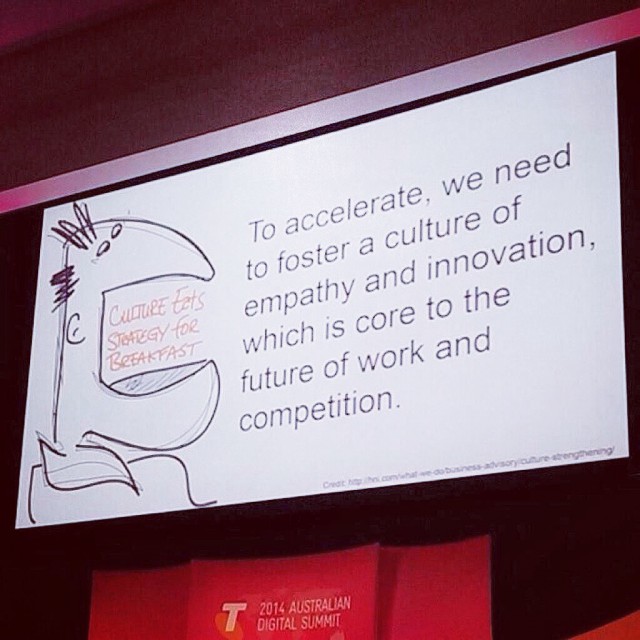
This was the focus of David Thodey’s opening address, a panel discussion on ‘working in start ups vs corporates’ and digital evangelist Brian Solis’s discussion on ‘approaching a digital future with an analog mindset’. The key line stringing together these segments was ‘culture eats strategy for breakfast’ or put differently – you can make all the strategic choices you want but without broad employee support for those choices, which may represent new ways of working, new incentives and rejection of existing skills, the strategy you set will count for nought.
But what does this mean for incumbent enterprises in the TMT industry like Telstra who are staring down uncertain futures built on offerings which are very different to those that make up the current business model? For Thodey it is very real, noting in his address “if we (Telstra) stay in this current form we will become irrelevant…we need to find ways we can apply our collective knowledge to change”. To add to this, Telstra is clear (as are many organisations undergoing this type of change) that customer centricity is critical you need to “change from the outside in”.
Whilst there is no shortage of rhetoric on the topic, there is a shortage of ‘magic’ solutions to the change required to meet new strategic goals. Below are 3 ingredients I believe need to be in place for cultural alignment to strategy and for change to occur in industries like Telecommunications and Media where there is a shorter change timeline due to disruption (technology or other). These principles drive at the idea that culture is inherently linked to human needs particularly those of safety and belonging:
1) Strategy infrastructure must be in place
Employees need to see (and where possible participate in) that strategy has been considered, debated and choices have been tested alongside the companies best portrait of future business conditions. Sensing and shaping is a key part of strategy which in many companies is performed by the CEO and CFO and strategy functions. Add to this the strategic conversations that happen between those setting and those implementing strategy and you have the basic infrastructure of strategy. Without this in place, particularly in larger companies, the change required to meet future challenges head on has little hope of occurring.
This plays out slightly differently at the smaller end of business scale. An entrepreneur or ‘few’ person company has very specific choices to compete in a market, the agility and small scale culture to match it. Here strategy infrastructure and culture of the company are inseparable. The tyranny of scale increases the risk of the infrastructure being left out or culture being ignored. Famously, the CEO of AirBnB Brian Chesky sent a company wide email to titled ‘Don’t F*ck up the culture’ which was on this very topic. It was titled based on advice Silicon Valley VC Peter Thiel gave to Chesky as company has entered more markets and received over $150m in funding.
2) Make the burning platform real for all employees
Reasons to change can often seem very distant particularly if you are at the coal face of a large organisation. The implication of a broad technology change or business model change may be far removed from the day job of the employee. Helping employees understand the implications of future business environments and choices that the enterprise is taking to compete and win requires leadership, communication and embedding strategic thinking into as much of the organisation as possible.
A large company that does this is GE. They use a process of innovation to inspire change in employees. Top talent are trained on innovation process and incentivised on new business model creation. With this model leaders and employees are forced to explore the consequences of the futures they will operate in. It is here that a burning platform becomes real.
3) Challenge the old and protect the new with the right incentives
In many cases moving to a new future will mean the death of currently very profitable business models. The challenge is to reinvent the core operations without betting the company. Incentivising staff to challenge the current business model (e.g the way money is made, the products and features offered, services, policies and processes) whilst allowing new businesses better suited to the future to thrive will support a culture that is prepared for the future. This includes for example, rewarding staff for revenue/earnings from new business, process efficiency/automation of core operations, CSat on new vs old products and channels and time spent by employees making vs operating. Career progression should also be structured around these incentives to ensure talent can see opportunities in the core as well as the new operations (i.e don’t put the C team on new business model generation).
A panel discussion at the Telstra Summit mulled over this idea with the ED of Digital at Telstra commenting “we recognise we destroy everything we buy”. Whether or not this is entirely the case, it points to the difficulty of challenging the old and protecting the new. Whilst not going into specifics around incentives, the conclusions of the panel were that you can’t build a new future on old technologies, digital is not enough; it must be customer centric and culture must be based on trust not control – agreed.
These ingredients send cultural signals to employees. In effect, by having these in place it is reinforcing a common understanding of how and why (tough) decisions are made in the enterprise. They show that the enterprise’s future is being sensed and choices are being made within that context, they show the possibility of new realities in the employee’s world and they balance the acceptance of new business models while maintaining a profitable core. Culture may eat strategy for breakfast but that doesn’t mean cultural alignment to strategy cannot occur… even if it takes time.