
What Anthropic’s research suggests about broader accountability, scalable expertise and the next operating model.
At a US firm, an accountant used AI to develop a prototype for auditing retirement contributions, work that had previously taken 80 hours. His colleagues were impressed. Months later, the application was still not in use: an external vendor needed to turn it into a production system.
There’s something revealing about this example. The accountant had found a way to automate a difficult piece of work, but the organisation couldn’t yet absorb the improvement. The constraint had shifted from producing the software to putting it to work.
It’s one of many examples in Anthropic’s new study, Working with AI. Published on 23 November 2026, the research draws on 66 interviews across 58 US businesses to examine where AI is creating value and how work is changing around it. The companies were Anthropic customers, selected for variety rather than to represent the wider economy.
I recently argued in The Job Is the Wrong Unit of Design for Agentic AI that the traditional job bundles execution, expertise and accountability in one person. AI allows us to separate these elements, raising questions about how work should be organised.
Anthropic’s findings suggest an interesting consequence. As the execution of individual tasks becomes easier, some businesses are giving people responsibility for more of the outcome. The work becomes more granular; accountability can become less fragmented.
When productivity gains get stuck at the hand-off
The researchers examined nearly 300 AI applications described in the interviews. Those associated with higher reported value also tended to involve more substantial organisational change. Anthropic’s Figure 1 shows a positive correlation of 0.39 between the two.
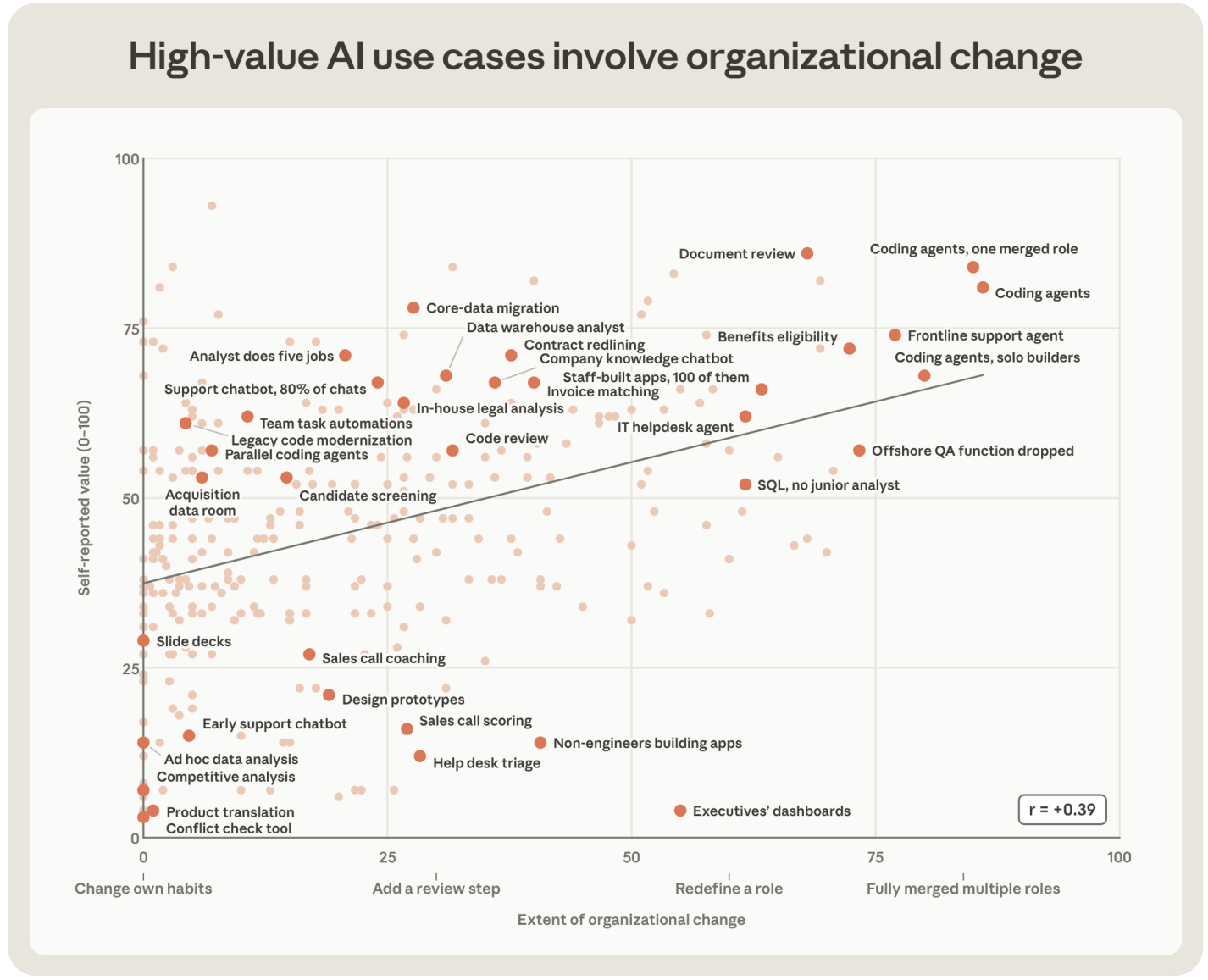
The finding is suggestive rather than definitive. Some businesses changed their processes to make AI useful; others reorganised after an application proved successful. The researchers did not independently measure the financial return of each deployment. Nevertheless, the pattern helps explain why faster tasks don’t automatically produce a faster business.
Consider software development. Coding agents can greatly increase the amount of code a team produces, while product decisions, review, testing, security and release management still take time. The constraint has moved. Accelerating the first activity can simply create a queue at the next one.
The same applies to marketing. If a team can generate 50 campaign concepts instead of five, someone still needs to decide which are worth pursuing, secure funding, assess brand and legal risks, and learn from what customers actually do. More options are useful only if the business can make better decisions about them.
Anthropic also found that interviewees more often described AI value in terms of increased output than reduced expenditure. Among applications for which the researchers classified an outcome, 55% were associated with more output and 19% with cost reductions. Other applications benefited employees directly (7%) or were not yet delivering value (19%). These are proportions of coded applications, not shares of economic value.
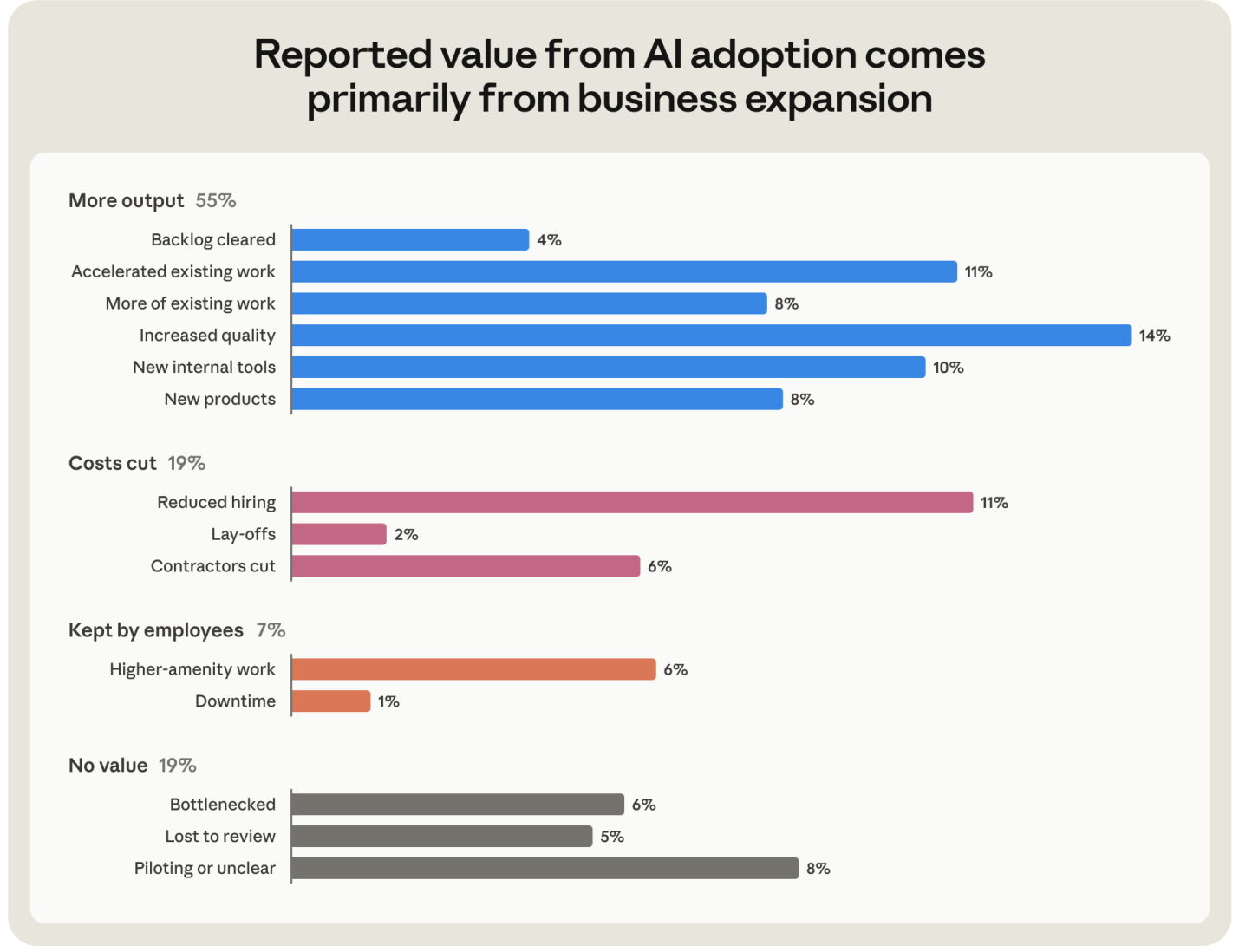
There is an important economic distinction here. Reducing the cost of a task is different from improving the value of the outcome it supports. A faster network diagnosis matters if it restores services sooner. A quicker sales proposal matters if it helps win, serve or retain a customer. In both cases, the critical measure sits beyond the individual task.
The value of knowledge depends on how far it can travel
This raises a second question that I think is missing from many discussions of AI productivity: how much is the underlying knowledge worth, and how widely can it be used?
There are at least three economic considerations. First, the value of the outcome: some activities have trivial consequences while others affect millions of dollars of revenue or a customer’s safety. Second, the volume of work: saving five minutes once has little value, but saving it across a million customer interactions can be material. Third, the reuse of expertise: a method developed for one problem may help solve many different problems.
That third category is particularly interesting. Consider a network engineer who has developed a reliable way to diagnose a recurring fault. Historically, that expertise might be applied by the engineer and passed informally to colleagues. If it can be codified, tested and made available to agents, the method could be used across network elements, operational teams and other workflows, without the engineer having to participate each time.
The diagnosis itself might save only a few minutes. Its cumulative value could be substantial. And the same method might support proactive maintenance, customer assurance or capacity planning. The skill has become more valuable because it travels.
Contrast that with a decision about restoring a major fibre route during an incident. It may be exceptionally valuable, but also highly dependent on current network conditions, contractual commitments and the consequences of a wrong choice. An agent can assemble the evidence and recommend options. The accountability for an irreversible action is another matter.
So the most valuable work is not necessarily the most repeatable, and the most repeatable work is not necessarily the most differentiated. This is why an inventory of tasks alone is an incomplete guide to where an enterprise should invest in AI.
Anthropic’s interviews offer an early view of what makes expertise reusable. Individual employees were building useful tools, but those tools often remained local. Firms that developed shared data and infrastructure gave more people the ability to apply capabilities across functions. The study did not quantify the economic returns to a reusable skill library; that is an inference worth testing.
It also comes with a risk. A codified rule that is wrong, outdated or stripped of important context can spread an error at remarkable speed. The more widely a skill is deployed, the more important its evaluation, ownership and maintenance become. Scaling knowledge requires discipline as well as technology.
The unexpected return of the generalist
For much of the last century, companies have pursued productivity through specialisation. Work was divided into functions and increasingly narrow roles. People became expert at their part of a process, while organisations added managers, hand-offs and controls to connect the parts.
AI may change that balance. Anthropic describes businesses combining responsibilities that previously sat in separate jobs. One company was bringing lead sourcing, account-executive work and customer success into a single role responsible for the customer lifecycle. Others were asking engineers to take on elements of product management, design, development and quality assurance.
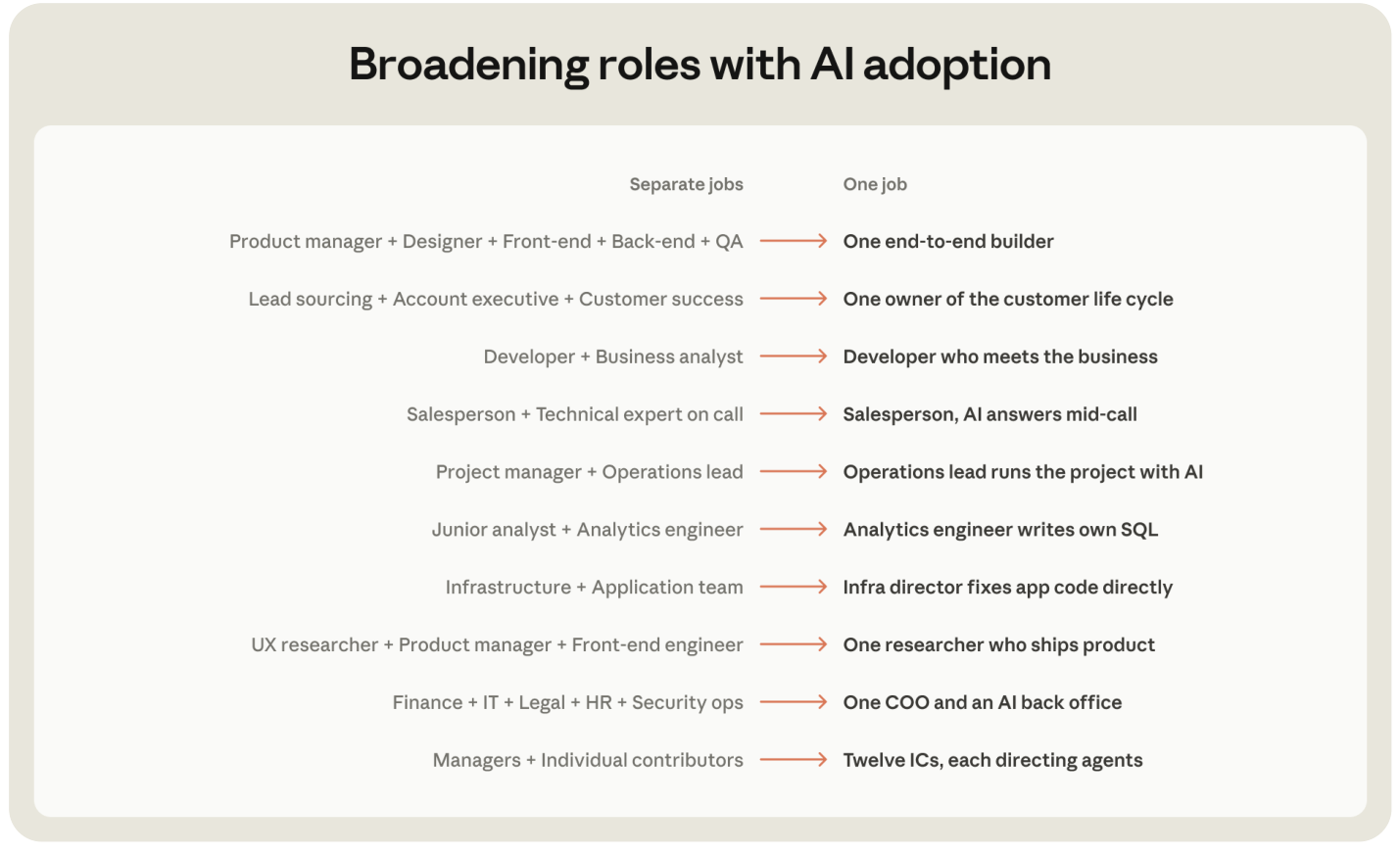
This doesn’t mean the return of an all-purpose employee expected to be good at everything. Specialist knowledge still matters, particularly where mistakes are costly. But a person supported by specialist agents can potentially own more of an end-to-end outcome without personally executing every step.
An engineer might spend less time writing routine code and more time understanding customers, choosing what to build and ensuring it works. A commercial executive might manage a relationship from the initial opportunity through delivery and ongoing service, drawing on agents for analysis, proposals and administration.
As the cost of specialist execution falls, handing work between separate teams can become the expensive part of the process. The organisational opportunity is to unbundle the work while rebundling responsibility around the outcome. That could support smaller multidisciplinary teams with clearer ownership and greater freedom to act.
The agent is ready. Who can decide?
The Anthropic study includes a law firm that built an AI-supported process for checking prospective clients for conflicts of interest. The tool was developed quickly and could route requests through existing systems. But it surfaced complex conflicts that the conflict-checking staff were then expected to handle, when they had previously passed such cases to attorneys. Staff resisted, and the project was shelved.
The technology changed the work without settling who was equipped and authorised to make the next decision.
A similar problem is easy to imagine in telecommunications. Take a complex enterprise network order involving sales, solution design, product management, engineering, delivery and billing. Agents might draft the proposal, validate configurations, check commercial terms and prepare provisioning instructions in a fraction of the time.
But what happens when the proposed solution breaches a product rule, creates a delivery risk or requires an exception to the commercial model? If three functions still need to negotiate who can approve the change, the work reaches the same bottleneck faster.
Giving one individual or small team responsibility for the customer outcome could remove much of that coordination, provided the team has explicit decision rights and clear limits. Significant safety, technical or regulatory choices would still be escalated to the right specialists. The point is to make those boundaries deliberate, rather than requiring a committee for every exception.
This is the difficult part of organisational redesign. Leaders need to decide who may act, on what evidence and with what accountability. An AI agent cannot settle those questions on their behalf.
Between central control and a thousand experiments
Anthropic describes the limitations of two common deployment strategies. Top-down automation can improve well-defined processes but provoke resistance when employees fear their own expertise is being used to make them redundant. Bottom-up experimentation can unleash useful innovation, yet an individual who builds a promising tool rarely has the authority to change the work of several other teams.
The researchers found repeated bottlenecks around reviewing AI output, employee adoption, missing context and supporting software built by nondevelopers. Figure 4 records how often such issues were identified in interview discussions. The largest counts related to too much output for people to check (49) and the need for expert review and testing (42); resistance to AI use also appeared frequently (43). These are coded mentions, not population-level percentages.
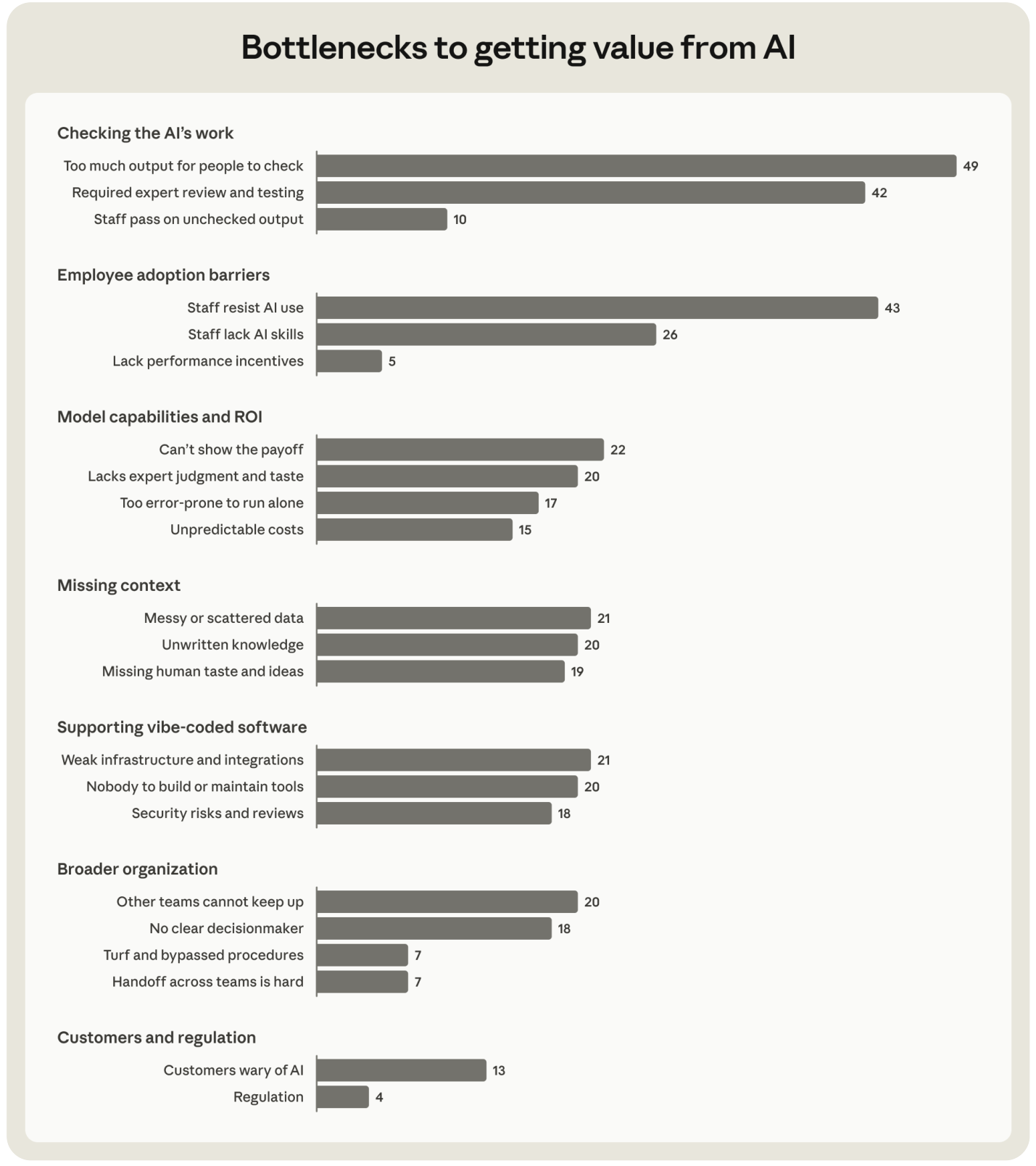
The organisations making better use of AI need more than agents and enthusiastic employees. They need trusted data, reusable skills, evaluation mechanisms, clear permissions and people who can resolve cross-functional decisions. Centrally provided infrastructure matters because an organisation cannot ask every domain expert to build and maintain their own secure production software.
At the same time, the people closest to customers and operations must have some authority to redesign the work. Otherwise they can automate their own activities while leaving the broader process untouched. That is why AI deployment increasingly becomes a question of operating model design.
People need a reason to give away their best methods
There is an uncomfortable human complication. The knowledge needed to make agents useful often belongs to people whose roles the technology may change. We ask them to codify their methods, explain the exceptions and help train the systems. Why would they do that if the immediate reward were a smaller job or a less valuable position?
One paralegal in Anthropic’s study initially refused to share the prompting methods that had made his work unusually effective. He saw them as a personal advantage. He later took on a wider responsibility for supporting AI adoption across the firm. The business gained access to expertise that might otherwise have remained private, while his contribution became broader.
The employment findings deserve care. Only two of the 58 interviewed companies described AI automation fully eliminating a position and leading to a job loss. Yet roughly two-thirds reported hiring less because of AI, and nine described cuts to contracted work, including some offshore services. This is a selected set of Anthropic customers, not a representative labour-market sample. It does, however, suggest that changes in workforce demand can appear in vacancies never opened and contracts not renewed, well before they appear in headline redundancy numbers.
The incentives need to change with the work. People should be recognised for creating methods others can reuse, improving outcomes across functions and taking ownership of more complex decisions. We also need to think carefully about apprenticeship. If juniors no longer perform the routine tasks through which previous generations developed judgement, organisations will have to create other ways to expose them to real decisions and their consequences.
The next bottleneck is already forming
AI models are improving too quickly for a single fixed operating model to remain useful for long. As coding accelerates, testing and product choices become more important. If those improve, customer understanding, delivery or commercial decisions may become the next constraint. A redesign that solves yesterday’s bottleneck can quickly reveal another.
I think the more durable capability is an organisation’s ability to keep reallocating work. That requires a clear map of capabilities and workflows, a way to codify and validate reusable expertise, and explicit human ownership of outcomes and decisions. It also requires managers who are willing to move authority and resources when the economics change.
Anthropic’s evidence is early and largely qualitative. We should test whether these approaches outperform task automation alone, and whether the costs of shared infrastructure and governance are justified by reuse at scale. But the direction is compelling: tasks can become smaller while the scope of human responsibility grows.
In my previous article I asked whether we would design the same jobs if we were starting again with AI. The more immediate question for leaders may be this: when AI gives someone the capacity to own more of an outcome, are we prepared to give them the authority as well?
References
- Wilmers, Nathan, Maxim Massenkoff and Peter McCrory (2026), Working with AI, Anthropic, 23 November 2026. https://www.anthropic.com/research/working-with-ai
- Corbett, Peter (2026), The Job Is the Wrong Unit of Design for Agentic AI, Strategy4TelcoMediaTech, 20 November 2026. https://strategy4telcomediatech.com/2026/11/20/job-wrong-unit-design-agentic-ai/


Leave a Reply