Tag: apple

  • Internet Trends 2018 – Highlights

    Internet Trends 2018 – Highlights

    The ‘Mary Meeker’ Internet Trends report is something I look forward to every year – Not just because of the interesting insights about the connected world but also just the sheer volume of powerpoint used to show these insights. This year’s report is 296 pages long, down from 350 pages in the previous year, but still presents a bit of challenge to distill all the insights. Luckily, I have done this for you in this post where I tease out the most interesting highlights from the report. That said, if you have a spare 2 hours, I suggest taking the time to read through the full presentation.

    On to the highlights:

    Global smartphone shipment growth has decreased to effectively nil (pp. 6)

    This may not be a surprise to anyone. As smartphone penetration reaches saturation in mature and now developing markets, shipments of new devices are in decline. Globally, ~1.4Bn smartphones are shipped per annum which has been the case for the last 2 years. The majority of these are still Android devices with iOS making up the balance. Interestingly, ‘other’ operating systems (e.g. Windows etc.) have declined to near obscurity in the last year. Outside of saturation, another big driver of the decrease in shipments is elongating replacement cycles (2-3 years). If this continues I suspect we will see negative growth in the next year, possibly in double digits.

    Internet user growth has also slowed to about 7% in 2016, down from 12% in 2016 (pp.7-8)

    Global internet users of 3.6 billion surpassed half the world’s population in 2018. With penetration reaching this level it is likely that double digit growth will be hard to find. The report also outlined the growth in Wifi – There are around 450 million wifi networks in the world, up from about 100 million five years ago. Cheaper devices and new access points should help Internet user growth, but this likely to be gradual over the course of the next decade.

    Internet growth is slowing but usage is increasing with the average adult spending about 6 hours per day with a digital device (pp.11)

    This is a trend that we have addressed in our Mobile Consumer Survey and TMT Prediction reports. The average smartphone user looks at their device over 50 times a day which may seem a lot, however our smartphones have become the ‘swiss army knife’ of the digital age taking in functionality previously reserved for other devices (e.g. TV, iPod, Calculator, Watch, Heart Rate Monitor, Measuring Tape etc.). Usage is likely to grow with the increasing ‘usefulness’ of digital devices in all aspects of our lives. Combining the slowing growth in internet take up and the increase in internet usage across devices, internet organisations will be battling more for user time on their service vs new users in the coming years to continue to achieve high growth rates.

    There are more than 30 million Amazon Echo devices in users’ homes, up from about 10 million at the end of 2016 (p.26)

    Voice-controlled products are taking off (e.g. Amazon Echo). The Echo’s install base in the U.S. grew from 20M in the third quarter of 2017 to more than 30M in the fourth quarter. This is combined with the number of ‘skills’ an Echo can now perform being close to 30K which has almost doubleed in a year. Unfortunately the report did not give a clear indication of who is winning the battle for the home but there are estimates that the global install base for all home devices will be ~60M by end of 2018.

    Roughly 13% of all retail sales come from e-commerce, up from about 5% a decade ago (pp.44-47)

    I was initially surprised by this figure having worked with organisations who generate over 25-30% of sales online. However, it does speak to the disruption of physical channel and call centre sales which has had a relatively ‘long fuse’ in the era of digital disruption. It is also localised with the US perhaps trailing behind other parts of the world in this trend. The report outlines that E-commerce sales growth is continuing to accelerate – growing 16 percent in the U.S. in 2017, up from 14 percent in 2016. Amazon is taking a bigger share of those sales at 28 percent last year and on the other hand physical retail sales are on the decline. In the section on China, Digital sales are ~20% which speaks to growth of services like Tencent and WeChat providing integrated e-commerce experiences.

    Tech’s influence on the world and the share of wealth is ever increasing with Tech companies rising to 25% of the market cap of the MSCI (pp.39-42)

    There is a really interesting section in the report on the comparison of tech companies to other listed companies. One indicator of tech’s influence is that tech companies account for six of the top fifteen R&D and Capex spenders in the U.S with Amazon, Google Alphabet, Intel, Apple and Microsoft in the top five slots. These companies, including Facebook, are the fastest growing spenders on that list. At an industry level, tech companies versus other industries (e.g. health, industrial products) in the United States, tech companies are the largest and fastest growing R&D and Capex spenders – this is not a bubble.

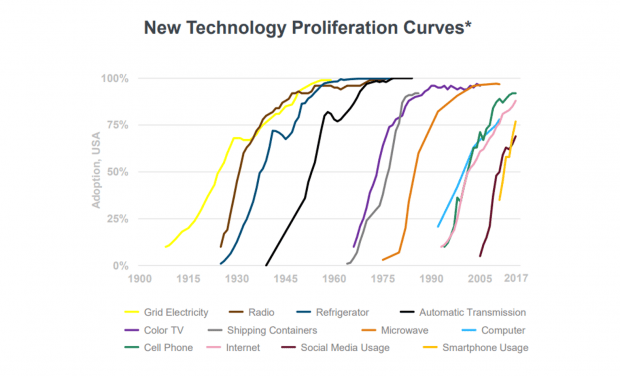
    The speed of technological disruption is accelerating – For example: Adoption of consumer internet took ~10 years, the dishwasher took 80 years (pp.142-165)

    The report looks at tech’s influence on the US economy and jobs. There are some excellent charts showing the adoption cycles of different household goods and the speed of adoption for each decreasing over time. There is also some interesting analysis of the affect of tech on the type of jobs people have. One chart shows the decline in ‘locomotive’ jobs at the same time as the growth in airline jobs (p.149).What I gathered from this section is that in this age we should expect that jobs will shift from structured full time ‘9-5’ arrangements to more on-demand and internet-centric work – there are about ~6M on demand works in the US which is up ~23% YoY (p.165).

    China is achieving relevance and growth in global technology (pp. 237-261)

    China is now home to nine of the world’s 20 biggest internet companies by market cap while the U.S. has 11. If you go back 5 years, China only had two and the U.S. had nine. There are some major trends supporting Chinese tech growth which are called out in the report:

    • E-commerce sales as a percent of total sales, at 20%, highest in the world and the fastest growing
    • Mobile internet users are now 753M (8% growth) and data usage is accelerating, 162% versus 124% in the previous year
    • Mobile video entertainment time is now 22% of all time spent online up from 13% in 2016 with short form video experiencing the most growth compared to long form and gaming
    • Mobile payment volumes are accelerating up 207% YoY vs 116% in the prior year led by Alipay and WeChat
    • On demand transport (car and bike) is up 96%

    The annual Internet Trends report is a rich library of interesting statistics about how our world is changing with the adoption of the internet and new technologies. The items covered above are the highlights I took from the 296 pages (I’ve left out a few sections including the ones on data privacy and big data/AI) but I encourage you to flick through the sections for a more detailed understanding of the trends covered in the report. Until next year!


  • The state of mobile in Australia: Highlights and implications from Deloitte’s Mobile Consumer Survey

    The state of mobile in Australia: Highlights and implications from Deloitte’s Mobile Consumer Survey

    2017 marks the 10th anniversary of the iPhone. Reflecting on the decade past, it is clear that Australians have enthusiastically embraced the smartphone and its many uses with consumers and businesses being the beneficiary of this era-defining technology. As mobility continues to mature beyond today’s smartphones into new more powerful devices or the mass adoption of wearables and drones it is important for businesses to stay across the trends in mobility and their implications for product strategies, innovation, customer experience, content and operations.

    Deloitte’s Mobile Consumer Survey, now in its fourth year, is a multi-country study of mobility around the world. The 2017 study comprises more than 51,500 responses across 33 countries. The Australian edition is based on 2,000 national responses from consumers aged 18-75 polled during May and June 2017. Special mention to the team that prepares this report in Australia led by Jeremy Drumm, Nick White, Morne Swiegers and Maggie Davey.

    This post draws out a number of the key findings from the 2017 Australian edition of Deloitte’s Mobile Consumer Survey and the implications for Australian businesses. The full report is insightful for those in leadership and management roles in Australia’s carriers/operators, RSPs or businesses looking to further understand how to capture the value of mobility to their organisation.

    ‘Silver surfers power smartphone swell’ (p.7)

    It may come as no surprise that smartphone ownership is on the rise for older generations – 78% of 65-75 year olds now own a smartphone which is up almost 10% on last years’ figure. With the decommissioning of the 2G network a portion of the population have left behind their feature phones and in 2017 88% of Australian’s own a smartphone. It is expected that in the coming 18 months 90-95% of Australian’s will own a smartphone as older generations continue to adopt and embrace this technology.

    Implications

    We are reaching saturation in smartphone ownership which means device manufacturers will need to continue to innovate to profit from replacement/market share vs growth from new adoption. For businesses looking to reach older generations, now is the time to seriously consider the mobile experience (sales/service) for the elderly.

    ‘A slice of Apple’s pie’ (p.8)

    Australians are Apple and Samsung junkies. We have the second highest % penetration of Apple and Samsung smartphones in the countries surveyed at 75% – only Luxemburg at 83% is higher. Interestingly, Samsung’s share has increased slightly YoY and Apple’s share has decreased by 2% all in a period which included the Galaxy note safety recall. The data in the survey correlates to users of Samsung Galaxy (S6-8) and iPhone (6-7) models. It will be interesting to see the change in next year’s data with the iPhone X (most expensive smartphone ever) and SIM enabled watch (Do i still need a smartphone?) adding new dimensions to smartphone ownership.

    Implications

    Australian’s are clearly premium smartphone buyers but we can expect the ~$AUD 2,000 iPhone X test Australian’s love for the brand as well as the growing number of competitive (tech and $ price) Android devices (e.g. Pixel 2, Huawei P10). I suspect this mix to change again next year perhaps with the non-Apple/Samsung smartphone brands gaining more mind and wallet share.

    ‘Demanding data divas’ (p.13)

    Australians are purchasing more data in 2017 than ever before – 60% of Australians now have a data limit 3GB or higher. Interestingly, those that have between 3-5GB plans are 2x more likely to exceed their data limit than those with 500MB or less. The report estimates those who exceed their data collectively to pay close to $30M per month or $313M per year for extra data.

    Implications

    Australians are data hungry. This is following a growing trend seen around the world. The obvious long term implication is that the operators that can provide the most data at an affordable rate will win and already a number of global carriers are offering unlimited plans. Operators will need to look to improve their cost base in order to remain competitive in an unlimited world. Equally, customer experience will begin to play more of a role as operators try to maintain quality connections across their network.

    ‘WiFi wins…this round’ (p.19)

    Australians are more likely to connect to WiFi in 2017 than 4G despite 86% of people being on 4G. This is believed to be the result of the current cost of mobile data plans rather than connectivity needs (e.g. speed) – only 40% of consumers identified that 4G is faster than their home speed.

    Implications

    This WiFi vs Mobile connectivity is a hotly debated topic in Australia currently. The reality is that it is more likely to be complementary rather that one replacing the other. The introduction of devices like ‘hybrid’ modems and ‘broadband plans’ to households are likely to reduce consumers concerns over the utility of one network or another. Bottom line, consumers and businesses want to be connected and to be able to access content, technology and services – in a world of ubiquitous connection, the type of network a consumer connects onto (e.g. WiFi, Mobile, Mesh) will likely be an afterthought.

    ‘High street hangs in’ (p.20)

    1 in 5 consumers visited an operator store in the last month and 3 in 5 in the last year. Stores are still important for operators especially for testing physical product and technical support. The cross channel stat – 23% of smarthphones (mostly by 35-44 year olds – 30%) were purchased online but only 3% of these were collected in the operator store – more scope for omni-channel experience.

    Implications

    Face to face and physical interactions with customers are still important particularly for operators – there is value in face to face exploration, sales, service and support interactions. Whilst there is a lot of information online and the channels to service customers the increasing pace of device innovation, new technologies and solutions is creating a complex environment for many to navigate. Stores will continue to deliver value particularly when aligned to a coherent and compelling omni-channel strategy.

    ‘Our homes are getting smarter’ (p.33)

    Ownership and access to connected devices in the home is on the rise. In the last year there have been increased purchases of cameras (9%), connected car systems (8%) and connected home appliances (5%). The popularity of home security systems seems to indicate consumers value connected home devices for increased security and convenience. There is also a clear preference for devices that are easily self-installed such as smart lighting.

    Implications

    These findings indicate that in the short to mid term bets in smart home IoT are best placed on products that have a clear customer benefit, short replacement cycle and are easily self-installed. More complicated home device set ups will require support to enable. Operators looking to provide consumer IOT solutions need to look carefully into the set up and support model (and cost) as part of the business case for mass-consumer IOT installations.

    ‘Seamless shopping on the go’ (p.44)

    Mobile payment solutions are up 14% from 2016 with over 25% of respondents suggesting they now use the mobile payment solutions. Pay Pal has taken a hit in this survey which is likely due to the fact that tap and go payments from the iOS app. Apple Pay is therefore increasingly popular accounting for 18% of mobile payments nudging out Samsung Pay at 12%.

    Implications

    There is still room for growth in mobile payments in Australia with solutions going beyond early adopters. There is increasing value in developers creating seamless experiences combining mobile applications and payments for fast purchasing on the go. App developers and online channels should look to include mobile payment options online and retail stores should look to include tap and go options where possible in the next 18 months.

    The bottom line

    Australian’s are high on the adoption curve for smartphones globally, we are consuming more data now than ever and we are using our devices everywhere and at anytime. Devices are becoming more innovative some innovations are getting our attention like fingerprint security (35% increase on 2016) and mobile payments (25% increase on 2016) but we still don’t care much (yet) for voice assistants.

  • Apple: The X Strategy

    Apple: The X Strategy

    In Apple’s most recent keynote on September 19th, the company announced the launch of a new generation of iPhone (the iPhone X) at the same time as upgrading their existing iPhone range with the iPhone 8. Underlying this move is an interesting strategy that I will investigate in this post focusing on how the iPhone X has (yet again for Apple) created segmentation in the market for an iPhone, the brand strategy underlying the X and how the launch of the X is a sign of the maturity of the mass production of smartphones and Apple’s response.

    Segmenting the iPhone market

    This is not the first time Apple has offered different types of iPhones in parallel with an upgrade to the existing model but it is the first time Apple has announced a more expensive, new design and a ‘full number’ upgrade at the same time. In 2013, the introduction of the 5C at the same time as the 5S or the introduction of the iPhone SE are examples of previous attempts to segment the market. In these instances the iPhone 5C, with an iPhone 5 design and plastic casing but iPhone 6 components, was a way for Apple to sell ‘no frills’ iPhones to more price-sensitive customers – thus segmenting the market at the ‘lower end’. In a similar vein, the iPhone SE allows people who want a decent iPhone to get one without paying top dollar (an upgrade on the 5C). This is particularly relevant to markets like China and India where the Apple brand has prestige but the price tag can be a barrier.

    The iPhone X represents a segmentation at the top end. It sells to two markets:

    • Those who want the most ‘prestigious’ phone on the market
    • Those who want the ‘newest’ and the ‘best’ phone

    The announcement of the iPhone 8 at the same time as the X is a new strategy which will test the strength and size of these markets for Apple. Some who would typically fit in these cohorts may opt for the iPhone 8 for a ‘good enough upgrade’ at $300 less, making the buyers of iPhone X relatively small. Apple’s first quarter results will show the outcome of this segmentation approach.

    iPhone X as a luxury brand

    The iPhone X will be the first smartphone to retail at USD$1000 – a premium pricing strategy. This is interesting strategically for two reasons. Firstly, over the past 10 years Samsung and Chinese device manufacturers like Huawei/LG have caught up to Apple in terms of design and technology. Their current smartphones have ~90% the same components/features (e.g. facial recognition) but for 30% less. Granted, Apple’s software/hardware integration may be worth a premium but this is an example of a strategy pushing for ‘good enough’ innovation at a premium price.

    Secondly, luxury goods are a comparatively faster growing market globally. In a recent Deloitte report Global Powers of Luxury Goods 2017, Deloitte highlights that luxury goods growth year on year is 6.8% with a CAGR of 5.2% (2013-2015), compared to a global rate of all goods of 1%. Entering the ‘luxury’ market for Apple and differentiating from its previous iPhone models is following the growth in this segment. In executing on a luxury strategy we may see Apple place more emphasis on marketing versus its core of product design.

    The iPhone and mass production

    A famous HBR case is that of Ford vs GM and the competing approaches to mass production (cost optimisation vs. flexibility). In short, Ford’s Model-T earned them the status of the dominant car manufacturer of the first three decades of the twentieth century. However, Ford’s focus on cost minimisation also led to inflexibility, allowing other manufacturers like General Motors to compete with newer designs and incorporate changing technology. The parallel here is that like Ford’s Model-T, iPhone design hasn’t changed greatly in the last 10 years. This has likely meant greater cost optimisation in Apple’s supply chain. The iPhone X represents a break away from cost optimisation with a new design (e.g. OLED Screens, edge to edge, new configuration of chips and cameras, ‘the notch’) meaning that Apple will likely oversee multiple supply chains for smartphone devices. This could be seen as a strategy to counter strong competition (i.e. the General Motors) from other manufacturers (e.g. Huawei and Samsung) which have multiple device designs in the market and could more easily adjust to changes in technology.

    At the macro-level, another ~1.7bn smartphone shipments are forecast by 2020. Some of these will be first time buyers of a smartphone whilst many will be replacements. Through its iPhone X strategy, Apple will hope to make millions of customers luxury device owners while also enticing those who might have settled for an SE or equivalent, the proud owners of an iPhone 8. A good test of this strategy will be to see whether next year, come September/October, Apple launches an X2, an 11 and/or a 9.

  • Apple’s WWDC and the state of today’s consumer tech battlegrounds

    Apple’s WWDC and the state of today’s consumer tech battlegrounds

    10 years ago Apple launched the iPhone, a product that has been at the forefront of the growth in mobility globally and an icon of the digital era – a major consumer technology battleground. The iPhone has positioned Apple as a leader in the Telecommunications, Media and Technology ecosystem along with its other offerings like the App Store, Apple Music, Apple TV, Watch and other devices.

    At the recent Apple developer conference last month (WWDC) there were a number of major software and hardware announcements made. Apple often uses the conference to showcase new products or product features as well as excite the developer community on how they might build (apps/services) on top of new hardware and software. Watching the event, I could not help but think about the messages of the announcements and what they say about Apple and the position of other players in the key consumer tech battlegrounds of today.

    This post outlines the some of the most interesting battlegrounds in consumer tech at the moment and what Apple’s messages at WWDC say about the competition for these domains.

    Battle for streaming: Winning in TV media is all about content (still)

    The first announcement of the conference was about Apple TV and the news that Amazon Prime Video will be available on Apple TV. This says a lot about the nature of streaming video/TV on demand and Apple’s role. Winning in this medium is not about the hardware or the software or even the integration of the two, it is about content which is something (at least in TV content) Apple has not been investing in at the scale of Amazon, Netflix and HBO.

    Battle for new content: Podcasts are growing in popularity for customers but not yet for advertisers… or Apple

    Apple announced iOS 11 their new smartphone operating system which could have made up the entire keynote itself. One of the features of the new OS is an improved podcast app allowing for greater functionality for users and analytics for podcast publishers. This addition speaks to the growing popularity of podcasts as a medium for Apple users and the growing demands of publishers. Despite growing over the past 5 years, podcast revenues are small compared to other content at ~$220M. This is relatively small if compared to other ad revenues Apple could be tapping in, which partially explains why podcasting has received little attention until now. Perhaps the changes Apple makes will increase the commercialisation of the content (e.g. visibility of listens, content changes).

    The battle for the assistant in-home: Apple vs Google vs Amazon

    The announcement of Apples’ Homepod has stolen a lot of the limelight post event with much excitement from techies and audiophiles alike. Like Amazon’s Echo and Google Home, Apple is now launching its own (belated) take on the home assistant. The focus of Apple’s unveiling of the Homepod showed how much ground Amazon and Google have made with their assistant products versus Siri with Apple making a big deal about the audio quality of the Homepod speaker firstly, the quality of the assistant (Siri) secondary and the price thirdly (>$100 more than the Amazon and Google assistant). If Amazon and Google have changed the game on Siri with the concept of the home assistant, Apple is trying change the rules by making the quality of the speaker the most important feature of the in-home assistant. It remains to be seen how many people need a home assistant and for Apple, one with an impressive speaker.

    The battle for the assistant on your wrist: Apple vs Google vs Amazon

    Siri also featured in the watchOS announcement with the introduction of the Siri watch face. This implies a broadening of the scope of Siri from voice commands to context based assistance when you need it. This may sound very similar to Google Now launched a few years ago the difference being that it is play to Apple’s main advantage over Google – integrated software and hardware. Google Now requires a different watch and phone entirely but Apple has this functionality on an increasingly popular watch that works natively with an iPhone.

    These consumer tech battlegrounds are interesting for the same reasons that the smartphone was 10 years ago (and continues to be) with the introduction of the iPhone. It is fair to say that the need for a home assistant or an assistant on your wrist is still not as great as the need for a smartphone, however how these battlegrounds change and the basis of that change will be of interest for the coming decade.

  • Technology and ‘me too’ strategy

    Technology and ‘me too’ strategy

    One of the strategy trends in technology that I find most interesting is the one of copying well – often known as ‘me too’ strategy. Technology innovation moves so quickly that companies are often left behind in the wake of technological change. However, technology in many cases can be easily copied and companies that follow well are often rewarded. In the short term the best ‘copy cats’ may not be the largest player in the market, however, they are often a close second. Equally, over time the ‘me too’ company may overtake the first to market by out innovating the company they began to copy in the first place. On the other hand, there are also some notable failures in ‘me too’ strategy in tech.

    The theory…‘Me too’ strategies tend to be deployed when there is a product that has successfully found ‘product market fit’ and where barriers to entry are low (i.e. copying the technology is sufficiently easy). It typically follows that a company introduces a new technology or product which is taken up by early adopters. As it crosses the ‘trough of disillusionment’ and reaches mass market, the copycats pounce to make their mark in the expanding market. ‘Me too’ entry at this stage is a much faster route to market than being a first mover.

    As more companies digitise, ‘me too’ strategies it can be argued, should be considered by more than just pure technology players. This article looks at 2 examples (one hardware, one software) of tech companies employing ‘me too’ strategies and the lessons learned for others looking to do the same.

    Microsoft Zune and the iPod

    Almost nobody remembers the Zune. And if you do, chances are you weren’t a ‘pod person’ during the height of iPod fanaticism. Launched in 2006, the Zune was Microsoft’s attempt to copy the success of Apple’s iPod which revolutionised portable music in 2001. Apple had been unrivaled with the iPod for 5 years so Microsoft sort to take a portion of a very large market with its own me too music player. The Zune was pulled in 2009 (3 years after launch) and 2 years into the rise of Apple’s iPhone launched in 2007. At the time Zune had 2% market share of portable MP3 players compared to the iPod’s 75%. The interesting fact was that 25% of the non-iPod market was up for grabs and Zune’s ambition was to take this and hopefully convert a few ‘pod people’ on the way.

    Lessons for ‘me too’ strategies:

    a) Following fast makes a difference: Microsoft was about 5 years too late into the portable music player market. By 2007 it was already developing a replacement in Windows Phone smartphones and the iPhone had started to remove the need for a separate music player device.

    b) Follow fast in a strategic domain: Microsoft at the time was a software company playing in a hardware battle. Pre-iPod touch, portable player software was pretty marginal and Zune brought the benefit of great software to the table. Keeping up with hardware requirements was not Microsoft’s core competency which made it difficult to convert great software experiences.

    c) Make a choice to follow and go hard at it: A few things about Microsoft’s approach to distributing and marketing Zune felt like they were ‘dipping their toe in the water’ – It was was only sold outside of the USA at the end of its life and its marketing was no match for the iPod fanaticism drummed up through clever marketing at Apple or the large effort put into marketing other Microsoft products like Bing or Windows 7.

    Snap and Instagram

    A different type of ‘me too’ strategy is currently playing out between Facebook and Snap Inc. In particular, Facebook’s photo sharing app Instagram is playing ‘me too’ to Snap’s flagship vanishing-messaging app and shows in Snap’s first quarterly earnings. Snap’s first quarterly report since their IPO was relatively underwhelming for low advertising revenue growth QoQ but moreover their lower than anticipated user growth. Snap struggled to maintain strong user growth 5% QoQ and 36% YoY which only just beat Twitter in its first quarter as a listed entity 4% and 30% over the same respective time frames. A big part of this is due to Facebook’s copying strategy. Through Instagram, Facebook has been quick to replicate features on Snap – Stories, interactive filters and messaging. Unlike the Zune example above, Instagram is making a different ‘me too’ play – a defensive one. It already has a 100 million active users (who do the same with Instagram as users of Snap – ‘kill time’) and has just started to increase monetisation efforts through advertising on the platform. With this number of users the strategy here is to not give any user a reason to want to use Snap. For Snap this makes user acquisition (a major determinant of success as a business) just that little bit more difficult.

    Lessons ‘me too’ strategies:

    You don’t have to be the challenger to employ a ‘me too’ strategy – Facebook/Instagram are the incumbent in this situation but it is clear they have kept a keen eye on the innovations made by Snap to messaging, photo filters, stories and advertising. In this case, ‘me too’ is being used by Facebook to protect the core (their network) against the challenger Snap.

    Defending a competitor employing a ‘me too’ strategy against you is hard if barriers to copy are low – In the case of Snap and Instagram the biggest barrier to copying is network. However, Instagram (and Facebook) have one of the largest networks in the world. The only major barrier therefore is software development. This however is a barrier easily overcome with Facebook’s ability to attract talented developers.

    A little more ‘me too’?

    The best copiers in tech (e.g. Samsung, Facebook) appear to have explicit strategic ambitions but use copying as a choice in ‘how they win’ in their chosen markets. Copying well requires the capability to keenly monitor innovations of others and produce (if needed) replicas to defend or grow in a category. With the pace of technological change, it is a wonder why copying well isn’t more prevalent in ‘pure play’ technology companies and those beginning to use technology to support their strategies.

  • Jeff Bezos’s Annual Letter: 3 ‘take aways’

    Jeff Bezos’s Annual Letter: 3 ‘take aways’

    Every year since Amazon’s inception in 1997, Jeff Bezos (founder and CEO of Amazon) has been writing a letter to shareholders. This year’s letter is the 20th edition which makes for an excellent point of reflection for the company that now has US$107BN in annual sales and a market cap of US$296BN just behind Facebook (sales US$18BN, market cap US$312BN).

    The theme of Bezos’s letter could be summarised as avoiding the perils of scale and maturity or ‘avoiding stasis’ which is neatly refered to as ‘Day 2’. He advocates for quick decisions, ‘obsessing on customer outcomes’ and maintaining a continuous state of ‘Day 1’ – the beginning of a company’s potential. This post covers 3 ‘take aways’ I had from the letter.

    The importance of a ‘Day 1’ approach in mature businesses

    Day 2 is stasis. Followed by irrelevance. Followed by excruciating, painful decline. Followed by death. And that is why it is always Day 1

    I don’t believe any business aims to pursue an ambition of ‘stasis’ or ‘irrelevance’. Quite the opposite actually – many strategies ‘aim to win’ in design and execution. So what is Bezos actually talking about here? Having worked with mature businesses as well as companies launching new products/operations there is often a different approach, culture, leadership and mindset at work compared to those that are pursuing scale, standardisation and optimisation. Businesses ‘starting out’ or as Bezos terms it ‘Day 1’ use an approach which is one primarily of experimentation, accepting failures, planting seeds, protecting saplings, and doubling down on customer delight. Outcomes are a major focus for ‘Day 1’ business (e.g. customer engagement, feedback). However, a ‘Day 1’ approach is often given less emphasis as strategy is translated to execution and scale through policy and process. The point Bezos makes is that in the long run, by ensuring a ‘Day 1’ approach is the policy and outcomes are managed (not process), businesses will be able continue to delight customers, stave off competition and avoid ‘painful decline’.

    Avoid having a ‘one-size-fits-all’ decision making process

    It’s important for decision-makers to disagree and commit…”You’ve worn me down” is an awful decision-making process. It’s slow and de-energizing. Go for quick escalation instead – it’s better.

    Bezos makes this point really well. A ‘Day 2’ approach to decision making can be one of analysis paralysis and consesnsus building which may lead to high quality decision making albeit very slowly. Having worked with organisations at both ends of decision making velocity (slow = 18-24mths vs. fast = days or weeks) there is a different culture that aligns to a high-velocity decision making organisation. The primary factor is that each decision should be judged on its merits with the authority appropriately delegated to individuals to make those decisions in a timely manner. Bezos adds a few nuggets here:

    1) 70-90% of information is all you need, any more and your business is likely to lose velocity

    2) Be good at recognising and correcting bad decisions (Amazon did this well with their smartphone product – Fire)

    Day 1 companies embrace external trends quickly – they don’t use words like ‘cannibalisation’… this is a Day 2 mindset.

    The outside world can push you into Day 2 if you won’t or can’t embrace powerful trends quickly. If you fight them, you’re probably fighting the future. Embrace them and you have a tailwind.

    I doubt you will ever hear Amazon talk about a new product or service ‘cannibalising’ their existing business. For that matter you are unlikely to hear this at Apple, Facebook or Google. However, in incumbent organisations this is often the language. In his letter, Bezos talks about embracing external trends, which on face value most business leaders would agree with. Truly embrace external trends may mean giving up some ground on a profitable core business in return for growing new revenue streams of the future – this is the hard part. He also suggests this needs to be done quickly. Working out the balance of core and new business (‘What level of cannibalisation is tolerable?’) can lead to slow decision making by which time a more nimble competitor is taking a lead on the trend and eating away at the core.

    There are so many examples of embracing external trends over fearing cannibalisation – Apple’s iPod vs iPhone is a good one. In the year the iPhone launched (2007) the iPod was 42% of revenue and the iPhone 2.5% – iPhone launched during peak iPod. At latest results, iPhones were close to 80% of Apple’s revenue with iPod now diminished to a button on an iPhone screen. The smartphone was the external trend, which meant ‘cannibalising’ a very profitable and successful business at its peak.

    I won’t be surprised if you haven’t finished reading this blog post and have instead gone straight to reading the letter – it’s a really interesting one. The letter came out a few weeks ago so there are also some interesting points of view on the content. I really enjoyed this article in the AFR on why Australian listed companies may struggle to replicate Bezos’s advice – suggesting that the primacy of shareholder over customer is a balance many Australian companies struggle with.

  • Google & Apple: The New Age of Transformation

    Google & Apple: The New Age of Transformation

    All companies need to transform. Despite their relative positioning in the digital age, Google and Apple are by no means an exception. As the digital era matures (characterised by cloud, social, mobile and data) and the age of exponential technologies ensues (Quantum Computing, AI, Blockchain, VR, IOT etc.), we are witnessing a battle for ascendancy between these two companies and a raft of new-comers. We are also witnessing their transformations.

    I’ve written and spoken publicly about transformation of businesses and I think it is helpful to have a working definition before exploring what is going on at Google and Apple. Transformation is about:

    Continuously evolving the way business is conducted to create sustainable value in response to shifts in the market or operating conditions.

    Both Google and Apple are on similar transformation trajectories despite their very different beginnings and their seemingly insurmountable positions in their respective markets. Apple was created in 1976 with a purpose of ‘making the personal computer ever more personal’ and Google was founded over 20 years later in 1998 with a purpose fit for the information age of “organising the world’s information”. Despite these differences, they both have leading roles in the cornerstones of the digital age – Apple has led the growth of mobility globally through its iPhone and other products. Google on the other hand has dominated internet search as well as other aspects of the consumerisation of the internet (e.g. SVOD, Maps). They are near equals in terms of market value, with Google narrowly nudging out Apple in being the world’s most valuable company in May this year with Apple claiming this title again recently.

    Shifts in the market and operating conditions

    We have just seen the latest quarterly results for Google and Apple and each talk to the shifting nature of the operating conditions facing each company.

    For Google:

    These results were exceptional particularly compared to last quarter’s earnings. It was in last year’s third quarter that Google added additional features to mobile search results, the effect of which may be coming in to play in the 20% increase in revenue it experienced this quarter. The company now controls 95% of the mobile-search market and 78% on desktops according to recent estimates. This is a strong position to be in but it is also points to a fundamental change in their operating conditions. The source of revenue is moving from desktop to mobile and with it the value attached to search advertising. Mobile ads are generally cheaper than desktop ads, so advertisers’ average price for an ad-click has declined as mobile ads have increased. Google said that advertisers’ cost per click decreased 11% in the quarter compared to 7% in the prior quarter. They are balancing mobile’s higher acquisition costs with sustainable advertising revenue.

    To add to this, Facebook’s recent quarterly announcement put a spotlight on the strength of competition Google faces for mobile advertising revenue. Facebook now controls 13% of the worldwide digital advertising business second only to Google at 32%. The future of search advertising is questionable compared to the specificity of Facebook’s ‘graph’. Also, the rise of AI and assistants (e.g. Alexa, Cortana, Allo, Siri) will provide a significant challenge to ‘traditional web-search’. Instead of searching and providing a list of options (paid for or influenced by advertisers), these services will just tell you the answer that is most suitable for you and what it already knows about you.

    For Apple:

    Devices, smartphones in particular, are continuing to play a huge role in our lives but innovation has slowed for the handset manufacturers and upgrade cycles appear to be slowing (although this may also be the effect of pulling forward people who have upgraded). What was interesting from the recent results is that the Mac business for Apple is now more of a side business to its phone, tablet and watch businesses, accounting for ~10% of total revenue. This may well change with the launch of the new Macbook but it also highlights the opportunity and difficulty of being a business primarily focused on product innovation vs. services in the technology industry. Product life-cycles can be fickle and innovations often become incremental (e.g. a slightly new camera) towards the end of a product’s s-curve.

    Apple is entering interesting territory as it searches for the next improvement on the smartphone or the watch (what is more personal than these devices?). It is also up against competition that are using data to make devices even more powerful – something that Apple is working towards with its Siri product but will struggle to lead due to the limited amount of data it captures by comparison to the likes of Google, Microsoft or Amazon.

    Continuously evolving Google and Apple

    Google’s transformation – Edges and ‘Moon shots’

    In August 2015, Google announced a change to become Alphabet which split off the ‘moon shot’ parts of its business from Google to provide structural separation. On the recent earnings call they noted:

    As we’ve frequently noted, our move to Alphabet was motivated by our belief that revolutionary ideas drive the next big growth areas. Long-term success requires a commitment to making bets, putting the right talent and resources behind those bets, and remaining flexible and dynamic as we pursue them.

    As of yet, Google’s ‘other bets’ which is the focus of ‘Alphabet’ have failed to return much to shareholders. The earnings call highlighted that in the case of ‘other bets’ Google last quarter spent more on stock-based compensation ($200 million) than they derived in revenue ($197 million). The recent shuttering of Google Fiber is also another example of a ‘moonshot’ providing dubious value to the company. It is still early days – the bold move to focus on ‘moon shots’ may yet pay off with a big business being born out of one of these bets.

    To its credit, Google has many sustainable growth opportunities, and all of them are on the edge of what Google is uniquely capable of doing (e.g. search advertising) rather than the more risky ‘moon shots’. Selling hardware (like its recent Pixel phone and Daydream VR announcement), developing Google Cloud or building out YouTube Red’s proposition are far less exciting than any ‘moon shot’ but are also a natural evolution from Google’s core search business. Not all of these will succeed (I don’t think Google expects them all to) but they all make sense in the context of Google’s business; most of the ‘other bets’, in contrast, exist only because Google has cash to put toward them.

    Sustainable transformation for Google means finding a balance between evolution brought on by more disruptive ‘moon shots’ (disruptive innovations) and transforming its core business on the edge (natural extensions of its existing business). The moonshots which leverage Google’s assets to a much greater extent, like Google’s self-driving car, provide compelling narrative for the Alphabet business – something Google is keenly aware of for the security of talent and future public funding.

    Apple’s transformation – Products and Services

    In contrast, Apple’s transformation efforts with regards to their product businesses show a tenacity for the company to make new products at the expense of cannibalising existing profitable businesses. For example, the iPod business (its many variations – Mini, Shuffle, Touch) was decimated by the iPhone’s launch and subsequent growth since 2007 and arguably the tablet business has usurped the PC/Laptop business. For Apple, its purpose of ‘making the computer ever more personal’ has meant that these transformations have had strong internal and external narratives which will continue to help Apple transform to support new products (driverless cars, airpods and virtual reality) and customers (B2B segments, emerging markets). However, this is not the major transformation issue for Apple. Rather, Apple’s ability to compete with ‘smarter products’ that use data and link to valuable services is its transformation challenge.

    iTunes and Apple’s cloud offerings are examples of the type of service transformation Apple has been capable of in the past. However, even these services have required their own transformation in the last 10 years with the growth in streaming music and video leading to the launch of Apple Music about 18 months ago and AWS’s dominance of cloud. Siri (Apple’s voice assistant) represents another example of how Apple is looking to bring integrated services into its products. Like iTunes before it, Siri is facing significant competition from other providers (like Amazon and Google) who are able to leverage much larger data sets (e.g. Google’s search database; Amazon’s consumer products database) to make their assistants smarter and more intelligent.

    At the core of these transformations is an evolution in capability. For Apple, it is about adapting and investing in capability that is service (instead of product) oriented and for Google it means applying existing capability to edge businesses or divesting moonshot capability when necessary. These two cornerstones of the Digital Era will continue to provide interesting case studies for how transformation occurs in a rapidly changing world of consumer preferences and technological innovation.

  • The iPhone SE Strategy

    The iPhone SE Strategy

    This past week Apple launched the iPhone SE as well as an updated version of the iPad Pro. Both devices are interesting in their design and construction – the iPhone SE has the smaller design of the iPhone 5 (4″ screen) with the components of the 6S whilst the new iPad has a smaller 9.7” display compared to its predecessor (12.3”), half the RAM and a smaller processor (probably for cost reasons). Design choices aside, the strategic rationale for both devices in particular the iPhone SE was not clear from the launch event. This post will explore the strategic rationale (where to play and how to win choices) and what it tells us about Apple’s approach to the global smartphone market.

    Apple has previously launched ‘scaled down’ and cheaper versions of its iPhone – the iPhone 5C is a case in point. It is tempting to compare the SE to the 5C but it is different…subtle as it may seem on first appearances. The SE is a high-end phone in a slimmed down design for a cheaper price whilst the 5C was an old design (unapologetically plastic) with year-old components for a cheaper price. In fact, Apple published this quote on its website to distinguish the SE from its other smartphones:

    “To create it [the iPhone SE], we started with a beloved design, then reinvented it from the inside out.”

    This description is important to have in mind when making sense of the strategic rationale and the SE’s place in the global smartphone market.

    Today’s global smartphone market

    If you were following the news from the Mobile World Congress recently you would have seen and heard about a number of smartphone manufacturers developing relatively sophisticated devices at a very competitive prices. Xioami’s Mi5 ($550 AUD), targeted at the Chinese domestic market, uses commoditised components to achieve a lower price point for the millions buying a smartphone for the first time. Similarly, UK smartphone startup Wileyfox is offering affordable smartphones for ~$500 AUD reducing the upfront cost for a device which in turn allows consumers to avoid the need for a 2-year lock-in contract with their carrier. These are the offerings defining the ‘low-end‘ of the smartphone market…which is growing and innovating.

    At the ‘high-end‘, Samsung and Apple enjoy healthy competition in almost every major market in the world. In Australia, over 70% of smartphones are either Apple (41%) or Samsung (32%) – this is a very large market for high-end phones driven by carrier subsidies and lock-in contract models. Globally, what sets these two giants apart however is status. Apple, particularly as the brand relates to China’s growing middle-class, is considered a luxury brand (along the same lines as Hermes, LV, Chanel etc.). To own an Apple is on par with owning a $2000 LV handbag (better value if you ask me :)). But what about the ‘mid-market’?

    Extending the high-end

    A misconception that people will have about the iPhone SE is that is targeted at the ‘mid-market’. However, if you believe status is a major driver, particularly in emerging markets such as China and India, then it is better to think of the SE as an extension of the high-end. The quote (above) from the Apple website gives some clues as to Apple’s intentions – ‘a beloved design’ (it looks like an Apple phone people know and love) ‘reinvented from the inside out’ (with the latest technology features). Unlike the 5C the SE is objectively a high-end smartphone with a price tag of $399 USD – an extension of the high-end.

    So who is the market for the iPhone SE?

    The smaller 4″ screen will attract some smartphone users, although I suspect there are many who people who are now used to the larger screen size of the 6 and 6S. I don’t believe this is Apple’s target market – why give away margin to people who are likely to buy an iPhone anyway? Conversely, I think the market for the SE is two-fold:

    1) Late-stage adopters in developed markets: People in developed markets who are buying their first smartphone or their first Apple device. This market is concerned with their device ‘just working’ (much more that early adopters – who will forgive glitches for the latest technology) and almost certainly more price sensitive than early-adopters. The cheaper an iPhone is, the more people there will be willing to pay for it.

    2) Tech enthusiasts in developing countries: Probably a larger market than the first category, this comprises of people who simply don’t have the funds to purchase a 6 or 6S…but want the latest Apple smartphone. This group also doesn’t want hand-me-down phones, they want the best, they just need to be able to afford it.

    The iPhone SE with its attractive price, industrial design and top-of-the line components is aimed squarely at the tech-savvy in China and India. It is still expensive and will not compete with the Xiaomi or Micromax models, but it is an iPhone and one that is likely to expand Apple’s presence in these huge markets.

    As Apple extends its ‘high-end’, the response in developing markets from the ‘low-end’ device manufacturers will be something to keep an eye on  – the question is how far will either side go to capture the markets that are buying their first smartphone?

  • What is going to happen in TMT in 2016?

    What is going to happen in TMT in 2016?

    I have often found that predicting the medium to long term future is a little easier than forecasting 12 months ahead. In fact this article should probably be called – what might happen in TMT in 2016… Case in point – we are likely to see driver-less cars on our roads in the next 5 years, biotechnology that can predict illnesses and tell our doctors in the next decade and human-like AI in the next 20 years. These advances are coming and soon. But what will happen in 2016? That’s a bit trickier but i’m going to take some shots in the post.

    1. This is the year Virtual Reality goes commercial

    The initial commercial versions of VR will likely underwhelm because of the hype surrounding them and the price – but 2016 will see Oculus ship the Rift and games and VR apps to go along with it. Games are likely to be the most prominent use of VR in 2016 with mass appeal growing only when more natural uses of the technology become available.

    2. Apple may falter in 2016

    Apple is very good at designing and launching products – this is its core competency. 2015, it has been argued, was a year Apple launched ‘beta products’ as it has done so in the past only to improve on them in the following year. However, there are two issues that face Apple which I think will come to the fore in 2016. The first being Apple’s ability to make money from services associated with its devices.  No product captures the tension between Apple’s product skill and service shortcomings more than the Apple Watch released last year. The Watch’s integration with Siri or other service platforms and therefore the cloud is an important factor in Apple’s ability to rival the services that Google can provide through it’s Google Now applications and improve its product proposition. This leads to the second point, technology cycles are starting to trend more toward services than devices. As connected device proliferation occurs it will be providers of services into these nodes that gain a larger share of profit (until the cycle swings back to devices…). Apple is currently getting by on the bets made between 2007-2011 – 2016 is a big year for some new strategic bets.

    3. A new form of wearables will take off

    2015 was certainly the year of the watch and the wrist will continue to be a source of growth for wearable tech in 2016. However i can help but think that wearables will move beyond the wrist into other parts of the body like the ears, feet, clothing or perhaps another go at eyewear. I am keenly watching the CES and MWC conferences to see this trend appear – there are already a few contenders: connected shoes, translators on your neck

    4. Publishing in social media will go badly for a high profile publisher 

    Last year – Facebook launched instant articles, Apple launched Apple news and SnapChat took on media publishing. This model shows promise as a new way to monetise content which reaches specific audiences based on their social graph. However, I believe the upside is likely to be weighted more to the social media properties than the publisher. In 2016, we will see the initial results of this test and they may not be good for publishers.

    5. HBO will go it along and rival Netflix in SVOD

    2016 will be the year that HBO is spun off from its parent company to create an SVOD competitor to Netflix. Netflix revenues grew 134% last year which has made it a darling of Wall St. This also signals that there is still room for new competition in the SVOD market and HBO would make a formidable competitor particularly giving its content production talent. In other quarters – it will be interesting to see where Google takes YouTube this year after its launch of YouTube Red late 2015 – my pick is an all in one multimedia player (music, video, long form exclusive content, live stream, gaming).

    6. Facebook’s next evolution – Messaging innovation

    2015 was unquestionably the year of Facebook with Whatsapp and Messenger allowing the social media giant to take a greater hold of the mobile eco-system. Founded in 2004… it could be called the decade of Facebook. But what is next? Facebook has a conundrum that it will overcome in 2016 – the fundamental premise of Facebook (like Twitter, LinkedIn) has been broadcasting but this is not necessarily where the long term value lies. The work on Messenger and Whatsapp is the most critical thing happening at the company and I suspect we will see new innovations in messaging (e.g. payments, B2C service queries, Facebook App Store).

    7. Amazon takes on logistics and the last mile in earnest

    If the broader technology cycle is moving toward services then Amazon is well positioned as a seller (the preeminent seller?) of the infrastructure those services run. Equally, if technology is disseminating from pure software to affecting the physical world, then it is definitely good to be building the most impressive logistics network that anyone has ever seen. Moves during the 2015 Christmas period give some insight into what may be the year Amazon takes on the global logistics players – see the neatly named ‘Project Aerosmith’.

    8. A virtual SIM in mass market devices

    I wrote about this last year and this prediction might be a year early but I suspect we will see (perhaps at MWC) the first devices with inbuilt SIMs that are able to switch between networks. We have already seen the Apple SIM in iPads but not not the Smartphone and not with mass market take up. Iphone 7 may offer this feature and the question will be whether carriers will accept the new SIM format (they may have no choice) – what changes will we see to carrier business models?

    Like in many articles that you see around this time of the year of some these predictions border on ‘the fiction side of non-fiction’ – and that is intentional. However, there is an element of truth in all of them.

    Happy new year and best wishes to everyone for a healthy and happy 2016.

  • Apple’s iPhone Upgrades: Unbundling Mobile Carriers

    Apple’s iPhone Upgrades: Unbundling Mobile Carriers

    Apple is officially entering the market for smartphone finance with the announcement of its iPhone upgrade scheme last week. The iPhone upgrade premise is simple – pay a monthly fee ($32 USD or~$45 AUD) for a new iPhone each year which is unlocked (so you can choose your carrier) and includes Apple’s insurance service ‘Apple Care’. This comes at a time when the narrative of ending subsidies has been pitched against device makers mainly because of the high up-front cost for consumers. There are strong indications that lower upfront costs are indeed driving high-end smartphone sales.  For carriers, though, it is device makers like Apple entering into financing and ‘rapid upgrades’ that puts at risk the lock-in, contract-based business model carriers have been seeking to maintain.

    Handset subsidies as a business model are as old as the history of handsets themselves. These are prevalent in most Western markets. In Australia, all major mobile carriers offer some sort of subsidy which can be up to $400 off the price of a top end smartphone, with some like Telstra offering a 1 year exchange (rapid upgrade plan) for a new phone (‘New Phone Feeling‘).  However, this latest announcement from Apple, in line with advancements toward a virtual SIM, start to paint the end-game for the mobile device value chain and the evolution of new business models.

    This post explores the major strategic implications to device makers (e.g. Apple, Android etc.) and carriers of device makers moving into smartphone financing+upgrade offerings bundled with device sales. 

    Device Makers

    Device makers have much to gain from bundling device sales, finance and upgrades. Here are the major strategic implications.

    Increased brand loyalty/reduced churn of smartphone provider

    Apple experiences less ‘device churn‘ than other device makers and many people who own an Apple device are fiercely loyal. However, under the current subsidy/24 month contract models there is a re-contract moment that gives a consumer the choice to switch device. For a mobile carrier, installment and rapid upgrade plans are a way to prevent churn off the network, for device makers they are a way to stop churn from iPhone to Android. In the former your next ‘free’ smartphone might be an Android or an iPhone. Under an Apple subscription, it will be an iPhone – a new level of loyalty and elasticity.

    Second-hand, emerging market opportunities

    What happens to all the rapid upgrade phones? They are typically refurbished and sold in second-hand markets. As device makers take on refurbishment and resale as part of offering financing and upgrades they are likely to end up competing with new devices in mature markets. This opens the door to selling in emerging markets. Whilst the lower-cost iPhone 5C has not had success in these markets a 1 year old, refurbished second-hand high-end iPhone 6 may – market entry by stealth. It could be expected that emerging markets will have a higher portion of second-hand older devices than brand new devices (per capita) thus representing a growth in market size for Apple.

    Value added services at the device not the carrier

    Like Google’s Project Fi, offering subsidies and upgrades is another case of device makers moving into the carrier’s domain. Apple has been rumoured to be looking at setting up an MVNO (like Google) – this article makes a pretty interesting case for why it should. But it’s not just the possibility of being an MVNO or access provider, there are other value added services in the carrier’s wheelhouse that device makers could offer like professional installation, entertainment packages and adjacent service offerings (e.g. health, fitness).

    Mobile Carriers

    The implications for mobile carriers are bleak. As noted, subsidies+upgrades from device makers are yet another case of the diminishing influence carriers have over their customers.

    Carriers left with nothing but access and service

    Previously, Apple sold the device while the carriers bundled financing and service; now Apple is bundling financing and the device leaving the carriers nothing but service. Add to this virtual SIMs, like the Apple SIM, and Apple is exerting total dominance over carriers. Granted, this is not an overnight conclusion but the road is mapped.

    Reduced customer reliance on carriers

    By eliminating re-contracting at the carrier, one more contact point between customer and carrier is taken away. Customers will have to choose which carrier to access but in a virtual SIM world (carriers will have to be open to this) this will be done through software on the device. Even as part of the iPhone upgrade plan, the iPhone is unlocked allowing conscientious users to access their carriers of choice or use multiple SIM cards. The future will be much simpler for users and carriers will need to rethink the value they add at each customer contact because there will be fewer.

    These changes will not happen overnight. We are still at least 12 to 24 months from the Apple SIM or standardised virtual SIM and people adopting it could take months or years after. As for financing and upgrades, most people will still buy from carriers for several years to come, and anyone already on an installment plan from their carrier will find it challenging to switch. However, the market power shift from carriers to devices continues (as it has done since the first iPhone release 8 years ago), unbundling carriers’ offerings piece by piece.