Tag: mobile

  • What to expect? – Deloitte’s 2018 Mobile Consumer Survey (Australian Cut)

    What to expect? – Deloitte’s 2018 Mobile Consumer Survey (Australian Cut)

    Deloitte’s annual Mobile Consumer Survey – Australian Cut is coming up to its 5th Edition with the 2018 report to be released in late November. The survey of >2,000 Australians explores trends in mobility – devices, mobility, usage, payments, content, privacy etc. and is part of a global survey which is now performed in 6 continents, 35 countries with 54,150 respondents – the largest of its kind.

    2017 Recap

    The 2017 report covered a number of key insights about the mobility ecosystem in Australia:

    • 88% of Australians own a smartphone and Australians have the second highest % penetration of Apple and Samsung smartphones in the countries surveyed at 75% – only Luxemburg at 83% is higher.
    • Australians are purchasing more data in 2017 than ever before – 60% of Australians now have a data limit 3GB or higher.
    • Australians are more likely to connect to WiFi in 2017 than 4G despite 86% of people being on 4G. This is believed to be the result of the current cost of mobile data plans rather than connectivity needs (e.g. speed)
    • 1 in 5 consumers visited an operator store in the last month and 3 in 5 in the last year. Stores are still important for operators especially for testing physical product and technical support.
    • Ownership and access to connected devices in the home is on the rise. In the last year there have been increased purchases of cameras (9%), connected car systems (8%) and connected home appliances (5%).
    • Mobile payment solutions were up 14% from 2016 with over 25% of respondents suggesting they now use the mobile payment solutions.

    What to expect in 2018?

    I’m really excited by the 2018 report – the behaviours related to mobility are continuing to evolve. We are now firmly in the era of smart entertainment, long form content outside of the home, smartwatches, biometrics (fingers and faces) and voice. We are also on the cusp a boom in usage with the first unlimited mobile data plans launched in Australia in 2018 and 5G internet just around the corner.

    This year’s report will look at the behaviours we are starting to witness:

    • We are already at very high smartphone penetration but have we hit peak smartphone usage yet? What might that look like?
    • What are people thinking about when they purchase a device? Is it more than just price?
    • What are users happy to give up (in terms of data privacy) in order to maximise the functionality they get from their mobile devices?
    • What is the extent of the influence of the global digital giants on or mobile habits and behaviours?

    Stay tuned for the launch of the 2018 report and please reach out if you are interested in exploring any of the data behind the report with us.

  • Business Models and Platforms in 2018

    Business Models and Platforms in 2018

    This is an excerpt of a talk I recently gave at Deloitte Australia’s TMT Summit, an annual event where our TMT (Telecommunications, Media and Technology) community and thought leaders in the sector come together to discuss the topics facing Australian and global TMT organisations. The conference focused on the topic of Industry 4.0 and looked at themes such as the enabling smart cities, better health outcomes and mobility as well as the introduction of new technologies, Flexible Consumption Models and new privacy laws.

    The talk was aimed at describing the nature of business models and platforms in 2018, their definition, how they have changed over time and how TMT organisations should consider new business models and platforms as they launch new technologies, look to transform with emerging and evolving technologies or look for new ways to make money.

    Business models and platforms in 2018 – TMT Summit (18th July 2018)

    The topic of business models and platforms and their interrelationship is important to Telecommunications, Media and Technology organisations that are:

    • In the process of planning for and rolling out new technologies (e.g. 5G, Software Defined Networks/Virtualised networks, AI)
    • Transforming their businesses with emerging and evolving technologies
    • Looking for new ways to make money (e.g. moving from ‘static’ to ‘flexible’ methods of value capture – think licence to subscription or for a telco – premise to user)

    Firstly, a quick look at the definitions of business models, platforms and ecosystems. ‘Business models are like art… they are difficult to describe but you know it when you see it’. If you do your research on definitions of business models it can be difficult to pin down a precise definition.

    Wikipedia defines it as “a plan for the successful operation of a business, identifying sources of revenue, the intended customer base, products, and details of financing”, godfather of management theory Peter Drucker defines a business model as “Assumptions about what a company gets paid for” and Joan Margretta former ‘Strategy Editor for HBR’ explains it in two questions “how do we make money in this business? What is the underlying economic logic that explains how we can deliver value to customers at an appropriate cost?” Boiling it down… it is genre of artworks that have 3 core elements, assumptions about making money that lead to a plan to do just that.

    If you are looking for examples of these, there are a few short business model descriptions neatly describe in the book ‘Seizing the Whitespace’ by Mark W Johnson. Doblin’s 10 types of innovation method also describes profit model types that can be adapted along with the other types of innovation in the process of getting tactical in changing an existing business or looking to create new opportunities.

    Connected to business models, particularly those of the last ten to twenty years, is the concept of platforms. Deloitte has some of the most compelling literature on the definitions, characteristics and applications of platforms. John Hagel proposes that a platform can be defined as “layers of infrastructure that impose standards on a system in which many separate entities can operate for their own gains” the features of a platform being a governance structure and a standard set of principles or protocols for communicating, coordinating and collaborating.

    Deloitte identifies 4 common types of platforms – those which aggregate (think of these as market places in their most basic form), those which facilitate social interactions (a social network or communication platform like Whatsapp or We Chat), those which mobilise action (get up, bang the table, kickstarter, Brigade) and those that support learning at scale (think Slack, Trello, Medium, Wikipedia) which can combine a mix of productivity, information resources and structured learning.

    To win in a platform world?…Occupy influence points on the platform. The theory goes that the greatest opportunities for value capture on platforms are at points that tend to emerge whenever and wherever relationships begin to concentrate on platforms. By having privileged access to a larger and more diverse array of knowledge flows, the company occupying an influence point has an opportunity to anticipate what’s going to happen by seeing signals before anyone else does. That company is also better positioned to shape these flows in ways that can strengthen its position and provide greater leverage.

    In the last 20 years, the increasing maturity and penetration of the internet, mobile internet and consumer technology have given rise to multiple influence points which organisations have sought to occupy, build enormous castles, surrounded by formidable moats. In 2018, it is abundantly clear (in a way that it was not only 4-5 years ago) that there is a stark contrast between ‘aggregator platforms’ and platforms in the Hagel sense of the word.

    Platforms like the ones Hagel has described rely on 3rd parties to occupy influence points which in turn make them useful and gives them an ability to build their moat through the creation of an ecosystem. Think of Apple’s ‘App Store’ which turned 10 last week as an example, where third party applications occupy influence points in an ecosystem facilitated (somewhat rigidly by Apple). There are now over 2 million apps of which very few are Apple proprietary apps.

    Aggregators on the other hand attract end users by virtue of their inherent usefulness and, over time, leave suppliers no choice but to follow the Aggregators’ dictates if they wish to reach end users. Facebook, Amazon each display this characteristic with their core platforms… for Facebook it is news media and Amazon it is suppliers of goods, for Google its any business wanting to be found on search.

    What about eco-systems vs platforms? At Monitor Deloitte we have created a new way of thinking about strategy (Strategy 3.0) in the era of ecosystems some of the material is being used in the challenges today. They can be defined as dynamic and co-evolving communities of diverse actors who create value through increasingly productive and sophisticated models of both collaboration and competition. An ecosystem differs from a platform in that:

    −    Encompasses many platforms and value

    −    It may not be owned or dominated by a single player

    −    They are more permanent vs. platforms

    So now that we have definitions for business models, platforms, aggregators and ecosystems. Let’s look at how these are playing out in 2018 in the world of TMT.

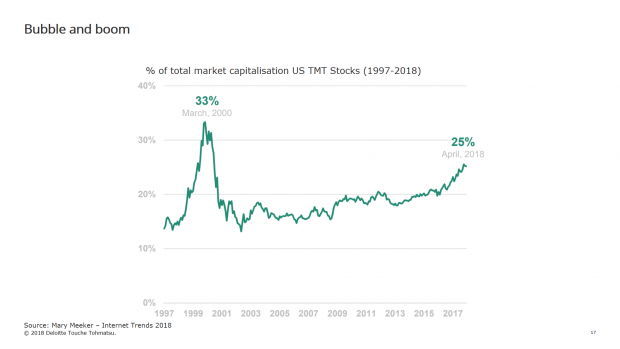
    The market capitalisation of Tech stocks is a good proxy for the looking at the value created by Tech companies. There is a lot to consider on this chart: technology change, economic cycles, elections, a financial crisis but the most interesting thing to ponder is the role of business models in the relative value of Tech stocks to the economy. We could split this into thirds but I’m going to look at the bubble in 1999 and today where Tech is 25% of the total market capitalisation.

    By the way… doesn’t this look familiar? It has a similar shape to the Gartner Hype Cycle for emerging technologies. It might just be a coincidence but one could say that we have perhaps finally hit a ‘plateau of productivity’ for many of the technologies that were on the peak of inflated expectations in 1997-1999.

    It has been said that whenever a new technology comes along that has the potential to dramatically change the competitive landscape, hundreds of companies are formed to try to exploit that opportunity, including many with weak management or poorly thought out business models. Intense competition ensues, returns on capital fall, and most of the new entrants either merge or go bankrupt. This was 1999-2000…

    There were a number of really good ideas during the dot.com bubble that just didn’t make it. Flooz was not one of them. Flooz.com sold online currency that could be used instead of credit cards. After users bought enough Flooz, they could spend it at participating online stores like Tower Records or Barnes & Noble. Despite the questionable merits of this business, Flooz.com raised $35 million from investors. Corporate partners Cisco and Delta Air Lines used Flooz for corporate gifts. Flooz also spent $8 million on an ad campaign featuring Whoopi Goldberg and went Flooz went bankrupt in August 2001, less than two years after it opened its virtual doors.

    Webvan, an online grocery shop with delivery, was an idea that would seem like a no-brainer in 2018 and ebay the e-commerce marketplace was the killer application of Web 1.0 and persists today. Fast forward to the other end of our chart. There is no Flooz, Webvan or ebay but 5 dominant organisations only one of which was in the list of top 5 most valuable companies in 1997. I can’t help but feel that ebay missed the boat that these 5 companies sailed away on. But there is a way to perhaps interpret where ebay wasn’t able to adapt quickly enough. The business model of each of the GAAF is complex, this is the nature of TMT businesses in 2018.

    One of the most compelling interpretations of how they make money and create this amount of value is described by Scott Galloway in his book ‘the four’ as the T-Algorithm. These are today’s 8 rules of what it takes to become a trillion dollar company. Without going through them all in detail, the three which stand out and which I believe all organisations should be considering are Product differentiation, Visionary Capital and Likeability:

    • Product differentiation: each of the four identify where technology can add value, or remove pain from the process/experience of purchasing and each try to offer more for less – e.g. free delivery, the ‘best’ phone+OS, any answer you want for free, all your friends on one platform.
    • Visionary capital: each of the four has the ability to attract cheap capital through the articulation of a vision that is easy to understand. Amazon doesn’t pay dividends, Google’s vision of organising the world’s information and Facebook’s vision of connecting the world are pretty compelling reasons to buy the stocks. Apple has over $250bn in cash reserves.
    • Likeability: “When the news is negative, you want to be perceived as a good company to which a bad thing has happened”. If you watched Mark Zuckerberg in his congressional hearing he got away pretty lightly. And if you don’t like Mark then find me someone who doesn’t like Sheryl Sandberg or for that matter who has a problem with ‘Leaning In’. Both of them are still at the company despite the scandal. The same could be said for the crazy but fun ‘don’t be evil’ Larry Page at Google or ‘im going to space’ Bezos or the cult that surrounds Apple.

    In Australia, there are very few of our local listed companies that could claim to be developing even a few of these 8 factors. In fact, many may find it difficult to achieve 1 or 2 due to their incumbent position, sector orientation, investor pressures or the regulatory environment. The business models of many of these organisations are actually born out of positions of relatively little competition which are in some cases over one hundred years old.

    In 2018 the business models that will generate a 1 trillion dollar valuation are most likely out of the reach of incumbent organisations unless they completely reinvent themselves, like Microsoft is doing or buy their way into it, like AT&T and Time Warner. In 2018, the assumptions and therefore the requirements to make a lot of money are understandably only available to a few. So what hope do businesses have?

    There is one other factor to consider…a TED Talk given by Bill Gross founder of the incubator Idealab gives us some clues. He studied the success and failure of over 100 companies and attributed the outcome to 1 of 5 factors. Timing is the most important factor closely followed by execution.

    As companies continue to experiment with Industry 4.0, and the new technologies that will enable it, they should also look to experiment with new business models that will unlock the value of these technology shifts. In doing so, they should be aware of the new rules in value creation dictated by platforms and ecosystems but also consider the number one and two factor for executing on the assumptions for making money and the plan to do so are timing and execution.

  • Internet Trends 2018 – Highlights

    Internet Trends 2018 – Highlights

    The ‘Mary Meeker’ Internet Trends report is something I look forward to every year – Not just because of the interesting insights about the connected world but also just the sheer volume of powerpoint used to show these insights. This year’s report is 296 pages long, down from 350 pages in the previous year, but still presents a bit of challenge to distill all the insights. Luckily, I have done this for you in this post where I tease out the most interesting highlights from the report. That said, if you have a spare 2 hours, I suggest taking the time to read through the full presentation.

    On to the highlights:

    Global smartphone shipment growth has decreased to effectively nil (pp. 6)

    This may not be a surprise to anyone. As smartphone penetration reaches saturation in mature and now developing markets, shipments of new devices are in decline. Globally, ~1.4Bn smartphones are shipped per annum which has been the case for the last 2 years. The majority of these are still Android devices with iOS making up the balance. Interestingly, ‘other’ operating systems (e.g. Windows etc.) have declined to near obscurity in the last year. Outside of saturation, another big driver of the decrease in shipments is elongating replacement cycles (2-3 years). If this continues I suspect we will see negative growth in the next year, possibly in double digits.

    Internet user growth has also slowed to about 7% in 2016, down from 12% in 2016 (pp.7-8)

    Global internet users of 3.6 billion surpassed half the world’s population in 2018. With penetration reaching this level it is likely that double digit growth will be hard to find. The report also outlined the growth in Wifi – There are around 450 million wifi networks in the world, up from about 100 million five years ago. Cheaper devices and new access points should help Internet user growth, but this likely to be gradual over the course of the next decade.

    Internet growth is slowing but usage is increasing with the average adult spending about 6 hours per day with a digital device (pp.11)

    This is a trend that we have addressed in our Mobile Consumer Survey and TMT Prediction reports. The average smartphone user looks at their device over 50 times a day which may seem a lot, however our smartphones have become the ‘swiss army knife’ of the digital age taking in functionality previously reserved for other devices (e.g. TV, iPod, Calculator, Watch, Heart Rate Monitor, Measuring Tape etc.). Usage is likely to grow with the increasing ‘usefulness’ of digital devices in all aspects of our lives. Combining the slowing growth in internet take up and the increase in internet usage across devices, internet organisations will be battling more for user time on their service vs new users in the coming years to continue to achieve high growth rates.

    There are more than 30 million Amazon Echo devices in users’ homes, up from about 10 million at the end of 2016 (p.26)

    Voice-controlled products are taking off (e.g. Amazon Echo). The Echo’s install base in the U.S. grew from 20M in the third quarter of 2017 to more than 30M in the fourth quarter. This is combined with the number of ‘skills’ an Echo can now perform being close to 30K which has almost doubleed in a year. Unfortunately the report did not give a clear indication of who is winning the battle for the home but there are estimates that the global install base for all home devices will be ~60M by end of 2018.

    Roughly 13% of all retail sales come from e-commerce, up from about 5% a decade ago (pp.44-47)

    I was initially surprised by this figure having worked with organisations who generate over 25-30% of sales online. However, it does speak to the disruption of physical channel and call centre sales which has had a relatively ‘long fuse’ in the era of digital disruption. It is also localised with the US perhaps trailing behind other parts of the world in this trend. The report outlines that E-commerce sales growth is continuing to accelerate – growing 16 percent in the U.S. in 2017, up from 14 percent in 2016. Amazon is taking a bigger share of those sales at 28 percent last year and on the other hand physical retail sales are on the decline. In the section on China, Digital sales are ~20% which speaks to growth of services like Tencent and WeChat providing integrated e-commerce experiences.

    Tech’s influence on the world and the share of wealth is ever increasing with Tech companies rising to 25% of the market cap of the MSCI (pp.39-42)

    There is a really interesting section in the report on the comparison of tech companies to other listed companies. One indicator of tech’s influence is that tech companies account for six of the top fifteen R&D and Capex spenders in the U.S with Amazon, Google Alphabet, Intel, Apple and Microsoft in the top five slots. These companies, including Facebook, are the fastest growing spenders on that list. At an industry level, tech companies versus other industries (e.g. health, industrial products) in the United States, tech companies are the largest and fastest growing R&D and Capex spenders – this is not a bubble.

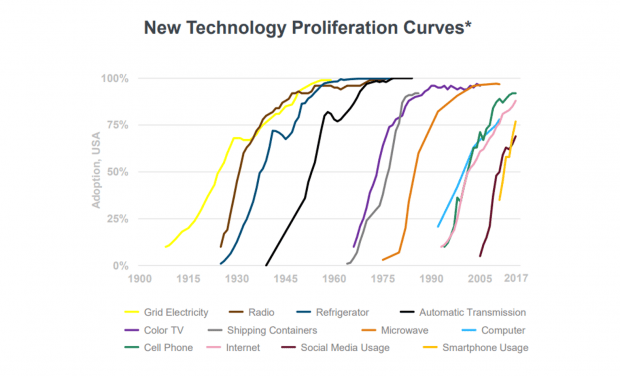
    The speed of technological disruption is accelerating – For example: Adoption of consumer internet took ~10 years, the dishwasher took 80 years (pp.142-165)

    The report looks at tech’s influence on the US economy and jobs. There are some excellent charts showing the adoption cycles of different household goods and the speed of adoption for each decreasing over time. There is also some interesting analysis of the affect of tech on the type of jobs people have. One chart shows the decline in ‘locomotive’ jobs at the same time as the growth in airline jobs (p.149).What I gathered from this section is that in this age we should expect that jobs will shift from structured full time ‘9-5’ arrangements to more on-demand and internet-centric work – there are about ~6M on demand works in the US which is up ~23% YoY (p.165).

    China is achieving relevance and growth in global technology (pp. 237-261)

    China is now home to nine of the world’s 20 biggest internet companies by market cap while the U.S. has 11. If you go back 5 years, China only had two and the U.S. had nine. There are some major trends supporting Chinese tech growth which are called out in the report:

    • E-commerce sales as a percent of total sales, at 20%, highest in the world and the fastest growing
    • Mobile internet users are now 753M (8% growth) and data usage is accelerating, 162% versus 124% in the previous year
    • Mobile video entertainment time is now 22% of all time spent online up from 13% in 2016 with short form video experiencing the most growth compared to long form and gaming
    • Mobile payment volumes are accelerating up 207% YoY vs 116% in the prior year led by Alipay and WeChat
    • On demand transport (car and bike) is up 96%

    The annual Internet Trends report is a rich library of interesting statistics about how our world is changing with the adoption of the internet and new technologies. The items covered above are the highlights I took from the 296 pages (I’ve left out a few sections including the ones on data privacy and big data/AI) but I encourage you to flick through the sections for a more detailed understanding of the trends covered in the report. Until next year!

  • Smartphone innovation: the invisible superpower

    Smartphone innovation: the invisible superpower

    This blog post is featured on Deloitte Australia’s blog in conjunction with the launch of Deloitte’s Global TMT Predictions 2018.

    As covered in our Global TMT Predictions 2018 report, the smartphone’s global success over the next five years will be underpinned by an array of innovations that are largely invisible to its users, but whose combined impact should feel tangible, in the form of greater ease of use, or improved functionality, for example for maps and photos.

    These invisible innovations should enable the smartphone to continue ‘absorbing’ the functionality of an ever-broader array of physical objects and to further displace the PC as the preferred device for a growing range of digital applications.

    There are three local trends that perhaps heighten the effect of invisible innovation on the smartphone in Australia. These include the strong penetration of high end smartphone devices in our market, the quality of mobile networks in Australia, and the already high adoption of smartphones for use in enterprise settings.

    Overall, expect to see alternate uses for the smartphone increasing in Australia.

    More and more gadgets are being integrated into smartphones, from apps that help us with day to day life-flow, or those that allow us to spend more time playing games or reading. Much as we’ve seen with the impact of Spotify and Apple Music on how we listen to music – reading and watching media are moving in the same direction. This is fostered by increases in screen size and improvement in network quality, especially as we move toward having more and potentially unlimited data, possibly making room for an increase in activities like watching long form video on our phones, where traditionally people would purchase another device.

    We’ll also see more smartphone activated Internet of Things (IoT) functions and work-flow based business applications. The enterprise will be well placed to see smartphone technology as a tool to support work agility and flexibility, giving people the confidence and ability to be mobile and do their work or training from anywhere. Small business can use the smartphone to do almost everything these days from placing orders to raising invoices or other random tasks. While sectors such as personal banking, home security and insurance will further capitalise on the smartphone to improve customer experiences.

    Strength in numbers

    Taken from our Mobile Consumer Survey 2017, here’s a numbers view of why the prevalence of premium phones with latest innovative technology will continue to be high here:

    • 88 percent of Australians now own a smartphone, up from 84 percent last year. Australia is likely to surpass the 90 percent penetration rate by end-2018, ahead of the global prediction of 2023.
    • Penetration rates for Australian under 55 years-old are already above the 90 percent mark and therefore the growth in penetration is likely to come from >55 age group. In 2017, there was a five-point increase for 55-64 year olds (77 percent to 82 percent) and a nine-point increase for 65-75 year olds (69 percent to 78 percent). This can be largely attributed to the decommissioning of the 2G network.
    • We’re starting to see growth (~50 percent increase 2017-2016) in the purchase of Internet of Things (IoT) that is cheap to install and smartphone activated – all enabled by smartphone apps.
    • 67 percent of Australians are using their smartphones for work. There’s only low use for submitting timesheets, expenses and accessing intranet sites, but expect this to increase as functionality becomes more useable.

    With these numbers in mind, telcos must look to maintain market share by providing Australians with the best phones on the best networks – they still need to be a focus on network quality. Other industries will look to further capitalise on the smartphone to improve customer experience, e.g. personal banking, home security, health insurance. And companies who target business applications (both small business and enterprise) should look to develop software that allows them and their employees to use simple mobile centric applications to run their business.

    Can smartwatch outsmart smartphone?

    With Australia reaching almost peak smartphone penetration, with one of the highest smartphone penetrations worldwide, we are big smartphone users.

    However, 41 percent of Australians adults think they use their mobile phones too much and 70 percent of Australian 18-24 year olds feel they use their phones excessively, with 50 percent trying to limit and half of them doing so successfully.

    Can the smartwatch assist here? We are seeing notable growth in the smartwatch (ownership almost doubled from five percent in 2016 to nine percent in 2017, according to our Mobile Consumer Survey 2017), and it’s likely to overtake the traditional fit bands as the price point comes down or as customers see more value in the functionality they receive for the price they pay. An increase in functionality is been driven by more powerful chips in wearable devices as well as the cellular connectivity.

    The beauty of the ‘smarter’ smartwatch means users can disconnect from their phone for many of the tasks they were previously relying on the smartphone for. People can use smartwatches to pay for things, contact people, and listen to music, while still being connected to the things that are critical such as call and text – but the phone stays at home.

    Organisations should keep this in mind when looking to create connected experiences for their users and how it may be transferred to a wearable format. There may be an increased opportunity to create new experiences whilst also supporting people’s smartphone usage.

    To find out more about TMT Predictions 2018 and view the other predictions, click here.

  • The state of mobile in Australia: Highlights and implications from Deloitte’s Mobile Consumer Survey

    The state of mobile in Australia: Highlights and implications from Deloitte’s Mobile Consumer Survey

    2017 marks the 10th anniversary of the iPhone. Reflecting on the decade past, it is clear that Australians have enthusiastically embraced the smartphone and its many uses with consumers and businesses being the beneficiary of this era-defining technology. As mobility continues to mature beyond today’s smartphones into new more powerful devices or the mass adoption of wearables and drones it is important for businesses to stay across the trends in mobility and their implications for product strategies, innovation, customer experience, content and operations.

    Deloitte’s Mobile Consumer Survey, now in its fourth year, is a multi-country study of mobility around the world. The 2017 study comprises more than 51,500 responses across 33 countries. The Australian edition is based on 2,000 national responses from consumers aged 18-75 polled during May and June 2017. Special mention to the team that prepares this report in Australia led by Jeremy Drumm, Nick White, Morne Swiegers and Maggie Davey.

    This post draws out a number of the key findings from the 2017 Australian edition of Deloitte’s Mobile Consumer Survey and the implications for Australian businesses. The full report is insightful for those in leadership and management roles in Australia’s carriers/operators, RSPs or businesses looking to further understand how to capture the value of mobility to their organisation.

    ‘Silver surfers power smartphone swell’ (p.7)

    It may come as no surprise that smartphone ownership is on the rise for older generations – 78% of 65-75 year olds now own a smartphone which is up almost 10% on last years’ figure. With the decommissioning of the 2G network a portion of the population have left behind their feature phones and in 2017 88% of Australian’s own a smartphone. It is expected that in the coming 18 months 90-95% of Australian’s will own a smartphone as older generations continue to adopt and embrace this technology.

    Implications

    We are reaching saturation in smartphone ownership which means device manufacturers will need to continue to innovate to profit from replacement/market share vs growth from new adoption. For businesses looking to reach older generations, now is the time to seriously consider the mobile experience (sales/service) for the elderly.

    ‘A slice of Apple’s pie’ (p.8)

    Australians are Apple and Samsung junkies. We have the second highest % penetration of Apple and Samsung smartphones in the countries surveyed at 75% – only Luxemburg at 83% is higher. Interestingly, Samsung’s share has increased slightly YoY and Apple’s share has decreased by 2% all in a period which included the Galaxy note safety recall. The data in the survey correlates to users of Samsung Galaxy (S6-8) and iPhone (6-7) models. It will be interesting to see the change in next year’s data with the iPhone X (most expensive smartphone ever) and SIM enabled watch (Do i still need a smartphone?) adding new dimensions to smartphone ownership.

    Implications

    Australian’s are clearly premium smartphone buyers but we can expect the ~$AUD 2,000 iPhone X test Australian’s love for the brand as well as the growing number of competitive (tech and $ price) Android devices (e.g. Pixel 2, Huawei P10). I suspect this mix to change again next year perhaps with the non-Apple/Samsung smartphone brands gaining more mind and wallet share.

    ‘Demanding data divas’ (p.13)

    Australians are purchasing more data in 2017 than ever before – 60% of Australians now have a data limit 3GB or higher. Interestingly, those that have between 3-5GB plans are 2x more likely to exceed their data limit than those with 500MB or less. The report estimates those who exceed their data collectively to pay close to $30M per month or $313M per year for extra data.

    Implications

    Australians are data hungry. This is following a growing trend seen around the world. The obvious long term implication is that the operators that can provide the most data at an affordable rate will win and already a number of global carriers are offering unlimited plans. Operators will need to look to improve their cost base in order to remain competitive in an unlimited world. Equally, customer experience will begin to play more of a role as operators try to maintain quality connections across their network.

    ‘WiFi wins…this round’ (p.19)

    Australians are more likely to connect to WiFi in 2017 than 4G despite 86% of people being on 4G. This is believed to be the result of the current cost of mobile data plans rather than connectivity needs (e.g. speed) – only 40% of consumers identified that 4G is faster than their home speed.

    Implications

    This WiFi vs Mobile connectivity is a hotly debated topic in Australia currently. The reality is that it is more likely to be complementary rather that one replacing the other. The introduction of devices like ‘hybrid’ modems and ‘broadband plans’ to households are likely to reduce consumers concerns over the utility of one network or another. Bottom line, consumers and businesses want to be connected and to be able to access content, technology and services – in a world of ubiquitous connection, the type of network a consumer connects onto (e.g. WiFi, Mobile, Mesh) will likely be an afterthought.

    ‘High street hangs in’ (p.20)

    1 in 5 consumers visited an operator store in the last month and 3 in 5 in the last year. Stores are still important for operators especially for testing physical product and technical support. The cross channel stat – 23% of smarthphones (mostly by 35-44 year olds – 30%) were purchased online but only 3% of these were collected in the operator store – more scope for omni-channel experience.

    Implications

    Face to face and physical interactions with customers are still important particularly for operators – there is value in face to face exploration, sales, service and support interactions. Whilst there is a lot of information online and the channels to service customers the increasing pace of device innovation, new technologies and solutions is creating a complex environment for many to navigate. Stores will continue to deliver value particularly when aligned to a coherent and compelling omni-channel strategy.

    ‘Our homes are getting smarter’ (p.33)

    Ownership and access to connected devices in the home is on the rise. In the last year there have been increased purchases of cameras (9%), connected car systems (8%) and connected home appliances (5%). The popularity of home security systems seems to indicate consumers value connected home devices for increased security and convenience. There is also a clear preference for devices that are easily self-installed such as smart lighting.

    Implications

    These findings indicate that in the short to mid term bets in smart home IoT are best placed on products that have a clear customer benefit, short replacement cycle and are easily self-installed. More complicated home device set ups will require support to enable. Operators looking to provide consumer IOT solutions need to look carefully into the set up and support model (and cost) as part of the business case for mass-consumer IOT installations.

    ‘Seamless shopping on the go’ (p.44)

    Mobile payment solutions are up 14% from 2016 with over 25% of respondents suggesting they now use the mobile payment solutions. Pay Pal has taken a hit in this survey which is likely due to the fact that tap and go payments from the iOS app. Apple Pay is therefore increasingly popular accounting for 18% of mobile payments nudging out Samsung Pay at 12%.

    Implications

    There is still room for growth in mobile payments in Australia with solutions going beyond early adopters. There is increasing value in developers creating seamless experiences combining mobile applications and payments for fast purchasing on the go. App developers and online channels should look to include mobile payment options online and retail stores should look to include tap and go options where possible in the next 18 months.

    The bottom line

    Australian’s are high on the adoption curve for smartphones globally, we are consuming more data now than ever and we are using our devices everywhere and at anytime. Devices are becoming more innovative some innovations are getting our attention like fingerprint security (35% increase on 2016) and mobile payments (25% increase on 2016) but we still don’t care much (yet) for voice assistants.

  • Apple: The X Strategy

    Apple: The X Strategy

    In Apple’s most recent keynote on September 19th, the company announced the launch of a new generation of iPhone (the iPhone X) at the same time as upgrading their existing iPhone range with the iPhone 8. Underlying this move is an interesting strategy that I will investigate in this post focusing on how the iPhone X has (yet again for Apple) created segmentation in the market for an iPhone, the brand strategy underlying the X and how the launch of the X is a sign of the maturity of the mass production of smartphones and Apple’s response.

    Segmenting the iPhone market

    This is not the first time Apple has offered different types of iPhones in parallel with an upgrade to the existing model but it is the first time Apple has announced a more expensive, new design and a ‘full number’ upgrade at the same time. In 2013, the introduction of the 5C at the same time as the 5S or the introduction of the iPhone SE are examples of previous attempts to segment the market. In these instances the iPhone 5C, with an iPhone 5 design and plastic casing but iPhone 6 components, was a way for Apple to sell ‘no frills’ iPhones to more price-sensitive customers – thus segmenting the market at the ‘lower end’. In a similar vein, the iPhone SE allows people who want a decent iPhone to get one without paying top dollar (an upgrade on the 5C). This is particularly relevant to markets like China and India where the Apple brand has prestige but the price tag can be a barrier.

    The iPhone X represents a segmentation at the top end. It sells to two markets:

    • Those who want the most ‘prestigious’ phone on the market
    • Those who want the ‘newest’ and the ‘best’ phone

    The announcement of the iPhone 8 at the same time as the X is a new strategy which will test the strength and size of these markets for Apple. Some who would typically fit in these cohorts may opt for the iPhone 8 for a ‘good enough upgrade’ at $300 less, making the buyers of iPhone X relatively small. Apple’s first quarter results will show the outcome of this segmentation approach.

    iPhone X as a luxury brand

    The iPhone X will be the first smartphone to retail at USD$1000 – a premium pricing strategy. This is interesting strategically for two reasons. Firstly, over the past 10 years Samsung and Chinese device manufacturers like Huawei/LG have caught up to Apple in terms of design and technology. Their current smartphones have ~90% the same components/features (e.g. facial recognition) but for 30% less. Granted, Apple’s software/hardware integration may be worth a premium but this is an example of a strategy pushing for ‘good enough’ innovation at a premium price.

    Secondly, luxury goods are a comparatively faster growing market globally. In a recent Deloitte report Global Powers of Luxury Goods 2017, Deloitte highlights that luxury goods growth year on year is 6.8% with a CAGR of 5.2% (2013-2015), compared to a global rate of all goods of 1%. Entering the ‘luxury’ market for Apple and differentiating from its previous iPhone models is following the growth in this segment. In executing on a luxury strategy we may see Apple place more emphasis on marketing versus its core of product design.

    The iPhone and mass production

    A famous HBR case is that of Ford vs GM and the competing approaches to mass production (cost optimisation vs. flexibility). In short, Ford’s Model-T earned them the status of the dominant car manufacturer of the first three decades of the twentieth century. However, Ford’s focus on cost minimisation also led to inflexibility, allowing other manufacturers like General Motors to compete with newer designs and incorporate changing technology. The parallel here is that like Ford’s Model-T, iPhone design hasn’t changed greatly in the last 10 years. This has likely meant greater cost optimisation in Apple’s supply chain. The iPhone X represents a break away from cost optimisation with a new design (e.g. OLED Screens, edge to edge, new configuration of chips and cameras, ‘the notch’) meaning that Apple will likely oversee multiple supply chains for smartphone devices. This could be seen as a strategy to counter strong competition (i.e. the General Motors) from other manufacturers (e.g. Huawei and Samsung) which have multiple device designs in the market and could more easily adjust to changes in technology.

    At the macro-level, another ~1.7bn smartphone shipments are forecast by 2020. Some of these will be first time buyers of a smartphone whilst many will be replacements. Through its iPhone X strategy, Apple will hope to make millions of customers luxury device owners while also enticing those who might have settled for an SE or equivalent, the proud owners of an iPhone 8. A good test of this strategy will be to see whether next year, come September/October, Apple launches an X2, an 11 and/or a 9.

  • Apple’s WWDC and the state of today’s consumer tech battlegrounds

    Apple’s WWDC and the state of today’s consumer tech battlegrounds

    10 years ago Apple launched the iPhone, a product that has been at the forefront of the growth in mobility globally and an icon of the digital era – a major consumer technology battleground. The iPhone has positioned Apple as a leader in the Telecommunications, Media and Technology ecosystem along with its other offerings like the App Store, Apple Music, Apple TV, Watch and other devices.

    At the recent Apple developer conference last month (WWDC) there were a number of major software and hardware announcements made. Apple often uses the conference to showcase new products or product features as well as excite the developer community on how they might build (apps/services) on top of new hardware and software. Watching the event, I could not help but think about the messages of the announcements and what they say about Apple and the position of other players in the key consumer tech battlegrounds of today.

    This post outlines the some of the most interesting battlegrounds in consumer tech at the moment and what Apple’s messages at WWDC say about the competition for these domains.

    Battle for streaming: Winning in TV media is all about content (still)

    The first announcement of the conference was about Apple TV and the news that Amazon Prime Video will be available on Apple TV. This says a lot about the nature of streaming video/TV on demand and Apple’s role. Winning in this medium is not about the hardware or the software or even the integration of the two, it is about content which is something (at least in TV content) Apple has not been investing in at the scale of Amazon, Netflix and HBO.

    Battle for new content: Podcasts are growing in popularity for customers but not yet for advertisers… or Apple

    Apple announced iOS 11 their new smartphone operating system which could have made up the entire keynote itself. One of the features of the new OS is an improved podcast app allowing for greater functionality for users and analytics for podcast publishers. This addition speaks to the growing popularity of podcasts as a medium for Apple users and the growing demands of publishers. Despite growing over the past 5 years, podcast revenues are small compared to other content at ~$220M. This is relatively small if compared to other ad revenues Apple could be tapping in, which partially explains why podcasting has received little attention until now. Perhaps the changes Apple makes will increase the commercialisation of the content (e.g. visibility of listens, content changes).

    The battle for the assistant in-home: Apple vs Google vs Amazon

    The announcement of Apples’ Homepod has stolen a lot of the limelight post event with much excitement from techies and audiophiles alike. Like Amazon’s Echo and Google Home, Apple is now launching its own (belated) take on the home assistant. The focus of Apple’s unveiling of the Homepod showed how much ground Amazon and Google have made with their assistant products versus Siri with Apple making a big deal about the audio quality of the Homepod speaker firstly, the quality of the assistant (Siri) secondary and the price thirdly (>$100 more than the Amazon and Google assistant). If Amazon and Google have changed the game on Siri with the concept of the home assistant, Apple is trying change the rules by making the quality of the speaker the most important feature of the in-home assistant. It remains to be seen how many people need a home assistant and for Apple, one with an impressive speaker.

    The battle for the assistant on your wrist: Apple vs Google vs Amazon

    Siri also featured in the watchOS announcement with the introduction of the Siri watch face. This implies a broadening of the scope of Siri from voice commands to context based assistance when you need it. This may sound very similar to Google Now launched a few years ago the difference being that it is play to Apple’s main advantage over Google – integrated software and hardware. Google Now requires a different watch and phone entirely but Apple has this functionality on an increasingly popular watch that works natively with an iPhone.

    These consumer tech battlegrounds are interesting for the same reasons that the smartphone was 10 years ago (and continues to be) with the introduction of the iPhone. It is fair to say that the need for a home assistant or an assistant on your wrist is still not as great as the need for a smartphone, however how these battlegrounds change and the basis of that change will be of interest for the coming decade.

  • MWC 2017 – Articles, Opinions, Podcasts

    MWC 2017 – Articles, Opinions, Podcasts

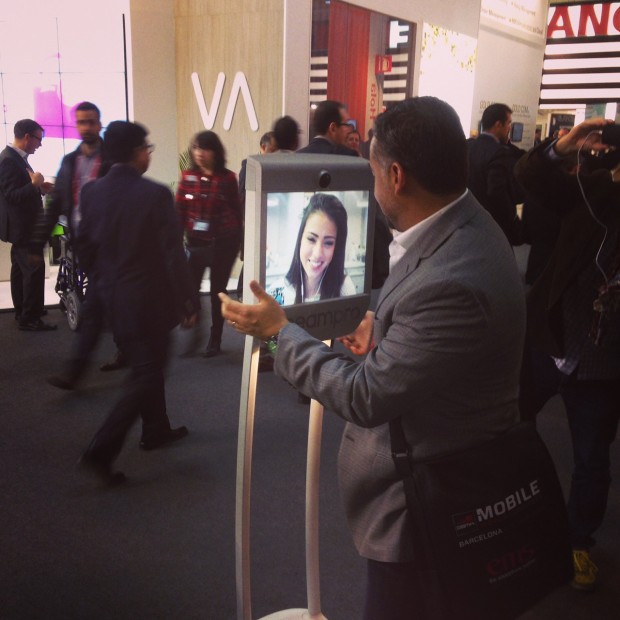
    Mobile World Congress (MWC) is over for another year. More than 108,000 people attended the show in Barcelona, which is an increase from last year of 6%. 2,300 companies were on display and there were 11 keynote sessions over the 4 days with topics ranging from 5G, IOT, Network virtualisation and OTT (Content, SaaS). But what were the key take aways from industry analysts and attendees?

    The State of the mobile industry – Techcrunch

    The MWC (attendees, keynotes, announcements) always provides an interesting insight into the state of the mobile ecosystem. At its origin, MWC was dominated by mobile infrastructure providers, carriers and handset manufacturers. Today, there are content providers, other OTT players, SaaS companies, browsers, car manufacturers, sports and fitness companies. The mobile ecosystem has expanded.

    Techcrunch gives their overview of the the trends from MWC in this article. Interestingly, they pick up on the fact that the industry seems to have moved on from the Samsung Galaxy Note 7 episode (even if you may have heard an announcement on the flight over) with only LG stressing the importance of their battery safety in their keynote for the G6. Along with exploding batteries, excitement has died down for smartwatches. CES in January had few smartwatch announcements (e.g. Garmin Fenix 5) and at MWC Huawei was the only major company announcing a new device. Smartwatch category sales are down – perhaps we are reaching (or have reached) peak smartwatch?

    MWC according to Android – Android Central

    MWC is predominantly an Android affair. Apple and other OS players have a comparatively small presence and in the last 5 years Samsung (the largest Android device manufacturer) has chosen the event to launch its flagship smartphone. This year however, Samsung chose not to launch their latest S8 smartphone at the congress which prompted the questions – has Samsung outgrown the MWC?

    For Android Central, the pick of the phones was the LG G6 which may start to rival the S8 as an alternative though it will ultimately be difficult to compete with Samsung’s budget and existing mind share with consumers. The P10 from Huawei, another often-talked about device at MWC is impressively spec’d, but for Android Central, misses some key features (e.g. smudge resistant screen).

    Macro trends at the MWC

    There are a number of articles that cover off the major trends in keynotes, announcements and the many panel sessions held through out. This post by Jaime Rodriquez Ramos (Monitor Deloitte Spain) and CNET’s ‘Final Wrapper’ article cover the major trends at MWC. Here are a few…

    Retro making a comeback – Nokia, Motorola and Blackberry all had MWC presence with new devices this year.

    Assistants, Chatbots and Robots – Last year at MWC VR was the hit…this year everyone had their own assistant from Baidu to Telefonica. The assistant is more than an interface it is about creating industry/customer ontology.

    5G – hype or reality? – Lots of demos and discussion but the industry hasn’t come to an agreement on what 5G will actually look like. What many agree on is that it has disruptive potential to the last mile of fixed broadband access (see AT&T and Verizon trials) also that we will see mass roll out of 5G in 2019 (sooner than previously expected).

    Startups leading gadget innovation (4YFN) – While the big companies fight for better batteries, screens and cameras at the main event, the side event ‘4 years from now (4YFN)’ showcased a number of interesting startups. A few notables – Hu:toma a bot marketplace company, Soracom a IoT platform, Skyguru an in-flight IOT service and a super light ultra thin phone made from composite materials by Carbonworks.

    Take aways for telecommunications carriers

    There are 3 major (traditional) mobile ecosystem players at MWC – Device manufacturers, telecommunication carriers and network infrastructure providers. This post by Kate Huggins (Monitor Deloitte Australia) highlights a number of the trends affecting carriers from MWC. Firstly, there are increasingly more categories which are ‘connectivity hungry’ including vehicles, drones and AR/VR which were all on display at MWC. Carriers will be required to meet the needs of these categories but as Kate points out – at what network cost. There was a lot of talk about the benefits of 5G at MWC but there was also concern from some corners about the return on capital from this network upgrade. Secondly, innovation in the physical infrastructure of networks may help to reduce the capital cost of networks (e.g. MIMO, HPUE) as well as the way networks are managed (e.g. network virtualisation). Thirdly, carriers need to start to prepare for a hyper-connected, hyper mobile future where consumers have virtual SIMs allowing the ability to switch between connectivity solutions seamlessly based on their context…

    The question is whether the operators enable this or Google does.

    Other sources

    There are a host of other sources that provide insight into the goings-on and take-aways from MWC. I enjoyed this Techpinions podcast and This Week in Tech’s take on the event.

    Until next year!

  • Predicting Tech in 2017: Reports, articles and blog posts

    Predicting Tech in 2017: Reports, articles and blog posts

    What will happen in technology in the coming year? So rapid is the pace of technology change that predicting the future can be risky. However, at this time of year it has become custom for analysts of the global technology industry to release their point of view on consumer trends, technology innovation, investment and industry performance. In the ‘prediction game’, a 12 month prediction can actually be more difficult to make than a 5 or 10 year one – longer term predictions pick up on mega-trends (e.g. computing power, autonomous vehicles, AI) whereas short term predictions look to specific points in a technology cycle, consumer sentiment or shorter term technology advancements.

    This post covers some of the most interesting reports, articles and blogs that are predicting the next 12 months in tech and highlights their key prognoses.

    Deloitte TMT Predictions 2017

    In its 16th year, Deloitte’s TMT predictions 2017 covers subjects that are topical in Technology, Telecommunications and Media but often revealing their implications in the coming year. Topics from previous years have included ‘Virtual Reality: the $1Bn niche’ (from 2016), ‘3D printing is a revolution: just not the revolution you think’ (from 2015), or ‘One became many: The Tablet market stratifies’ (from 2014). The report is led by Paul Lee and Duncan Stewart, co-authored by a global team and has a comprehensive reference list to support the analysis.

    The recently launched TMT predictions have a tighter focus than previous years (10 predictions in 2017 vs 17 predictions in 2016). They have also been grouped together for the first time reflecting the convergence occurring in TMT. The overarching theme of the 10 predictions is the capability being brought to our daily lives by advances in computing power and machine intelligence. In the prediction ‘Biometric security reaches the billions’, Deloitte picks up on the trend that a growing portion of people now have devices with biometric security enabled (35% in Australian) but only 2 thirds of people with biometric security use it. This is predicted to increase globally in 2017 as 1 billion devices in the world will have biometric capability. Deloitte also predicts that in 2017 over 300 million smartphones (a fifth of all units sold) will have on-board neural-net capability. This is the computing power to perform offline machine learning activities. Smartphone innovation is trending beyond cameras and physical design to the ‘smarts’ that can be performed natively – predicting app usage, supporting health outcomes, facial and recognition of a person’s emotional state.

    This report has been picked up by the mainstream media in Australia who covered the prediction topics of tablet sales, cyber security and machine learning on our smartphones as matters of interest.

    Fred Wilson VC – What is going to happen in 2017?

    Fred Wilson, founder of Union-Square Ventures and of AVC blog writes a prediction post each year which outlines his thoughts about what will happen in technology. Last year he predicted VR to disappoint (it did); one of Facebook, Google, Amazon or Apple to falter (they didn’t, except Apple has worrying signs); and publishing inside Facebook would go badly for some high profile publishers (it hasn’t, but the ugly downside of Facebook as a publishing platform revealed itself in the form of a fake news crisis).

    This year Fred Wilson’s predictions like Deloitte’s TMT single out machine intelligence as a driver of technological change including stating that:

    “AI will be the new mobile. Investors will ask management what their “AI strategy” is before investing and will be wary of companies that don’t have one”

    Fred is also predicting more IPOs and M&A activity in 2017 lead by Snapchat and possible changes to capital gains as a result of a Trump presidency and tax reform. Whilst Russian hacking of elections are topical, Fred predicts that ‘cyber warfare’ will be ‘front and centre’ in our lives a prediction that Deloitte corroborates in its prediction that DDOS attacks will reach terabyte level frequently in 2017.

    Recode: Predicting the Top 10 tech developments for 2017

    Tech blog Recode publishes its predictions every year just before CES. The predictions pick up on well-known tech topics but give their spin on the coming 12 months. Some of the more interesting predictions this year include: Non-gaming related applications of VR growing faster than gaming applications, Amazon Echo becoming the default gateway to the smart home, large scale IOT projects being down-scaled but small scale IOT project (e.g. smart home) booming; and mobile app installs declining as technology services increase (e.g. registering for skills on Alexa).

    Reading the Recode predictions, a number of these efforts appear to be underway already in some shape or form, it will be interesting to see the extent to which they play out in local jurisdictions (e.g. Alexa entering homes in Australia with Amazon launch in 2017).

    MIT Technology Review: 5 big predictions for Artificial Intelligence in 2017

    AI (machine intelligence) is an over-arching mega-trend supporting a number of the predictions this year. MIT Technology Review puts forward a view of the trends in AI that will play out this year. From a technology standpoint – Positive reinforcement (an approach where computers figure out how to navigate a maze by trial and error and then associate the positive outcome—exiting the maze—with the actions that led up to it) will be applied to automated driving and industrial processes. Advances will also be seen in the application of generative adversarial networks that can create synthetic data based on learned and un-learned data sets.

    From a consumer point of view – China is predicting to take on AI in a serious way in 2017 and the Review predicts a slight backlash to the hype around AI off the back of ‘fake’ AI start up Rocket AI last year and other imposters likely to appear in the near future.

    Fintech Predictions for 2017

    Fintech has been a ‘buzz topic’ in tech for a few years now. Shopping around for predictions in this area of tech brings up a few interesting posts. David Klein who has written a number of articles for Techcrunch outlined Fintech trends in 2016 (which he tells us he was 75% right about…not too bad). In his 2017 edition, Klein predicts a consolidation of lending Fintech, growth in asset management Fintech, more acquisition activity by incumbent financial institutions and blockchain having operational success in financial institutions.

    A blog that covers all things Fintech – The Daily Fintech – also has predictions for 2017. These predictions are slightly more speculative than other prediction commentary for 2017 but it does pose food for thought – Will Bitcoin ‘move from dark net to clear net’ in 2017? Will Insurtech funding slow down? Will VC funding for Fintech in Asia outstrip all other VC funding in the West?… time will tell.

    KPBC – Internet Trends (Mary Meeker Report)

    Yes, this is not an early 2017 report…but it is an important annual report released in June which highlights the trends in the coming year. Originally intended to be ‘internet trends’ the Mary Meeker report has moved beyond internet connectivity to cover topics like mobile commerce, artificial intelligence and data privacy.

    The June 2016 report had predictions including the rise of voice interfaces as a (20% of searches of internet content from voice – Siri, Alexa, Google) or messaging becoming the ‘home screen’ for many mobile users worldwide with the growth of services like WeChat and Messenger. Looking forward to the 2017 edition already!

    “The future is already here, it’s just not evenly distributed”

    This quote rings true when you consider many of these predictions for tech in 2017. Tablet sales will be down, cyber-attacks will be up, some phones are getting smarter, voice will begin to replace the handset in home, Bitcoin will stop being a ‘shady’ currency, M&A activity will increase but B rounds in VC will dry up… depending where you are in the world – these trends may already be part of your currently reality. Here is to 2017 and the technology change it holds for us all!


  • Google & Apple: The New Age of Transformation

    Google & Apple: The New Age of Transformation

    All companies need to transform. Despite their relative positioning in the digital age, Google and Apple are by no means an exception. As the digital era matures (characterised by cloud, social, mobile and data) and the age of exponential technologies ensues (Quantum Computing, AI, Blockchain, VR, IOT etc.), we are witnessing a battle for ascendancy between these two companies and a raft of new-comers. We are also witnessing their transformations.

    I’ve written and spoken publicly about transformation of businesses and I think it is helpful to have a working definition before exploring what is going on at Google and Apple. Transformation is about:

    Continuously evolving the way business is conducted to create sustainable value in response to shifts in the market or operating conditions.

    Both Google and Apple are on similar transformation trajectories despite their very different beginnings and their seemingly insurmountable positions in their respective markets. Apple was created in 1976 with a purpose of ‘making the personal computer ever more personal’ and Google was founded over 20 years later in 1998 with a purpose fit for the information age of “organising the world’s information”. Despite these differences, they both have leading roles in the cornerstones of the digital age – Apple has led the growth of mobility globally through its iPhone and other products. Google on the other hand has dominated internet search as well as other aspects of the consumerisation of the internet (e.g. SVOD, Maps). They are near equals in terms of market value, with Google narrowly nudging out Apple in being the world’s most valuable company in May this year with Apple claiming this title again recently.

    Shifts in the market and operating conditions

    We have just seen the latest quarterly results for Google and Apple and each talk to the shifting nature of the operating conditions facing each company.

    For Google:

    These results were exceptional particularly compared to last quarter’s earnings. It was in last year’s third quarter that Google added additional features to mobile search results, the effect of which may be coming in to play in the 20% increase in revenue it experienced this quarter. The company now controls 95% of the mobile-search market and 78% on desktops according to recent estimates. This is a strong position to be in but it is also points to a fundamental change in their operating conditions. The source of revenue is moving from desktop to mobile and with it the value attached to search advertising. Mobile ads are generally cheaper than desktop ads, so advertisers’ average price for an ad-click has declined as mobile ads have increased. Google said that advertisers’ cost per click decreased 11% in the quarter compared to 7% in the prior quarter. They are balancing mobile’s higher acquisition costs with sustainable advertising revenue.

    To add to this, Facebook’s recent quarterly announcement put a spotlight on the strength of competition Google faces for mobile advertising revenue. Facebook now controls 13% of the worldwide digital advertising business second only to Google at 32%. The future of search advertising is questionable compared to the specificity of Facebook’s ‘graph’. Also, the rise of AI and assistants (e.g. Alexa, Cortana, Allo, Siri) will provide a significant challenge to ‘traditional web-search’. Instead of searching and providing a list of options (paid for or influenced by advertisers), these services will just tell you the answer that is most suitable for you and what it already knows about you.

    For Apple:

    Devices, smartphones in particular, are continuing to play a huge role in our lives but innovation has slowed for the handset manufacturers and upgrade cycles appear to be slowing (although this may also be the effect of pulling forward people who have upgraded). What was interesting from the recent results is that the Mac business for Apple is now more of a side business to its phone, tablet and watch businesses, accounting for ~10% of total revenue. This may well change with the launch of the new Macbook but it also highlights the opportunity and difficulty of being a business primarily focused on product innovation vs. services in the technology industry. Product life-cycles can be fickle and innovations often become incremental (e.g. a slightly new camera) towards the end of a product’s s-curve.

    Apple is entering interesting territory as it searches for the next improvement on the smartphone or the watch (what is more personal than these devices?). It is also up against competition that are using data to make devices even more powerful – something that Apple is working towards with its Siri product but will struggle to lead due to the limited amount of data it captures by comparison to the likes of Google, Microsoft or Amazon.

    Continuously evolving Google and Apple

    Google’s transformation – Edges and ‘Moon shots’

    In August 2015, Google announced a change to become Alphabet which split off the ‘moon shot’ parts of its business from Google to provide structural separation. On the recent earnings call they noted:

    As we’ve frequently noted, our move to Alphabet was motivated by our belief that revolutionary ideas drive the next big growth areas. Long-term success requires a commitment to making bets, putting the right talent and resources behind those bets, and remaining flexible and dynamic as we pursue them.

    As of yet, Google’s ‘other bets’ which is the focus of ‘Alphabet’ have failed to return much to shareholders. The earnings call highlighted that in the case of ‘other bets’ Google last quarter spent more on stock-based compensation ($200 million) than they derived in revenue ($197 million). The recent shuttering of Google Fiber is also another example of a ‘moonshot’ providing dubious value to the company. It is still early days – the bold move to focus on ‘moon shots’ may yet pay off with a big business being born out of one of these bets.

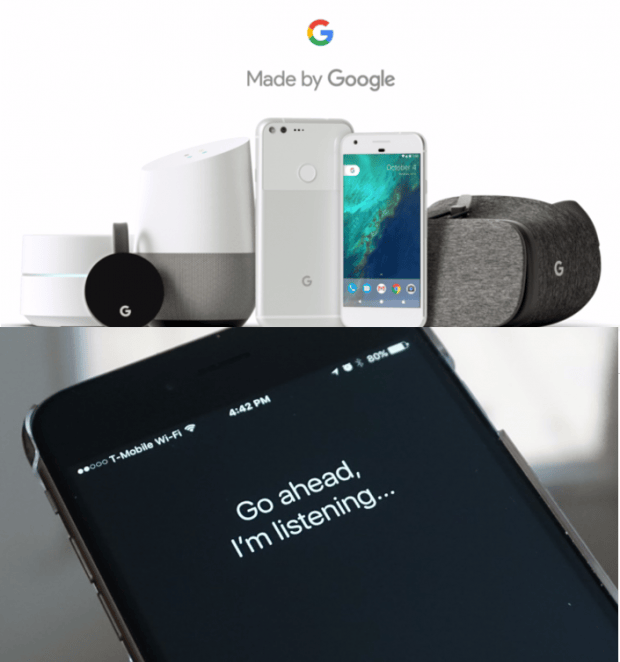
    To its credit, Google has many sustainable growth opportunities, and all of them are on the edge of what Google is uniquely capable of doing (e.g. search advertising) rather than the more risky ‘moon shots’. Selling hardware (like its recent Pixel phone and Daydream VR announcement), developing Google Cloud or building out YouTube Red’s proposition are far less exciting than any ‘moon shot’ but are also a natural evolution from Google’s core search business. Not all of these will succeed (I don’t think Google expects them all to) but they all make sense in the context of Google’s business; most of the ‘other bets’, in contrast, exist only because Google has cash to put toward them.

    Sustainable transformation for Google means finding a balance between evolution brought on by more disruptive ‘moon shots’ (disruptive innovations) and transforming its core business on the edge (natural extensions of its existing business). The moonshots which leverage Google’s assets to a much greater extent, like Google’s self-driving car, provide compelling narrative for the Alphabet business – something Google is keenly aware of for the security of talent and future public funding.

    Apple’s transformation – Products and Services

    In contrast, Apple’s transformation efforts with regards to their product businesses show a tenacity for the company to make new products at the expense of cannibalising existing profitable businesses. For example, the iPod business (its many variations – Mini, Shuffle, Touch) was decimated by the iPhone’s launch and subsequent growth since 2007 and arguably the tablet business has usurped the PC/Laptop business. For Apple, its purpose of ‘making the computer ever more personal’ has meant that these transformations have had strong internal and external narratives which will continue to help Apple transform to support new products (driverless cars, airpods and virtual reality) and customers (B2B segments, emerging markets). However, this is not the major transformation issue for Apple. Rather, Apple’s ability to compete with ‘smarter products’ that use data and link to valuable services is its transformation challenge.

    iTunes and Apple’s cloud offerings are examples of the type of service transformation Apple has been capable of in the past. However, even these services have required their own transformation in the last 10 years with the growth in streaming music and video leading to the launch of Apple Music about 18 months ago and AWS’s dominance of cloud. Siri (Apple’s voice assistant) represents another example of how Apple is looking to bring integrated services into its products. Like iTunes before it, Siri is facing significant competition from other providers (like Amazon and Google) who are able to leverage much larger data sets (e.g. Google’s search database; Amazon’s consumer products database) to make their assistants smarter and more intelligent.

    At the core of these transformations is an evolution in capability. For Apple, it is about adapting and investing in capability that is service (instead of product) oriented and for Google it means applying existing capability to edge businesses or divesting moonshot capability when necessary. These two cornerstones of the Digital Era will continue to provide interesting case studies for how transformation occurs in a rapidly changing world of consumer preferences and technological innovation.