Blog

  • Jeff Bezos’s Annual Letter: 3 ‘take aways’

    Jeff Bezos’s Annual Letter: 3 ‘take aways’

    Every year since Amazon’s inception in 1997, Jeff Bezos (founder and CEO of Amazon) has been writing a letter to shareholders. This year’s letter is the 20th edition which makes for an excellent point of reflection for the company that now has US$107BN in annual sales and a market cap of US$296BN just behind Facebook (sales US$18BN, market cap US$312BN).

    The theme of Bezos’s letter could be summarised as avoiding the perils of scale and maturity or ‘avoiding stasis’ which is neatly refered to as ‘Day 2’. He advocates for quick decisions, ‘obsessing on customer outcomes’ and maintaining a continuous state of ‘Day 1’ – the beginning of a company’s potential. This post covers 3 ‘take aways’ I had from the letter.

    The importance of a ‘Day 1’ approach in mature businesses

    Day 2 is stasis. Followed by irrelevance. Followed by excruciating, painful decline. Followed by death. And that is why it is always Day 1

    I don’t believe any business aims to pursue an ambition of ‘stasis’ or ‘irrelevance’. Quite the opposite actually – many strategies ‘aim to win’ in design and execution. So what is Bezos actually talking about here? Having worked with mature businesses as well as companies launching new products/operations there is often a different approach, culture, leadership and mindset at work compared to those that are pursuing scale, standardisation and optimisation. Businesses ‘starting out’ or as Bezos terms it ‘Day 1’ use an approach which is one primarily of experimentation, accepting failures, planting seeds, protecting saplings, and doubling down on customer delight. Outcomes are a major focus for ‘Day 1’ business (e.g. customer engagement, feedback). However, a ‘Day 1’ approach is often given less emphasis as strategy is translated to execution and scale through policy and process. The point Bezos makes is that in the long run, by ensuring a ‘Day 1’ approach is the policy and outcomes are managed (not process), businesses will be able continue to delight customers, stave off competition and avoid ‘painful decline’.

    Avoid having a ‘one-size-fits-all’ decision making process

    It’s important for decision-makers to disagree and commit…”You’ve worn me down” is an awful decision-making process. It’s slow and de-energizing. Go for quick escalation instead – it’s better.

    Bezos makes this point really well. A ‘Day 2’ approach to decision making can be one of analysis paralysis and consesnsus building which may lead to high quality decision making albeit very slowly. Having worked with organisations at both ends of decision making velocity (slow = 18-24mths vs. fast = days or weeks) there is a different culture that aligns to a high-velocity decision making organisation. The primary factor is that each decision should be judged on its merits with the authority appropriately delegated to individuals to make those decisions in a timely manner. Bezos adds a few nuggets here:

    1) 70-90% of information is all you need, any more and your business is likely to lose velocity

    2) Be good at recognising and correcting bad decisions (Amazon did this well with their smartphone product – Fire)

    Day 1 companies embrace external trends quickly – they don’t use words like ‘cannibalisation’… this is a Day 2 mindset.

    The outside world can push you into Day 2 if you won’t or can’t embrace powerful trends quickly. If you fight them, you’re probably fighting the future. Embrace them and you have a tailwind.

    I doubt you will ever hear Amazon talk about a new product or service ‘cannibalising’ their existing business. For that matter you are unlikely to hear this at Apple, Facebook or Google. However, in incumbent organisations this is often the language. In his letter, Bezos talks about embracing external trends, which on face value most business leaders would agree with. Truly embrace external trends may mean giving up some ground on a profitable core business in return for growing new revenue streams of the future – this is the hard part. He also suggests this needs to be done quickly. Working out the balance of core and new business (‘What level of cannibalisation is tolerable?’) can lead to slow decision making by which time a more nimble competitor is taking a lead on the trend and eating away at the core.

    There are so many examples of embracing external trends over fearing cannibalisation – Apple’s iPod vs iPhone is a good one. In the year the iPhone launched (2007) the iPod was 42% of revenue and the iPhone 2.5% – iPhone launched during peak iPod. At latest results, iPhones were close to 80% of Apple’s revenue with iPod now diminished to a button on an iPhone screen. The smartphone was the external trend, which meant ‘cannibalising’ a very profitable and successful business at its peak.

    I won’t be surprised if you haven’t finished reading this blog post and have instead gone straight to reading the letter – it’s a really interesting one. The letter came out a few weeks ago so there are also some interesting points of view on the content. I really enjoyed this article in the AFR on why Australian listed companies may struggle to replicate Bezos’s advice – suggesting that the primacy of shareholder over customer is a balance many Australian companies struggle with.

  • MWC 2017 – Articles, Opinions, Podcasts

    MWC 2017 – Articles, Opinions, Podcasts

    Mobile World Congress (MWC) is over for another year. More than 108,000 people attended the show in Barcelona, which is an increase from last year of 6%. 2,300 companies were on display and there were 11 keynote sessions over the 4 days with topics ranging from 5G, IOT, Network virtualisation and OTT (Content, SaaS). But what were the key take aways from industry analysts and attendees?

    The State of the mobile industry – Techcrunch

    The MWC (attendees, keynotes, announcements) always provides an interesting insight into the state of the mobile ecosystem. At its origin, MWC was dominated by mobile infrastructure providers, carriers and handset manufacturers. Today, there are content providers, other OTT players, SaaS companies, browsers, car manufacturers, sports and fitness companies. The mobile ecosystem has expanded.

    Techcrunch gives their overview of the the trends from MWC in this article. Interestingly, they pick up on the fact that the industry seems to have moved on from the Samsung Galaxy Note 7 episode (even if you may have heard an announcement on the flight over) with only LG stressing the importance of their battery safety in their keynote for the G6. Along with exploding batteries, excitement has died down for smartwatches. CES in January had few smartwatch announcements (e.g. Garmin Fenix 5) and at MWC Huawei was the only major company announcing a new device. Smartwatch category sales are down – perhaps we are reaching (or have reached) peak smartwatch?

    MWC according to Android – Android Central

    MWC is predominantly an Android affair. Apple and other OS players have a comparatively small presence and in the last 5 years Samsung (the largest Android device manufacturer) has chosen the event to launch its flagship smartphone. This year however, Samsung chose not to launch their latest S8 smartphone at the congress which prompted the questions – has Samsung outgrown the MWC?

    For Android Central, the pick of the phones was the LG G6 which may start to rival the S8 as an alternative though it will ultimately be difficult to compete with Samsung’s budget and existing mind share with consumers. The P10 from Huawei, another often-talked about device at MWC is impressively spec’d, but for Android Central, misses some key features (e.g. smudge resistant screen).

    Macro trends at the MWC

    There are a number of articles that cover off the major trends in keynotes, announcements and the many panel sessions held through out. This post by Jaime Rodriquez Ramos (Monitor Deloitte Spain) and CNET’s ‘Final Wrapper’ article cover the major trends at MWC. Here are a few…

    Retro making a comeback – Nokia, Motorola and Blackberry all had MWC presence with new devices this year.

    Assistants, Chatbots and Robots – Last year at MWC VR was the hit…this year everyone had their own assistant from Baidu to Telefonica. The assistant is more than an interface it is about creating industry/customer ontology.

    5G – hype or reality? – Lots of demos and discussion but the industry hasn’t come to an agreement on what 5G will actually look like. What many agree on is that it has disruptive potential to the last mile of fixed broadband access (see AT&T and Verizon trials) also that we will see mass roll out of 5G in 2019 (sooner than previously expected).

    Startups leading gadget innovation (4YFN) – While the big companies fight for better batteries, screens and cameras at the main event, the side event ‘4 years from now (4YFN)’ showcased a number of interesting startups. A few notables – Hu:toma a bot marketplace company, Soracom a IoT platform, Skyguru an in-flight IOT service and a super light ultra thin phone made from composite materials by Carbonworks.

    Take aways for telecommunications carriers

    There are 3 major (traditional) mobile ecosystem players at MWC – Device manufacturers, telecommunication carriers and network infrastructure providers. This post by Kate Huggins (Monitor Deloitte Australia) highlights a number of the trends affecting carriers from MWC. Firstly, there are increasingly more categories which are ‘connectivity hungry’ including vehicles, drones and AR/VR which were all on display at MWC. Carriers will be required to meet the needs of these categories but as Kate points out – at what network cost. There was a lot of talk about the benefits of 5G at MWC but there was also concern from some corners about the return on capital from this network upgrade. Secondly, innovation in the physical infrastructure of networks may help to reduce the capital cost of networks (e.g. MIMO, HPUE) as well as the way networks are managed (e.g. network virtualisation). Thirdly, carriers need to start to prepare for a hyper-connected, hyper mobile future where consumers have virtual SIMs allowing the ability to switch between connectivity solutions seamlessly based on their context…

    The question is whether the operators enable this or Google does.

    Other sources

    There are a host of other sources that provide insight into the goings-on and take-aways from MWC. I enjoyed this Techpinions podcast and This Week in Tech’s take on the event.

    Until next year!

  • Mobile World Congress 2017 – What to expect?

    Mobile World Congress 2017 – What to expect?

    Mobile World Congress (MWC) 2017 in Barcelona starts this Sunday. This annual event now attracts over 100,000 attendees and includes keynotes, panel discussions, displays and meetups from many of the most influential players in mobile technology and the mobile ecosystem. Over the course of the last 10 years, the landscape of players at MWC has morphed from being heavily device/handset focused to including software and service providers that play a role in the mobile ecosystem.

    For the last two years I have covered the major announcements and talking points from the MWC. In 2015, the major talking points were net neutrality, wearables, IOT and 5G. In 2016, was all about virtual reality, tapering-off in device innovation and vehicles. In this post I look at what we might be able to expect at MWC 2017 and provide some tips for first timers.

    Device announcements

    There are always a few major device announcements at MWC. Last year, LG stole the show with their G5 device which included modular hardware (e.g. removable batteries). The excitement for this was not matched by sales in the G5 so this year we are likely to see a ‘tamer’ G6 as a redemption.

    Samsung has always used the MWC to announce its latest smartphone, however we are not going to see an S8 smartphone launch in Barcelona. Rather, Samsung is tipped to launch its Galaxy Tab S3 which is a premium tablet product. In a turbulent year for Samsung, launching a Tablet against a backdrop of falling Tablet sales globally is a gutsy move (predicted to be ~165 million units globally in 2017).

    Huawei is expected to launch a new smartphone and smartwatch. After being relatively unknown in the Australia 3 years ago, they are bringing impressive hardware to the market at competitive price points. The P10 smartphone and smartwatch 2 are expected to be talking points of the conference.

    For the nostalgic, Blackberry is back courtesy of Chinese manufacturer TCL who will be launch the DTEK60. TCL licensed the BlackBerry name after pursuing the Acatel brand name in price sensitive markets. It will be interesting to see if broad appeal of Blackberry still applies despite a number of high-profile failures. Nokia is also making a comeback with its revamped 3310. This may be a sentimental gift for those who remember when two out of every five mobile phones was a Nokia or an upgrade for those still using the phone on 2G (which is being mothballed in many markets).

    5G

    Expect more discussion on 5G from the tech providers and the carriers. Verizon has just announced 5G trials in 11 US markets a week before the conference. There are a number of other trials expected for later in the year in Asia, Australia and some European countries. Despite these trials, 5G has not yet been codified as a standard. Many of the 5G trials and the commercial rollout of LTE Advanced and LTE Pro are an evolution to 5G, piecing together the elements required (MIMO, Beamforming, Licence Assisted Access, High levels of aggregation and QAM). MWC attendees should be looking to compare vendor roadmaps vs. carrier roadmaps, compare trial approaches of vendors and carriers and discuss the the implications for fixed line services.

    IOT

    Now a perennial topic of the conference. This year a lot of the IOT discussion at the conference is expected to focus on devices using LPWAN (Low Power Wide Area Networks) particularly in industrial IOT. In addition, computing on the edge of these devices will be a topic for discussion with increasing concerns for device security and reliance on connectivity for processing power. MWC attendees should be interested in new use cases for IOT, trials of IOT systems and platforms globally and the state of consumer IOT.

    Tips for first timers…

    There is so much to see at MWC (and Barcelona) in a short amount of time.

    • Sunday is announcement day (for some device manufacturers) but the real show starts Monday – pace yourself!
    • Reed Hastings of Netflix is replacing Mark Zuckerberg for the Monday keynote. Expect him to talk about the future of content, data analytics and media distributions
    • Prior to Reed, sessions on autonomous vehicles and chatbots and virtual assistants in the main auditorium look interesting with speaks from car manufacturers, to software start ups providing their perspectives
    • Get out to see the exhibits from the vendors – Ericsson, Huawei, IBM, Samsung, AT&T and Android have all had interesting displays in previous years
    • A companion event ‘4 Years from Now’ (4YFN) is held at Fira Montjuïc which showcases start ups (mostly SaaS) from around Europe and has talks from companies that are core to the mobile ecosystem (e.g. Facebook) and those that ar emerging. Chat to the founders, find something new.
  • Predicting Tech in 2017: Reports, articles and blog posts

    Predicting Tech in 2017: Reports, articles and blog posts

    What will happen in technology in the coming year? So rapid is the pace of technology change that predicting the future can be risky. However, at this time of year it has become custom for analysts of the global technology industry to release their point of view on consumer trends, technology innovation, investment and industry performance. In the ‘prediction game’, a 12 month prediction can actually be more difficult to make than a 5 or 10 year one – longer term predictions pick up on mega-trends (e.g. computing power, autonomous vehicles, AI) whereas short term predictions look to specific points in a technology cycle, consumer sentiment or shorter term technology advancements.

    This post covers some of the most interesting reports, articles and blogs that are predicting the next 12 months in tech and highlights their key prognoses.

    Deloitte TMT Predictions 2017

    In its 16th year, Deloitte’s TMT predictions 2017 covers subjects that are topical in Technology, Telecommunications and Media but often revealing their implications in the coming year. Topics from previous years have included ‘Virtual Reality: the $1Bn niche’ (from 2016), ‘3D printing is a revolution: just not the revolution you think’ (from 2015), or ‘One became many: The Tablet market stratifies’ (from 2014). The report is led by Paul Lee and Duncan Stewart, co-authored by a global team and has a comprehensive reference list to support the analysis.

    The recently launched TMT predictions have a tighter focus than previous years (10 predictions in 2017 vs 17 predictions in 2016). They have also been grouped together for the first time reflecting the convergence occurring in TMT. The overarching theme of the 10 predictions is the capability being brought to our daily lives by advances in computing power and machine intelligence. In the prediction ‘Biometric security reaches the billions’, Deloitte picks up on the trend that a growing portion of people now have devices with biometric security enabled (35% in Australian) but only 2 thirds of people with biometric security use it. This is predicted to increase globally in 2017 as 1 billion devices in the world will have biometric capability. Deloitte also predicts that in 2017 over 300 million smartphones (a fifth of all units sold) will have on-board neural-net capability. This is the computing power to perform offline machine learning activities. Smartphone innovation is trending beyond cameras and physical design to the ‘smarts’ that can be performed natively – predicting app usage, supporting health outcomes, facial and recognition of a person’s emotional state.

    This report has been picked up by the mainstream media in Australia who covered the prediction topics of tablet sales, cyber security and machine learning on our smartphones as matters of interest.

    Fred Wilson VC – What is going to happen in 2017?

    Fred Wilson, founder of Union-Square Ventures and of AVC blog writes a prediction post each year which outlines his thoughts about what will happen in technology. Last year he predicted VR to disappoint (it did); one of Facebook, Google, Amazon or Apple to falter (they didn’t, except Apple has worrying signs); and publishing inside Facebook would go badly for some high profile publishers (it hasn’t, but the ugly downside of Facebook as a publishing platform revealed itself in the form of a fake news crisis).

    This year Fred Wilson’s predictions like Deloitte’s TMT single out machine intelligence as a driver of technological change including stating that:

    “AI will be the new mobile. Investors will ask management what their “AI strategy” is before investing and will be wary of companies that don’t have one”

    Fred is also predicting more IPOs and M&A activity in 2017 lead by Snapchat and possible changes to capital gains as a result of a Trump presidency and tax reform. Whilst Russian hacking of elections are topical, Fred predicts that ‘cyber warfare’ will be ‘front and centre’ in our lives a prediction that Deloitte corroborates in its prediction that DDOS attacks will reach terabyte level frequently in 2017.

    Recode: Predicting the Top 10 tech developments for 2017

    Tech blog Recode publishes its predictions every year just before CES. The predictions pick up on well-known tech topics but give their spin on the coming 12 months. Some of the more interesting predictions this year include: Non-gaming related applications of VR growing faster than gaming applications, Amazon Echo becoming the default gateway to the smart home, large scale IOT projects being down-scaled but small scale IOT project (e.g. smart home) booming; and mobile app installs declining as technology services increase (e.g. registering for skills on Alexa).

    Reading the Recode predictions, a number of these efforts appear to be underway already in some shape or form, it will be interesting to see the extent to which they play out in local jurisdictions (e.g. Alexa entering homes in Australia with Amazon launch in 2017).

    MIT Technology Review: 5 big predictions for Artificial Intelligence in 2017

    AI (machine intelligence) is an over-arching mega-trend supporting a number of the predictions this year. MIT Technology Review puts forward a view of the trends in AI that will play out this year. From a technology standpoint – Positive reinforcement (an approach where computers figure out how to navigate a maze by trial and error and then associate the positive outcome—exiting the maze—with the actions that led up to it) will be applied to automated driving and industrial processes. Advances will also be seen in the application of generative adversarial networks that can create synthetic data based on learned and un-learned data sets.

    From a consumer point of view – China is predicting to take on AI in a serious way in 2017 and the Review predicts a slight backlash to the hype around AI off the back of ‘fake’ AI start up Rocket AI last year and other imposters likely to appear in the near future.

    Fintech Predictions for 2017

    Fintech has been a ‘buzz topic’ in tech for a few years now. Shopping around for predictions in this area of tech brings up a few interesting posts. David Klein who has written a number of articles for Techcrunch outlined Fintech trends in 2016 (which he tells us he was 75% right about…not too bad). In his 2017 edition, Klein predicts a consolidation of lending Fintech, growth in asset management Fintech, more acquisition activity by incumbent financial institutions and blockchain having operational success in financial institutions.

    A blog that covers all things Fintech – The Daily Fintech – also has predictions for 2017. These predictions are slightly more speculative than other prediction commentary for 2017 but it does pose food for thought – Will Bitcoin ‘move from dark net to clear net’ in 2017? Will Insurtech funding slow down? Will VC funding for Fintech in Asia outstrip all other VC funding in the West?… time will tell.

    KPBC – Internet Trends (Mary Meeker Report)

    Yes, this is not an early 2017 report…but it is an important annual report released in June which highlights the trends in the coming year. Originally intended to be ‘internet trends’ the Mary Meeker report has moved beyond internet connectivity to cover topics like mobile commerce, artificial intelligence and data privacy.

    The June 2016 report had predictions including the rise of voice interfaces as a (20% of searches of internet content from voice – Siri, Alexa, Google) or messaging becoming the ‘home screen’ for many mobile users worldwide with the growth of services like WeChat and Messenger. Looking forward to the 2017 edition already!

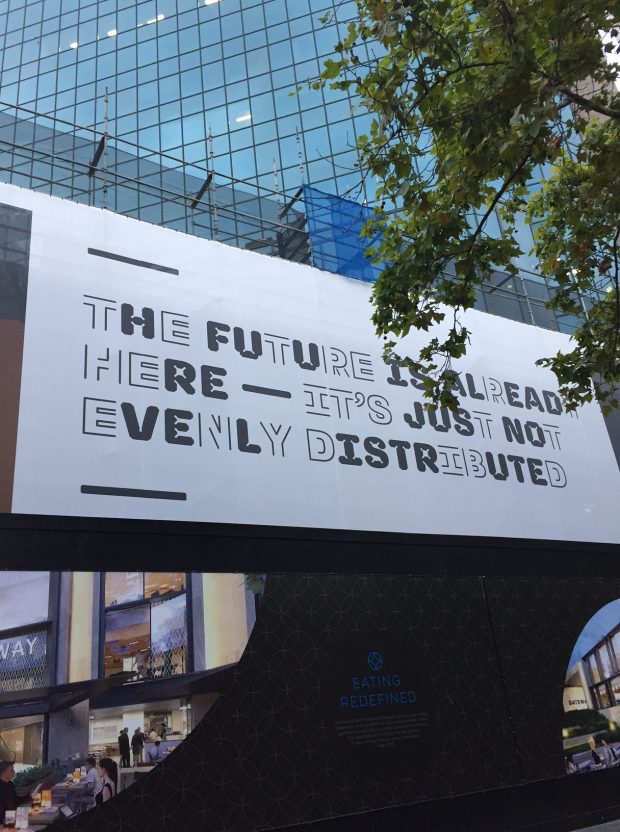
    “The future is already here, it’s just not evenly distributed”

    This quote rings true when you consider many of these predictions for tech in 2017. Tablet sales will be down, cyber-attacks will be up, some phones are getting smarter, voice will begin to replace the handset in home, Bitcoin will stop being a ‘shady’ currency, M&A activity will increase but B rounds in VC will dry up… depending where you are in the world – these trends may already be part of your currently reality. Here is to 2017 and the technology change it holds for us all!


  • The 3 most influential TMT ideas in 2016

    The 3 most influential TMT ideas in 2016

    As 2016 comes to a close, it is a good time to reflect on what has been another interesting year in the Telecommunications, Media and Technology (TMT) industries. Last year I covered the ‘Top 5 stories’ in 2015 which included the launch of Apple Watch, Ad-Blocking, the re-birth of Google as Alphabet and the imminent demise of Yahoo. These stories have all continued into 2016 – Yahoo sold to Verizon for US$5Bn, Google (Alphabet) has faced criticism for its ‘moonshot’ approach and Apple is looking for new revenue streams outside of consumer products including moving into AI.

    This year, this post is slightly different in that it covers the big ideas not just the stories. As far as world events go, 2016 will be remembered for the edgy political backdrop brought about by Brexit and a hard-fought (particularly on social media) US presidential election. The changes that will eventuate from enacting Brexit and a change of presidency in the US will have enduring effects on the global economy and TMT into 2017 and beyond. For the TMT industry specifically, this post explores the ideas that have been most influential – the ones that will continue to shape the media, telecommunications and tech industries in 2017 and beyond. Some of these ideas were born from the global political backdrop and others are the result of advances in technology and implementation of new use cases.

    So…what were the most influential ideas in TMT in 2016 and why will they continue to shape the industry in 2017 and beyond?

    1. Fake News

    In the news media, the boundaries between satire, propaganda, reality based on facts and news that has been indisputably made-up have been blurred for years. In 2016 however, the growth and maturity of social media as a news source, a US presidential election fought on dubious claims/facts and the ubiquity of user-generated content formed the perfect storm for the creation, proliferation and exploitation of news stories that were fake. One analysis performed by Buzzfeed highlighted that Fake News stories like Pope Francis endorsing Donald Trump for president (he didn’t) and Hillary selling weapons to ISIS (she didn’t) actually performed better than real news on the 2016 presidential election toward the end of the campaign. Fake news articles also performed well outside of politics with stories about numerous dead celebrities (who are alive and well), match-fixing Superbowl 50 and a Nazi submarine being found in Lake Ontario all receiving readership and significant attention.

    Why is this an influential idea?

    There are 3 major reasons why ‘fake news’ as a concept will continue to be influential in 2017 and beyond:

    1. Society acting on fake news has serious consequences: There is the very real issue that parts of society are being influenced by and acting upon fake news reports. In 2016, fake news is thought to have had a large influence on how people decided to vote in the presidential election but it has also led to other activities such as a shooting in a pizza restaurant in Washington D.C. People acting on false news has and will continue to have very serious consequences for society.
    2. Filtering of social media feeds: Secondly, and more specific to TMT is the role Facebook and other social media sites play as the distributors of fake news stories and how they will act to maintain credibility (seen to be important for its users and business model). By 2016, Facebook has evolved from being a digital property where ‘offline networks’ of friends congregate to being a news source (62% of US adults get their news from social). This has come through the growth of services like Instant Articles and Facebook Live. Media and social are now more intertwined than ever with a majority of Facebook users prioritising time spent reading their Facebook feed over reading a newspaper. The social business model (based on advertising spend) rewards engagement with stories/articles/baby pictures – anything to keep you on the feed longer. The scrutiny waged against social sites like Facebook is related to the algorithm that is used to serve up content to users that will ensure engagement, time in feed and clicks on advertisements are maximised – even if the content happens to be fake. Facebook CEO Mark Zuckerberg has denounced the link between their algorithm and fake news claiming ‘99% of what people see is authentic’. However, there is increasing pressure on social sites to intervene where news they are distributing is fake. On first appearance, this sounds like a positive thing in the fight against fake news. With greater consideration, increased filtering of social media feeds (even for fake news) is a very slippery slope toward the owners of these sites censoring and controlling everything you see (beyond driving engagement for advertisements).
    3. Growth in fact-checking and a return to traditional news sources: Fake news has been somewhat of a boon to fact-checking sites and traditional media. Fact checking sites like Snopes, Factcheck.org and Poynter have received attention this year as sites performing the function of reviewing the facts supporting news stories or claims by politicians. Part of Facebook’s response to the fake news claims has been to propose the use of these sites to check the facts of stories in their news feeds. What is interesting for media organisations will be the growth in these organisations as the arbiters of ‘truth’ in news stories (a potentially valuable role). As credibility of news displayed on sites like Facebook is called into question, traditional media sites have an opportunity to entice readers back to their properties for fact-filled and expert opinion.

    Fake news will be influential to news media and social media in the coming years both in terms of the content developed and distributed but also the business models these organisations are defending and evolving.

    2. Everything as a service

    In this post ‘The Best is Last’ from April 2016, Benedict Evans points out:

    A technology often produces its best results just when it’s ready to be replaced — it’s the best it’s ever been, but it’s also the best it could ever be. There’s no room for more optimisation — the technology has run its course and it’s time for something new, and any further attempts at optimisation produce something that doesn’t make much sense…

    At the Mobile World Congress in Barcelona this year it was apparent that smartphone innovation has hit a peak and we are starting to see a 2 tier market – incremental innovations (better camera, screen, battery) from the premium hardware manufacturers and commoditisation of these features by fast following low-cost players. In 2016, we have reached peak smartphone innovation. This has been corroborated by slower replacement rates of smartphones globally in 2016 and a halving of smartphone sales from 14.4% growth YoY in 2015 to only 7% YoY on 2016. If this technology has “run its course” what is the something new that will replace it?

    In 2016, there has been a lot of discussion about what comes next after the smartphone. From observations of the last few years it’s not tablets, nor is it watches; it could be voice assistants and possibly headsets. Regardless of the technology and the form factor, the business model of product manufacturing (particularly in the fast paced world of Tech) is not scalable nor is it particularly responsive to major advances in technology. This year, product companies like Apple, Siemens, GE, Phillips etc. have started to become public about their transformations from products to services. They are taking a lead from other internet businesses (Uber, Airbnb, Amazon etc.) that ‘everything as a service’ is a highly scalable, profitable and ultimately richer (in terms of data, user feedback, product development) model by which to conduct business. Take Amazon Web Services as an example – it offers computing power as a service (instead of buying servers) to companies all around the world. In doing so it has greatly reduced the barriers to entry for start ups, growing with the businesses it supports and is now making a healthy profit.

    There will always be a need for product businesses in technology – in fact Google made a move into products this year with the Pixel phone. However, it is the services (everything as a service) that accompany, support or are developed as part of the product ecosystem that are likely to be the most profitable and scalable.

    Why is this an influential idea?

    ‘Everything as a service’ will be an influential idea for two major reasons:

    1. It will underpin the development of new products: The development of new tech products (possibly any product) in the future will look to consider the service elements that could support it. This could include AI (computer intelligence as a service), insurance, analytics, data storage, security and privacy. The internet is very effective at distributing services and product developers will increasingly be effective at designing product-service combinations.
    2. It is at the core of business transformation in the digital age: I’ve written about Google and Apple’s transformation efforts which are underpinned by ‘everything as a service models’. Other companies such as Siemens and GE, which are eyeing off the consumer and industrial markets for the ‘internet of things’, are also undergoing transformations of their own. They are looking to incorporate ‘everything as a service’ type models into their businesses to not only be makers of machines but fully integrated digital businesses. These transformations will take time and will continue to evolve for years to come.

    3. Blockchain can ‘fix the internet’

    One of my favourite articles of the year was from Walter Isaacson of the Aspen Institute – “The internet is broken. Starting from scratch, here’s how I would fix it.” In the article, he outlines a number of changes that would make the internet more secure, more private and less prone to monopolisation by aggregators. In 2016 we know more about blockchain than ever and its use cases in TMT and other industry sectors. Its key characteristics include a digitally distributed ledger which is updated in real-time, cryptographically secure, irreversible and auditable, making it a prime candidate for supporting new technologies as they emerge and for fixing issues in the internet’s design.

    In supporting new technologies, Telecommunications provide some interesting examples. 5G technology will start its implementation possibly as early as 2017 in some countries. Blockchain could be used to streamline the processes of implementing 5G connectivity. To realise 5G potential of ubiquitous access across various networks, network providers will need to handle heterogeneous access nodes and diverse access mechanisms. Selecting the fastest access node for every user or machine will be a central challenge which blockchain can enable. This will create a new generation of access technology selection mechanisms to build sustainable solutions. Another example technology is the ‘Internet of Things’ for which blockchain can enable secure and error free peer-to-peer connectivity for thousands of IoT devices with cost-efficient self-managed networks.

    Walter Isaacson highlights 5 ways to fix the internet of which 4 have potential blockchain solutions:

    1. Create a system that enables content producers to negotiate with aggregators and search engines to get a royalty whenever their content is used: A difficult issue to solve in the internet particularly the negotiation part. Companies like Mediachain are looking to connect content producers with aggregators to register, track and identify creative works online (even if it is sampled, remixed or copied) using blockchain protocol.
    2. Embed a simple digital wallet and currency for quick and easy small payments for songs, blogs, articles, and whatever other digital content is for sale: This is bitcoin.
    3. Encode emails with an authenticated return or originating address:Blockchain based identity and authentication is becoming more popular through organisations like Blockstack or Blockverify which build server-less applications that allow users to be in control of their data. This could be used for messaging in the future where advances in email authentication through DKIM and STF are not satisfactory.
    4. Enforce critical properties and security at the lowest levels of the system possible, such as in the hardware or in the programming language, instead of leaving it to programmers to incorporate security into every line of code they write: Blockchain uses cryptography in its protocol to secure information. Thus, blockchain based applications use this underlying security to achieve higher levels of security at the application level.

    Why is this an influential idea?

    The internet is a forty year old concept. Isaacson points out in his article:

    “It is still a marvelous and miraculous invention, but now there are bugs in the foundation, bats in the belfry, and trolls in the basement.”

    The technology to help update the internet for many of its flaws and to support the introduction of new technologies and business models is blockchain. In 2016, the TMT industry moved beyond defining what blockchain is to identifying and implementing applications of blockchain to solve for issues of security, fraud, privacy and distribution. We have finally reached a point of understanding that blockchain is an ‘enabler of things’ much like the internet was 40 years ago and is at a grand scale today. While blockchain may not ever reach the scale of the internet, the next 40 years will see its growth and use in new technologies especially where the internet is failing the most.

    2016 has been an interesting year for TMT advancements. Other ideas that narrowly missed out on a top 3 spot were ‘Transportation as a service’, ‘Consumerisation of IT’ and ‘Reverting back: Books, Vinyl and TV Advertising’. I look forward to writing about these and other advancements on strategy4telcomediatech in 2017.

    Thank you for reading in 2016 and happy new year!


  • The State of Start Ups.

    The State of Start Ups.

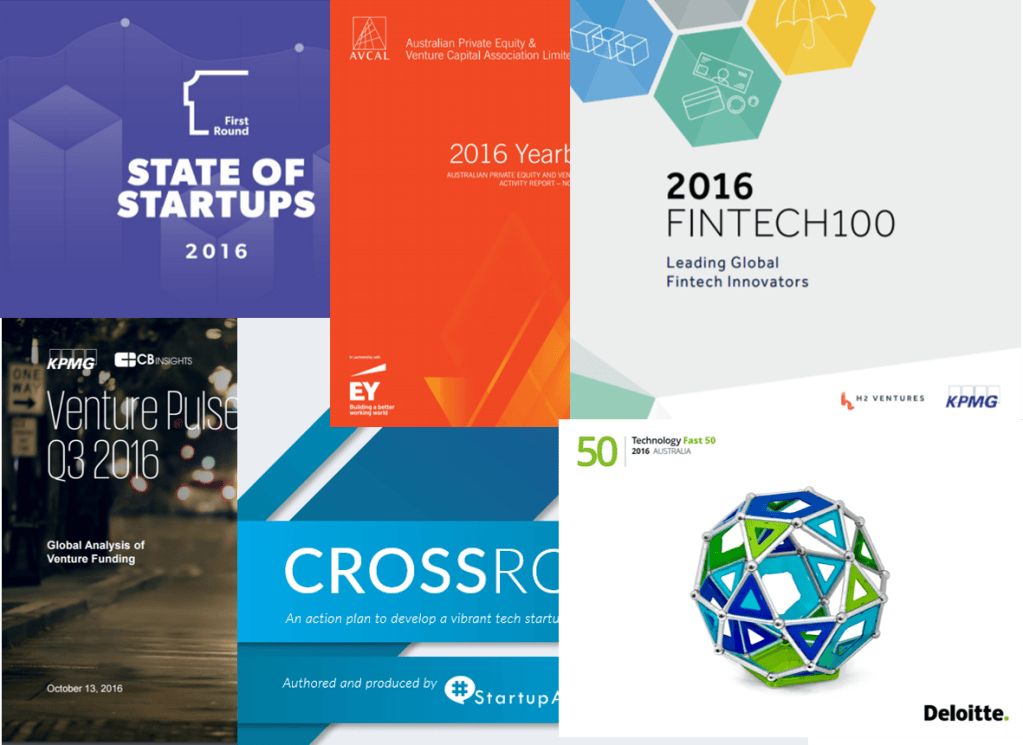
    At almost no time in the last 10 years has there been this much publicly available information on the state of venture capital, start ups and sub-categories of start up organisations (e.g. fintech, fastest growing start ups). In the last few months, half a dozen reports/surveys have been released globally and in Australia which paint a comprehensive picture of the growth and health of disruptive small-medium enterprise (often referred to as ‘start ups’) and the various players that support them (e.g. investors, incubators/accelerators, educational institutions). This post is not about the state of reporting on this industry (although I think that speaks volumes about state of the industry analysing start ups), rather this post aims to give a brief overview of the available reports and summarise the main messages on the state of start ups and what the future may hold for the industry globally and in Australia. (Please add any recent reports I may have missed in the comments).

    Global Reports and Findings

    Deloitte Tech Fast 500 (APAC, EMEA, North America)

    For more than 20 years, Deloitte has provided a snapshot of the fastest growing companies in technology. The report is regionally developed and ranks applicants based on their relative revenue growth over 3 consecutive years. If you are looking for fast-growing companies releasing new, emerging technologies – this is the report. The companies listed represent industries from software to biotech, SaaS, cloud computing, data analytics, and mobile sectors.

    This year’s winners in each region include Chengdu Wolaila (China, APAC) which provides e-commerce and 24-hour express delivery services through an internet portal called Sposter (lock box), Fingerprint Cards AB (Sweden, EMEA) which develops, produces and markets biometric technology and LootCrate (US, North America) a subscription box service for geeks (1337).

    State of start ups

    In its second year, First Round Capital’s State of Start Ups Survey aims to capture what it is like to be a start up founder. It surveys 700 founders covering topics like ‘Are we in a start up bubble?’ and ‘Is now a good time to start a business?’. This is a helpful overview of sentiment and gives an insight into the diversity of founders and their teams. Australia’s equivalent is the Start up Muster – the 2015 results are here (2016 out shortly).

    Venture Pulse

    Looking at the state of venture capital at Global scale, the Venture Pulse report produced by CB Insights and KPMG gives a quarter by quarter snapshot of VC activity globally and by region highlighting deals, stage of deals, industries and key trends. An informative read for the macro perspective on VC.

    Israel and UK Venture update

    If you are looking for more detail on VC, particularly in Israel and European markets, this report prepared by Gil Dibner provides a detailed overview of the deals done in Israel and Europe. It looks at all the angles – industry, size, rounds, stage of company, country vs country… Very interesting to see what’s ‘hot’ in Israel at the moment – Cyber Security is a clear favourite for investors in Q3.

    Fintech 100

    The Fintech 100 is a relatively new report jumping on the bandwagon of ‘start up lists’. This report by KPMG and H2 Ventures profiles the companies at the heart of the rise of technologies disrupting traditional financial institutions – ‘Fintech’. This is a really comprehensive list and gives an excellent sense of the types of Fintech being created (e.g. lending, payments) and the origins/profiles of the companies and their founders.

    Compass Global Start up Report 2015

    There are a number of reports that seek to compare countries or cities on their relative strengths in terms of innovation and ‘entrepreneurialism‘. The report produced by Compass with contributions from Deloitte provides a comprehensive and structured overview of the relative strengths the entrepreneurial ecosystem of cities globally on the aspects of funding, performance, talent, start up experience and market reach. Sydney slipped 4 places from 12 to 16 between the 2012 and 2015 rankings. Not surprisingly, Silicon Valley takes the number 1 spot. Looking forward to the next edition.

    The 3 things you need to know from global reports…

    1. Software is still ‘eating the world’ – Whichever way you cut it, software and SaaS as a sub-sector of software are still the most popular type of start up company to invest. They are also the fastest growing companies. >50% of deals done globally in the last year were software/SaaS deals followed by deals in the mobile/telecoms (~17%) and healthcare (~10%) sectors. In the US Tech Fast 500 report listing the fastest growing companies, 290 companies were software of which 44% were SaaS, 24% Enterprise Software and 10% Security. A number of the globl reports talk to the future opportunity in sectors like AgTech, Life Sciences, Sensors, Security and Space with IOT and Bitcoin on the otherhand being considered as ‘overhyped’ (at least according to the State of Start ups survey respondents).
    2. Are we in a bubble? – The evidence points to… possibly. 57% of First Round Survey respondents say we are in a bubble but this is down 22% from the prior year – so it is almost a coin toss. At the same time, 43% of respondents are optimistic about exits in 2016 up 10% from 2015. From an investment point of view, VC investment globally hit an 8 quarter low in Q3 2016, but this may be a period of stabilisation after Brexit, US elections and predicted US rate rises in Q4. 2015 was an outstanding year for VC deals with $131Bn invested compared to 2014’s $91Bn. By end of Q3 2016, VC back deals totaled $79Bn. This implies that a very impressive Q4 is required to meet 2014 levels – perhaps this is the bubble stretching?
    3. Asia wakes up – The Compass report’s biggest mover between 2012 and 2015? Singapore. This gateway to SE Asia has implemented numerous government backed incentives to the tune of $3bn (to 2020) to support their entrepreneurial ecosystem and it is paying dividends. The Compass report did not include Chinese cities in its rankings – but if it did it believes Beijing and Shanghai would be top 10. This is backed up by the rise Chinese companies in hi-tech industries (DJI is now the world’s largest Drone manufacturer) as well as Fintech. The Fintech 100 features numerous Chinese based companies with 5 in the top 10. Expect to see more from APAC in the coming months/years.

    Australian Reports and Findings

    Deloitte Tech Fast 50

    Australia’s version of Deloitte’s regional reports, ‘The Fast 50’ profiles the fastest growing tech businesses in Australia. Many of the companies that make the list are now household names like Vocus and Siteminder, which are now in their 7th and 6th year in ‘The Fast 50′ rankings respectively. Other list makers are breakthrough businesses which are experiencing rapid growth in Australian and overseas markets. The winners’ report profiles of the Fast 50 companies as well as providing a comprehensive overview of the issues facing fast growing tech companies in Australia.

    StartupAus – Crossroads Report

    The 2016 Crossroads Report is the 3rd edition from StartupAus which started producing the report in 2014. This is a report of biblical proportions (and size… at 182 pages!). It contains comprehensive stats, opinions from industry representatives and recommendations to move the Australian entrepreneurial ecosystem forward. Highlights in this edition include state by state overviews, international policy framework examples and a 6 theme action plan. There is a lot in this report. In some ways, this indicative of the developing maturity of the start up industry…and the industry that analyses it.

    AVCAL Yearbook

    This is the annual report (started in 1999) from the industry body that represents Private Equity and Venture Capital in Australia. The yearbook is often taken to be the ‘single source of truth’ for investment, deal, capital raising and exit figures in Australia despite analysts now having access to Pitchbook, CB Insights and Crunchbase databases. No hype here, just facts with some VC industry advocacy thrown in.

    The 3 things you need to know from Australian reports…

    1. Australia is falling behind the rest of the world – Sydney (the focal point for the Australian entrepreneurial ecosystem) slipped 4 spots in Global rankings and Melbourne slipped out of the top 20. The reasons? A shortage in funding, poor exit volumes/returns and a lack of reach in to global markets. The 6 themes the Crossroads report outlines in its action plan aim to address these issues suggesting more favourable tax conditions, government intervention and a focus on education. The Tech Fast 50 report highlights similar themes suggesting that despite our relative rankings, ‘the time is ripe’ to start a company in Australia.
    2. Funding boost..but are there companies and returns worth investing in? – According to AVCAL, 2016 saw the highest investment by Australian VC in the last 10 years at $347M (this does not include the $250M invested in Campaign Monitor in 2014 by offshore VC). In addition, VC ‘dry powder’ at June 2016 was $883M which was up ~$100M from the prior year amidst a number of announcements of VC capital raises. Of the $347M invested, only ~$240M went into Australian companies which was ~$40M above the 10 year average. For VCs to get the returns they need, they are still looking beyond Australian shores. Equally, super funds are starting to ‘dabble’ in this asset class with only a few pension funds adding to VC round in the last year to the tune of ~$300M. $300M is <0.02% of the total pension asset pool in Australia (the 3rd largest in the world on $ size and % of GDP).
    3. Australia is due for another high profile exit – There is nothing like a high value exit to spur on the virtuous cycle of investment in the start up industry. Much of the interest in start ups and VC in Australia at 2016 is arguably the result of high profile exits like Atlassian’s IPO in December 2015. The Crossroads report lists milestones from the Australian ecosystem. Notably, many of the company related milestones are not about exits, rather they are about investments made in series A and B rounds. With the exit window opening globally and more exit experience in the Australian industry, it is quite possible that Australia will see a high profile exit in the next 12-24 months. This would likely have the knock-on effect of encouraging greater investment from institutional investors and drawing more talent into the start up industry.

    We now have more publicly available information on the start up industry than ever before. The reports covered in this article provide a snapshot of the state of start ups and the industry that supports and analyses them. Globally the reports paint a picture of the rise of Asian tech businesses, the continued dominance of SaaS and apprehension about the funding bubble. In Australia, the ecosystem is just getting warmed up. Local reports point to a need for Australia to improve its relative attractiveness globally as a destination to start new business. This is likely to be supported by increased funding/government support and more high profile exits in the next 12-24 months.

  • Google & Apple: The New Age of Transformation

    Google & Apple: The New Age of Transformation

    All companies need to transform. Despite their relative positioning in the digital age, Google and Apple are by no means an exception. As the digital era matures (characterised by cloud, social, mobile and data) and the age of exponential technologies ensues (Quantum Computing, AI, Blockchain, VR, IOT etc.), we are witnessing a battle for ascendancy between these two companies and a raft of new-comers. We are also witnessing their transformations.

    I’ve written and spoken publicly about transformation of businesses and I think it is helpful to have a working definition before exploring what is going on at Google and Apple. Transformation is about:

    Continuously evolving the way business is conducted to create sustainable value in response to shifts in the market or operating conditions.

    Both Google and Apple are on similar transformation trajectories despite their very different beginnings and their seemingly insurmountable positions in their respective markets. Apple was created in 1976 with a purpose of ‘making the personal computer ever more personal’ and Google was founded over 20 years later in 1998 with a purpose fit for the information age of “organising the world’s information”. Despite these differences, they both have leading roles in the cornerstones of the digital age – Apple has led the growth of mobility globally through its iPhone and other products. Google on the other hand has dominated internet search as well as other aspects of the consumerisation of the internet (e.g. SVOD, Maps). They are near equals in terms of market value, with Google narrowly nudging out Apple in being the world’s most valuable company in May this year with Apple claiming this title again recently.

    Shifts in the market and operating conditions

    We have just seen the latest quarterly results for Google and Apple and each talk to the shifting nature of the operating conditions facing each company.

    For Google:

    These results were exceptional particularly compared to last quarter’s earnings. It was in last year’s third quarter that Google added additional features to mobile search results, the effect of which may be coming in to play in the 20% increase in revenue it experienced this quarter. The company now controls 95% of the mobile-search market and 78% on desktops according to recent estimates. This is a strong position to be in but it is also points to a fundamental change in their operating conditions. The source of revenue is moving from desktop to mobile and with it the value attached to search advertising. Mobile ads are generally cheaper than desktop ads, so advertisers’ average price for an ad-click has declined as mobile ads have increased. Google said that advertisers’ cost per click decreased 11% in the quarter compared to 7% in the prior quarter. They are balancing mobile’s higher acquisition costs with sustainable advertising revenue.

    To add to this, Facebook’s recent quarterly announcement put a spotlight on the strength of competition Google faces for mobile advertising revenue. Facebook now controls 13% of the worldwide digital advertising business second only to Google at 32%. The future of search advertising is questionable compared to the specificity of Facebook’s ‘graph’. Also, the rise of AI and assistants (e.g. Alexa, Cortana, Allo, Siri) will provide a significant challenge to ‘traditional web-search’. Instead of searching and providing a list of options (paid for or influenced by advertisers), these services will just tell you the answer that is most suitable for you and what it already knows about you.

    For Apple:

    Devices, smartphones in particular, are continuing to play a huge role in our lives but innovation has slowed for the handset manufacturers and upgrade cycles appear to be slowing (although this may also be the effect of pulling forward people who have upgraded). What was interesting from the recent results is that the Mac business for Apple is now more of a side business to its phone, tablet and watch businesses, accounting for ~10% of total revenue. This may well change with the launch of the new Macbook but it also highlights the opportunity and difficulty of being a business primarily focused on product innovation vs. services in the technology industry. Product life-cycles can be fickle and innovations often become incremental (e.g. a slightly new camera) towards the end of a product’s s-curve.

    Apple is entering interesting territory as it searches for the next improvement on the smartphone or the watch (what is more personal than these devices?). It is also up against competition that are using data to make devices even more powerful – something that Apple is working towards with its Siri product but will struggle to lead due to the limited amount of data it captures by comparison to the likes of Google, Microsoft or Amazon.

    Continuously evolving Google and Apple

    Google’s transformation – Edges and ‘Moon shots’

    In August 2015, Google announced a change to become Alphabet which split off the ‘moon shot’ parts of its business from Google to provide structural separation. On the recent earnings call they noted:

    As we’ve frequently noted, our move to Alphabet was motivated by our belief that revolutionary ideas drive the next big growth areas. Long-term success requires a commitment to making bets, putting the right talent and resources behind those bets, and remaining flexible and dynamic as we pursue them.

    As of yet, Google’s ‘other bets’ which is the focus of ‘Alphabet’ have failed to return much to shareholders. The earnings call highlighted that in the case of ‘other bets’ Google last quarter spent more on stock-based compensation ($200 million) than they derived in revenue ($197 million). The recent shuttering of Google Fiber is also another example of a ‘moonshot’ providing dubious value to the company. It is still early days – the bold move to focus on ‘moon shots’ may yet pay off with a big business being born out of one of these bets.

    To its credit, Google has many sustainable growth opportunities, and all of them are on the edge of what Google is uniquely capable of doing (e.g. search advertising) rather than the more risky ‘moon shots’. Selling hardware (like its recent Pixel phone and Daydream VR announcement), developing Google Cloud or building out YouTube Red’s proposition are far less exciting than any ‘moon shot’ but are also a natural evolution from Google’s core search business. Not all of these will succeed (I don’t think Google expects them all to) but they all make sense in the context of Google’s business; most of the ‘other bets’, in contrast, exist only because Google has cash to put toward them.

    Sustainable transformation for Google means finding a balance between evolution brought on by more disruptive ‘moon shots’ (disruptive innovations) and transforming its core business on the edge (natural extensions of its existing business). The moonshots which leverage Google’s assets to a much greater extent, like Google’s self-driving car, provide compelling narrative for the Alphabet business – something Google is keenly aware of for the security of talent and future public funding.

    Apple’s transformation – Products and Services

    In contrast, Apple’s transformation efforts with regards to their product businesses show a tenacity for the company to make new products at the expense of cannibalising existing profitable businesses. For example, the iPod business (its many variations – Mini, Shuffle, Touch) was decimated by the iPhone’s launch and subsequent growth since 2007 and arguably the tablet business has usurped the PC/Laptop business. For Apple, its purpose of ‘making the computer ever more personal’ has meant that these transformations have had strong internal and external narratives which will continue to help Apple transform to support new products (driverless cars, airpods and virtual reality) and customers (B2B segments, emerging markets). However, this is not the major transformation issue for Apple. Rather, Apple’s ability to compete with ‘smarter products’ that use data and link to valuable services is its transformation challenge.

    iTunes and Apple’s cloud offerings are examples of the type of service transformation Apple has been capable of in the past. However, even these services have required their own transformation in the last 10 years with the growth in streaming music and video leading to the launch of Apple Music about 18 months ago and AWS’s dominance of cloud. Siri (Apple’s voice assistant) represents another example of how Apple is looking to bring integrated services into its products. Like iTunes before it, Siri is facing significant competition from other providers (like Amazon and Google) who are able to leverage much larger data sets (e.g. Google’s search database; Amazon’s consumer products database) to make their assistants smarter and more intelligent.

    At the core of these transformations is an evolution in capability. For Apple, it is about adapting and investing in capability that is service (instead of product) oriented and for Google it means applying existing capability to edge businesses or divesting moonshot capability when necessary. These two cornerstones of the Digital Era will continue to provide interesting case studies for how transformation occurs in a rapidly changing world of consumer preferences and technological innovation.

  • Australia’s Tech Dilemma

    Australia’s Tech Dilemma

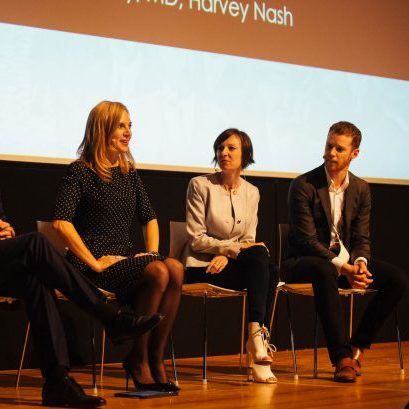
    What is Australia’s tech dilemma? I was recently invited to speak on a panel at an event created by BandT magazine called “Daze of Disruption“. The topic of discussion was “Australia’s Tech Dilemma”. This post is an outline of the notes I put together in preparation for the event and reflect my experiences with Deloitte’s TechFast50, TwoTribes and S4TMT in Australia and overseas.

    The topic “Australia’s Tech Dilemma” implies that Australia has a singular ‘tech dilemma’ … but there is more than one. And we have heard them all:

    Should we try to be Silicon Valley? Should we be the Silicon Valley of Asia? Why can’t we be more like Tel Aviv? What is our unique technology advantage? How do we attract our share of tech talent and funding? How can we grow a thriving technology ecosystem?…

    These dilemmas relate to the growing globalisation of, and competition in, the technology ecosystem (more about this later) as ‘software eats the world’ and smartphones grow to become common household items – everywhere. They are also heightened by the curtain dropping on one industrial era and the birth of another – a virtual one which is causing structural adjustments as job automation, task virtualisation and connectivity force workers to learn new skills. But these dilemmas are not unique to Australia. They are dilemmas for all locations vying for relevance in a global market for technology talent, funding, return on investment and customers.

    When visiting Toronto and New York last month I met with a number of local technology founders and VCs who separately expressed similar dilemmas for their locations – Should we be more like Silicon Valley? How to attract and retain technology talent? How can we grow a thriving tech ecosystem? There are some unique dilemmas though. For Toronto, proximity to the mega-hubs of Silicon Valley, Chicago and New York as well as the larger consumer markets of North America bring the unique challenges/opportunities of creating pathways to and from these locations for talent and funding and breaking into markets much like RIM did (maker of Blackberry from Waterloo just outside of Toronto) in the 2000’s. In New York, the high cost of living (7th most expensive in 2015, Singapore was 1st) creates dilemmas of its own with many early stage technology ventures looking to the up and coming (less costly) ecosystems in Austin, Seattle or even Boulder, Colorado.

    What are the conditions creating Australia’s unique tech dilemmas?

    For Australia, the conditions creating our unique tech dilemmas relate to two major factors:

    1) Competition in the global technology ecosystem and our domestic and regional markets for talent, customers, funding and returns.

    2) They are also intrinsically tied to our strengths, for example:

    We are an island nation which means we enjoy a fantastic quality of life with 90% of the population living close to the ocean But… this also brings an ‘island nation mentality’ – defensiveness, a desire for self-sufficiency instead of fostering connections. Australian businesses are 21 out of 24 of the OECD countries in terms of collaboration.

    We have excellent (by world standards) educational institutions and a stable economic and regulatory environment But… many of our most innovative people or foreigners trained in Australian institutions end up going offshore or back home. Approximately 2 million foreign students have been through Australian higher education institutions in the last 10 years with only a small percentage staying on or keeping ongoing ties to Australia.

    We come from the land of plenty – agriculture, mining and property But… there has been an historic reliance on the commodity boom and we are disproportionately consolidated in our major industries – we haven’t HAD to innovate.

    According to a 2015 Compass report on Global Startup Ecosystems, Sydney ranks #16 (slipping 4 places from 2012) and Melbourne is out of the Top 20. Talent is cited as a strength for Sydney (despite its high cost compared to the region). Sydney however lags in terms of funding, return on investment and market reach – being a small (but relatively sophisticated) consumer base. Creating and nurturing a thriving Australian technology scene in the backdrop of global competition and our unique local conditions comes with some unique dilemmas.

    Australia’s unique technology dilemmas

    Looking at the technology ecosystem aspects of talent, customers, funding and returns some of our unique ‘tech dilemmas’ are as follows.

    Talent dilemmas

    Talent dilemmas are the most important for Australia to solve. Technology talent will be the driving force behind Australia’s position and differentiation in the technology ecosystem. Below are a few dilemmas:

    Homegrown talent: How do we foster the skills (primary to tertiary) required to fuel a globally competitive technology industry? How do we make being a technology entrepreneur as attractive and stable a career choice as traditional (high ATAR careers) such as law, banking and finance?

    International talent: How do we attract the best international talent to our shores by promoting our quality of life? How do we keep better ties with the millions of foreign students trained in Australian universities? How do we remove the boundaries to collaboration (the ‘island mindset’) with the best technology talent in the global ecosystem?

    Much has been written about potential solutions to these dilemmas including a greater focus on STEM (science, technology, engineering and mathematics) education in our schools and revising visa conditions for technology talent, but there are other options. The Compass report suggests Sydney would be an excellent location for a second office for major technology companies globally. Pundits in Singapore are already thinking along these lines; attracting Google to set up an Asian headquarter in Singapore could be part of the solution for technology talent.

    Winning solutions to each of these dilemmas (talent or otherwise) require drawing on our strengths (see above) and differentiating in the technology ecosystem regionally and globally. They may include promoting ‘Silicon Beach‘ in our universities and international technology powerhouses or expanding our tech infrastructure (e.g. spaces, offices, incubators) out of our expensive CBDs to new locations to help democratise tech. We could look to formalising alumni relationships with foreign students educated in Australia to promote their ties to Australia abroad or draw the typically risk-averse talent of corporate Australia into the local technology ecosystem to consider technology as a career option.

    Getting more specific, we could highlight and incentivise a particular type of technology talent to thrive in Australia that is valuable to the global ecosystem. The panel at Daze of Disruption considered Design skills as a natural talent advantage for Australia – should Australia be the regional and global design hub for technology? (another dilemma…).

    Customers (Market Reach) dilemmas

    We are a very small market domestically but we are closely positioned to a number of the largest and growing consumer and enterprise markets in the world including Indonesia, China and India. Many of our fastest growing companies fail to export their product or service (these are typically non-tech companies) and our largest tech companies have the majority of their customers in the US (e.g. Canva, Campaign Monitor, Atlassian). Our unique dilemmas here are:

    Customers: How do we leverage the cultural diversity of the Australian population to test and export technologies suitable for overseas markets? How do we develop technology products or services for the major consumer and enterprise markets of Asia?

    The solutions here are not obvious or easy. It requires having an excellent understanding of the challenges (of a particular market segment) in these vast markets, not to mention technology entrepreneurs creating global solutions. ‘Pathways to Silicon Valley‘ are often discussed as being important for the Australian tech ecosystem but arguably, pathways to Jakarta, Beijing, Shanghai and Bangalore are more important (a role our governments could play). Australian/Singaporean entrepreneur Marcus Lim has recognised this and is developing a simple payments platform targeting the large Indonesian market after success with an Australian domestic focused consumer tech platform. He sites the difficulties of entering a market like Jakarta (regulation, skepticism of foreigners) but these need to be overcome if we are to improve our market reach.

    Funding and Returns dilemmas

    The availability of funding has increased in Australia over the last 5 years as the global funding for tech has grown post-GFC and superannuation funds in Australia have again allocated money back into alternative investments (early to late stage VC being one of them). That said, returns on tech investments are still relatively poor compared to global investments with growth of exit valuations under-performing compared to other countries.

    Funding: How do we maintain confidence in the Australian technology sector compared to other industries? How do we support technology companies to grow and scale quickly with funding? How do we attract global funding to Australian shores?

    Returns: How do we create pathways for founders and investors to realise the value of their ventures through IPOs or other exits?

    Tech is a risky sector for investment and Australians are risk averse. Money flowed out of the sector in the early 2000s and again during the GFC – right now is a new awakening for Australian investment in tech. Globally, investors are looking for the next big thing in tech and it could come from Australia. Government plays an important role in signalling and incentivising private investment in Australian tech (particularly more risky sub-sectors or growth stages). For private investors, one solution is smarter investment (tech portfolios which are risk weighted) which will breed returns and success, while attracting more funding to the sector. Another solution includes increasing liquidity for private investment with more successful local IPOs and exits.

    We have much to be excited about for Australian tech – our dilemmas are actually opportunities. They are unique and will need unique solutions which play to our strengths but also differentiate us in the regional and global competition for technology talent, customers, funding and returns.

  • eSports and business: Big but small

    eSports and business: Big but small

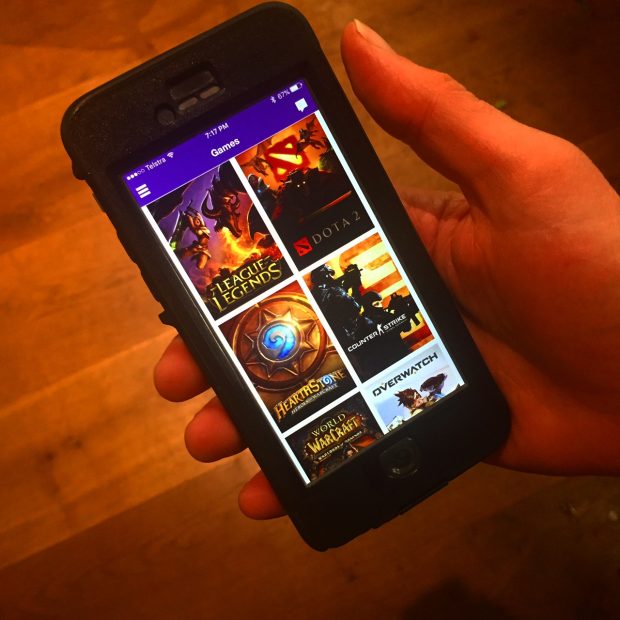
    DOTA 2, LoL, Hearthstone, PewDiePie, Suma1L, Dager, Evil Geniuses…Do any of these words mean anything to you? If they do you are probably up to date with the world of eSports. If not, hopefully this post will pique your interest in a world traditionally only available to ‘gosu‘ in the PC Bangs of downtown Seoul or ‘gamers’ in their dark-lit bedrooms.

    Gaming is now big sport with growing viewership worldwide thanks to platforms like Amazon’s Twitch. Just this month, the 2016 edition of the The International, DOTA 2’s (a game) biggest tournament of the year, was held in Seattle. The total prize money for the tournament was US$20 million. To put that into perspective, the Australian Open Tennis total prize money this year was US$31.1 million. This is a sport that may seem very niche but one that is fast becoming recognised (at least in prize money) as a spectacle comparable with traditional athletic pursuits and other content.

    Media and telecommunications companies in Australia and globally are beginning to seriously consider eSports as a media property and growing business. However, is it all it seems to be? How big is it? Why invest in it? This article looks at these questions and others to uncover the business of eSports.

    Gamers and Esports viewers 

    It is important to consider alignment to core audience or growth audiences if looking to invest in eSports. So – who plays and/or watches eSports? According to Activate Inc. Tech and Media Outlook this market is 75% millennial (ages 18-33) and 82% male – Probably not surprising. This is an attractive market segment for many media and telecommunication companies. Globally it is estimated that there are over 150 million regular and occasional viewers of eSports which according to Deloitte’s 2016 TMT Predictions is up ~25% from 2015. Much of this fan base is in South Korea, China and US but it is expanding with large tournaments being held in Australia.

    Viewer value

    With a large viewership also comes the value associated with it.

    eSports prize money is growing.The top ranked DOTA 2 player in 2015,  Peter Dager, earned over US$2 million, nearly double that of the top ranked player in 2014.The revenue from viewership is also growing.

    In 2016, it is expected that the revenue generated by eSports viewership from rights, subscriptions and ticket sales will be in the order of US$500 million. This according to Deloitte is up ~25% on the 2015 figure and according to at least one analyst heading for $1.2 billion by 2018. This is a growing market – one that is growing faster than any other ‘sport’ in the world.

    Companies looking to take advantage of this growth should consider where and how they can create and capture value. There have already been a number of high profile acquisitions and investments in the eSports market mostly in digital viewership platforms or viewing spaces/theatres . Amazon acquired Twitch for just under $1 billion in 2014, while 2015 saw Swedish media company Modern Times acquire a majority stake in ESL, the oldest eSports company for $87 million. Russian investors have committed $100 million. Canadian motion picture exhibitor Cineplex is spending $15 million to acquire an eSports company and create a new gaming league that will take place in its theatres, and the first dedicated eSports venue has been opened in the UK in partnership with a cinema chain.

    Growing but comparatively a very small market

    Despite the attractiveness of eSports in terms of demographics, prize money and viewer numbers the total revenue (US$500 million) is by global standards comparatively small. European soccer and all major league sports in the US are expected to eclipse eSports revenue in 2016. Soccer, which has been a significant investment for cable and telecommunication companies in Australia (Foxtel, Optus) and worldwide (BskyB, BT) is expected to generate US$30 billion in revenues and NFL Football, the largest of the US sports, is expected to generate US$11 billion.  The NHL, the smallest of the US sports, is US$4 billion – nearly 10 times the size of eSports. Looking forward – even if eSports grows to $1.5 billion in revenue, as some predict it will, this represents one percent of global sports revenues of over $150 billion. A small drop in a large ocean.

    So what to make of the business of eSports?

    As a phenomenon, eSports is intriguing – to get a sense of the hype just watch a PewDiePie video or a Twitch channel. As a business it has challenges. Organisations expecting to generate the kinds of returns they obtain from other sports or content may be underwhelmed. However, there some adjacent upsides to consider. These include the ability to reach millions of people on a regular basis in an attractive demographic, the different revenue models available in gaming formats (e.g. subscriptions, ‘freemium’, in-app purchases), and the relationship between gaming and exponential technologies like Virtual and Augmented Reality. Companies that are able to capture value from eSports’ adjacent applications will have the best chance of capitalising on this billion dollar niche.

  • The case for ‘place as a platform’

    The case for ‘place as a platform’

    Platforms have grabbed unprecedented attention in the digital era. This can be partially attributed to the hype surrounding internet-enabled platforms in every realm of commerce. A deeper reason that platforms have lately captured the attention and imaginations of business leaders is that they enable a “pull-based” approach to serving customers profitably. The opposite to this is a “push based” approach which requires anticipating customer demand and bringing the right resources and people to produce the right quantity of a good or service at the right time. This approach is efficient if the forecast is right… but this is a big ‘if’ – particularly in the industries that have a fixed physical space or place as the cornerstone of their business.

    In recent times, pubs and restaurants in Sydney have experienced rising property, labour and supply costs compounded by increased competition and enforcement of ‘lock out’ laws (no new patrons after 130am). To illustrate the impact of these factors on hospitality, there was news recently of the sudden collapse of Sydney food and pub group Keystone, which runs the Australian franchise of Jamie Oliver’s Jamie’s Italian. The news article points to a simple story: “overreach in the competitive world of food and beverage and too much debt.” But, there is something more to it…The world has fundamentally changed since many of today’s venues (around the world) were established. How and where people choose to spend their time and money has fundamentally changed and the network of suppliers that support venues are now more digitally savvy than ever.

    This post looks at the case for ‘place’ as a platform – or said another way:

    The opportunity created for venues or physical spaces by the convergence of the digital and physical worlds providing layers of capabilities and standards that other players in that market can tap into and use.

    To illustrate, the post will briefly run through four different characteristics of place as a platform. Before this, it is hard to talk about ‘place as a platform’ without mentioning the recent phenomena of Pokemon Go. Not to dwell on the features of the augmented reality game (as it has been covered in numerous blogs) but it demonstrates how the concept of ‘place’ is changing. Pokestops, lures and hosting Pokemon gyms in a venue (e.g. restaurants, museums, parks) is an example of how the physical and digital are melding together to create new uses for space and new ‘pull factors’ for venues characteristic of platforms.

    Four characteristics of place as a platform

    Pop-up vs Permanent

    Many venues are founded with the intent of becoming permanent fixtures. This is best suited to a traditional world where people have a favourite place to go to or where affinity with patrons is created mostly by proximity to a venue. It is aligned to the “push model” of customer acquisition. Platforms however need not be permanent – by their very nature they are fluid in the way they bring new players (customers and suppliers) together to create value that is decoupled from a permanent fixture or focus. The growing trend in the retail industry towards short-term leasing and pop-up stores is an example. Pop-up stores aim to test new and alternative retail offerings with customers, maximising their returns in a short period of time. Large retail property companies like Westfield are embracing this trend creating space for short term leasing in their malls. The opportunity is to do the same in hospitality creating the conditions to maximise value in a short period of time through scarcity, exclusivity and test and learn principles.

    On-demand vs Linear

    Closely related to the concept of a pop-up venue is that of a venue on-demand. The ‘physical world’ has a lot to learn from the trend in media to on-demand content and ‘binge watching’. Traditional venues have opening hours, waitlists and queues. Platform venues are transparent, opening up their schedules, seating plans, customer details and menus. They are democratised by allowing customers to choose when they should open and what they should offer. They are also variablised – staffing up and stocking up based on demand rather than ‘potential demand’. To enable this, the economics of the venue need to be determined using on-demand principles (e.g. What is the number of people required to open the venue on Sunday at break-even or higher).

    Participants vs Patrons

    Participation is a common requirement for many internet-enabled platform businesses (e.g. iTunes, Airbnb). This can be in the form of membership to the platform or participation as a developer building on the platform. Membership helps to create stickiness and orients the platform around the pull vs. push mechanism for customer acquisition. It also supports the customer experience and alignment with the venue’s success. For places to become platforms, membership is likely to be a core enabler. This is not a new concept in hospitality, in fact is is very similar to many ‘clubs’ in the world. Consequently, membership allows for governance of the place as platform. Members agree to the terms of the platform and the experience is then fixed around those principles. Place as a platform will require a base level of membership but the opportunity to monetise off non-members (e.g. pay-per-use, extensions of place (e.g. food delivery from the kitchen)) then exists.

    Then there are other participants outside of members – ‘the developers’. Companies like Deputy which helps businesses manage bespoke work forces or accounting software like Xero are ‘plugins’ into the venue. Place as a platform will allow many participants to ‘play’ in the physical space not just patrons.

    Scale vs Single use 

    Platforms are scalable which is almost the exact opposite of how most venues are set up. Many hospitality businesses ‘fixed to place’ with the exception of franchise models which are formulas that can scale out across multiple places (e.g. McDonalds, KFC etc.). Redefining place as a platform requires a level of modularisation of the experience, products or services from the venue. Where possible these aspects should be digitised to allow for distribution and replication. For example, the sign-in/booking process and software, the member notification services or even the menu could be adopted by other venues.

    There will always be a place for traditional venues – not every successful business is a ‘platform’. But the case for place as a platform is becoming clearer. The divide between digital and physical is closing which opens up new opportunities for places to interact with venue goers and suppliers in a platformatised, pull-based way. The venues that adapt by offering pop-up concepts, on-demand to participants (rather than patrons) and at scale, will be best place to capture value in a digital+physical world.