Blog

  • ‘Are you all in or all out?’: Telecommunications and media strategy in an age of context

    ‘Are you all in or all out?’: Telecommunications and media strategy in an age of context

    Last week I had the pleasure of hearing Robert Scoble (Scobleizer) speak at a Telstra sponsored event. His talk focused on the ‘age of context’ trends (Sensors, Wearables, Location, Social, Data) which are covered in his 2013 book of the same name. There were also numerous references to the ‘freaky line’ in regards to the pervasiveness of digital products and services in our lives. Scoble encouraged the audience to consider whether they were ‘all in or all out’ with regard to data shared online – Scoble is ‘all in’. He also implored that as connected technology continues to become a bigger part of the way we live it is inevitable that we will have to ‘give Mark Zuckerberg the data he wants’.

    Whilst contextual trends continue to mature with the recently announced Apple Watch (and other wearables like it) which is likely to capture many hearts and minds (I’m undecided) and increasing use of apps like Google Now and Tapingo (which offers you products and services based on your habits), many companies will need to consider how to incorporate these into their strategy and business models. For Telecommunications and Media companies context can lead to 1) new ways of communicating and contextual content, 2) offering greater value to customers, consumers and advertisers from existing products and services and 3) improving the way companies operate. In each case however, for context to be successful as part of a strategy, policy (e.g. privacy regulation, company policy, workplace relations) and cultural (e.g. ‘are you all in or all out’, sharing data with people) change needs to be addressed as an enabler to not only the enterprise benefits but the social benefits of context.


    1. New ways of communicating and contextual content

    For telecommunications and media companies there are many possibilities to differentiate using context. Context can for example change the way we communicate with each other. The Apple Watch is offering people new ways to communicate through sensors in the band and watch. With this functionality one would have the ability to tap someone, share your heart beat and ‘share a squiggle’. Adding context to traditional messaging could turn SMS messages (with little context) into messages that place both the sender and the recipient in the moment in which they received it. For example, having just finished a marathon a message could be sent with a stat on my location, picture of the medal, video of the finish line or a time lapse of the whole race and the pulse of my (resting) heartbeat. With the addition of context to communication people will be able to experience (see, feel, and smell – see Scentee) each other’s lives in a whole new way.

    For media companies, adding context can lead to new types of content. Sports, which equates to the lion’s share of advertising revenue for media companies in Australia and globally could in the near future change to more contextual based content. For example, Australian company Catapult Sports which is the world leader in elite sports analytics, could turn its analysis into content which provides context (real-time) about how the game is being played and what the winning factors are. Like context in communication, new contextual-based content will deepen the meaning and engagement for audiences providing new forms of ‘reality’ viewing.


    2. Contextual services and contextual advertising

    There has been much written about adding context to services. UBER cabs is a classic example of providing context to a the traditional cab ride. Not only can a customer see where the cab is and when it will arrive, the use of ‘surge pricing’ when cabs are in high demand provides context to the market for transport. Telecommunications companies could add context to their existing services through the use of mobility and tracking. For example, setting up communications services in a dwelling can be difficult for many customers. Providing contextual troubleshooting, which could be triggered from a QR code on a router via mobile, supported by a video link to a problem solving technician video could reduce the need to send an expensive technician. In the case where a technician is required in person, their job could be made quicker and more user friendly by receiving contextual information on the fault before being deployed.

    Contextual advertising works in a similar way. Based on the context of a particular consumer, advertisements can be placed (by mobile or on billboards) to attract a purchase response from a consumer. Tapingo is an excellent example of this in that it learns your routine and offers goods and services based on your routines. It applies to content related advertising as well. Armed with knowledge of the context in which someone is engaging content (with family & friends, in bed, on the couch, at home or at a pub) advertising can be even more targeted.


    3. Improving the way companies operate

    Ever wondered why some people stay later in the office than others? Are they actually more or as productive as the person who comes in at 9am and leaves at 5pm. Contextual tracking of employees could provide these answers and help to influence the positive working behaviours of staff. The same could be applied to assets. Traditional telecommunications and media companies are asset intensive (network infrastructure, broadcasting stations, print press) which means that low utilisation of assets or poor maintenance can lead to lower return on capital. Adding contextual analysis and data to these assets has the ability to improve utilisation (e.g. where is the best location for a new network tower?) customer experience (e.g. where are our customers or our competitors experiencing drop-outs?) and maintenance (e.g. which location is likely to lead to the most wear and tear?). These are just a few examples of context as it could apply to improving the way companies operate – there are many more.


    We are at the dawn of ‘the age of context’ as Robert Scoble tells us. There are many opportunities for telecommunications and media companies to create new ways of engaging customers, servicing their needs and operating more efficiently. Standing in the way however are some very tough policy hurdles (e.g. workplace agreements on employee tracking) and entrenched cultural patterns including skepticism surrounding the use of personal data. Giving away your context as a customer, consumer or employee comes with Orwellian connotations (and possibly consequences) and should not be taken lightly. It does seem though that a tipping point will be reached as the proliferation of context ready devices (e.g. sensors, wearables) reaches common use and more people are compelled to be ‘all in’ than ‘all out’.

     

  • Hope is not a strategy for startups and small to medium sized businesses

    Hope is not a strategy for startups and small to medium sized businesses

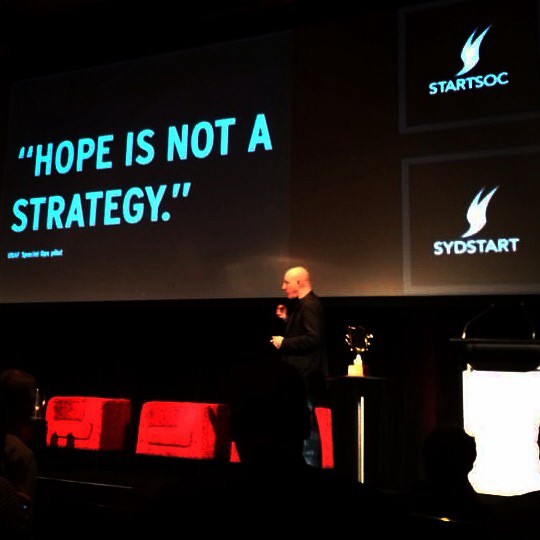
    Strategy for small businesses was top of mind this week with SydStart and the ‘Future of Small-Medium Business’ Summit held in Sydney. Though very different in the purpose, attendance and dialogue I encountered some interesting insights on strategy, startups and small to medium businesses (SMBs) in Australia.

    SydStart founded by Pete Cooper (@Pc0) in 2009 is the largest professional tech startup conference, expo and community in Australia. The event gives a voice to people ‘who have done cool stuff’ and people ‘trying to do cool stuff’ from Australia’s tech start up ‘eco-system’. In the first category the speakers included the likes of Atlassian’s Mike Cannon-Brookes, Freelancer’s Matt Barrie, Canva’s Melanie Perkins and Brigade’s (ex-Causes) James Windon – all representatives of successful tech startups or VC-backed ventures. Talks ranged from the reflective (‘5 lessons learned from social media’) to the practical (‘How to attract funding’ or ‘How to assess a business opportunity’) to the aspirational (‘How to make the public sector more engaging’). In the ‘trying to do cool stuff’ category there were pitches from 10 Australian startups with the car analytics and social community GoFar winning the best pitch.

    The ‘Future of Small-Medium Business’ Summit had a very different feel. Attended by mostly corporate spectators it featured a panel discussion from Telstra’s CEO David Thodey (a very large business), the Shadow Minister for Employment and Workplace Relations Brendan O’Connor, Red Balloon CEO Kristie Buchanan and Birdsnest.com Founder Jane Cay. Discussion focussed on very practical topics such as use of social media for small business, global nature of Australian small digital businesses, the government’s support of small business (or lack of it) and some interesting ‘in the trenches’ stories from Jane and Kristie. Overall the discussion was further from the ‘edge’ than any of the sessions at SydStart in terms of small business innovation and investment however it provided very practical commentary on owning, operating and growing SMBs.

    In the course of the two sessions there were a number of comments about the startup and small business landscape in Australia. Below are 4 comments charting the nexus between strategy and small business highlighting the importance of strategic thinking for even early stage businesses:

    1) ‘Most innovation in Australia comes from small to medium businesses’ – David Thodey

    As many large Australian businesses look to reverse disruption that has affected their core businesses or step ahead of the next wave of disruption it is easy to see how SMBs could be considered as the innovation engine room of Australia. This comment reflects the idea that as small businesses are lean, able to adapt to change and test and learn as a function of survival. For SMBs the ability to continue to innovate (business models, offerings and experiences) should be considered a key part of their strategy, particularly as they scale, attract new customers and attention of new competitors.

    2) ‘Your investors should help you achieve your goals’ – Mike Cannon-Brookes

    Strategy is as important to investing as the money itself. Whilst there is considered a funding gap for startups and SMBs in Australia between $500k and $10m, there is plenty of money for great ideas and most importantly those with strategy. It also works both ways where selecting an investor is about their ability to help achieve the wining aspirations of the startup. This may mean taking a reduction in valuation to get the right set of skills on board.

    3) ‘I spend very little time thinking about my competitors or the government’ – Jane Cay

    Running a startup or small business as a lean operation is hard work (packing boxes, managing accounts, responding to customers) which often means there is little time for strategy. Whilst most small businesses have business plans, setting time aside to think strategically (e.g. ‘where do we want to win?’ ‘where will we play?’ ‘how will we win with our offerings in the markets we play in?’) will allow for focus as scale is achieved.

    4) ‘If you can’t smell the fire burning you haven’t sniffed hard enough’ – Mike Cannon-Brookes

    Running on a lean operating model and building scale requires both an build and operate mindset. As you build, test and refine and transition to operate there are bound to be fires that need to be put out (e.g. revenue leakage, system failure, process breakdown). Executing on a strategy is always less than a perfect process, it requires time to test, learn and improve as you move towards your goals.

    The is no shortage of good business ideas in Australia – in fact there are a lot of great business ideas in the startup/SMB community. However, for each great idea setting winning aspirations and defining the choices to reach those aspirations are as important for startups/SMBs as they are for Australia’s largest businesses. A well thought out strategy can enable innovation, attract supportive funding and advisor talent, bring busy founders out of the ‘day to day’ weeds of operations and set a course to test, learn and refine.


  • Disrupted becomes disruptor: 3 areas where Telecommunications and Media companies should be investing

    Disrupted becomes disruptor: 3 areas where Telecommunications and Media companies should be investing

    Media and telecommunications companies have born the brunt of the first wave of digital disruption which has led to reduced profits, distruction of traditional business models, reconfiguration of capabilities and the rise of new digital businesses. Those who have invested in digital transformation (by adapting to customer needs, creating new digital products and services, capturing value from digital and internal efficiencies) and are alive to tell the story are now in a position to invest in the next wave of disruption with the mindset of the disruptor – the disrupted becomes disruptor.

    I am sure many media companies are wishing they invested in RealEstate.com early on or for telcos Whatsapp or Viber. Whilst these opportunities are not as apparent in media and telecommunications these days, I believe there are 3 other areas in Australia that are ripe for investment on the basis that the impact of digital disruption to the broader economy would be high, the unmet needs are matched to media and telco capabilities/offerings but they are not yet disrupted or lag the rest of the world in digitisation.

    The 3 areas are Democracy, Identity and Health. To emphasise, these areas are not yet disrupted and in each the largest lagging factor is policy and culture. Any investment in digital offerings would need to be accompanied by campaigns to change policy and to culture which media and telecommunications companies are in a strong position to undertake.

    1) Democracy – the digital voter and politician

    The opportunity here is to digitise the democratic process in Australia. Australia is one of only eleven countries where compulsory voting is enforced which means that being informed as a voter is central to better decision making and a better country. Whilst other aspects of our lives have become more transparent, mobile, social and simple – the simple act of casting a vote remains a manual, untimely, and disconnected from the issues. Not to mention the cost to administer the electoral system.

    In America there are a number of startups looking at this – POPVOX, Code for America, the Sunlight Foundation and Brigade. Brigade President James Windon says his company is looking at bringing technology to the democratic process to make ‘having your say’ more gratifying, he believes “technology is making people feel increasingly powerful…but politics is making us feel increasingly disempowered”. Brigade, though in its infancy, may have a solution putting decision making, literally in the hands of voters – swipe left for cuts to health care, swipe right for increased health care funding.

    What media and telecommunications companies could do here is own the digitisation of the voter lifecycle. Media companies in particular already play a large role in shaping public opinion, it wouldn’t be a big step to facilitate the process. The knowledge gained on voter choice could also influence content and advertising choices.

    2) Identity – the digital me

    Closely tied to the concept of democracy is the ability to identify yourself online. The opportunity is to have a single identification to all online properties and activities. The old 100 point ID check is still used as a primary means of identification but even that has its flaws in terms of authenticating a user.

    In Australia and globally a number of organisations are looking at this problem, but not yet with holistic success. Australia’s greenID uses third party sources and screen scraped data to ‘triangulate’ that you are indeed who you say you are. If you are interested in buying Bitcoin you will be asked to perform a greenID check. Other organisations have looked at vertical specific ID solutions such as Valimo Mobile ID which combined with Norway’s BankID allows high assurance identity checking on all mobile banking apps.

    For media and telecommunications companies the opportunity is to provide identification services to consumers and businesses. The power being not only the ability to understand the consumers behaviors but also to facilitate access to networks, content and services which will use networks. One can picture a connected world (SIC: ‘Internet of things’) where humans and machines have IDs which are interconnected and essential to the concepts of ownership and access.

    3) Health – the digital cure

    It is fair to say that although Australians lead the world in medical and scientific research, we lag the world in the digitisation of medical services. Also tied to identity, the ability to access medical records, services and knowledge digitally is far behind countries such as the USA.

    In the US, a company such as Theranos which offers ‘in pharmacy’ (e.g. Walgreens) blood testing and diagnostic labs making transparent, less invasive testing accessible for thousands of people is an example of digitising a basic medical service. The company has plans to personalise this through mobile devices but it is only 10 years into its journey. In Australia there are some fringe examples of medical digitisation with companies like HealthEngine making doctors appointment books more accessible and MyFilmBag allowing patients the ability to store and retrieve their X-rays and scans digitally.

    The opportunity for media and telecommunications companies is multifarious. Much of media content is health and lifestyle related (e.g. Biggest Loser) and integration into digital health would be a logical step. Equally, communication services are an integral part of medical knowledge and advice. The ability for media and telecommunications companies to select the right investments but also shape public policy and culture on e-health will be key to succeeding in and digital health revolution.

    In the not so distant future the areas of democracy, identity and health will experience the type of digital disruption that media and telecommunications has experienced in the last 5 years. Those who have survived have the opportunity to play disruptor in these areas. It will however take more than creating or buying the next digital business, it will require influencing policy makers and the cultural attitudes of Australians in order to bring about the magnitude of change that we have seen in other industries.

  • A win for Australian innovation and Telstra – the verdict on Muru-D’s first round

    A win for Australian innovation and Telstra – the verdict on Muru-D’s first round

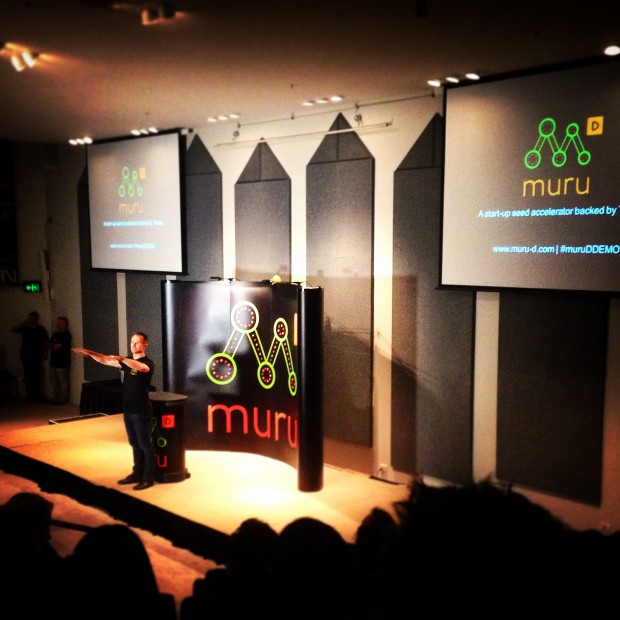
    Last week I attended the demo night for Muru-D‘s first round of start ups. Muru-D, in the words of Charlotte Yarkoni (President of Global Applications and Platforms at Telstra and Muru-D co-founder), represents Telstra’s plan to build a ‘healthy and robust innovation ecosystem across Australia’.

    The demo night, attended by Telstra CEO David Thodey, startup mentors, angel investors, private equity, advisers and corporates was presented as a sort of ‘score check’ on how this vision of an ecosystem is shaping up in Muru-D’s first year. With 300 startup applications and only 9 chosen to enter the incubator, it was not surprising that the quality of the business concepts presented on the night was of a higher standard than you might get at a university equivalent. This was only matched by the maturity of the ideas with some already attracting large customers and deals to continue scale growth.

    The 9 pitches shown on the night were all digital businesses attacking consumer, business and government needs across a range of problem statements including – providing better education, safety reporting, photo solutions for health and ecommerce and financing for small business. Regardless of the problem statement being solved, all the concepts were innovative, some were achieving scale and a few were already generating decent earnings.

    The idea with the most disruptive potential was Momentum Cloud (education) a personalised learning platform which aims to build a stronger relationship between teachers, parents and students through an online forum. Parents can interact with their child’s teacher in setting goals and manage/monitor learning outcomes through a range of tools. Already established in 275 schools, Momentum Cloud has the potential to revolutionise the traditional learning environment.

    Other ideas on the night were examples of sustaining innovation. Take Safesite, a digital site safety management platform. This platform allows worksite teams and safety managers to photograph and report safety incidents in a digital form. Equally, Farmbot is bringing farming to the ‘internet of things’ by adding sensors to parts of a farm (e.g Water tank, feed bin) which then provide data to farmers on usage, occupancy and the effect on the crop or livestock. Others, like Pixc or Vistr looked to improve a process and information for small business owners.

    But there was more to the night than watching 9 impressive pitches from young (mostly) entrepreneurs. In the small auditorium in the back blocks of Sydney’s Surry Hills (and beamed live to Melbourne) a slice of the ‘innovation ecosystem’ of Australia was meeting. In the networking after I met people from large corporations looking for a business to bolt into their operations, venture capitalists and angels looking for a prospect, advisors looking for new ideas to talk to their clients about and students looking for inspiration. If this were Charlotte Yarkoni’s desired start to Muru-D it was a success.

    Telstra stands to gain a lot from this venture. Whilst no doubt there are some costs involved (renovating an old exchange, capital for 9 start ups, etc.) at worst Telstra has been seen to be promoting innovation in Australia where there is a significant gap from either the public or private sector. The more likely outcome is that Telstra will end up with a stake in a number of successful businesses providing new revenue streams (from new business models) to offset a disrupted core (PSTN) business. This will come with the added bonus of changing the culture in its heavily engineering based business and promoting innovation in the Australian business community.

  • ‘Sharetelco’ – applications of the shared economy to Telecommunications in Australia

    ‘Sharetelco’ – applications of the shared economy to Telecommunications in Australia

    Sharing is quickly gaining acceptance as an alternative way of thinking about property. Services like Airbnb, Uber, GoGet, Flyte and numerous local car and bike share schemes enable consumers to share their assets in return for some sort of benefit. The reasons for sharing can be monetary, altruistic or environmental – a Nielsen survey conducted in late 2013 found that in Asia-Pacific 78% of people are willing to share their assets with 81% willing to share from others. What is clear is that traditional B2C markets in many industries must now consider the disruption brought about by C2C facilitators – unless they themselves offer sharing alternatives or facilitate the sharing of assets.

    Telecommunications companies tend to pitch their products at the individual consumers or businesses with personal devices and single person plans for mobile, broadband and content. There are some considerations in a telco environment about what is ‘owned’ (do you really own wifi and data?) and what can be shared, however if you take consumer ‘assets’ as the example there are a number possibilities. The market in Australia is already changing with the major players offering sharing of data between devices. This however, is only the tip of the iceberg in what could be a larger more holistic sharing of telecommunications services and assets. Below I explore sharing concepts as they apply to network, data and devices – three core consumer telecommunications products.

    1) WiFi/Network sharing

    In 2006 Martin Varsavsky founded Fon in Madrid. He was inspired by the idea that the whole world could be cloaked in WiFi, thus removing the need for mobile broadband networks. Fon is now the largest WiFi network in the world with 12 million hotspots in over 100 countries. The network allows a subscriber to use WiFi at home but also anywhere a FON hotspot exists all off the same plan – in Varsavsky’s words “share a little WiFi at home and you can roam the world for free”.

    We are yet to see Fon materialise in Australia however the wheels are in motion. In May this year Telstra announced a deal with Fon to roll out 2 million new hotspots leveraging customers’ home routers. The company sees this as an opportunity to complement its LTE roll out by reducing load on its 4G mobile network.

    2) Data sharing and Content

    Wanting to offload a few gigs spare at the end of the month? The ability to share data (spare or otherwise) between friends, family or a business/community is a concept that has been dabbled in – for example Vodafone Australia’s ‘Shared Mobile Broadband‘ allowing businesses to share data between 5 employees to a total data plan and 2degreesmobile in New Zealand which outs sharing at the heart of its value proposition. What is missing which these plans is a more holistic sharing experience with the ability to ‘gift’ data to other users or see a social network of users to provide a top up to.

    Data sharing has another application – content. How many people do you know who have downloaded Breaking Bad or Game of Thrones? Users tend to download very similar content from the net time and time again. If this were able to sit cached on a shared server and be accessed instead of downloaded then it would have many benefits. Benefits could include being able to access the content but not use your data or reducing strain precious bandwidth. There are of course issues with illegal downloads but not all content would fit in this category.

    3) Device sharing

    ~50% of Australians now own a smartphone and almost as many own a tablet. With new models being released annually (or quicker) there are many consumers with more than one of these devices and a portion which could be shared or sold on secondary markets. Other industries have developed sharing solutions for tangible assets (e.g. property, cars, bikes) which have turned into sizeable markets.

    A solution which allowed for simple access (shared or other) to the oversupply of devices may allow Telcos to access markets which are not able to access or interested in a 2 year contract and new device (e.g. theoretically at most 50% of the population). The ability to also ‘bring your own device’ (BYOD) with the requisite support for access and connectivity is a success factor to this solution. If successfully implemented, a shared device telco may reduce device related servicing and supply chain costs for this segment whilst allowing Telcos to make money selling data, content and other services.

    Globally there some emerging applications of the shared economy to telecommunications. However, its manifestations in network, data and devices or a combination are not yet prevalent in Australia. Strategically this represents an opportunity to serve customers (existing or new) in a different way, effectively creating or accessing new markets where previous barriers existed – after all that ‘new phone feeling‘ may actually be the ‘shared phone feeling’.


  • New business models of the ‘seamless’ communications service provider highlight difficult strategic choices

    New business models of the ‘seamless’ communications service provider highlight difficult strategic choices

    A new communications service provider (CSP) is emerging and it is smooth. Customers will be able to access consistent experiences across all channels, operations will be harmonious through integrated systems and processes offering personalised billing, servicing and selling, and platforms will be uninterrupted offering ubiquitous data, cloud services and new technologies to customers. This is the future of CSPs, however the proximity of this future in Australia is debatable. With the rollout of NBN not likely to be completed before 2020 and continued regulatory limitations, an ‘end state’ is not likely to be reached in the near future despite the industry driving to more customer centric experiences and operating models.

    In a world of seamless customer experience, operations and platform integration a number of new communication service business models are likely to emerge. Some of the puzzles pieces that make up these models are already beginning to surface in telecommunications Globally and in Australia. In this post I briefly outline 2 potential business models in the the seamless world of CSPs.

    1. The ‘Data Market CSP’ (Data as a currency)

    When you strip away the complexity of telecommunications incrementalism, where customers are asked to purchase ‘contracts’, ‘plans’, ‘caps’ and ‘bundles’, in a seamless CSP environment you are just left with data. A kind of CSP provider could materialise around the business model offering a limited amount of data to customers across all devices. Each customer could buy a monthly share of data that could be used to download and upload content but also to trade with other shareholders. It would allow customers to use the data they need, sell the data they don’t, buy the data they want and gift to others. This is not Bitcoin, but one could forsee a situation where scarcity of data (at certain bandwidth) could become currency-like.

    2. The ‘free’ CSP

    Over-the-top (OTT) content providers are gaining prevalence globally and in Australia. Fetch TV and Tbox are examples of Australia’s OTT service providers with Netflix (up to 200k users in Australia), Hulu and Roku establishing footprint in UK and US markets. In a world where media and communications converge, a business model of ‘free’ data and access may exist in return for offering up your personal data or watching advertisements. Device makers and media companies alike are eyeing off this model as convergence accelerates globally. Amazon, Google and Apple each have mobile devices and OTT services which with access to data would open up the possibility of this model.

    These are just two examples of business model possibilities in an ecosystem of seamless experiences, operations and platforms. Whilst these concepts may only materialise in the relatively distant future, they represent disruption in the industry’s well established value chains, legacy businesses and pose threats and create opportunities for new growth prospects. This change is almost unavoidable and leaves leaders of Australia’s CSPs with difficult strategic choices – How to position for growth but minimise reduction in legacy revenue? Who to partner with and who to compete with? What is the right level of infrastructure investment and in which infrastructure? Which services will our digital consumers engage with now vs. in the future?

    For leaders of CSPs to make these choices with confidence it is critical that their winning aspirations or strategic intent is well defined. This intent should inform these choices but also be the driver of transformation in nearly every aspect of business to maintain differentiation and relevance.

  • Mobile apps and alternative online news sources are shaping the new journalistic organisation in Australia

    Mobile apps and alternative online news sources are shaping the new journalistic organisation in Australia

    Online news media engagement results released in the last month show a growing need for Australian news media companies to engage consumers through their mobile apps. In addition, data shows that the deck chairs in online news are shifting. Whilst the incumbent local news providers still claim top honors in audience engagement in Australia, overseas services/alternate news providers (typically free services) are increasing audience penetration in UK and US markets with some signs of local growth. Whilst a clear strategy for engagement through mobile apps is important now, a competitive strategy to combat the growing popularity of alternate news is needed…very soon. These factors combined will the development of new kinds of journalistic organisations globally and in Australia.

    Last week Nielsen published its audience results for online news. The headline results show that Australian-based incumbents such as smh.com.au, news.com.au and ABC news sites are still ahead of major international players such as The Guardian. In addition, Sydney Morning Herald has jumped to the top of the table in terms of audience but still lags its closest rival on time spent on site with news.com.au having +20mins more engagement time over the month. Interestingly, people spend on average 1hr and 27mins on news.com.au over the course of a month – this is just less than 3mins per day – Are we really engaged?

    Nielsen’s results this month also provided insight into how Australians consume their news. Through the IAB-Nielsen mobile pilot, an industry wide mobile measurement panel, we now have figures about how we connect through applications (apps). The first insights show consumers spending 18hrs per month on mobile and 15hrs per month on tablet news apps. Compared to the web properties this is a significantly higher level of engagement. How does this Australian data compare globally?

    Last month Reuters released its 2014 Digital News Report, a yearly survey of 10 nations outlining online news consumption trends. Australia is not one of the countries involved in the survey but those surveyed are representative of the larger economies in Europe, North and South America and Japan. A key finding in the report is the growth in mobile devices (smartphone or tablet) to access news with 37% of respondents in all countries surveyed using a mobile device to access news. This correlates to figures on apps. In the UK, 50% of smartphone users engage apps to read their news, an increase of 6% since 2013.

    The survey shows variability between countries on app usage with a country like Finland having a higher preference for web browser news than news apps. What is clear however is that smartphone users (as opposed to tablets) tend to use more apps (67% in UK). Australian new media companies need to assess their digital strategy to make choices on engaging consumers through apps or browsers and incorporating the functionality of smartphones into their engagement experience. The battle ground for news will most likely be won in an app.

    The Reuters survey also outlines the growth alternative news sites. Huffpost and Buzzfeed account for over 20% of weekly news engagement in the US and over 10% in the UK. Add to this the trend of accessing social networks for news (37% of survey respondents in US access Facebook for news weekly, 22% in the UK) and there is an increasingly changing landscape for online news media. These sites are yet to feature in Australian reports but will no doubt become increasingly popular. Australian news media companies will soon need to determine how their online properties will compete. I believe these strategies need to differentiate on functionality and engagement features rather than content.

    The online news landscape continues to change with new waves of disruption. Mobile and social consumption is reaching a higher level of intensity globally with similar trends emerging in Australia. Adapting is about making choices – choices that will turn online news incumbents into a new kind of journalistic organisation.

  • 5 insights for Australian media companies from NYT’s Innovation Report

    5 insights for Australian media companies from NYT’s Innovation Report

    In mid-May the New York Times (NYT) leaked its innovation report. The 96 page report was the result of a 6-month review into newsroom innovation and digital strategy at the NYT. At the heart of the report is an outline of the cultural change still needed in the shift to digital. It’s detailed, emotional and touches on everything from social media to print culture and how editorial works with the product, design, technology and business strategy.

    The report reflects on many of the challenges currently facing Australia’s ‘traditional media’ companies. In this post I summarise 5 insights which I believe are highly relevant to Australia’s media industry.

    1. Distributing online content requires more effort than traditional media distribution

    Australian media companies, like NYT, need to work harder to ensure that their content reaches the digital doorsteps of their target consumers.Traditional media in Australia (and globally) was based on a value chain where content distribution power was in the hands of few. The ability to deliver media into the hands of as many readers and viewers as possible was ‘one of the most-sophisticated customer-outreach operations in history’. The report (page 23) outlines that in the shadow of this large scale operation putting ‘journalism on the web’ adopted a passive approach – but in fact a new more proactive and even more sophisticated approach is needed. Consumers of media are finding and engaging with content in vastly different ways – these are the realities of a ‘cluttered internet and distracted mobile world’.

    2. In a digital ecosystem, strategy defines competition, not content

    Australian media companies, particularly free-to-air TV or newspapers, often define their competitor set based on a content lens (e.g. Biggest Loser vs MKR, Tennis vs Olympics). However, competition should be viewed through the lens of the strategies employed to win in a changing audience environment. For the NYT (page 24), Buzzfeed, HuffingtonPost and USA today are not succeeding because of their content, they are beating the NYT because of their ‘sophisticated social, search and community-building tools and strategies’. All this…is in spite of their content.

    3. The media company of the future is digital first, physical second

    Many of the publicised digital transformations in Australian media companies have been about dragging the physical business into a digital age. For the NYT (page 81) this is not enough: ‘the NYT needs to accelerate its transformation from a newspaper that also produces a rich and impressive digital report into a publication that also produces a rich and impressive newspaper’. For Australian companies that have undergone or are undergoing this transformation aggressively questioning traditional media assumptions is imperative and may mean that existing structures require re-building from the groud up.

    4. Digital capabilities and talent must be empowered to create content and define media strategy

    Digital talent in many traditional media companies is rare or at worst misused. As the battleground for audiences is not where traditional media companies like the NYT are strongest (the journalism or content itself) building ‘impressive support systems for digital journalists’ is a high priority. The NYT report (page 89) outlines that the newspaper’s digital talent (platform editors, producers and developers) were dissatisfied by the service role (administering and fixing) they play and need to play a more central role in shaping digital strategy and changing the way content is written for the web, mobile and social.


    5. A strong analytics operation is essential to the digital needs of media companies

    Whilst data analytics has become more important as a function for many Australian media companies, few are using it in a way which helps to inform decision making organisation-wide. The NYT report (page 94) outlines a problem from which many media companies suffer – ‘everyone forgets about metadata…all your assets are useless unless you have metadata’. The ability to personalise content, drive traffic to online properties, understand readers’ needs and measure success all rely on data. Without it, it is difficult to set goals and assess progress.


    Having been involved in the creation of similar reports for media and telecommunications companies I was very excited to read this report cover-to-cover and you should too. The style is raw in tone and candid in its discussion of NYT politics and the sense of ‘not doing enough, quick enough’ – not too dissimilar to other strategies with which I have been associated. The traditional vs digital debate still looms large in many of Australia’s media and telecommunications companies and we are bound to see other reports of this nature until leadership begins to acknowledge the gap between them and their digital troops – interestingly NYT’s executive editor Jill Ambramson stepped down days after the finalisation of the report…go figure.


  • How public events are influencing media and telecommunications business models

    How public events are influencing media and telecommunications business models

    In a World Cup and Winter Olympics year it would be remiss of me not to blog about how public events, large and small, are influencing the strategies of companies in the telecommunications and media industries.

    As I write this post, the VIVID festival lights up Sydney, contributing significantly to the Opera House’s 28% growth (CAGR) in digital visitation since the festival’s inception in 2009. The other major event in Sydney this week is the YouTube Fan Fest at Luna Park which brings local and global YouTube talent to the stage for fans to see and interact with their YouTube stars, live rather than over their screen. Whilst this is the first year that the YouTube Fan Fest has made it to our shores, it is likely to become a regular feature along with other ‘out of platform’ events from other media companies. Take Pandora radio as an example – they serve up passive listening through their ‘music genome’ based service on card radios through a My Link app in new model Holden and Ford cars. Public events are an extension of their business model. Pandora can host a public ‘off platform’ event that brings together listeners of a similar demographic for a concert by a band for whom they have a curated radio station. This can take place at a Holden dealership and be attend and sponsored by advertisers who can offer and test physical product samples with attendees.

    So why will we see more of these events? The secret to the success of ‘off-platform’ experiences in public events is that it provides media companies an opportunity to connect with their ecosystem in a physical context rather than online. It connects digital consumerism and digital social interaction to the physical – and well…there are some experiences that only exist in a physical world (e.g. Drinking Pepsi’s latest drink flavour with the lead singer of your favorite band and your best friends while listening to the band’s new album pumping out of a Holden Commodore).

    Public events are also influencing the telecommunications world. Ever been to a large public event and not been able to send a text to a friend because the network is jammed because others are trying to do the same? There is now the ability to ‘go off network’ to send your message through FireChat, an application that allows smartphones to connect to each other directly. As long as two devices (or bunches of devices) can connect to one another by Bluetooth or WiFi radio you’ll be able to chat. The technology is called mesh networking – it enables people to create their own network and become an extension of the internet. What better place to do this than at large public events? The way the use of these networks evolve and mature could potentially challenge telecommunications companies’ strategies to providing service to high density areas (e.g city specific strategies).

    The growth in these two trends – ‘off platform event marketing’ and ‘mesh networking’ is driven by social – not just in the digital sense but in the physical sense as well. Public events offer opportunities for media and telecommunications companies to drive new forms of customer engagement and in some cases explore new business models.

  • Why being public about data privacy is disruptive to media and telecommunications companies

    Why being public about data privacy is disruptive to media and telecommunications companies

    I recently attended a panel discussion with the Managing Director of Facebook Australia in which all the usual questions came up: How many people use Facebook? What does Facebook plan to do with Whatsapp? What is your value proposition? How do you guard from being the next Myspace?

    In a brief overview of the company, Will Easton outlined Facebook’s plans to optimise their social platform, ‘own’ the mobile ecosystem with individual and messenger apps and build the communication platform of the future. He also stressed the importance that Facebook places on user experience, saying ‘the whole company revolves around’ it particularly as Facebook sees itself as ‘the place where people’s social media journey starts’.

    What was missing from this overview of the company was any explicit mention of the role data privacy plays in Facebook’s strategy, business model or in Easton’s description of the company’s devotion to user experience. As users of Facebook, Google and almost any media or telecommunications company we trade the use of our data (for targeted advertising or other purposes) for the use of the platform or service or content. This idea is as old as the internet and has many advocates and just as many detractors – there is even an International Data Privacy Day. So why don’t media and telecommunications companies tell their users, explicitly outside the fine print, what they do with your data? And why isn’t the trade-off you make to use their product or service more prominent?

    There are countless examples of media and telecommunications companies that have come under increasing scrutiny for the way data is used. Facebook, Google, Zynga and Snapchat, just to name a few, have all been called out for cases where users’ data has been ‘misused’ or the use of the data ‘miscommunicated’ to the users. If you are interested in who has ‘got your back‘ this year on data privacy the Electronic Frontier Foundation publishes a yearly report on how companies protect your data from government requests. But are government requests the problem? Perhaps this view is more strongly supported in the US.

    Just this week Europe’s highest court ruled that people have the ‘right to be forgotten‘ by asking Google and others to remove some sensitive information from internet search results. This sentiment points to the idea that in using these services (like search or viewing content) you generate personal data which could be used against you by companies like Google. Perhaps trying to get a job at Google may be harder if you have some incriminating search queries. The flip side of this thought, is that the data you create actually supports you to make more informed choices through targeted advertising (goodbye random floating banner adverts).

    Where privacy and strategy meet is in the business model combination of: 1. data, 2. targeted access to customers and 3. advertising dollars. This is a $503bn market globally and $3.47bn in Australia. Here lies the protential for disruption – what would you pay to have your data kept private or forgotten on Facebook or Google in place of using their products and services? $10 a month? Perhaps you don’t care? Or perhaps using the service isn’t as important to you as your data or how it may be used in the future? Perhaps you want to be paid? There are already a number of companies exploring options around privacy like TOR or Trustlayers. TOR is software which fluctuates your IP and MAC address so as to remain undetected on some sites (obviously not those you choose to login to) and Trustlayers is an enterprise data privacy compliance software.

    Whilst this market is still small and perhaps only suited to the hypercondriacs and conspiracy theorists… it has disruptive potential. Media and telecommunications companies should consider bringing data privacy choices to the user, making them public and part of the user experience. This will help to combat growth in data privacy start ups, user abandonment and damaging regulation.