Blog

  • Twitter’s strategy: a ‘systems thinking’ analysis

    Twitter’s strategy: a ‘systems thinking’ analysis

    Twitter’s future has received a lot of press in recent times. From its convoluted ‘strategy statement’ released late last year to acquisition rumours ,with Google as an acquirer, this year. What is going on with this social media platform which currently has over 288M monthly active users, 500M tweets per day and a market cap of +$30bn? The answer may lie in an analysis of the system Twitter inhabits and the changing influence it has this system.

    The history of Twitter is similar to other social/search sites like Facebook and Google in that it was built for web but has matured into a mobile product making use of contextual and ‘real time’ functions like geo-location, messaging and ‘Live Events’. But it’s move into mobile wasn’t on its own. In fact, many 3rd-party developer apps (e.g. Twitteriffic, Tweetdeck, Tweetbot, Tweetie) set up as mobile Twitter clients shortly after the iPhone launch bringing the web experience to mobile and pioneering functionality that Twitter would later use on its own mobile platform. It is worth analysing this point – the interplay between 3rd party apps, mobile and Twitter – using a ‘systems thinking’ approach to shed light on what could be the future strategic direction of Twitter and potentially other social media properties.

    What is ‘systems thinking’?

    Simply put – it is the understanding of how things (objects, animals, businesses etc.), as parts of a system, influence one another within a whole. A good example is understanding an eco-system like a rainforest by analysing the plants, birds, bugs, weather etc. in the forest and how they influence each other. In business, it is akin to understanding the value chain, the actors in it and the influence they have on one another as they aspire to create value. For Twitter, the core ‘parts of the system’ (social media advertising) are businesses and consumers, social media platforms, 3rd party developers, advertisers and content 

    The Twitter system: Once open – now closed

    As outlined above, Twitter’s move to mobile was on the back of creations by 3rd-party developers. Since then however, the pressure to monetise and create shareholder value (post IPO) from its platform has led to a strategy of closing out parts of the system. There are 4 events that show this:

    1. In 2010 Twitter launched promoted tweets on its platform as a way to monetise. This is not dissimilar to other social media profit models that use advertising in the main social feed to attract users to products.
    2. To succeed in advertising it restricted 3rd- party apps (the same ones that had led it to mobile) to 100k user tokens which limited their ability grow and to control Twitter content in their apps, thus growing the propriety properties.
    3. Acquisition of MoPub in 2013 which is a hosted ad-serving business for mobile publishes. Its functionality allows app developers to serve up targeted advertising across mobile applications.
    4. Cutting off Meerkat: During SXSW last month, Meerkat a ‘one to many’ streaming video application launched which used Twitter APIs to promote live streams to your Twitter followers. Twitter had recently acquire Periscope (a similar offering to Meerkat) – justifiable in that sense but another sign to 3rd-party apps that Twitter wants to protect its 3rd-party platform – keeping engagement (and revenue) local.

    These events are logical given the pressure to monetise but it is possible to think of an alternate outcome for this system – one that is more open to other parts and for which Twitter could potentially generate significant longer term value.

    An alternate Twitter system: Once closed – now open

    Twitter like other social media platforms has a privileged asset – a unique understanding about its users’ identity (e.g. @petecorbett). It knows what users like and what their interests are by analysing who they follow and what they tweet about and this is powerful (Facebook only knows ‘who you are and who you know’ and Google knows ‘what you are searching for and when’). 

    Therefore, the thing that makes Twitter the company valuable in its system is not the features on the Twitter platform, the app or anything to do with the digital product (e.g. the 140 characters, #, @usernames) – rather, it is the knowledge of its user base. More specifically, it is the Twitter identities and the understanding that can be gleaned from how those identities are used and how they interact that matters.

    With this understanding (Twitter’s value is its users’ ‘interest graph’ and not the functionality and ability to monetise on its platform) it could play to win with a much more open approach to its system:

    1. Make the Twitter Identity central: The choice to increase advertising on the Twitter timeline should be replaced by ensuring as many people as possible have and use a Twitter identity (on the Twitter app or on 3rd party-apps).
    2. Open the identities up to 3rd parties to get people to build out their Twitter identity: 3rd-parties should build all kinds of apps that have a need to connect people with common interests, publishers would be an obvious candidate and maybe even an app that streams live video or allows people to share podcasts, live music – just about anything to get more people using the Twitter identity and building their interests related to their profile.
    3. Serve up advertising on 3rd-party platforms: Utilising Twitter’s MoPub business, serve up advertising off the Twitter platform, thus making Twitter ‘cleaner’ and increasing scope and scale for new types of monetisation.

    An approach like this is analgous to other platforms like Uber and Airbnb. Twitter could, if it chooses a different strategy in its system, be the world’s largest social media advertiser…with no advertising on its platform.

  • Mobile World Congress 2015: 5 trends you need to know about and their implications for Australia

    Mobile World Congress 2015: 5 trends you need to know about and their implications for Australia

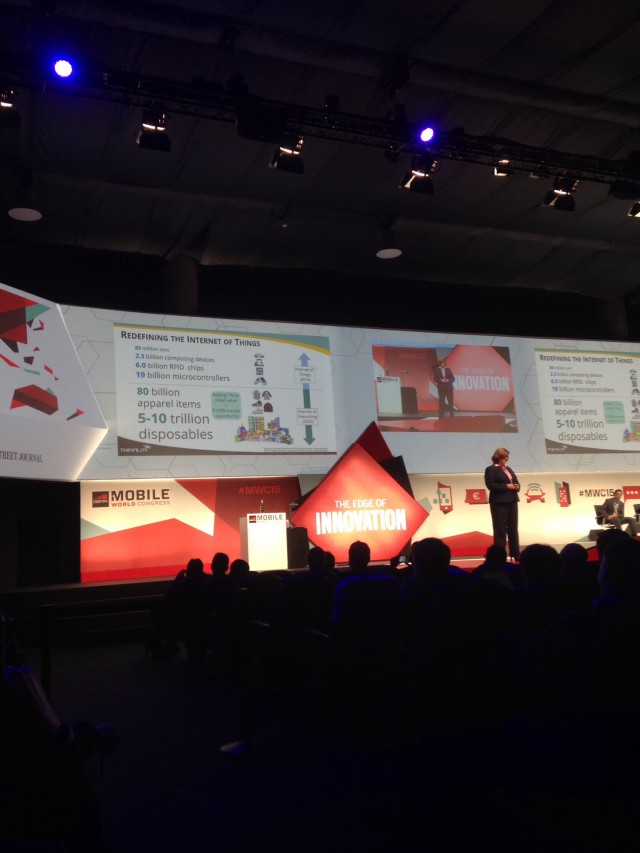
    During the Mobile a World Congress in Barcelona last month I highlighted in two linkedin posts the main themes from the events, exhibits and speakers I attended. A month on, I thought I would cover off the 5 major trends outlined at the event and their implications for Australia.

    1. 5G is still just a concept

    Possibly the most talked about topic of the conference was 5G, what can be expected and when. The reason for the excitement is that many players in the mobile ecosystem are looking to better network coverage, bandwidth, spectrum utilization, lower latency and power use to support increasingly larger numbers of devices and connected objects. Whatever 5G becomes the hope is it will address these challenges and create new business opportunities for traditional TMT companies and emerging players developing internet of things/M2M offerings.

    In Australia, 4G was rolled out in 2011 and the trend has been that a G is added every year. Given that Australia is 4 years in to 4G it could be sometime before 5G is deployed. That said, at MWC Telstra announced plans to partner with Ericsson to develop 5G which could be commercial by 2020.

    2. The concept of a ‘connected life’ is very (very) real…and coming to your life soon

    Companies manufacturing devices are now going well beyond smartphones and mobile connectivity. Many of the seminars at the MWC highlighted products of different form factors, particularly wearables, with mobile lifestyle at their core. On display were Ford’s smart bike, Will I Am’s connected fashion bracelets, smart furniture and smart toothbrushes which were just some examples of non-technology type brands moving into mobile technology. At the Innovation City pavilion connectivity of all types were on display including connected cars, connected infrastructure and devices that connect in and out of home.


    In Australia, many of these technologies will begin to appear in households, businesses and public spaces in the next few years – connected homes and cars in particular. And they will be connected by intelligent connectivity like Thread or other software defined network solutions. As a result there will be significant opportunities in the Australian market for data analytics, analysis and artificial intelligence to create meaningful linkages.


    3. Smart cities are of major interest to vendors but will require joint action from both public and private sectors


    Sustainable citywide connectivity was the topic of discussion at a number of MWC booths – connected roads, transport, water supply, sewerage, energy, waste management, lighting and public safety solutions were all on display. For many exhibitors, the smart city conversation focuses on scalability and the interoperability of IoT solutions across metropolitan systems. The question is, can cities afford these solutions? There was quite a bit of discussion about requirements for connected cities’ core infrastructure with new technology offerings and the associated cost/benefit.


    As has been pointed out in the Australian media – Australian cities are in no hurry to become smart and the smart waste/water solutions exhibited at MWC and other IOT conferences are at sot probably at the bottom of the list. Adelaide (Australia’s 5th largest city) intends to establish an innovation hub with support from CISCO focusing on smart transport, education and utility solutions. One of the key success factors in this deal is that there is no added financial outlay for the government. Like many things related to the IOT things including solutions across the value chain, partnerships are core to their success.


    4. Security and privacy are gaining prominence quickly…and there is no turning back


    With IoT a major trend, there was a noticeable uptick in security and privacy vendors at MWC. The key message being that as more items are connected and more of our information is in a virtual worl there is a greater need for security and privacy measures. Despite this very real risk and the pain it could cause there is too much value in the virtual world to turn back.

    One example on show was the Silent Circle Blackphone 2 smartphone and Blackphone+ tablet. Both run PrivatOS 1.1, an Android O/S that allows IT administrators to manage, lock and wipe devices. The Blackphone 2 also comes with the “Silent Suite,” which encrypts VoIP video and voice calls, along with encrypted messaging and an encrypted address book. These products are examples of the world we are moving toward where security and privacy are an added feature, a necessity and to some extent a luxury good.


    Data retention laws passed in Australia last week which will force telecommunications providers to keep phone and internet records for two years effectively standardising data retention across the industry. In parallel Telstra is offering customers new access to their metadata for a fee. These are changes to privacy laws which aim to make data retention consistent. What these companies and government do with the data is still not discussed but at the very least a level of transparency surfaced. Australia will need to further beef up security and privacy laws when things like driverless cars become commonplace.


    5. Social media companies are bringing internet to the rest of the world which may disrupt industries in new ways


    Mark Zuckerberg’s keynote at MWC focused specifically on Internet.org and the partnerships Facebook, Google and other the social media behemoths are entering in with telecom carriers – or potentially become carriers themselves. The full market impact is still to be realized, but if these deals begin to gel, there could potentially be a huge, disruptive transition in the way telecommunications services are managed and offered.


    Living in Sydney or Melbourne it would be hard not to have noticed a bus shelter or TV advertisement for Facebook’s Internet.org. Why advertise Internet.org in a country that has a reported internet penetration rate of 94%? I believe the other 6% need access to the internet but this is limited to the most remote areas of Australia. The other view of this is that Facebook is garnering support for its plans to be the internet provider for the ‘rest of the world’, the 68% that have no internet. They will need support not just because of this massive undertaking but because the opposition they may face as an advertising company providing internet access.


  • 3 reasons why enterprises should embrace the shared economy

    3 reasons why enterprises should embrace the shared economy

    I wrote in a previous post about the shared economy and how telecommunications and media organisations could embrace its principles to generate new revenue opportunities – but it could also be time for enterprises to start adopting the likes of Uber and Airbnb as operational enablers. Whilst consumers have started to use these services very few enterprises, particularly in Australia, have adopted sourcing policies which set these companies as preferred suppliers or operational enablers. This despite the fact that Uber is now the world’s largest taxi company (valued at $41bn) and Airbnb the largest accommodation company (valued at $20bn) though neither own a taxi fleet or real estate.

    Below are three reasons why adopting these companies as preferred suppliers or operational enablers could be beneficial tactically and strategically for enterprise:

    1) The shared economy is cheaper for your enterprise

    Travel is typically a large line item on most enterprise P&Ls and taxis/accommodation make up a good portion of that cost. Uber’s, Uber 4 Business offers ~30% discount to regular taxi fares, which added to the ability to ride share as well as reducing time taken waiting for taxis could add up to about a 40% (my estimate) discount on taxi travel. Airbnb is similar – the average accommodation cost at a hotel in Sydney with a corporate rate is about $200 per night whilst the average room per night in Sydney on Airbnb is $120 (a 40% discount). If you assume the annual travel bill for a large enterprise (5000 employees) is $25m and at lease half is hotel and taxi related then at ~40% saving could net a benefit of ~$5m per year. Not an insignificant number.

    Sure – there are concerns for the quality, safety and legality (particularly UberX) of these platforms which need to be mitigated. However, enterprise could open up ways to mitigate these risks through enterprise specific ratings of cars/property or individual insurance propositions.

    2) Shared economy APIs allow enterprises to better understand employee behaviors

    Where, why and how employees travel is often not well understood by many large organisations. There are benefits to understanding and analysing this information. They range from the tactical such as understanding and reducing expense leakage (ensuring requested and expensed travel is compliant) to more strategic applications. For example, a field force or sales force that uses shared travel sites – gaining access to travel data can help to plan future sales and service visits, field force size, perhaps even office location planning or market expansion. As Uber/Airbnb open up APIs to developers, enterprises could take advantage of shared economy data using it to benchmark spend against organisations and industries, measuring environmental footprint or optimizing other operational elements.

    3) Embracing the shared economy in operations may lead enterprise to develop new business models

    Whilst the major benefits of adopting shared economy services in operations may be in productivity and cost reduction it could also have trickle-on effects into new business models. It is not inconceivable that enterprises in 10 years will have business models that use, participate and monetise all assets in a shared, highly utilised and on-demand way. As enterprise adopt shared asset models they may also be able to identify asset classes to share with either consumers or other enterprises. An example could be a fleet heavy organisation (e.g. Building materials, mining, transport) which often have high utilisation targets. Like Uber or Airbnb who aim to improve the overall utilisation of transport and real estate, so could these fleet operations. The same could be said for commercial property and skills based businesses.

    Consumer use of the shared economy is only half the story. As enterprise and B2B interactions become highly personalised, employees will expect enterprise to promote the use of these services as well. And there are major benefits to adopting shared economy businesses as preferred suppliers or operational enablers – tactically (cost reduction, productivity, sustainability) and strategically (new business models, participation in the shared economy and business planning). The concerns with opening these services up to wholesale enterprise use need to be worked through by enterprises not to mention the effect enterprise may have on Uber and Airbnb in terms of demand and service growth.

    One thing is certain, these companies and others like them will play an increasingly important role in the future business particularly as driverless cars are introduced and accommodation prices rise… The question then remains – when will your enterprise embrace the shared economy?

  • The Internet of Things value chain – who will win?

    The Internet of Things value chain – who will win?

    One of the main topics at the Mobile World Congress (MWC15) in Barcelona last week was the ‘Internet of Things’ (IOT). By no means a new concept but certainly one that is evolving in its form as well as the business models that support it. According to Gartner, there will be 26bn devices on IOT by 2020 which is expected to contribute between $600bn to $1.3 trillion to the US economy by 2025. It’s big. Simply described, the value chain of the Internet of Things has four basic components:

    1. Objects (nodes, devices, controllers)

    2. Networks (connection between devices, connection to a network of devices, connection to cloud)

    3. Cloud (data storage, analytics, security, privacy)

    4. Services and APIs (cloud interfaces for software development using the data, service provision etc.)

    Whilst the players are settling in and business models are still forming in each of these components it was clear from the presentations from a number of representatives in each component at the MWC that some are likely to do better than others. Here are 5 insights from MWC which speak to how the value chain is evolving and who may win in the longer term.

    1. Object makers are turning commoditised products into value service interfaces

    IOT has helped makers of commoditised items bring new product value. Take for example the humble lightbulb which you can buy for $2. Philips is making connected light bulbs (Bluetooth, wifi and sensor enabled) which can now be sold for $60. These bulbs can be controlled from your smartphone and act as a direct service interface opening up Philips to provide security, fire protection or beacon-like marketing services. Another example is Nest, which follows the Internet of ‘Unsexy’ Things turning thermostats, drop cams, smoke alarms and CO monitors into desirable, connected devices. In January last year Google acquired Nest for $3.2bn which is an attempt to strengthen Google’s household presence through web-connected appliances thus opening up other parts of the IOT value chain.

    There is certainly an advantage to being the the maker of the nodes, and players like ThinFilm, who are creating low cost smart labels to attach to consumable items, are likely to create very profitable businesses from being the gateway into IOT from value-added product features and where possible obtaining some margin from service provision.

    2. The network providers that can connect the most devices, securely and without downgrading device performance will win network value but are also best positioned for downstream value

    One of the hurdles for IOT is connecting many devices (from different makers, systems etc.) freely and easily. This requires a simple, secure and scalable solution which can combine wifi forms, bluetooth and other connections and allow devices to talk to one another. Threadgroup is helping to do this by offering a mesh network that can connect devices with different connectivity characteristics to a single network which then connects to cloud and other mobile devices. Consumer take up of IOT inparticular is predicated partly on the ease of connecting multiple devices.

    For enterprise and industrial IOT companies seem to be taking an industry specific approach to network. Take Cisco who have solutions for ‘connected’: transportation, healthcare, mining etc. they like others see industry bespoke solutions as a means to providing network but also specific cloud and service solutions thus converting values in the downstream parts of the value chain.

    3. One controller to control them all – maybe

    The smart home control experience like the network is about the ability to add then control multiple devices regardless of make, model and manufacturer. Thiru and Bala from Peel are looking to provide that control point in their product Peel – which eliminates the need to have multiple remote controls. They are doing very well so far with over 100M users worldwide, 7Bn remote commands and deals with many TV manufacturers. What is special about a single control point is that it is that it can also become an ecommerce and service channel for the connected home where you could order new lights, smoke alarms or a pest inspection.

    Although Peel looks well placed, it’s clear the mobile manufacturers are not going to let the control point go. Take Xaiomi who’s smart phone controls a network of proprietary smart home devices. There is a significant amount to be gained by being the focal point of the smart home, but will there be only one?

    4. No one provider has an end to end IOT solution yet – partner or perish

    Providing an end to end IOT solution does not yet seem to be the model but there are companies well placed to do so – e.g. Apple. Partnerships will be important as object makers partner with network or cloud providers and visa versa to ensure they are not left out of the IOT ecosystem.

    5. Incumbent CSPs and mobile network providers become further commoditised

    The importance of partnering is most clear for incumbent CSPs who have relationships with clients but are not the makers of objects, do not provide mesh networks for connecting multiple devices and who don’t have robust cloud offerings. In this state a CSP provides just the pipe connection to the cloud. IOT will drive greater data usage but stands to be commoditised as a ‘non-value’ add component of the value chain.

    Some parts of the IOT value chain will attract more of the trillions of dollars that are predicted to be made through the Internet of Things than others. My take is that at the outset object makers will generate significant value from conversion of non-connected to connected objects but longer term those who provide services related to those objects – security, fire, well being etc. may attract larger recurring value. The control point stands to be at the centre of the smart home and opens up a new channel for products and services. Network providers won’t be able to do it alone but greatest value will be placed on ease of use/connectivity, security and privacy. Cloud will have minimal value with out API revenue which is likely to be split between and service provider/software developers who use the data to save enterprises/consumers money, time or resources.

  • The ‘full stack’ startup: Lessons for incumbents

    The ‘full stack’ startup: Lessons for incumbents

    The concept of being a ‘full stack’ startup is not new. In fact many prominent examples of these startups exist including Tesla, Uber, Warby Parker, Nest, Buzzfeed, Harry’s and Netflix. What ‘full stack’ refers to is building the complete end-to-end product and service by-passing most existing systems or assets in the industry value chain. This is opposed to traditional technology approaches which are to sell or license the technology to existing companies in that industry.

    Let’s explore two examples to give you a picture:

    Tesla

    The model for electric engines in the automobile industry was focused on selling this new technology to the likes of Ford, GM and Toyota – incumbents in the Automobile market. What Tesla does is not only produce the engines but also designs and builds the car, markets it, manages the software and the infrastructure to support the car and consumer. This is effectively the whole operating model. Tesla does this in order to innovate, completely control the customer experience (which at this stage is for high end users) and most importantly capture a greater portion of the economic benefit in the value chain.

    Über/Airbnb

    Über’s taxi platform started off as a ‘full stack’ startup. In the beginning not only did Uber provide the marketplace for cars but it also screened drivers, bought some cars and/or paid drivers to standby in popular areas to keep the wait times low. It has since expanded beyond Uber Black offerings and where it has lost control of assets has suffered some bad publicity. The point though is that it owned the end to end offering at least initially instead of selling the platform to existing taxi companies which many offerings did prior.

    This is not too dissimilar to Airbnb, who at initial startup stages employed staff go to dwellings, inspect them and take the pictures to make them as consistent as possible. It now also defines very tightly the expectations for landlords as well as tenants.

    What can incumbents learn from the end to end approach?

    1) ‘Full Stack’ approaches an industry using a combination of design, analytics and systems thinking

    The ‘full stack’ start up is a combination of these three approaches. Designing for the user experiences, using data between operating model layers (through APIs) to improve the offering and the operating model and identifying the parts of the system that are most profitable. As incumbents evolve and innovate existing offerings these approaches should help to inform their where to play and how to win choices.

    2) A ‘Full Stack’ approach is best suited to ‘information based industries’ or those that have resisted technology

    Obvious industries for this approach include health, education, food, transportation and financial services. These are mostly industries where prices have outpaced inflation due to lack of technology facilitation. They are also not as reliant on large asset holdings for the most part. Space X may be the only exception to this rule.

    3) A ‘Full Stack’ approach requires organisations to be good at many things, a silo approach won’t work

    This is the major challenge for this approach. A start up needs to be able to operate up and down the operating model which requires many different skills which may be hard to find in one spot – everything from software, hardware, design to supply chain management, sales and partnerships. Incumbents may be able to defend or evolve their position in the value chain if they have skills and coordination between operating layers as opposed to silos.

    I think we are at the start of this end to end movement an approach which avoids bad product experience, cultural resistance to new technologies and unfavorable economics. Those who have succeeded to date (e.g. Netflix, Nest, Buzzfeed) will take on other industries with the very same approach. Incumbents need to learn for this approach and evolve/innovate their offering end to end.


  • Mobile vs traditional strategy signals in earnings updates – Facebook, Google and Microsoft

    Mobile vs traditional strategy signals in earnings updates – Facebook, Google and Microsoft

    The past two weeks have been full of earnings announcements from the world’s largest publicly listed media and tech companies. In this post i explore the key strategy elements that came out of Facebook, Google and Microsoft’s earnings calls. The two key themes that arose in each of the earnings calls have been – mobile vs desktop advertising and positioning core business models in growing a portfolio of new products.

    Facebook – Reveals just how deep its mobile strategy runs

    Facebook, like Twitter and other social media stalwarts aren’t signing up new users at the rate they once did. They are however, generating more revenue per user which is credit to the revenue/monetization side of both businesses. Facebook’s fourth-quarter earnings grew 34%, to $701 million, propelled by a 49% increase in revenue, to $3.58 billion. Its focus on mobile advertising revenue was a major driver and has led closing the gap between FB and Google in this revenue stream.

    What was most interesting about the earnings call was CEO Mark Zuckerberg’s articulation of FB’s strategy as well as the operating structure of the company:

    “In terms of the product developments that we do here, we have four major groups inside of the company. This is kind of how our company is organized. We have one which is focused on growing the community, one which is focused on kind of increasing content consumption and people’s engagement, another which is focused on kind of efficiency and helping people to get the most value out of each moment that they’re spending in Facebook. And then the fourth group is our core business, which is focused on helping people to see the best ads and basically make the most money per moment that people are spending at the lowest cost in most efficiency in terms of serving people.”

    Strategically this articulation is very sound. Firstly there is a clear cycle their products run through – 1. Acquire users, 2. Increase Engagement 3. Increase user value (stickiness) 4. Monetise. This cycle is then reflected in the structure of the organization as articulated in Zuckerberg’s statement above. Finally, FB has the discipline and the funding (thanks to their great results) to ensure their products go through each of these phases. This will be the approach they follow for FB’s other major non-monetized products like Instagram, WhatsApp and Messenger. Investors may be impatient now, but Zuckerberg i feel has the company focused on the longevity of its offerings and revenue streams.

    Google – A mobile giant with a transactional desktop product

    The most interesting strategic discussion on Google’s report was slowing search queries on personal computers versus growth in mobile advertising. WSJ summary after call was quick to point out that Google doesn’t break out the revenue from mobile devices in the same way that Facebook does. Google’s lack of transparency here could suggest that it is still predominantly a desktop company where Facebook which started out on desktop approached mobile with a no-holes barred attitude and their earnings call shows this.

    Google is no doubt a very importantly player in mobile particularly for Android enabled devices. Omid Kordestani, interim Chief Business Officer, sought to redefine mobile on the call:

    “We continue to evolve the foundation of Google’s advertising business to reflect a multi-screen constantly connected world. Mobile is now a behavior, not a device, and it has a variety of unique characteristics.”

    And this is where Facebook is so strong. Facebook has a portfolio of products that capture attention and drive mobile behaviour. The mobile platform is intended for advertising and not just to drive an immediate transaction, but instead to change your preferences (based on friends suggestions). Google is is a desktop product which is transaction focused. As offerings like Google Now strengthen in user value we are likely to see a greater shift of focus to mobile advertising in these earnings calls.

    Microsoft – Windows to take a back seat in a new services model

    Microsoft’s earnings announcement was jam packed with interesting insights into their strategy. Their age old aspiration of ‘Windows on every computer’ has copped quite some criticism in recent times and has been seen as the thing holding back their innovation and to some extent their revenue. Satya Nadella, a year into his new role, is being tripped up in overseas markets as a slump in China and Japan and a stronger U.S. dollar curbed sales of business-software licenses. There was talk about the XP upgrade cycle, Problems in Japan and China, Improving cloud margins and probably most interesting the balance of Microsoft’s all-device strategy with its core Windows offering. Nadella noted:

    “At the highest level, our strategy here is to make sure that the Microsoft Services i.e. cloud services be it Azure, Office 365, CRM Online or Enterprise Mobility suite are covering all the devices out there in the marketplace. So that way we maximize the opportunity we have for each of these subscription and capacity based services. So that’s the core rational for why we are doing cross platform…the uniqueness of Windows comes because we don’t think of these services and their application end points as apps, but fundamentally core to the Windows experience. So we are building them natively into windows.”

    Here Nadella is saying that Microsoft will make money on services (e.g. Cloud, Office 365) and offer Windows as a way to differentiate those services leaving you free to use other operating systems like IOS to access those services. This is different from the old Microsoft and relegates Windows to the a background role in its strategy. This will be tough culturally for Microsoft.

    The shift to mobile and building an ecosystem around it is on for Facebook, Google and Microsoft. The choices they are having to make about their core desktop based products will be interesting to watch as culturally, particularly for Microsoft, this may mean the decrease in importance of its most popular product ‘Windows’ in its suite of services.

  • A Google MVNO in Australia – the implications uncovered

    A Google MVNO in Australia – the implications uncovered

    There was news this week that Google is looking to become a mobile virtual network operator (MVNO) in the US market. Amir Efrati from ‘The Information‘ reported that ‘Google is preparing to sell mobile phone plans directly to customers and manage their calls and mobile data over a cellular network… the new service is expected to run on Sprint and T-Mobile’s networks…a launch this year seems likely’. This news was also picked up by the Wall Street Journal that puts further support behind the rumour. In this post I explore what a Google MVNO in Australia could mean for MNOs (Mobile network operators) and MVNOs and Google.

    What does this mean for Australian MNOs and MVNOs?:

    Classic MVNO strategy is about doing deals with MNOs to address segments in the market that the MNOs cannot reach themselves due to factors like brand, distribution or price. In other words MNOs don’t do deals with MVNOs to kill their own profitable businesses, instead they look to extend their competitive advantage due to owning and leveraging the physical network infrastructure. In Australia there are 4 MNOs (Telstra, Voda, Optus and Voda/Hutch) which provide network coverage to a host smaller of MVNOs. Google entering the Australian market as an MVNO would require a deal to be created with one of the four Australian MNOs all of which have large mobile plan businesses which a Google MVNO could potentially threaten.

    What we can learn from Google’s reported MVNO play in the US market however is that it is working on deals with Sprint and T-Mobile which are the smallest of the four national carriers (Verizon and AT&T are the others) in terms of subscribers and network reach. A deal with the smallest of the MNOs could be momentous in an industry that relies on significant fixed cost (capital) to be spread across a large subscriber base to turn capital expenditure into free cash flow to then build out networks (size and quality) further. Creating a deal with these smaller MNOs and driving subscriber take up could change the market from 2 major players to 3.

    Applied to the Australian context a similar opportunity could exist with the smaller MNOs (Voda or Optus) which would afford them the ability to grow in their subscriber base and therefore network size and quality and earn better returns on their capital investment. A deal with a cashed-up Google is not unrealistic and would have a similar effect of changing the competitive dynamics from 3 major network brands to 2.

    What does this mean for Google?:

    As an MVNO, Google would be offering new mobile phone plans to customers. Depending on the terms of the deal, Google could offer cheap plans for Nexus, Android and Google cloud subscribers giving way to a suite of Google vertical integration. At its most basic level, this will allow more people to use the Web and Google can show them more advertisements, in line with their core business model. An aggressive approach could allow Google to become even more targeted using network data or ‘browser cookies’ to learn which sites users frequent thus extracting a higher price from its advertising model which could more than offset cheaper plans.
    Being an MVNO has some downside for Google in that it would need to develop marketing, distribution and customer service capabilities which are not necessarily in its sweet spot.

    Whilst this news out of the US market is exciting and potentially disruptive in the Australian context, a Google MVNO in Australia may be some time off yet. In fact, we may have Google Fibre in Australia before a Google MVNO.


  • Apple and Android software is glitchier than ever…but that’s how the business model works

    Apple and Android software is glitchier than ever…but that’s how the business model works

    Having recently updated an iPhone 5 and MacBook with Apple’s latest IOS (8.1.2) and OSX (Yosemite) software I am experiencing a number of bugs. Buttons don’t work, screens freeze, thumbnails do not update… the list goes on. This was also a similar experience when updating the iPhone 4 with IOS 7 and OSX Mavericks on MacBook. It points to a documented cycle where Apple or Google (with Android) releases new software (often around the time of a new hardware release), the new software becomes buggy, bugs are fixed, stability is restored temporarily then another update brings a new set of bugs. If you have experienced this and are not annoyed by it as a user you should at least be concerned by it. For companies that are so focused on user experience as Apple and Google, this suggests an area of improvement… except that it is also integral to their business model in selling hardware.

    The factors driving this cycle appear to be widening the software/hardware gap:

    Platform integration:

    Apple and Google are selling, and customers expect, an experience that that works across all hardware products (mobile, tablet and PC…possibly other hardware in the future). This includes continuity of experience where starting a message on one device can be finalized and sent on another. It is not just the complexity of this new software but the fact that all devices require updates to maintain compatibility – basically a large amount of software needs to be updated.

    Complexity of features and openness:

    There are increasingly a large number of features for users and developers. This is what Apple and Google markets to customers – ‘feature innovation’. But with so many new features the likelihood that everything works perfectly is decreasing. Apple in particular is also starting to support more and more third party applications and hardware which adds to the complexity and decreases the chance that everything works perfectly.

    Competition:

    Competition between Apple IOS and Android has increased. So fierce is this competition that the need to differentiate has created a ‘software race’ of sorts as the two giants try to outdo each other in features and functionality.

    The hardware cycle:

    New Apple and Android based phones, tablets and PCs (e.g. Samsung) are released release on roughly a yearly cycle. With each hardware update and new software update is provided. The software release often matches the new hardware but becomes incompatible (to a certain extent) for the old hardware.

    It is this last factor that is very tightly related to the business model. In 2015 it is predicted that 1 billion mobile phones and about half as many tablets and PCs will be sold in global markets. A portion of these will be from wear and tear and some because of new exciting features. The majority, I believe, will be related to the gap between hardware an software performance.

    Apple and Google ask customers to update to the newer version of software (through software alert) on their older device, rather than suggesting the optimized version for their particular device, which perpetuates this gap causing customers to seek an upgrade to the latest hardware. This is their business model and a version of ‘planned obsolescence’ and I believe Apple and Google sell significantly more devices as a result.

    So what is the appropriate gap between hardware and software performance? Is it unreasonable to expect an iPhone 5 to work perfectly with iOS 8? The answer for a consumer is probably no particularly as the iPhone 5 is less than 2 years old (the length of a standard phone contract). It is possible that Apple and Google’s software strategy will in the future consider performance impacts on hardware and provide hardware specific updates thus decreasing the performance gap and improving experience for all customers…But don’t hold your breath as this will only come with major business model change or a decrease in hardware sales.


  • If ‘culture eats strategy for breakfast’…here are 3 ingredients for cultural alignment to strategy

    If ‘culture eats strategy for breakfast’…here are 3 ingredients for cultural alignment to strategy

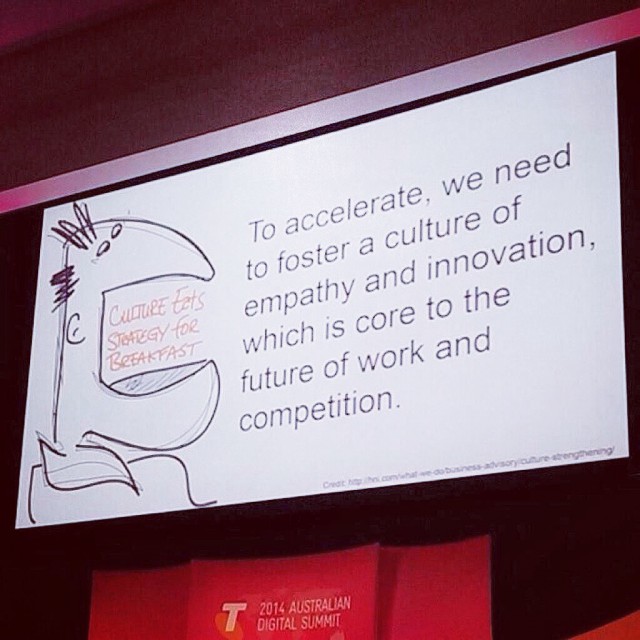
    There were a number of thought provoking themes at the Telstra Digital Summit this week in Sydney. These included CEO of Klout Joe Fernandez’s presentation on the rise of consumer personal marketing, Paypal’s Jeff Clementz overview of the future of payments, Karen Stocks from Twitter on the use of #LIVE marketing on the platform and Troy Malone from Evernote on revolutionising workflow with their software and finding themselves in the process. Whilst these topics were interesting, but in some cases very product orientated (i.e Evernote and PayPal) the topic which stood out most was how important cultural change and leadership are in a digital future.

    This was the focus of David Thodey’s opening address, a panel discussion on ‘working in start ups vs corporates’ and digital evangelist Brian Solis’s discussion on ‘approaching a digital future with an analog mindset’. The key line stringing together these segments was ‘culture eats strategy for breakfast’ or put differently – you can make all the strategic choices you want but without broad employee support for those choices, which may represent new ways of working, new incentives and rejection of existing skills, the strategy you set will count for nought.

    But what does this mean for incumbent enterprises in the TMT industry like Telstra who are staring down uncertain futures built on offerings which are very different to those that make up the current business model? For Thodey it is very real, noting in his address “if we (Telstra) stay in this current form we will become irrelevant…we need to find ways we can apply our collective knowledge to change”. To add to this, Telstra is clear (as are many organisations undergoing this type of change) that customer centricity is critical you need to “change from the outside in”.

    Whilst there is no shortage of rhetoric on the topic, there is a shortage of ‘magic’ solutions to the change required to meet new strategic goals. Below are 3 ingredients I believe need to be in place for cultural alignment to strategy and for change to occur in industries like Telecommunications and Media where there is a shorter change timeline due to disruption (technology or other). These principles drive at the idea that culture is inherently linked to human needs particularly those of safety and belonging:

    1) Strategy infrastructure must be in place

    Employees need to see (and where possible participate in) that strategy has been considered, debated and choices have been tested alongside the companies best portrait of future business conditions. Sensing and shaping is a key part of strategy which in many companies is performed by the CEO and CFO and strategy functions. Add to this the strategic conversations that happen between those setting and those implementing strategy and you have the basic infrastructure of strategy. Without this in place, particularly in larger companies, the change required to meet future challenges head on has little hope of occurring.

    This plays out slightly differently at the smaller end of business scale. An entrepreneur or ‘few’ person company has very specific choices to compete in a market, the agility and small scale culture to match it. Here strategy infrastructure and culture of the company are inseparable. The tyranny of scale increases the risk of the infrastructure being left out or culture being ignored. Famously, the CEO of AirBnB Brian Chesky sent a company wide email to titled ‘Don’t F*ck up the culture’ which was on this very topic. It was titled based on advice Silicon Valley VC Peter Thiel gave to Chesky as company has entered more markets and received over $150m in funding.

    2) Make the burning platform real for all employees

    Reasons to change can often seem very distant particularly if you are at the coal face of a large organisation. The implication of a broad technology change or business model change may be far removed from the day job of the employee. Helping employees understand the implications of future business environments and choices that the enterprise is taking to compete and win requires leadership, communication and embedding strategic thinking into as much of the organisation as possible.

    A large company that does this is GE. They use a process of innovation to inspire change in employees. Top talent are trained on innovation process and incentivised on new business model creation. With this model leaders and employees are forced to explore the consequences of the futures they will operate in. It is here that a burning platform becomes real.

    3) Challenge the old and protect the new with the right incentives

    In many cases moving to a new future will mean the death of currently very profitable business models. The challenge is to reinvent the core operations without betting the company. Incentivising staff to challenge the current business model (e.g the way money is made, the products and features offered, services, policies and processes) whilst allowing new businesses better suited to the future to thrive will support a culture that is prepared for the future. This includes for example, rewarding staff for revenue/earnings from new business, process efficiency/automation of core operations, CSat on new vs old products and channels and time spent by employees making vs operating. Career progression should also be structured around these incentives to ensure talent can see opportunities in the core as well as the new operations (i.e don’t put the C team on new business model generation).

    A panel discussion at the Telstra Summit mulled over this idea with the ED of Digital at Telstra commenting “we recognise we destroy everything we buy”. Whether or not this is entirely the case, it points to the difficulty of challenging the old and protecting the new. Whilst not going into specifics around incentives, the conclusions of the panel were that you can’t build a new future on old technologies, digital is not enough; it must be customer centric and culture must be based on trust not control – agreed.

    These ingredients send cultural signals to employees. In effect, by having these in place it is reinforcing a common understanding of how and why (tough) decisions are made in the enterprise. They show that the enterprise’s future is being sensed and choices are being made within that context, they show the possibility of new realities in the employee’s world and they balance the acceptance of new business models while maintaining a profitable core. Culture may eat strategy for breakfast but that doesn’t mean cultural alignment to strategy cannot occur… even if it takes time.


  • What’s next for social media business models? – Metcalfe, Mobile, Messaging and Control

    What’s next for social media business models? – Metcalfe, Mobile, Messaging and Control

    This past week I received 2 emails which made me think I should explore the next thing for social media business models. The first was an invite to the ad-free social media network ‘Ello’. The site boasts that it is ad-free won’t harvest your data and sell to any other third party. It even points a finger at mainstream social media in its manifesto stating in its first line that ‘your social network is owned by advertisers’. After just 10 minutes on the site you can see that it was designed to be simple with features similar to Twitter but the ability to sort your feed into ‘friends’ and ‘noise’ (I like this!). You can post text, pictures and videos with no restriction characters but as of yet there is no ‘retweet’ function. Having only 1 friend on it there was not much going on and the format kind of reminded me of old Bulletin Board Services (BBS) pre-World Wide Web with graphics.

    The second email was from LinkedIn which in the context of Ello’s finger pointing at mainstream social sites seemed very timely. In short, the email asked rhetorically ‘who owns all of the content you post on LinkedIn? You do, and you always have’. Specifically it pointed to individuals’ control over their data – ‘We’ll always ask your permission before using your content in third-party ads, publications, or websites’, data history– ‘If you delete something from our platform, we won’t use it anymore.’ and content ownership – ‘We don’t own or have exclusive rights to your content’. These changes as well as changes to LinkedIn’s privacy seem to be a response to mainstream allegations of misuse of personal data.

    The invite to Ello and LinkedIn’s message of privacy reassurance are evidence of the old adage associated with mainstream social media that ‘you are the product not the customer’. It is also an indication that the associated business model of ‘selling’ user data to advertisers may be under threat. Whilst this may not be a serious threat yet, there are alternative business models for social media networks which may form the basis of successful social media businesses in the future.

    1) Freemium based model

    Freemium is a recognised revenue model in which a basic service/product is offered with new features attracting a fee. Many newspapers and apps have taken this model to firstly drive scale with the free offering and monetise from the user base who place value in and extended service. This is Ello’s business model. Its basic features are free, as the social site becomes more popular they will offer new features for a subscription payment.

    Whilst this has been very successful with other digital businesses (particularly those which are sticky with users like LinkedIn) I feel this will be difficult for Ello compete with mainstream social media which is free. Firstly, Facebook and Twitter currently offer a much superior ‘free’ user experience compared to Ello (despite the advertising) and secondly, the critical mass of users that makes those social sites sticky will be very difficult to replicate. I would like to believe that people will pay for features in a social network (e.g. the ability to retweet, the ability to play games) but unless data privacy is so important to the social media using individual I fear it is destined to remain a niche.

    2) Community based model

    The idea that a social media network could be as important to the world as an encyclopaedia like Wikipedia is plausible. Social media networks offer users a way to connect with their friends, acquaintances, thought leaders and the rest, which in a digital age could be thought of as a necessity. Wikipedia’s business model is donation based. It is free to all to use but asks for periodic donations and volunteering to ensure its site is up to date. The site’s CEO Jimmy Wales has previously said the encyclopaedia has a staff of only 35 people.

    I think this is a plausible option for social media in the future. The trouble with this however is the ability to scale into a large enough network from scratch – enter Metcalfe’s Law. Metcalfe’s Law states that the value of a network is proportional to the square of the number of connected users of the system. As with Ello, there would need to be a migration from mainstream social media to create a network of any great value. One possible solution to this could be for Wikipedia to expand its offering to include a social network. There are enough users of the encyclopaedia to plausibly convert them to a social network. But don’t hold your breath, Jimmy Wales has other ambitions (charity phone networks with The People’s Operator) and supporting a social media network appears to be a step removed from its core.

    3) Messaging models

    The most significant change to social media business models will come from messaging services which are already replacing the forum style of social networking offered by Facebook and others. It is not uncommon to find people below the age of 30 using messaging services like Snapchat, Whatsapp, WeChat, Line and Instagram in place of Facebook. Half of the top 10 messaging apps have more that 300 million users which compared to Facebook’s 1.2 Billion users is as sizeable threat to the social network – luckily Facebook owns Whatsapp (+500M users), Instagram and Facebook Messenger (+200M users each).

    Of the messenger apps 2 out of the top 10 have quantified revenue models. In 2013 Line had reported earnings of $335 million in revenue driven largely from the sales of sponsored stickers and KakaoTalk. despite its small user base was the second highest-grossing app with $204 million in revenue from in-app games and upgrades. Other services are adopting these and other models are Viber and Tango which partnered with Twitter’s MoPub in December 2014.

    Regardless of the prevailing business model – social is evolving with data privacy, mobile and messaging are putting pressure on the existing ad funded models of mainstream social sites. I believe the formula for success of future social networks rests on the ability for the network to connect users first and foremost, to provide a superior mobile experience, offer a cross platform messaging capability and provide users control over their data.